
LAWU-103 · Lesson 1 of 12 · 25 min
Intentional torts to the person
▶ Video coming soon A video version of this lesson is on the way.
Professor Walter Brenneman opens the first Torts class at Larkhaven Law School by asking Section B a question that sounds simple. "Somebody gets hurt. When should somebody else have to pay?" He waits. Daniel Reyes, who spent three years as a paralegal at a plaintiffs' personal-injury firm in El Paso, says that the answer is easy: when the other person was at fault. Priya Natarajan, the economics major, suggests that the person who can prevent the harm most cheaply should pay. Hannah Lindqvist asks whether the law cares about fairness between the two people or about making society safer. "All three of you have just summarized a century of tort theory," Brenneman says. "This course is about which of those answers the law gives, and when."
Brenneman spent twelve years as a trial lawyer before he started teaching, the first five defending insurance companies and the rest representing injured people. He tells the class that he has tried cases on both sides of almost every issue they will study, and that he still thinks the best way to learn torts is to watch one bad day unfold and ask, for each injury, who can sue whom and for what. So Section B will spend the semester with one invented bad day.
The running problem: the Haldane County Fair
The Haldane County Fair runs every August on the county fairgrounds an hour west of the law school. It is organized by the Haldane County Agricultural Society, a nonprofit whose general manager is Ruth Albers. On Saturday, August 22, 2026, the last full day of the fair, a series of things went wrong. All of it is fictional, but each piece is built from the kinds of cases Brenneman handled in practice.
- Early in the evening, Kim Sorensen, who sells phone accessories from a booth on the midway, told a security guard that a teenager had just taken a phone case. The guard, Dwayne Pruitt of Varrow Security Services, which the Agricultural Society hires to staff the fair, grabbed 16-year-old Theo Garza by the arm and walked him to a storage trailer behind the grandstand. Theo had a receipt in his pocket. He was held for about fifty minutes before his mother, Elena Garza, arrived.
- At a carnival ride called the Whirlwind, run by a traveling operator, Midway Rides, Inc., a lap bar opened during the ride and 17-year-old Kayla Brooks was thrown onto the platform.
- At a food stand, a propane regulator on a grill failed and a flash fire burned an employee, Luis Ortega.
- At 9:30 p.m., the fireworks show put on by Brightfall Pyrotechnics LLC began. One shell burst low, and burning debris fell into the crowd. It struck Nadia Okoro, a 29-year-old dental hygienist, while her mother, Grace, stood beside her. Embers set hay bales burning by the livestock barn, a show steer broke loose and knocked down a 71-year-old fairgoer, Harold Lindgren, and the fire later spread to a barn on the neighboring Pedersen farm.
- The next morning, the local news website, the Haldane Ledger, posted a photo of Theo being led away under the headline "Teen caught stealing at fair."
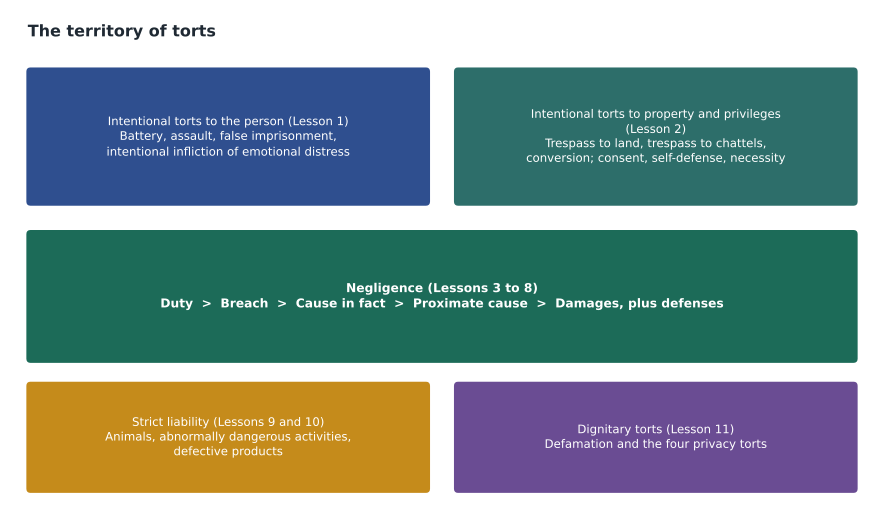
Over twelve lessons the class will work through every one of these events. This first lesson starts with the oldest part of tort law: the intentional torts. They are the torts closest to the criminal law, and they are where Theo's story begins.
What a tort is
A tort is a civil wrong, other than a breach of contract, for which the law provides a remedy, usually money damages. The person who brings the claim is the plaintiff; the person sued is the defendant, sometimes called the tortfeasor. Tort law is mostly state law, and mostly common law: rules made by judges deciding cases. Legislatures have changed it in many places, for example through comparative fault statutes, damages caps and wrongful death acts, but the core doctrines still come from cases.
Tort law overlaps with criminal law but differs in purpose and procedure. A crime is a wrong against the public prosecuted by the government, with the defendant's liberty at stake and proof beyond a reasonable doubt required. A tort is a wrong against a person, sued on by that person, with liability proved by a preponderance of the evidence. The same act can be both. If Pruitt unlawfully held Theo, the state could in theory prosecute him for unlawful restraint, and Theo could sue him for false imprisonment, and the two cases would proceed independently.
Scholars offer several justifications for tort liability, and Brenneman asks the class to keep them in mind because courts invoke all of them. Corrective justice says that a person who wrongfully harms another should repair the harm. Deterrence says that liability gives people and businesses a reason to take precautions. Compensation says that injured people should be made whole, often with the cost spread through insurance. A fourth idea, popular with economists, is efficiency: liability should be placed so that people take precautions that cost less than the harm they prevent. These goals often point the same way, but not always.
Sources
Because tort law is spread across thousands of state decisions, lawyers rely on secondary sources that organize it. The most influential are the Restatements published by the American Law Institute. The Restatement (Second) of Torts, published in volumes between 1965 and 1979, remains widely cited, especially for intentional torts, defamation and privacy. The Restatement (Third) is being published in parts: Products Liability (1998), Apportionment of Liability (2000), Liability for Physical and Emotional Harm (two volumes, 2010 and 2012), Liability for Economic Harm, and Intentional Torts to Persons, which the American Law Institute announced as available in April 2026 after more than a decade of work. A volume on defamation and privacy is still in progress. Restatements are not binding law, but courts often adopt their sections.
Intent
Every intentional tort requires intent, and intent in tort law has a specific meaning. Under the Restatement (Second) section 8A, and the Restatement (Third)'s definition in Liability for Physical and Emotional Harm section 1, a person acts with intent to produce a consequence if the person acts either with the purpose of producing it or knowing that it is substantially certain to result. Intent does not require a desire to harm. It requires a purpose to bring about, or knowledge of the near-certainty of, the consequence the particular tort requires: a contact, an apprehension, a confinement.
Garratt v. Dailey, 46 Wash. 2d 197, 279 P.2d 1091 (1955), is the classic illustration. Brian Dailey, five years old, moved a lawn chair while Ruth Garratt, an adult, was about to sit down. She fell and broke her hip. The trial court found that Brian did not mean to hurt her. The Washington Supreme Court sent the case back: if Brian knew with substantial certainty that she would try to sit where the chair had been, he had the intent required for battery, whether or not he wished her harm. The case also shows that children can commit intentional torts. Minors are liable for their own torts if they can form the required intent, and many states hold parents liable, usually up to a modest statutory cap, for a child's willful or malicious acts.
Vosburg v. Putney, 80 Wis. 523, 50 N.W. 403 (1891), adds another lesson. In a classroom, after the teacher had called the class to order, eleven-year-old George Putney kicked fourteen-year-old Andrew Vosburg lightly on the shin. The kick aggravated an earlier injury and led to a serious infection that cost Andrew the use of the leg. The court held that the kick was unlawful because it happened in class, where the implied consent of playground roughhousing did not apply, and that Putney was liable for all the harm that followed, even though he could not have foreseen it. This is the eggshell plaintiff rule: a tortfeasor takes the victim as he finds him.
Transferred intent
Under the doctrine of transferred intent, a defendant who intends a tort against one person but causes it to another is liable to the person actually harmed. In Talmage v. Smith, 101 Mich. 370, 59 N.W. 656 (1894), the defendant threw a stick at one boy on a shed roof and hit another in the eye; he was liable to the boy he hit. Intent also transfers among the five traditional trespass-based torts (battery, assault, false imprisonment, trespass to land and trespass to chattels): a defendant who intends only to frighten someone with a near miss but actually strikes them commits battery.
Battery
Battery is an intentional, harmful or offensive contact with another person. Under the Restatement (Second) section 13, the elements are an act, intent to cause a harmful or offensive contact (or an imminent apprehension of one), and a resulting harmful or offensive contact. Contact is offensive if it offends a reasonable sense of personal dignity, judged by social norms rather than by the plaintiff's unusual sensitivities, unless the defendant knows of and exploits those sensitivities.
Contact need not be skin to skin. In Fisher v. Carrousel Motor Hotel, Inc., 424 S.W.2d 627 (Tex. 1967), a hotel club manager snatched a plate from a Black mathematician's hand while shouting that he would not be served. The Texas Supreme Court held that grabbing an object closely identified with the body was a battery, and that the plaintiff could recover for the humiliation even without physical injury. Contact can also be indirect: setting a trap, poisoning food or striking with a thrown object all count.
Courts divide on how much intent battery requires. Most say it is enough to intend the contact, if the contact turns out to be harmful or offensive by social standards; this is sometimes called single intent. Some courts require dual intent: an intent to contact and an intent that the contact be harmful or offensive. In White v. Muniz, 999 P.2d 814 (Colo. 2000), the Colorado Supreme Court required dual intent where an elderly woman with Alzheimer's disease struck her caregiver. The difference matters most for defendants with diminished capacity and for well-meant but unwanted touching.
Worked problem
Did Pruitt batter Theo?
Pruitt, a security guard, grabbed Theo by the upper arm, held it firmly and walked him across the midway to a trailer. Theo was not hurt. Pruitt says he only meant to stop a thief from running.
Show solution
- Act and intent: Pruitt deliberately grabbed and held Theo's arm, so he intended the contact. His motive, to stop a suspected thief, is not a defense to intent.
- Harmful or offensive: being seized and marched across a crowded fairground offends a reasonable sense of dignity, even without physical injury.
- Contact: the grab itself.
- Privilege: Pruitt's real argument is not that there was no battery but that he was privileged, either under the shopkeeper's privilege or as a reasonable detention of a suspected thief. Lesson 2 covers privileges.
Answer: The elements of battery are met. Whether Pruitt is liable depends on whether a privilege applies, which turns on whether he had reasonable grounds and acted in a reasonable manner and for a reasonable time.
Assault
Assault in tort law is not an attack. It is the intentional creation of a reasonable apprehension of an imminent harmful or offensive contact (Restatement (Second) section 21). The plaintiff must be aware of the threat at the time; there is no assault if someone swings at a sleeping person and misses. The apprehension need not be fear: a professional boxer who sees a punch coming and is confident he can block it is still apprehensive of a contact in the legal sense.
Three limits recur. First, the threatened contact must be imminent: a threat to beat someone up next week is not an assault, though it may support other claims. Second, words alone usually are not enough, but words combined with conduct, such as raising a fist, can be. Third, words can negate an apparent threat. In the old case of Tuberville v. Savage (1669), a man put his hand on his sword and said that if it were not assize time (when the royal judges were in town), he would not take such language. The court held that his words showed he was not going to strike, so there was no assault. One of the earliest recorded assault cases, I de S et ux v. W de S (1348), involved a man who swung a hatchet at an innkeeper's wife in the dark and missed; the court held him liable even though no contact occurred.
In the trailer, Theo says, Pruitt stood in the doorway, slapped a baton against his palm and said, "Try to leave and see what happens." The class debates whether that is an assault. Brenneman points out that the threat was conditional, but conditional threats can still be assaults when the condition is one the defendant has no right to impose. Pruitt had no right to make Theo stay, so the threat may count.
False imprisonment
False imprisonment is the intentional confinement of a person within boundaries fixed by the defendant, without consent or legal privilege, where the plaintiff is aware of the confinement or is harmed by it (Restatement (Second) sections 35 and 42). Confinement can be accomplished by physical barriers, physical force, threats of force, or an assertion of legal authority that the plaintiff reasonably believes. It is not confinement to block one route if a reasonable means of escape is available and known, nor to make a person feel morally obliged to stay. Duration does not matter to liability, though it matters to damages.
Stores and their guards often detain suspected shoplifters, and the law gives them a limited privilege to do so. The common law shopkeeper's privilege, now codified in most states, allows a merchant to detain a person for investigation if the merchant has reasonable grounds to believe the person has taken goods, and if the detention is reasonable in manner and duration. In Coblyn v. Kennedy's, Inc., 359 Mass. 319, 268 N.E.2d 860 (1971), a store employee stopped a seventy-year-old man in front of other customers, grabbed his arm and demanded that he return to the store, where he suffered a heart attack. He had simply forgotten that he was wearing a scarf he already owned. The Massachusetts court held that the employee lacked reasonable grounds and that the public, forceful manner of the stop was unreasonable.
Intentional infliction of emotional distress
The newest of the intentional torts protects against severe emotional distress caused by outrageous conduct. Under the Restatement (Second) section 46, a defendant who by extreme and outrageous conduct intentionally or recklessly causes severe emotional distress to another is liable for that distress, and for any bodily harm that results. The claim has four elements: extreme and outrageous conduct, intent or recklessness, causation, and severe distress.
The outrageousness requirement is demanding. The conduct must go beyond all possible bounds of decency and be regarded as atrocious and utterly intolerable in a civilized community, according to the Restatement's comments. Insults, indignities, threats and annoyances, even serious ones, usually are not enough. Courts are more willing to find outrageousness when the defendant abuses a position of power, knows the plaintiff is especially vulnerable, or engages in a repeated pattern of conduct. In State Rubbish Collectors Ass'n v. Siliznoff, 38 Cal. 2d 330, 240 P.2d 282 (1952), an association of garbage collectors threatened to beat a competitor and destroy his truck unless he paid; the California Supreme Court allowed recovery for the fright and illness that followed. In Harris v. Jones, 281 Md. 560, 380 A.2d 611 (1977), a supervisor repeatedly mimicked an employee's stutter. The court found the conduct could be outrageous but held that the employee had not proved severe distress, showing how hard the last element can be.
The First Amendment limits emotional distress claims based on speech. In Hustler Magazine, Inc. v. Falwell, 485 U.S. 46 (1988), the Supreme Court held that a public figure cannot recover for a parody that no reasonable reader would take as stating actual facts, unless the plaintiff meets the actual malice standard of defamation law. In Snyder v. Phelps, 562 U.S. 443 (2011), the Court held that picketers near a soldier's funeral, whose signs addressed matters of public concern, could not be held liable for emotional distress, however hurtful their message.
Applying the torts to Theo
By the end of class, Section B has sketched Theo's possible claims against Pruitt. Battery for the grab, unless privileged. Possibly assault for the baton threat in the trailer. False imprisonment for the fifty minutes in the trailer, which is the strongest claim: the confinement was complete, Theo was aware of it, and the question will be whether Pruitt had reasonable grounds and acted reasonably. Emotional distress claims are possible but harder, because the conduct must be outrageous and the distress severe.
Jordan Kimura, the Army veteran who leads the study group, asks the practical question: who has money? Pruitt is a guard paid by the hour. His employer, Varrow Security, may be liable under respondeat superior if he acted within the scope of employment, and the Agricultural Society might be liable as the party that hired Varrow and controlled the fairgrounds. Brenneman says the class will come back to vicarious liability in Lesson 9. "Defendants pick themselves by what they do," he says. "Plaintiffs pick defendants by who can pay. You need to know both."
Summary and key terms
- A tort is a civil wrong, other than breach of contract, remedied mainly by damages; tort law is largely state common law, organized by the Restatements.
- Intent means purpose or knowledge to a substantial certainty that the consequence will follow (Garratt v. Dailey); it does not require a wish to harm.
- Transferred intent makes a defendant liable to an unintended victim and across the five trespass-based torts.
- Battery is an intended harmful or offensive contact; contact with things closely connected to the body counts (Fisher v. Carrousel Motor Hotel).
- Assault requires a reasonable apprehension of imminent contact; words alone are usually not enough, and words can negate a threat.
- False imprisonment requires confinement within fixed boundaries without a reasonable means of escape; the shopkeeper's privilege allows reasonable detention on reasonable grounds.
- Intentional infliction of emotional distress requires extreme and outrageous conduct, intent or recklessness, and severe distress; the First Amendment limits claims based on speech about public matters.
- Tort
- A civil wrong, other than a breach of contract, for which the law provides a remedy.
- Intent
- Purpose to produce a consequence, or knowledge that it is substantially certain to result.
- Transferred intent
- The rule that intent to commit a tort against one person, or one trespass-based tort, carries over to the harm actually caused.
- Battery
- An intentional, harmful or offensive contact with another person.
- Assault
- Intentionally causing a reasonable apprehension of an imminent harmful or offensive contact.
- False imprisonment
- Intentional confinement of a person within fixed boundaries without consent or privilege.
- Shopkeeper's privilege
- A merchant's limited privilege to detain a suspected shoplifter on reasonable grounds, in a reasonable manner and for a reasonable time.
- Eggshell plaintiff rule
- The rule that a tortfeasor is liable for the full harm to the victim, even if the victim was unusually vulnerable.
Practice problems
Work each problem on paper first, then reveal the answer to check.
A student throws a water balloon at a friend as a joke, but it hits a stranger walking by. Has the student committed battery against the stranger?
Show answer
Yes. The student intended a contact with the friend, and under transferred intent that intent carries over to the stranger who was hit. Whether the contact was offensive is judged by a reasonable sense of dignity; an unexpected soaking by a stranger likely qualifies.
A store manager tells a customer he suspects of shoplifting, "Please wait here; I'm calling the police," and walks away. The customer could leave by the front door but stays because she feels embarrassed. Is she falsely imprisoned?
Show answer
Probably not. There was no physical barrier, force, threat or assertion of legal authority that confined her, and a reasonable means of escape was available. Feeling socially obliged to stay is not confinement.
Why did the plaintiff in Harris v. Jones lose even though the court thought the supervisor's conduct could be outrageous?
Show answer
Because the plaintiff did not prove severe emotional distress. The distress element is separate and demanding: the distress must be so severe that no reasonable person could be expected to endure it.
A five-year-old knocks over an elderly neighbor while playing tag, without meaning to touch her. Is that a battery?
Show answer
Not unless the child intended a contact or knew one was substantially certain. Accidental contact during play is a negligence question, not battery.
Lesson quiz · 5 questions
Score 60% or more to complete this lesson.
Create a free account to save your progress, take quizzes and earn a certificate.