
LAWU-103 · Lesson 12 of 12 · 21 min
Capstone: a torts problem
▶ Video coming soon A video version of this lesson is on the way.
For the last class before the exam, Professor Brenneman puts the fair aside. "You know the Haldane facts too well," he tells Section B. "An exam will give you facts you have never seen, written so that every sentence matters. So let's do one together." He hands out a fact pattern of the kind he writes for exams, gives the class forty minutes to outline an answer, and then works through it issue by issue. This lesson reproduces the problem and the model analysis, along with the method for writing a torts answer that the class has practiced all semester.
How to approach a torts problem
Brenneman's method has five steps, and he writes them on the board.
- Read the call of the question first. If it asks about the claims of one plaintiff against one defendant, do not write about everyone. If it is open ("discuss the rights and liabilities of the parties"), you must find every plausible claim.
- Make a party chart. List each potential plaintiff down one side and each potential defendant across the top. For each pair, ask which torts might apply: intentional torts, negligence, strict liability, products liability, dignitary torts and vicarious liability.
- Spot the issues by reading facts as signals. Professors include facts for a reason. A waiver signals express assumption of risk; a statute signals negligence per se; an employee signals respondeat superior; a parent watching signals bystander emotional distress.
- Organize each claim by its elements, in IRAC form: state the issue, state the rule, apply the rule to the facts, and conclude. Spend most of your time on application, using the facts. A bare statement of the rule earns little credit, and a conclusion without analysis earns less.
- Address defenses and damages. Many answers stop after liability. A complete answer covers comparative fault, assumption of risk, privileges, immunities and the kinds of damages available, including punitive damages.
The problem
Copperline Adventure Park operates zip lines in a wooded river valley. Its longest line, the Raptor, runs 1,800 feet downhill, and riders reach speeds of about 45 miles per hour. Riders wear harnesses and helmets supplied by the park, and an employee at the launch platform clips each rider's harness trolley to the cable. The trolleys, made by Valtrek Zipline Systems, Inc., slow riders at the end with a spring brake on the cable and a magnetic backup brake built into the trolley. The state's amusement ride safety law requires zip line operators to use a primary and a secondary braking system, and to keep both in working order.
Before entering, every rider must accept an online release. Carmen Morales accepted it on her phone for herself and her 15-year-old daughter, Jenna, by checking a box beneath a scrolling window of text. The release stated that the participant "knowingly assumes all risks, including the risk of negligence by the park and its employees and equipment suppliers," and that the parent released all claims on the minor's behalf.
On a busy Saturday in June, to speed up the lines, the park manager, Doug Hensley, told staff to remove the magnetic backup brakes from the Raptor's trolleys because they slowed riders too much near the end and caused riders to stop short, requiring staff to retrieve them. He told employees that the spring brake was enough. Valtrek's manual warned that the trolley must never be used without the backup brake. Valtrek's design allowed the backup brake to be removed with a standard wrench and did not include any interlock preventing use without it; a competitor's trolley uses a tamper-resistant fastener.
Jenna rode the Raptor that afternoon. As she approached the end, the spring brake's worn pad failed to slow her enough, and with no backup brake she slammed into the end platform at high speed, breaking her pelvis and fracturing her skull. On the ride up, she had loosened the chin strap of her helmet because it felt tight; experts disagree about whether a tight strap would have reduced her head injury. Her mother watched the impact from the viewing deck beside the platform and has since been treated for severe anxiety and depression.
Jenna's friend Aiden Park, 16, filmed the crash. A park employee, Brent Lowry, grabbed Aiden's phone, told him he could not leave until he deleted the video, and kept him in the staff office for thirty minutes, saying the police were on their way. They were not. Aiden eventually deleted the video and left. That evening, Copperline posted on its social media account: "A rider was injured today after removing safety equipment against staff instructions. Your safety is our priority!" Several local news sites repeated the post, and classmates identified Jenna.
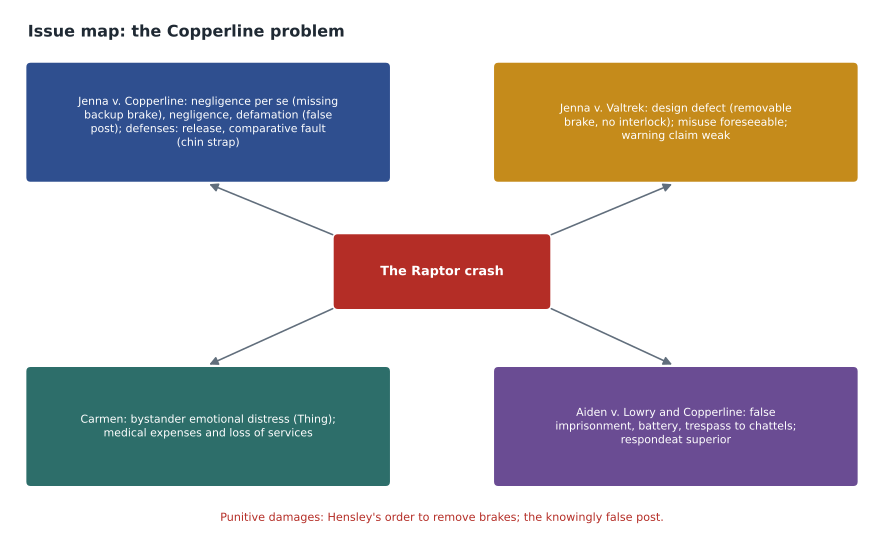
Discuss the claims of Jenna, Carmen and Aiden against Copperline, Valtrek and the individual employees.
| Plaintiff | Against Copperline | Against Valtrek | Against individuals |
|---|---|---|---|
| Jenna | Negligence and negligence per se; possibly strict liability; defamation; vicarious liability for employees | Products liability: design and warning defects | Hensley: negligence (personally liable for own torts) |
| Carmen | Bystander emotional distress; loss of the child's services and medical expenses | Bystander emotional distress derivative of the product claim | Hensley |
| Aiden | Vicarious liability for false imprisonment, battery, trespass to chattels or conversion | None | Lowry: false imprisonment, battery, conversion |
Model analysis: Jenna v. Copperline
Negligence
Duty. Copperline, by operating a high-speed ride and holding its park open to the public, created a risk of physical harm and owed riders a duty of reasonable care. Riders are invitees, and the park has a special relationship with them as a business open to the public.
Breach. The facts give several routes. First, negligence per se: the state ride safety law requires a primary and secondary braking system in working order. Removing the backup brake violated the statute, which was plainly designed to protect riders like Jenna from exactly this kind of collision. No excuse applies; convenience and faster lines are not recognized excuses (Restatement (Third) section 15). In most states, this unexcused violation establishes breach. Second, ordinary negligence: under the Hand formula, the burden of keeping the backup brake (slower lines, more staff retrievals) was trivial compared with the probability and gravity of high-speed collisions. Third, the worn spring brake pad suggests inadequate inspection and maintenance. Copperline will argue that the spring brake normally suffices, but the manual's warning and the statute undercut that.
Causation. But for the removal of the backup brake, which exists to stop riders when the primary brake fails, Jenna likely would have stopped safely; the worn pad is a concurrent cause, also attributable to Copperline. Proximate cause is easy: a rider hitting the platform at speed is the very risk that made removing the backup brake negligent. The loosened chin strap is not a superseding cause; it bears at most on comparative fault and the extent of her head injury.
Damages. Jenna suffered serious physical injuries: a broken pelvis and skull fracture, with past and future medical expenses, pain and suffering, and possible future loss of earning capacity.
Vicarious liability. Hensley's order was given within the scope of his employment as manager, so Copperline is liable for it under respondeat superior; it is also directly negligent through its manager's decision. Hensley is personally liable for his own negligence.
Strict liability. Jenna may argue that operating a high-speed zip line is an abnormally dangerous activity. Most courts would likely reject this, because careful operation with proper braking can largely control the risk and amusement rides are generally governed by negligence. The argument is worth raising but is not her best claim.
Defenses
The release. Copperline will rely on the online release. Several problems undercut it. First, enforceability against a minor: many states refuse to enforce a parent's pre-injury release of a minor's claims against a commercial operator, though some enforce them. Second, scope and public policy: even where releases are enforced, most courts will not enforce them for gross negligence or reckless conduct, and deliberately removing a statutorily required safety device to speed up lines, against the manufacturer's warning, is a strong candidate for gross negligence. Some courts also refuse to enforce releases that would excuse violations of safety statutes. Third, formation: a clickwrap release with a checkbox beneath scrolling text is usually enough to show assent, so formation is less likely to defeat it. A recreational zip line probably does not affect the public interest under the Tunkl factors.
Comparative fault. Jenna loosened her chin strap. If the jury finds this was unreasonable and contributed to her head injury, her recovery for that injury may be reduced in a comparative fault state. It would not affect her pelvis injury, which the strap had nothing to do with, and the expert dispute leaves causation uncertain. In one of the few contributory negligence jurisdictions, Copperline would argue it bars her claim entirely, a harsh result a court might avoid through causation analysis limited to the head injury. Because she is a minor, the jury will judge her conduct by the standard of a reasonable fifteen-year-old.
Primary assumption of risk. Copperline may argue that riders assume the inherent risks of zip lining. But brake failure caused by an operator removing safety equipment is not an inherent risk of the activity; it is a risk created by the operator's breach.
Punitive damages
Hensley removed a statutorily required safety device to increase throughput, despite the manufacturer's explicit warning. A jury could find this was a conscious disregard of riders' safety, supporting punitive damages against Copperline, subject to state law on employer liability for managerial conduct and the due process limits of State Farm v. Campbell.
Model analysis: Jenna v. Valtrek
Valtrek is a commercial manufacturer of the trolley, so strict products liability applies.
Design defect. Jenna will argue that the trolley was defectively designed because it allowed the backup brake to be removed easily with a standard wrench and lacked an interlock. Under risk-utility, she must show a reasonable alternative design: the competitor's tamper-resistant fastener is evidence of one, apparently feasible and inexpensive. Valtrek will respond that it designed for use with the backup brake and that removal was a misuse by the operator.
Misuse and alteration. Removal of the backup brake was a substantial alteration. But a manufacturer is responsible for reasonably foreseeable misuse. Operators facing pressure to move lines faster and annoyed by riders stopping short is a foreseeable reason to remove a brake that is easy to remove, which is the very point of the design defect claim. If the jury finds the removal foreseeable, it does not defeat liability, though it will reduce Valtrek's share of fault relative to Copperline.
Failure to warn. Valtrek's manual warned never to use the trolley without the backup brake. That warning was adequate as to the operator, who ignored it, and a heeding presumption will not help Jenna where the operator knew of the warning. Her warning claim is weak; her design claim is stronger.
Causation and apportionment. Both Copperline's removal of the brake and Valtrek's removable design are factual causes of an indivisible injury. Depending on the state, the defendants may be jointly and severally liable, or each liable only for its share of fault, with Copperline likely bearing the larger share.
Model analysis: Jenna's defamation claim
Copperline's post stated that a rider was injured after removing safety equipment against staff instructions. That is a false statement of fact: the safety equipment that was removed, the backup brake, was removed by the park. Her loosened chin strap might make the statement partly accurate, so Copperline will argue substantial truth. But the gist of the post, that the rider caused her own injury by defying staff, is false and defamatory, because it blames her for the accident. The post did not name Jenna, but classmates identified her, so it is of and concerning her. Jenna is a private figure. If the accident is a matter of public concern, she must prove at least negligence for actual damages and actual malice for presumed or punitive damages under Gertz. Because Copperline knew its manager had removed the brakes, a jury could find it knew the post was false, which is actual malice. The news sites that repeated the post may also be liable as republishers, subject to the fault rules; the social media platform is protected by section 230.
Model analysis: Carmen's claims
Carmen watched Jenna strike the platform from the viewing deck. Under Thing v. La Chusa and similar rules, she is closely related to the victim, was present at the scene and contemporaneously aware of the injury, and suffered serious distress beyond that of a disinterested witness, as shown by her treatment for severe anxiety and depression. She can recover for emotional distress from Copperline and, because the same injury-producing event is attributable to Valtrek's defective product, potentially from Valtrek as well. Her own claim is also subject to the release she signed for herself, with the same enforceability problems discussed above. As a parent, she may also recover Jenna's medical expenses and, in many states, the loss of her services during minority.
Model analysis: Aiden's claims
False imprisonment. Lowry confined Aiden in the staff office for thirty minutes by telling him he could not leave until he deleted the video and asserting that police were coming, an assertion of authority Aiden could reasonably believe. Aiden was aware of the confinement. The shopkeeper's privilege does not apply: Aiden was not suspected of taking anything, and wanting to suppress a video of an accident is not a legitimate ground for detention.
Battery and trespass to chattels or conversion. Grabbing Aiden's phone out of his hand is an offensive contact with an object closely connected to his body (Fisher v. Carrousel Motor Hotel), and taking the phone and forcing deletion of the video interfered with his chattel. Holding the phone for thirty minutes and forcing the deletion likely amounts at least to trespass to chattels, because it deprived him of the phone's use and destroyed data on it; whether it is serious enough for conversion is debatable.
Vicarious liability. Lowry was acting, however wrongly, to protect his employer's interests, so his torts were likely within the scope of employment, making Copperline vicariously liable. Copperline may argue that the conduct was so outrageous that it fell outside the scope, but courts often find intentional torts committed to further the employer's business within the scope.
What makes an answer strong
After walking through the analysis, Brenneman shows the class two sample answers to an earlier exam. The weaker one recites rules accurately but spends a single sentence on each application and reaches conclusions without explaining them. The stronger one uses nearly every fact, explains why each fact matters, acknowledges arguments on both sides, and reaches a reasoned conclusion on each issue while noting where the result depends on a jurisdiction's rule. "I am not grading whether you reach my conclusion," he says. "I am grading whether you see the issues, know the rules, and use the facts. The facts are where the points are."
Hannah Lindqvist asks how to handle issues where states differ, such as contributory negligence or parental releases. Brenneman says to state the majority rule, apply it, and note how the result would change under the minority rule if the difference matters. Jordan Kimura asks about time. "Budget it by the points," Brenneman says. "If Jenna's negligence claim is the heart of the question, don't spend half your time on Aiden's phone."
Summary and key terms
- Read the call, chart the parties, read facts as signals, analyze each claim element by element in IRAC form, and finish with defenses and damages.
- A statutory safety requirement signals negligence per se; a release signals express assumption of risk and its limits for minors and gross negligence.
- Product claims require choosing the defect category; foreseeable misuse does not defeat a design defect claim, and an adequate warning ignored by an intermediary weakens a warning claim.
- Multiple defendants causing one injury raise apportionment and joint and several liability questions.
- Bystander distress claims follow Thing-type requirements; false imprisonment and conversion claims often accompany attempts to suppress evidence.
- Strong answers use the facts, address both sides and flag where the result depends on the jurisdiction's rule.
- IRAC
- Issue, rule, application, conclusion: the standard structure for legal analysis.
- Party chart
- A grid of possible plaintiffs and defendants used to find every claim in a problem.
- Call of the question
- The instruction at the end of a problem that defines what to analyze.
- Gross negligence
- An extreme departure from ordinary care, often not releasable by contract.
- Republisher
- A person who repeats a defamatory statement and may be liable as a publisher.
- Apportionment
- Dividing liability among defendants and the plaintiff according to fault.
Practice problems
Work each problem on paper first, then reveal the answer to check.
In the Copperline problem, why is negligence per se Jenna's strongest route to breach against Copperline?
Show answer
Because the state ride safety law required a working secondary brake, the statute was designed to protect riders from exactly this collision, Jenna is in the protected class, and removing the brake for faster lines is not a recognized excuse.
Why might Valtrek remain liable even though Copperline removed the backup brake against Valtrek's warning?
Show answer
Because removal was a foreseeable misuse of a trolley designed so the brake could be removed with a standard wrench, and a feasible tamper-resistant alternative existed. Foreseeable misuse does not defeat a design defect claim; it affects apportionment of fault.
Does the online release bar Jenna's claim against Copperline?
Show answer
Probably not. Many states refuse to enforce parental pre-injury releases of minors' claims against commercial operators, and most will not enforce releases for gross negligence or violations of safety statutes, which deliberate removal of a required brake likely is.
Why does the shopkeeper's privilege not protect Lowry's detention of Aiden?
Show answer
Because the privilege allows detention only on reasonable suspicion of theft for investigation. Aiden was not suspected of taking anything, and detaining him to force deletion of a video is not a privileged purpose.
Lesson quiz · 5 questions
Score 60% or more to complete this lesson.
Create a free account to save your progress, take quizzes and earn a certificate.