
LAWU-103 · Lesson 8 of 12 · 25 min
Damages and defenses
▶ Video coming soon A video version of this lesson is on the way.
With duty, breach and causation behind them, Section B reaches the questions that decide what a negligence case is worth: what defenses reduce or bar recovery, how damages are measured, and how liability is divided among several defendants. Professor Brenneman says these are the questions clients actually ask. "Nobody walks into a lawyer's office and asks whether there was a duty," he says. "They ask what they can get, and what the other side will say they did wrong."
The fireworks case supplies the facts. About five minutes before the low burst that injured Nadia Okoro, an earlier shell failed to rise properly and burst over the field, closer than the others. The announcer asked spectators at the front of the lawn to move back fifty feet. Nadia and her mother Grace, who were filming the show on their phones, stayed where they were. Their admission tickets, like everyone's, carried a printed statement on the back: "The holder assumes all risks of attending the fair, including fireworks, rides and livestock, and releases the Haldane County Agricultural Society, its contractors and vendors from all claims, including claims of negligence."
Contributory negligence
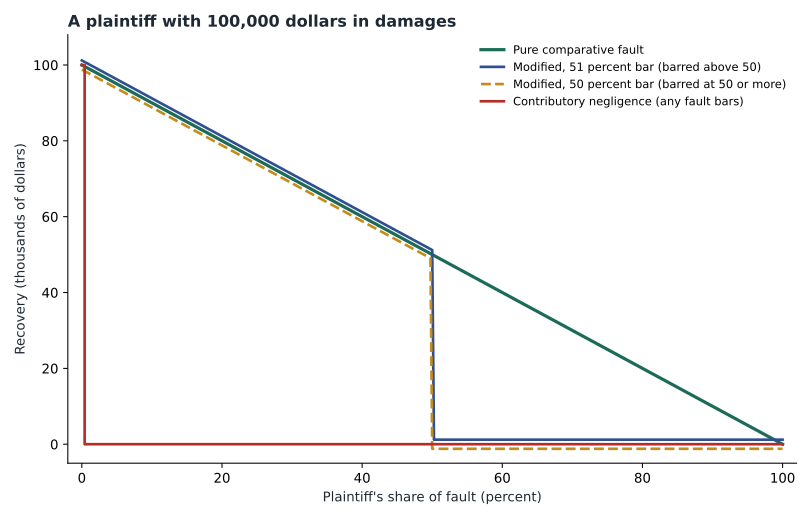
A plaintiff's own negligence is called contributory negligence. Under the traditional common law rule, any contributory negligence, however slight, barred the plaintiff's recovery entirely. The rule is usually traced to Butterfield v. Forrester, 11 East 60, 103 Eng. Rep. 926 (K.B. 1809), in which a man riding fast at dusk collided with a pole the defendant had left across the road; the court held he could not recover because he could have avoided it with ordinary care. To soften the rule, courts developed the last clear chance doctrine: a negligent plaintiff could still recover if the defendant had the last clear opportunity to avoid the accident and failed to take it.
Contributory negligence as a complete bar now survives in only a handful of jurisdictions: Alabama, Maryland, North Carolina, Virginia and the District of Columbia. Courts in those states have declined to abandon it, often saying that any change is for the legislature; Maryland's highest court reaffirmed the rule in Coleman v. Soccer Ass'n of Columbia, 432 Md. 679, 69 A.3d 1149 (2013).
Comparative fault
Every other state has replaced contributory negligence with comparative fault, which reduces the plaintiff's damages in proportion to her share of fault. Most did so by statute; some, like California in Li v. Yellow Cab Co., 13 Cal. 3d 804, 532 P.2d 1226 (1975), and Tennessee in McIntyre v. Balentine, 833 S.W.2d 52 (Tenn. 1992), by judicial decision. There are three main versions.
- Pure comparative fault: the plaintiff recovers damages reduced by her share of fault, whatever that share is. A plaintiff 90 percent at fault recovers 10 percent of her damages. About a dozen states, including California, New York and Washington, follow this approach. Florida, long a pure comparative fault state, switched to a modified rule for most negligence cases in 2023.
- Modified comparative fault, 50 percent bar: the plaintiff recovers reduced damages only if her fault is less than the defendant's; she is barred if her fault is equal to or greater than the defendant's.
- Modified comparative fault, 51 percent bar: the plaintiff recovers reduced damages as long as her fault is not greater than the defendant's; she is barred only if her fault exceeds the defendant's. Most states follow one of the two modified versions, with the 51 percent bar the more common.
In multiple-defendant cases, states also differ on whether the plaintiff's fault is compared with each defendant's separately or with the combined fault of all defendants. The difference can decide whether a plaintiff who is 40 percent at fault, suing two defendants who are each 30 percent at fault, recovers anything in a modified state.
Worked problem
Nadia's share of fault
After the announcer's warning, Nadia stayed at the front of the lawn to keep filming. She was struck by debris five minutes later. Assume a jury finds her damages are 600,000 dollars and assigns 20 percent of the fault to her and 80 percent to Brightfall.
Show solution
- Was she negligent? A reasonable person warned to move back after a malfunction might well have done so. The jury could find her careless, though she will argue she was still behind the rope line where the fair had told spectators they would be safe.
- Contributory negligence state (for example, Virginia): any negligence bars her recovery entirely, unless last clear chance applies, which is unlikely here.
- Pure comparative fault: she recovers 600,000 dollars reduced by 20 percent, or 480,000 dollars.
- Modified comparative fault, either version: her 20 percent is less than Brightfall's 80 percent, so she also recovers 480,000 dollars.
Answer: In most states, her own carelessness would reduce her award by her share of fault. Only in the five contributory negligence jurisdictions would it bar her claim entirely, which is why the choice of law can decide the case.
Assumption of risk
Assumption of risk is a defense based on the plaintiff's voluntary acceptance of a known risk. Modern courts divide it into categories that work quite differently.
Express assumption of risk
A plaintiff can agree in advance, by contract, to release a defendant from liability for negligence. Such exculpatory agreements, often called waivers or releases, are enforced in most states if they are clear, conspicuous and unambiguous about covering the defendant's own negligence. But courts refuse to enforce them in several situations. Most states will not enforce a release of liability for intentional, reckless or grossly negligent conduct. And courts refuse to enforce releases that affect the public interest. In Tunkl v. Regents of the University of California, 60 Cal. 2d 92, 383 P.2d 441 (1963), a hospital required patients to sign a release of liability for its employees' negligence as a condition of admission. The California Supreme Court struck it down, identifying factors that mark a transaction affecting the public interest: the business is suitable for public regulation, it performs a service of great importance to the public, it holds itself out as willing to serve any member of the public, it has a decisive bargaining advantage, it uses a standardized adhesion contract with no option to pay more for protection, and the customer is placed under the control of the business.
Recreational activities like skiing, gyms and adventure parks are generally treated as not affecting the public interest, so releases for them are often enforced, though some states, including Virginia, Louisiana and Montana, refuse to enforce pre-injury releases of negligence liability in most or all settings. States are also split on whether a parent can release a child's claims before an injury. Many refuse to enforce such releases, at least for commercial activities, while others enforce them, especially for community and school activities.
Primary implied assumption of risk
Some risks are so inherent in an activity that the defendant has no duty to protect against them. A spectator at a baseball game assumes the risk of foul balls in unscreened seats under the traditional baseball rule; a skier assumes the risk of moguls and changing snow. In Murphy v. Steeplechase Amusement Co., 250 N.Y. 479, 166 N.E. 173 (1929), a man rode an amusement ride called the Flopper, a moving belt designed to make riders fall, and broke his kneecap. Cardozo wrote that the timorous may stay at home: one who takes part in a sport accepts the dangers that inhere in it so far as they are obvious and necessary. In Knight v. Jewett, 3 Cal. 4th 296, 834 P.2d 696 (1992), a woman injured when a fellow player knocked her down during an informal touch football game could not recover, because coparticipants in active sports owe no duty to avoid ordinary carelessness inherent in the sport, only a duty not to injure intentionally or recklessly. This category is really a no-duty rule.
Secondary implied assumption of risk
When a defendant has breached a duty and the plaintiff knowingly and voluntarily encounters the resulting danger, most comparative fault states treat the plaintiff's choice as a form of comparative negligence rather than a complete bar. The Restatement (Third) of Torts: Apportionment of Liability takes this view. Nadia's choice to stay at the front after the warning is best analyzed this way: as conduct the jury weighs in assigning her share of fault, not as a complete defense.
Worked problem
Does the ticket release bar Nadia's claim?
The back of Nadia's ticket said that the holder assumed all risks and released the Agricultural Society and its contractors from claims including negligence. Nadia never read it. Brightfall, a contractor, relies on it.
Show solution
- Clarity: the release mentions negligence and fireworks, which helps the defendants.
- Conspicuousness and assent: fine print on the back of a ticket, never signed, is often held not to form an agreement at all. Many courts require that a release be signed or at least brought to the plaintiff's attention.
- Scope: if Brightfall's conduct was grossly negligent or reckless, for example knowingly ignoring the code distance after previous malfunctions, most states would not enforce the release for that conduct.
- Public interest: a county fair is not a hospital, so Tunkl factors probably do not invalidate it on that ground alone.
Answer: The release is unlikely to bar Nadia's claim, mainly because an unsigned, fine-print ticket term is weak evidence of agreement and because the conduct may be grossly negligent. In a few states, it would be unenforceable regardless.
Damages
Compensatory damages aim to put the plaintiff in the position she would have been in had the tort not occurred, so far as money can. They fall into two categories.
Economic damages, sometimes called special damages, compensate measurable financial losses: past and future medical expenses, past lost earnings, future lost earning capacity, the cost of household help and the repair or replacement of property. Future losses must be proved with reasonable certainty, usually through medical experts, vocational experts and economists, and are reduced to present value because the plaintiff receives a lump sum today for losses spread over years.
Noneconomic damages, sometimes called general damages, compensate pain and suffering, emotional distress, disfigurement, and loss of enjoyment of life. They have no market measure, and juries have wide discretion, subject to a trial judge's power to reduce excessive awards by remittitur. A spouse may also recover for loss of consortium, the loss of the injured person's companionship and services.
Two doctrines shape compensatory awards. Under the avoidable consequences rule, a plaintiff cannot recover for harm she could have avoided with reasonable effort after the injury, such as by following medical advice. Under the collateral source rule, the defendant's liability is not reduced because the plaintiff received benefits from an independent source, such as health insurance or sick pay. Many states have modified the collateral source rule by statute, for example by allowing evidence of insurance payments or limiting recovery of medical bills to the amounts actually paid rather than the billed amounts.
When the injured person dies, two kinds of statutory claims replace the common law rule that tort claims died with the victim. Survival statutes preserve the claims the decedent had at death, such as pain and suffering before death and medical bills. Wrongful death statutes give the decedent's family a claim for their own losses, such as lost financial support and, in many states, loss of companionship.
Punitive damages
Punitive damages are awarded not to compensate but to punish and deter defendants whose conduct is malicious, willful or in reckless disregard of others' rights. Standards vary; many states require proof by clear and convincing evidence, and some restrict when an employer can be held liable for punitive damages based on an employee's conduct.
The Supreme Court has held that grossly excessive punitive awards violate the Due Process Clause. In BMW of North America, Inc. v. Gore, 517 U.S. 559 (1996), BMW sold as new a car that had been repainted after acid rain damage without telling the buyer. An Alabama jury awarded 4,000 dollars in compensatory damages and 4 million dollars in punitive damages, reduced on appeal to 2 million dollars. The Court struck the award down, identifying three guideposts: the degree of reprehensibility of the defendant's conduct, the ratio between punitive damages and the actual or potential harm, and the difference between the punitive award and civil penalties authorized for comparable misconduct. In State Farm Mutual Automobile Insurance Co. v. Campbell, 538 U.S. 408 (2003), the Court struck down a 145 million dollar punitive award accompanying a 1 million dollar compensatory award, stating that few awards exceeding a single-digit ratio between punitive and compensatory damages will satisfy due process, and that a defendant should be punished for the conduct that harmed the plaintiff, not for unrelated conduct. In Philip Morris USA v. Williams, 549 U.S. 346 (2007), the Court held that a jury may not punish a defendant for harm to nonparties.
Brightfall's punitive exposure will depend on what discovery shows. In Brenneman's hypothetical, the company had two earlier low-burst incidents in 2025 involving shells from the same supplier, and it kept using the same shells and the same short rope line. A jury could find that this was reckless disregard of spectators' safety.
Apportionment among defendants
When two or more defendants' negligence caused an indivisible injury, the traditional rule was joint and several liability: each defendant is liable for the plaintiff's entire damages, and the plaintiff may collect the whole judgment from any of them. A defendant that pays more than its share can seek contribution from the others. The rule places the risk that one defendant is insolvent on the other defendants rather than on the injured plaintiff.
Since the adoption of comparative fault, many states have abolished or limited joint and several liability. Some make each defendant liable only for its own share of fault (several liability). Others keep joint and several liability only for defendants above a threshold share of fault, only for economic damages, or only when the plaintiff is fault-free. Settlements complicate matters further: states differ on whether a nonsettling defendant's liability is reduced by the dollar amount of a settlement or by the settling defendant's share of fault.
Tort reform and other limits
Beginning in the 1970s and 1980s, many state legislatures enacted tort reforms: caps on noneconomic or punitive damages, especially in medical malpractice cases; limits on joint and several liability; changes to the collateral source rule; shorter statutes of limitations; and statutes of repose that bar claims a fixed number of years after a product is sold or a building is completed, regardless of when the injury occurs. California's medical malpractice cap on noneconomic damages, set at 250,000 dollars in 1975, was raised by legislation in 2022 with a schedule of annual increases and separate, higher caps for wrongful death cases. State courts have divided on whether damages caps violate state constitutional rights such as the right to a jury trial; several state supreme courts have struck caps down, while others have upheld them.
Other defenses can bar claims regardless of fault: statutes of limitations (often two or three years for personal injury, sometimes extended by a discovery rule until the plaintiff knew or should have known of the injury and its cause), and immunities. Sovereign immunity protects governments except where waived, as the Federal Tort Claims Act and state tort claims acts waive it for many negligence claims; charitable immunity has been abolished or limited in nearly every state; and intrafamily immunities between spouses and between parents and children have been largely abolished or narrowed.
Summary and key terms
- Contributory negligence fully bars recovery only in Alabama, Maryland, North Carolina, Virginia and the District of Columbia.
- Other states use pure comparative fault or a modified version that bars plaintiffs whose fault is equal to (50 percent bar) or greater than (51 percent bar) the defendant's.
- Express releases are enforced if clear, unless they cover reckless conduct or affect the public interest (Tunkl); primary implied assumption of risk is a no-duty rule (Murphy; Knight v. Jewett); secondary assumption of risk merges into comparative fault.
- Compensatory damages include economic and noneconomic losses; future losses are reduced to present value; the avoidable consequences and collateral source rules shape awards.
- Punitive damages require malicious or reckless conduct and are limited by due process (BMW v. Gore; State Farm v. Campbell; Philip Morris v. Williams).
- Joint and several liability has been limited in many states; tort reform statutes cap damages and shorten limitation periods.
- Contributory negligence
- The plaintiff's own negligence; a complete bar in a few jurisdictions.
- Comparative fault
- Apportionment of damages according to the parties' shares of fault.
- Last clear chance
- A doctrine allowing a negligent plaintiff to recover if the defendant had the last opportunity to avoid the harm.
- Express assumption of risk
- A contractual release of liability for negligence.
- Primary assumption of risk
- The rule that defendants owe no duty to protect against risks inherent in an activity.
- Collateral source rule
- The rule that a defendant's liability is not reduced by benefits the plaintiff received from independent sources.
- Punitive damages
- Damages to punish and deter malicious or reckless conduct.
- Joint and several liability
- Liability of each of several defendants for the plaintiff's entire damages.
- Statute of repose
- A statute barring claims a fixed time after an event, regardless of when the injury occurs.
Practice problems
Work each problem on paper first, then reveal the answer to check.
A plaintiff is found 50 percent at fault and the single defendant 50 percent. What does she recover in a state with a 50 percent bar, and in one with a 51 percent bar?
Show answer
Nothing in the 50 percent bar state, because her fault is equal to the defendant's. Half her damages in the 51 percent bar state, because her fault is not greater than the defendant's.
A gym member signs a clear release covering the gym's negligence and is hurt when a poorly maintained machine breaks. Is the release likely enforceable?
Show answer
In most states, yes, because a gym is not a business affecting the public interest under Tunkl and the release clearly covers negligence. It would not cover gross negligence or recklessness, and a few states refuse to enforce such releases at all.
Why did the Supreme Court strike down the punitive award in State Farm v. Campbell?
Show answer
Because a 145-to-1 ratio was grossly excessive, the jury had punished out-of-state and unrelated conduct, and few awards exceeding single-digit ratios satisfy due process.
A plaintiff's health insurer paid all her medical bills. Can the defendant reduce its liability by that amount?
Show answer
Not under the traditional collateral source rule, though many states have modified the rule by statute, and the insurer may have a right to be reimbursed from the recovery through subrogation.
Lesson quiz · 5 questions
Score 60% or more to complete this lesson.
Create a free account to save your progress, take quizzes and earn a certificate.