
LAWU-103 · Lesson 3 of 12 · 21 min
Negligence: duty and the reasonable person
▶ Video coming soon A video version of this lesson is on the way.
Intentional torts make good stories, but they are a small part of tort practice. Most tort cases, and most of this course, concern negligence: harm caused not on purpose but by carelessness. "Car crashes, falls, medical mistakes, fires, defective products," Professor Brenneman lists. "Nearly everything that happened at the fair after dark is a negligence case, or a case where the plaintiff will plead negligence alongside something else." This lesson introduces the elements of negligence and the standard of conduct the law expects: the care of a reasonable person.
From trespass to fault
Early English law offered two writs for injuries. Trespass covered direct, forcible injuries and, at least in theory, required no proof of fault. Trespass on the case covered indirect injuries and came to require proof of wrongful conduct. In the nineteenth century, American courts consolidated the law around fault. In Brown v. Kendall, 60 Mass. (6 Cush.) 292 (1850), the defendant was trying to separate two fighting dogs with a stick when he raised it over his shoulder and accidentally struck the plaintiff in the eye. Chief Justice Lemuel Shaw held that the defendant was liable only if he failed to use ordinary care, the care a prudent and cautious person would use in the circumstances, and that the plaintiff bore the burden of proving it. Brown v. Kendall is often taken as the moment American tort law adopted negligence as the general standard for accidental harm.
The elements of negligence
A plaintiff who sues for negligence must prove five elements. First, a duty: the defendant owed the plaintiff an obligation to use reasonable care. Second, breach: the defendant failed to meet the standard of care. Third, cause in fact: the breach was a factual cause of the harm. Fourth, proximate cause, which the Restatement (Third) calls scope of liability: the harm was the kind of harm that made the conduct negligent. Fifth, damages: the plaintiff suffered actual harm, usually physical injury or property damage. Unlike trespass to land, negligence is not actionable without actual damage; there are no nominal damages for a near miss.
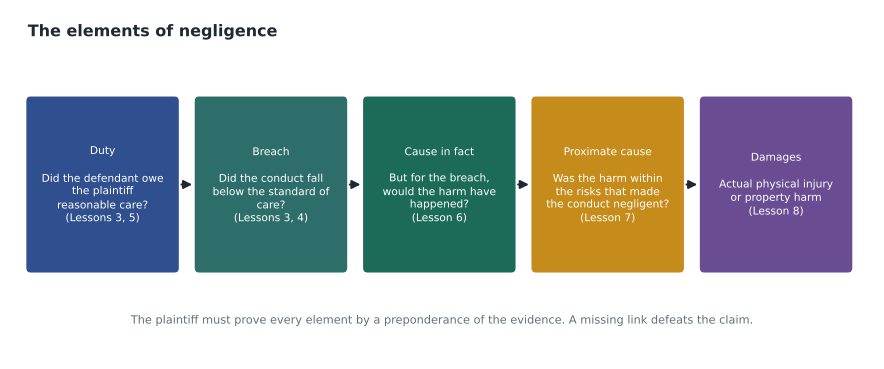
The elements are a checklist for analysis. Lawyers and courts sometimes blur them, and several doctrines can be described under more than one heading. Duty and proximate cause in particular overlap, as the class will see in Palsgraf in Lesson 7. Brenneman's advice is practical: on an exam or in a brief, take the elements in order, and when a fact could belong under two headings, discuss it where the case law in your jurisdiction puts it.
The general duty of reasonable care
When does a person owe a duty of care? Historically, courts recognized duties in particular relationships and situations and built the law up category by category. The modern view, stated in the Restatement (Third) of Torts: Liability for Physical and Emotional Harm section 7, is that an actor ordinarily has a duty to exercise reasonable care when the actor's conduct creates a risk of physical harm. In exceptional cases, when an articulated countervailing principle or policy warrants it, a court may decide that the defendant has no duty or a limited duty for a category of cases.
Two features of this formulation matter. First, the duty arises from the defendant's own conduct creating risk, which is why ordinary activities like driving, cooking, building or putting on a fireworks show carry a duty of care to people who might be hurt. Second, no-duty rules are decided by courts as a matter of law, for categories of cases, on policy grounds, not by asking whether this particular injury was foreseeable. The Restatement (Third) moves the case-specific question of foreseeability into breach and scope of liability. Not every state follows that approach; many courts still treat foreseeability as a central part of the duty analysis. Lesson 5 covers the major areas where courts limit duty: failing to rescue, landowners, emotional harm and pure economic loss.
At the fair, duty is not hard for most defendants. Brightfall Pyrotechnics, which set off explosive shells near a crowd, created an obvious risk of physical harm to spectators. Midway Rides, which operates a machine that whirls people through the air, created a risk to riders. The Agricultural Society, which invites the public onto its grounds, owes duties as a land possessor. The harder questions are about what reasonable care required of each.
The reasonable person
The standard of care in negligence is the conduct of a reasonable person under the same or similar circumstances. The reasonable person is not a real person. He or she is a legal construct, sometimes described as a person of ordinary prudence, who is neither perfect nor careless, who knows what an ordinary person in the community knows, and who takes the precautions that ordinary prudence requires.
Vaughan v. Menlove, 3 Bing. (N.C.) 468, 132 Eng. Rep. 490 (C.P. 1837), is the leading case, and it involves hay. The defendant built a hay rick near the edge of his property, next to the plaintiff's cottages. He was warned several times that it was likely to catch fire by spontaneous combustion, and he said he would chance it. It ignited and burned the cottages. His lawyer argued that he should be liable only if he failed to act with the best of his own judgment, and that he was not a very bright man. The court rejected that subjective standard. The question was whether he had acted as a person of ordinary prudence would have acted, because a standard based on each defendant's own judgment would be as variable as the length of each person's foot. The hay bales stacked by the fair's livestock barn, which caught fire from falling embers, make Vaughan v. Menlove a natural starting point for the class.
The reasonable person standard is objective, but it takes account of some characteristics of the actor.
Physical characteristics
A person with a physical disability is held to the standard of a reasonable person with that disability. A blind pedestrian must act as a reasonable blind person would, for example by using a cane or a guide dog, but is not negligent simply for failing to see. The disability does not lower the standard of care; it changes what reasonable care requires.
Mental capacity
By contrast, the law generally does not adjust the standard for mental limitations or mental illness. An adult with below-average intelligence is held to the standard of a reasonable person of ordinary intelligence, as the defendant in Vaughan was. Courts give several reasons: the difficulty of measuring mental capacity, the risk of fraud, the desire to give caretakers an incentive to supervise, and the view that the injured person should not bear the loss. A minority of courts make an exception for sudden and unforeseeable mental incapacity. In Breunig v. American Family Insurance Co., 45 Wis. 2d 536, 173 N.W.2d 619 (1970), a driver who believed God was steering her car swerved into oncoming traffic. The Wisconsin Supreme Court recognized that a sudden mental illness with no forewarning could excuse negligence, as a sudden heart attack would, but upheld the verdict against her because she had experienced delusions before and had reason to anticipate them.
Children
Children are held to the standard of a reasonable child of the same age, intelligence and experience. Very young children, often those under five, may be held incapable of negligence altogether. But a child who engages in an adult activity, one that is inherently dangerous and normally undertaken by adults, is held to the adult standard. In Robinson v. Lindsay, 92 Wash. 2d 410, 598 P.2d 392 (1979), a thirteen-year-old driving a snowmobile injured an eleven-year-old passenger; the Washington Supreme Court held him to the adult standard because operating a powerful motorized vehicle is an adult activity. Courts have applied the same rule to minors driving cars, boats and motorcycles.
Special knowledge and skills
A person with greater knowledge or skill than the ordinary person must use it. A trained electrician who notices a frayed wire is expected to recognize the danger even if an ordinary person would not. Professionals such as doctors, lawyers and engineers are held to the standard of care of a reasonably competent member of the profession, usually established by expert testimony about professional custom. Lesson 4 discusses how custom works in ordinary negligence and why medical malpractice treats it differently.
Emergencies
A person who faces a sudden emergency not of her own making is judged by what a reasonable person would do in that emergency. The emergency does not change the standard; it is one of the circumstances. A driver who swerves to avoid a child who darts into the street and hits a parked car may have acted reasonably even though, in hindsight, braking would have been better. Many states no longer give a separate emergency instruction to juries, reasoning that the general reasonable-person instruction already covers it.
| Characteristic | Standard applied | Example |
|---|---|---|
| Physical disability | Reasonable person with that disability | A blind pedestrian must use a cane, but is not negligent for failing to see |
| Below-average intelligence | No adjustment; ordinary prudence | Vaughan v. Menlove |
| Sudden, unforeseeable mental illness | Minority of courts excuse it | Breunig v. American Family (no excuse on the facts) |
| Child | Reasonable child of like age, intelligence and experience | A seven-year-old crossing a street |
| Child in an adult activity | Adult standard | Robinson v. Lindsay (snowmobile) |
| Professional | Reasonably competent member of the profession | A surgeon's care judged by expert testimony |
| Emergency | Reasonable person in that emergency | Swerving to avoid a child in the road |
Applying the standard: the fireworks show
The class turns to Brightfall Pyrotechnics. Brightfall's crew set up about 600 shells in mortar tubes on a field east of the grandstand. Spectators watched from the grandstand and from a roped-off lawn. According to the class materials, the distance from the nearest mortar to the rope line was 280 feet, and one shell, a six-inch aerial shell, burst at a low altitude instead of high in the air, scattering burning debris onto the lawn.
What would a reasonable display operator have done? Daniel Reyes says the answer depends on what professionals do. Marcus Webb, the former battery engineer, points out that fireworks displays are governed by detailed standards: many states and localities adopt the National Fire Protection Association's code for fireworks displays, NFPA 1123, which sets minimum separation distances based on shell size, requirements for inspecting shells and handling malfunctions, and qualifications for the licensed operator in charge. Brenneman says that is exactly the right instinct. Industry standards and safety codes do not automatically define negligence, but they are strong evidence of what reasonable care requires, and violating a code adopted as law may be negligence per se. Lesson 4 takes up both points.
Worked problem
Was the reasonable-person standard met at the fireworks show?
Brightfall's operator, a licensed pyrotechnician with fifteen years of experience, set the rope line at 280 feet. The code adopted by the state, in Brenneman's hypothetical, requires 70 feet of separation per inch of shell diameter for the largest shell, which for a six-inch shell is 420 feet. The operator says that he has used 280 feet for years without incident.
Show solution
- Duty: Brightfall created a risk of physical harm to spectators by launching explosives near them, so it owed a duty of reasonable care (Restatement (Third) section 7).
- Standard: a reasonable professional display operator. As a licensed expert, the operator must use his superior knowledge.
- Evidence of breach: the separation was two-thirds of the code minimum. Years without incident do not show reasonable care; they may show luck. As in Vaughan v. Menlove, saying he would chance it is no defense.
- The code violation may itself establish negligence per se if the code was adopted as law and was designed to protect spectators from this risk (Lesson 4).
Answer: The operator likely breached the standard of care. The remaining questions, which later lessons address, are whether the short separation caused Nadia's injuries, whether strict liability applies to fireworks displays, and whether Nadia's own conduct reduces her recovery.
Judge and jury
In a negligence trial, the judge decides questions of law, including whether a duty exists. The jury decides questions of fact, including what happened and whether the defendant's conduct fell below the standard of care. Breach is usually a jury question, because applying the reasonable-person standard to particular facts calls for the community's judgment. A judge may take the question from the jury only if reasonable people could not disagree. Oliver Wendell Holmes Jr. argued that judges should gradually develop fixed rules of conduct from experience; in Baltimore & Ohio Railroad v. Goodman, 275 U.S. 66 (1927), he wrote that a driver approaching a railroad crossing who could not see must stop and get out of the car to look. Seven years later, in Pokora v. Wabash Railway, 292 U.S. 98 (1934), Justice Cardozo rejected that rule as unrealistic and dangerous, and returned the question to the jury. Most courts have followed Cardozo's skepticism of fixed rules for ordinary conduct.
Priya Natarajan asks whether that makes negligence unpredictable. Brenneman agrees that it does, somewhat, and says that the unpredictability is the price of a standard flexible enough to cover every human activity. "No legislature could write rules for every way a person might be careless," he says. "So we ask twelve people from the community to decide what a careful person would have done."
Summary and key terms
- Negligence requires duty, breach, cause in fact, proximate cause (scope of liability) and actual damages.
- Brown v. Kendall made fault, the failure to use ordinary care, the general standard for accidental harm in American law.
- Under the Restatement (Third) section 7, an actor whose conduct creates a risk of physical harm ordinarily owes reasonable care; courts create no-duty rules only for categories of cases on policy grounds.
- The standard of care is that of a reasonable person in the circumstances, judged objectively (Vaughan v. Menlove).
- The standard adjusts for physical disabilities, childhood and special skills, but generally not for mental limitations; children in adult activities meet the adult standard (Robinson v. Lindsay).
- Duty is a question of law for the judge; breach is usually a question of fact for the jury.
- Negligence
- Failure to exercise the care a reasonable person would exercise in the circumstances, causing harm.
- Duty
- A legal obligation to use reasonable care toward another.
- Breach
- Conduct that falls below the applicable standard of care.
- Reasonable person
- The objective standard of a person of ordinary prudence in the same or similar circumstances.
- Adult activity doctrine
- The rule that a child engaged in an inherently dangerous adult activity is held to the adult standard of care.
- Sudden emergency doctrine
- The principle that conduct in an unexpected emergency not of one's making is judged in light of the emergency.
- Standard of care
- The level of conduct the law requires, ordinarily reasonable care.
- NFPA 1123
- The National Fire Protection Association code for outdoor fireworks displays, adopted in many jurisdictions.
Practice problems
Work each problem on paper first, then reveal the answer to check.
A driver with an IQ well below average misjudges the speed of an oncoming car and causes a crash. Can he argue that he did the best he could?
Show answer
No. The reasonable person standard does not adjust for below-average intelligence. He is judged by what a person of ordinary prudence would have done (Vaughan v. Menlove).
A fourteen-year-old rides a bicycle on a sidewalk and hits a pedestrian. Which standard applies?
Show answer
Most courts would apply the standard of a reasonable fourteen-year-old with like intelligence and experience, because bicycling is a common childhood activity, not an inherently dangerous adult activity. Some courts might treat motorized vehicles differently.
Under the Restatement (Third) approach, where does the question whether this particular harm was foreseeable usually belong?
Show answer
In breach and scope of liability, not duty. Duty is decided for categories of cases as a matter of policy.
Why is breach usually decided by a jury?
Show answer
Because applying the reasonable-person standard to specific facts requires the community's judgment about what ordinary prudence required, and reasonable people often disagree.
Lesson quiz · 5 questions
Score 60% or more to complete this lesson.
Create a free account to save your progress, take quizzes and earn a certificate.