
LAWU-103 · Lesson 2 of 12 · 25 min
Property torts and privileges
▶ Video coming soon A video version of this lesson is on the way.
In the second class, Professor Brenneman moves from wrongs against the person to wrongs against property, and then to the defenses that apply to all the intentional torts. The defenses, which the law calls privileges, matter more in practice than the torts themselves, he tells Section B. "Most intentional tort cases are not about whether the defendant touched the plaintiff. Everyone agrees he did. They are about whether he was allowed to."
The fair provides material for both halves of the class. When the fire spread toward the Pedersen farm that night, a volunteer firefighter crew tore down a stretch of the Pedersens' fence and cut a firebreak through their hayfield. A family fleeing the smoke drove their pickup across the same field to reach the county road, flattening a strip of soybeans. And when Dwayne Pruitt grabbed Theo Garza's arm, Theo pulled away and shoved him, and Pruitt now says that Theo battered him.
Trespass to land
Trespass to land is an intentional entry onto land in the possession of another, or causing a thing or another person to enter it, or remaining on the land after a right to be there ends (Restatement (Second) section 158). The intent required is only the intent to be on that particular piece of land. A defendant who walks onto a neighbor's lot believing it to be his own is a trespasser, because he meant to be where he was. Mistake about ownership is no defense. No harm is required: the plaintiff can recover nominal damages for the entry itself, and actual damages for any harm caused. The tort protects possession, so a tenant in possession, rather than the landlord, is usually the proper plaintiff.
The rule that harmless trespass is actionable has deep roots. In Dougherty v. Stepp, 18 N.C. 371 (1835), a surveyor entered the plaintiff's unenclosed land and caused no damage; the North Carolina court held that every unauthorized entry is a trespass entitling the owner to at least nominal damages. The modern case students remember is Jacque v. Steenberg Homes, Inc., 209 Wis. 2d 605, 563 N.W.2d 154 (1997). A mobile home dealer, told repeatedly by an elderly farm couple that it could not cross their snowy field to deliver a home to a neighbor, did so anyway because the road route was harder. The jury awarded 1 dollar in nominal damages and 100,000 dollars in punitive damages. The Wisconsin Supreme Court upheld the award, reasoning that the right to exclude is one of the most essential property rights and that punitive damages were needed to deter intentional trespass that caused no measurable harm.
Trespass can also be committed by causing objects or substances to enter land, such as throwing a rock, flooding a field or, in some states, depositing particles. Intrusions by invisible things like noise, odors and vibrations are usually treated as nuisance, which requires a substantial and unreasonable interference with use and enjoyment rather than an entry. Airspace is protected only up to the height reasonably needed for the owner's use; overflights at ordinary altitudes are not trespasses.
Trespass to chattels and conversion
Personal property, which lawyers call chattels, is protected by two related torts. Trespass to chattels is an intentional interference with another's possession of a chattel, by taking it or by using or intermeddling with it, that causes some harm: damage to the chattel, deprivation of its use for a substantial time, or harm to the possessor (Restatement (Second) sections 217 and 218). Unlike trespass to land, trespass to chattels requires actual harm; an owner cannot recover nominal damages for someone merely touching her car.
Intel Corp. v. Hamidi, 30 Cal. 4th 1342, 71 P.3d 296 (2003), applied that requirement to email. A former Intel employee sent six mass emails criticizing the company to as many as 35,000 employees. Intel sued for trespass to chattels, claiming interference with its computer system. The California Supreme Court held that because the emails did not damage the system or impair its functioning, there was no trespass. Intel's complaint was really about the content of the messages, which trespass to chattels does not protect.
Conversion is the more serious version: an intentional exercise of dominion or control over a chattel that so seriously interferes with the owner's right to control it that the defendant may justly be required to pay its full value (section 222A). Courts weigh factors such as the extent and duration of the interference, the defendant's intent and good faith, the harm done and the inconvenience to the owner. The remedy is a forced sale: the defendant pays the full market value at the time of conversion and, in effect, keeps the chattel. A good-faith purchaser of stolen goods can be liable for conversion to the true owner, because the tort turns on control of the property, not on wrongdoing. In Moore v. Regents of the University of California, 51 Cal. 3d 120, 793 P.2d 479 (1990), the California Supreme Court refused to treat a patient's excised cells, used without his knowledge to develop a valuable cell line, as property he could sue for in conversion, though it allowed a claim for breach of the doctor's duty to disclose.
| Tort | What it protects | Harm required? | Usual remedy |
|---|---|---|---|
| Trespass to land | Exclusive possession of land | No; nominal damages available | Damages for harm, nominal damages, injunction, punitive damages for willful trespass |
| Trespass to chattels | Possession of personal property | Yes: damage, loss of use or harm to possessor | Damages for the harm or loss of use |
| Conversion | The right to control personal property | Serious interference | Full market value at the time of conversion (a forced sale) |
| Nuisance | Use and enjoyment of land | Substantial and unreasonable interference | Damages and, sometimes, an injunction |
Privileges: an overview
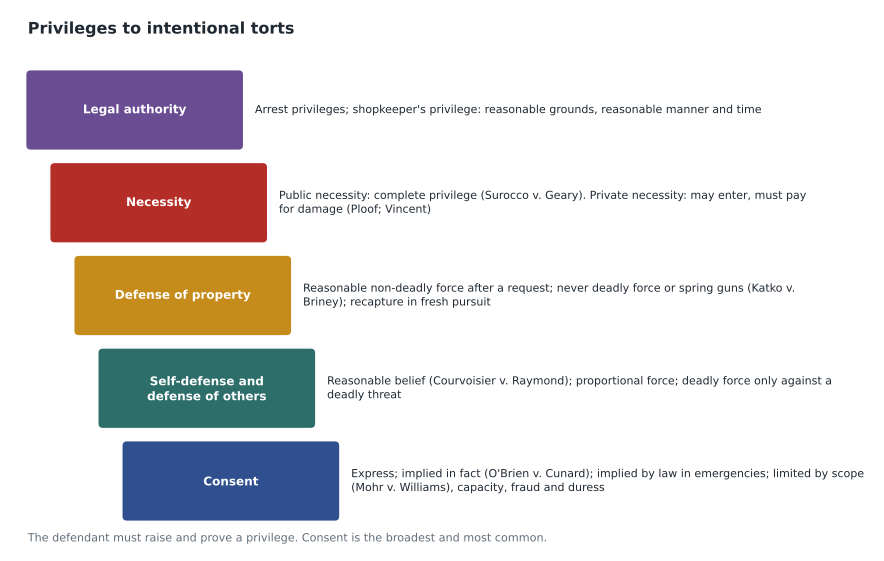
A privilege is a reason the law recognizes for allowing conduct that would otherwise be a tort. The defendant has the burden of raising and proving a privilege. The privileges fall into three groups: consent, in which the plaintiff agreed to the conduct; self-help privileges, in which the defendant protected himself, others or property; and privileges based on public policy, such as necessity and legal authority. Brenneman draws them on the board as a ladder, with consent at the bottom because it is the broadest and most common.
Consent
A plaintiff who consents to conduct cannot complain of it. Consent may be express, in words, or implied in fact from conduct. In O'Brien v. Cunard Steamship Co., 154 Mass. 272, 28 N.E. 266 (1891), a passenger stood in a line of people receiving vaccinations on board ship and held up her arm. The court held that her conduct showed consent, whatever her private wishes. Consent may also be implied by law in an emergency: a doctor may treat an unconscious patient when immediate action is needed to prevent serious harm and there is no reason to believe the patient would refuse.
Consent has limits. It must be given by someone with capacity, so a young child or a person who is intoxicated or mentally incapacitated may be unable to consent. It must not be obtained by fraud about the essential nature of the act, or by duress. And conduct that exceeds the scope of consent is not protected. In Mohr v. Williams, 95 Minn. 261, 104 N.W. 12 (1905), a patient consented to surgery on her right ear; once she was under anesthesia, the surgeon found the left ear in worse condition and operated on it instead. The Minnesota court held that the surgery on the unconsented ear was a battery, even though it was skillfully done. Today, most claims about inadequate disclosure of medical risks are brought as negligence claims under the doctrine of informed consent, and battery is reserved for operations to which the patient did not consent at all.
Consent to an illegal act is a contested area. Under the traditional majority rule, participants in an unlawful fight could sue each other, because consent to a crime was ineffective. The Restatement (Second) section 892C takes the opposite view: consent is effective even if the conduct is criminal, unless the criminal statute was designed to protect a class of persons, such as minors, against their own poor judgment.
Self-defense and defense of others
A person may use reasonable force to defend against what she reasonably believes is an imminent harmful or offensive contact. The belief need only be reasonable, not correct. In Courvoisier v. Raymond, 23 Colo. 113, 47 P. 284 (1896), a shopkeeper, besieged by rioters at night, shot a man who turned out to be a deputy sheriff coming to help. The Colorado Supreme Court held that the question for the jury was whether the shopkeeper reasonably believed he was in danger, not whether he actually was.
The force must be proportional to the threat. Deadly force, meaning force likely to cause death or serious bodily injury, is privileged only against a reasonable threat of death or serious bodily injury. States divide on whether a person must retreat before using deadly force if she can do so safely: some require retreat, except in one's own home; many others, by statute, have adopted stand-your-ground rules eliminating that duty. Self-defense ends when the threat ends: a person who keeps hitting an attacker who has been subdued becomes the tortfeasor. The same rules apply to the defense of third persons, and most states now allow a defender who reasonably but mistakenly believes intervention is needed to rely on the privilege.
Worked problem
Was Theo's shove privileged?
Pruitt grabbed Theo's arm without warning. Theo, startled, wrenched free and shoved Pruitt in the chest, causing him to stumble. Pruitt then seized Theo again and walked him to the trailer. Pruitt claims Theo battered him.
Show solution
- Prima facie battery: Theo intentionally shoved Pruitt, a harmful or offensive contact.
- Self-defense: Theo was being grabbed by a stranger; he could reasonably believe he faced an offensive contact. But if Pruitt was privileged to detain him, Theo may not resist a privileged detention with force, as with a lawful arrest.
- If Pruitt lacked reasonable grounds or used unreasonable force, the detention was not privileged, and Theo's limited, non-deadly shove to free himself was proportional.
- If Pruitt was privileged but Theo reasonably believed he was being attacked by a stranger, many courts would still protect Theo's reasonable mistake, especially if Pruitt gave no sign of his authority.
Answer: Theo's best defense is self-defense: a proportional, non-deadly response to an unexpected grab. Its strength depends on whether Pruitt identified himself and had a privilege to detain, which are the same facts that decide Theo's own claims.
Defense of property and recapture of chattels
A possessor may use reasonable force, after a request to stop if a request would not be futile, to prevent or end an intrusion onto land or an interference with chattels. Deadly force is never privileged solely to protect property. Katko v. Briney, 183 N.W.2d 657 (Iowa 1971), is the leading case. The Brineys, tired of break-ins at an unoccupied farmhouse, rigged a shotgun to fire at the legs of anyone who opened a bedroom door. Katko, who broke in to steal old bottles and jars, was badly wounded. The Iowa Supreme Court upheld a verdict for Katko, including punitive damages, because a property owner may not do indirectly, with a mechanical device, what he could not do in person: use deadly force to protect property when no one's life is threatened.
A person whose chattel has been wrongfully taken may use reasonable force to recapture it in fresh pursuit, but only if the taking was wrongful and the owner acts promptly. Once the pursuit ends, the owner must use legal process. This is the common law root of the shopkeeper's privilege discussed in Lesson 1.
Necessity
Necessity privileges an intrusion on property to prevent a greater harm. The law distinguishes two kinds.
Public necessity applies when the defendant acts to avert an imminent public disaster. It is a complete privilege: the defendant owes nothing for the damage. In Surocco v. Geary, 3 Cal. 69 (1853), the mayor of San Francisco ordered the plaintiffs' house blown up to stop a spreading fire. The California court held that he was not liable, because destroying property to stop a conflagration is privileged when the danger is real and imminent. Some state constitutions or statutes now provide compensation in such cases, and the takings clause may apply when the government acts deliberately to take property for public use.
Private necessity applies when the defendant acts to protect his own person or property, or that of a few others, from a serious threat. It is an incomplete privilege: the defendant may enter and use the property, and the owner may not expel him, but the defendant must pay for any actual damage. Two Minnesota and Vermont cases from the early twentieth century define it. In Ploof v. Putnam, 81 Vt. 471, 71 A. 188 (1908), a family sailing on a lake moored at the defendant's dock to escape a sudden storm, and the defendant's servant unmoored the boat, which was wrecked. The Vermont court held that the necessity gave the family a privilege to use the dock, so the defendant was liable for unmooring them. In Vincent v. Lake Erie Transportation Co., 109 Minn. 456, 124 N.W. 221 (1910), a steamship captain kept his ship tied to the plaintiff's dock during a violent storm, and the ship's pounding damaged the dock. The Minnesota court held that the captain acted prudently and had a right to stay, but the shipowner still had to pay for the damage, because it had deliberately used another's property to save its own.
Worked problem
The fence, the firebreak and the pickup
Volunteer firefighters tore down 200 feet of the Pedersens' fence and cut a firebreak through their hayfield to stop the fire from reaching the village. A family drove their pickup across the same field to escape the smoke, destroying part of a soybean crop.
Show solution
- Firefighters: they acted to avert an imminent public disaster, a spreading fire threatening homes. Public necessity is a complete privilege, so they owe nothing (Surocco v. Geary). The Pedersens may have claims under a state compensation statute or, if the government took property deliberately, under the takings clause.
- The family: they acted to protect themselves, so private necessity applies. They were privileged to cross, and the Pedersens could not lawfully have stopped them (Ploof).
- But private necessity is incomplete: the family must pay for the crop damage they caused (Vincent).
Answer: The firefighters are not liable; the fleeing family is privileged to enter but liable for actual damage to the crop. The real fight over the Pedersens' losses will be against whoever caused the fire, which is a negligence and strict liability question for later lessons.
Legal authority and discipline
Police officers, and in narrower circumstances private citizens, have privileges to arrest. A citizen may generally arrest for a felony actually committed if she reasonably believes the person committed it, and for a breach of the peace committed in her presence; she acts at her peril if no felony was in fact committed. Security guards usually have only a citizen's arrest power plus the shopkeeper's privilege, which is why Pruitt's case will turn on reasonable grounds. Parents, and in some states teachers, have a privilege to use reasonable force to discipline children, though many states have narrowed or abolished it for schools.
Summary and key terms
- Trespass to land requires only an intentional entry; mistake is no defense and nominal and punitive damages are available (Jacque v. Steenberg Homes).
- Trespass to chattels requires actual harm (Intel v. Hamidi); conversion is a serious interference for which the defendant pays full value.
- Consent may be express, implied in fact or implied by law in emergencies; conduct beyond its scope is not protected (Mohr v. Williams).
- Self-defense allows reasonable, proportional force against a reasonably perceived threat; deadly force only against deadly threats.
- Deadly force may not be used to protect property alone, directly or by a spring gun (Katko v. Briney).
- Public necessity is a complete privilege (Surocco v. Geary); private necessity is incomplete, so the defendant pays for damage (Ploof; Vincent).
- Trespass to land
- An intentional entry onto land possessed by another, or remaining after permission ends.
- Trespass to chattels
- An intentional interference with possession of personal property that causes harm.
- Conversion
- A serious interference with another's right to control a chattel, remedied by payment of its full value.
- Privilege
- A legally recognized justification for conduct that would otherwise be a tort.
- Implied consent
- Consent shown by conduct or presumed by law in an emergency.
- Public necessity
- A complete privilege to damage property to avert an imminent public disaster.
- Private necessity
- An incomplete privilege to use another's property to avoid serious harm, subject to paying for damage.
- Nuisance
- A substantial and unreasonable interference with the use and enjoyment of land.
Practice problems
Work each problem on paper first, then reveal the answer to check.
A hiker, believing a meadow is public land, camps there overnight without damaging anything. The meadow is private. Is the hiker liable?
Show answer
Yes, for trespass to land, at least for nominal damages. The hiker intended to be on that land, and mistake about ownership is not a defense.
A homeowner sees a teenager stealing a bicycle from his porch and fires a gun at him. Is the homeowner privileged?
Show answer
No. Deadly force is not privileged to protect property alone. The homeowner may use reasonable non-deadly force and may pursue to recapture the bicycle, but shooting is not reasonable.
Why did the shipowner in Vincent have to pay for the dock even though the captain acted reasonably?
Show answer
Because private necessity is an incomplete privilege. The ship could stay, but the owner deliberately used another's property to save its own and had to compensate for the damage.
A surgeon, operating with consent to remove a patient's appendix, also removes a suspicious mole on the patient's arm. Is there a battery?
Show answer
Likely yes, because removing the mole exceeded the scope of consent and was not an emergency. Mohr v. Williams treats an unconsented operation as a battery even if done skillfully.
Lesson quiz · 5 questions
Score 60% or more to complete this lesson.
Create a free account to save your progress, take quizzes and earn a certificate.