
LAWU-103 · Lesson 5 of 12 · 22 min
Special duty problems: rescue, land and emotional harm
▶ Video coming soon A video version of this lesson is on the way.
Lesson 3 described the general duty of reasonable care that arises when a person's conduct creates a risk of harm. This lesson covers the areas where courts have limited that duty or shaped it with special rules. Professor Brenneman calls them the duty problems, and he lists them on the board: failing to act, owning land, causing only emotional harm, and causing only economic loss. "In each of these areas," he says, "a court can tell a plaintiff who was plainly hurt by a defendant's carelessness that the defendant owed no duty. You need to know when, and why."
Misfeasance and nonfeasance
The common law distinguishes misfeasance, which is acting in a way that creates a risk, from nonfeasance, which is failing to act to help someone in peril the defendant did not create. Misfeasance carries the ordinary duty of reasonable care. Nonfeasance traditionally carries no duty at all. The Restatement (Third) section 37 states the rule: an actor whose conduct has not created a risk of physical harm to another has no duty of care to the other unless a court determines that one of the affirmative duties recognized elsewhere applies.
The rule produces stark results. In Yania v. Bigan, 397 Pa. 316, 155 A.2d 343 (1959), Bigan, who was running a strip-mining operation, urged Yania to jump into a water-filled trench on Bigan's property. Yania jumped and drowned while Bigan watched. The Pennsylvania Supreme Court held that Bigan had no legal duty to rescue him, because Bigan had not caused Yania to jump by any legally significant act (taunting an adult did not count) and had not otherwise created the peril. Students find the case troubling, and Brenneman says they should. Courts give several reasons for the rule: the difficulty of deciding which of many bystanders should have acted, respect for individual liberty, and reluctance to force people into dangerous situations.
At the fair, after Kayla Brooks was thrown from the Whirlwind, a teenager named Ethan Moss, who was waiting in line, saw her lying on the platform. He walked away to find his friends without calling for help. Under the traditional rule, Ethan owed Kayla no duty: he did not create the peril and had no special relationship with her.
Exceptions: special relationships
The no-duty-to-rescue rule is riddled with exceptions. The most important are special relationships. The Restatement (Third) section 40 lists relationships that give rise to a duty of reasonable care with regard to risks arising within the relationship: a common carrier with its passengers, an innkeeper with its guests, a business or other possessor of land that holds its premises open to the public with those lawfully on the premises, an employer with its employees in imminent danger at work, a school with its students, a landlord with its tenants, and a custodian with those in its custody. The fair, as a business holding its grounds open to the public, owed its patrons a duty of reasonable care to respond to injuries and dangers on the grounds, which is why fair staff and the ride operator, unlike Ethan, had to act.
Courts have sometimes found special relationships in other settings. In Farwell v. Keaton, 396 Mich. 281, 240 N.W.2d 217 (1976), two teenage friends were out together when one was badly beaten; the other put him in the back seat of a car, drove around and eventually left him in his grandparents' driveway, where he was not found until morning and died. The Michigan Supreme Court held that companions on a social venture have a special relationship, so the surviving friend owed a duty of reasonable care.
Exceptions: creating the risk and undertaking to help
A person whose conduct, even innocent conduct, creates a continuing risk of physical harm has a duty to exercise reasonable care to prevent or minimize the harm (Restatement (Third) section 39). A driver who without fault hits a pedestrian must take reasonable steps to get help. And a person who undertakes to help another, even without any initial duty, must exercise reasonable care in doing so if the failure to do so increases the risk of harm or the other person relies on the undertaking (sections 42 to 44). A rescuer who starts to help and then abandons the victim in a worse position, or discourages others from helping, can be liable. To encourage rescues, every state has a Good Samaritan statute protecting at least some people who give emergency aid in good faith from liability for ordinary negligence, though the statutes vary widely in whom they cover.
A few states have statutes requiring bystanders to give reasonable assistance. Vermont's duty-to-assist statute, 12 V.S.A. section 519, requires a person who knows that another is exposed to grave physical harm to give reasonable assistance if it can be done without danger or peril to the rescuer, with a small fine for violations. Minnesota and Rhode Island have similar laws. They are rarely enforced, and none creates a broad civil cause of action, but they show that the common law rule is a choice, not a necessity.
Duties to protect third parties
Special relationships can also create a duty to protect others from a person in the defendant's charge. In Tarasoff v. Regents of the University of California, 17 Cal. 3d 425, 551 P.2d 334 (1976), a patient told his university psychologist that he intended to kill a young woman, Tatiana Tarasoff. The psychologist notified campus police, who briefly detained the patient and released him; no one warned Tarasoff, and the patient later killed her. The California Supreme Court held that a therapist who determines, or reasonably should determine, that a patient presents a serious danger of violence to another has a duty to use reasonable care to protect the intended victim, which may require warning her. Most states have since adopted some form of the Tarasoff duty, many by statute, and some states have rejected it or made it permissive. The Restatement (Third) section 41 recognizes a duty of care by parents, custodians, employers and mental-health professionals with respect to risks posed by those under their control or care.
Duties of land possessors
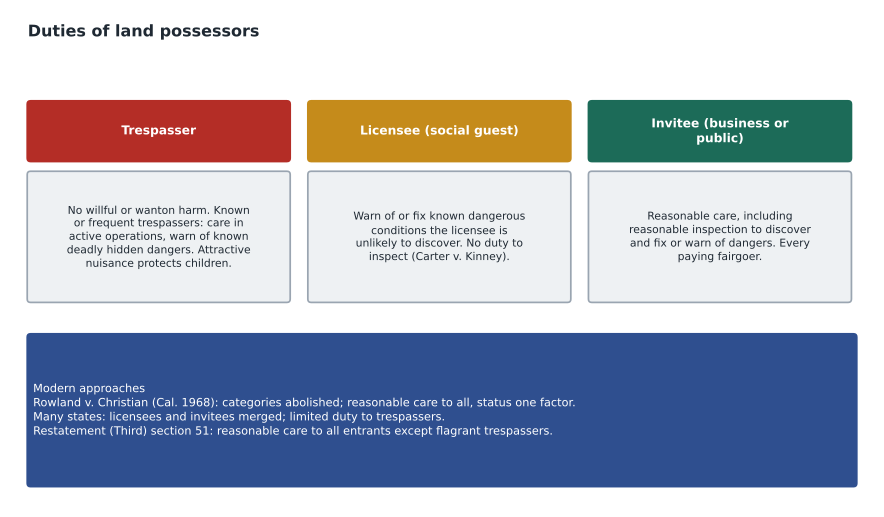
The traditional common law sorted people who come onto land into three categories, each owed a different duty by the possessor.
- Trespassers, who enter without permission, are owed only a duty not to injure them willfully or wantonly. Once the possessor knows that trespassers are present or constantly intrude on a limited area, many courts require reasonable care in active operations and warnings about known, hidden, deadly dangers. Children who trespass are protected by the attractive nuisance doctrine (Restatement (Second) section 339): a possessor is liable for harm to trespassing children from an artificial condition if the possessor knows children are likely to trespass, the condition poses an unreasonable risk of death or serious harm that children, because of their youth, will not recognize, and the burden of eliminating the danger is slight compared with the risk.
- Licensees, who enter with permission but for their own purposes, including social guests, are owed a duty to warn of or make safe known dangerous conditions that the licensee is unlikely to discover. The possessor need not inspect for unknown dangers. In Carter v. Kinney, 896 S.W.2d 926 (Mo. 1995), a man who slipped on ice while attending a Bible study at the defendants' home was held to be a licensee, not an invitee, because the hosts received no material benefit from his visit, so they owed no duty to inspect for ice they did not know about.
- Invitees, who enter for a business purpose of the possessor or because the land is held open to the public, are owed reasonable care, including a duty to inspect for and correct or warn of dangers the possessor should discover.
Every fairgoer who paid admission, and every vendor's employee working on the grounds, was an invitee of the Agricultural Society. So Bev Sandoval, who slipped on melted ice and lemonade by the 4-H barn, was owed reasonable care, including reasonable inspection. Her case will turn on notice: whether the spill had been there long enough that a reasonable inspection would have found it, or whether the fair's own lemonade stand created a recurring hazard that called for mats, drains or more frequent checks.
Abolishing the categories
Many courts and commentators criticized the categories as arbitrary. Why should a social guest, who is a licensee, be owed less care than a salesman, who is an invitee? In Rowland v. Christian, 69 Cal. 2d 108, 443 P.2d 561 (1968), a social guest cut his hand on a cracked bathroom faucet handle that his host knew about but did not mention. The California Supreme Court abolished the categories altogether and held that a land possessor owes everyone the duty of reasonable care in the circumstances, with the plaintiff's status as one factor. A number of states followed California completely. More, perhaps the largest group, merged licensees and invitees into one category owed reasonable care while keeping a separate, limited duty to trespassers. The rest retain the three traditional categories. The Restatement (Third) section 51 adopts a general duty of reasonable care owed by land possessors to all entrants except flagrant trespassers, to whom it applies a narrower duty.
Two special statutes are worth knowing. Every state has a recreational use statute that limits the liability of landowners who open their land to the public free of charge for recreation, usually to willful or malicious conduct, to encourage access to private land for hunting, hiking and similar uses. And many states have statutes limiting landlords' and possessors' duties in specific settings, such as firearms or criminal acts.
Emotional harm
Courts have been cautious about negligence claims for purely emotional harm, out of concern about fraudulent claims, unlimited liability and the difficulty of measuring distress. The law has developed in stages.
Under the old impact rule, a plaintiff could recover for emotional distress only if the defendant's negligence caused some physical impact, however slight. A few states keep versions of it. Most replaced it with the zone of danger rule: a plaintiff who was put in immediate risk of physical harm by the defendant's negligence may recover for emotional distress caused by fear for her own safety, even without impact. In Falzone v. Busch, 45 N.J. 559, 214 A.2d 12 (1965), a woman sitting in a parked car was nearly struck by a car that hit her husband; the New Jersey Supreme Court held she could recover for the fright and resulting illness. The Supreme Court adopted the zone of danger test for claims under the Federal Employers' Liability Act in Consolidated Rail Corp. v. Gottshall, 512 U.S. 532 (1994).
Bystanders
The hardest cases involve bystanders who are not themselves endangered but witness injury to someone they love. In Dillon v. Legg, 68 Cal. 2d 728, 441 P.2d 912 (1968), a mother watched from the curb as a negligent driver struck and killed her young daughter. The child's sister, who was closer to the car and in the zone of danger, could recover under the existing rules; the mother, outside the zone, could not. The California Supreme Court held that the mother's claim depended on foreseeability, guided by three factors: whether she was near the scene, whether her shock resulted from directly perceiving the accident rather than learning of it later, and whether she was closely related to the victim.
Two decades later, concerned that Dillon's flexible factors had produced inconsistent results, the same court narrowed them into firm requirements in Thing v. La Chusa, 48 Cal. 3d 644, 771 P.2d 814 (1989). A bystander may recover only if she is closely related to the injury victim, is present at the scene of the injury-producing event when it occurs and is then aware that it is causing injury to the victim, and as a result suffers serious emotional distress beyond that which would be anticipated in a disinterested witness. The mother in Thing, who arrived at the scene after her son had been struck, could not recover. Most states now allow some form of bystander recovery, usually with requirements close to Thing's; the Restatement (Third) section 48 permits recovery by a close family member who perceives the event contemporaneously.
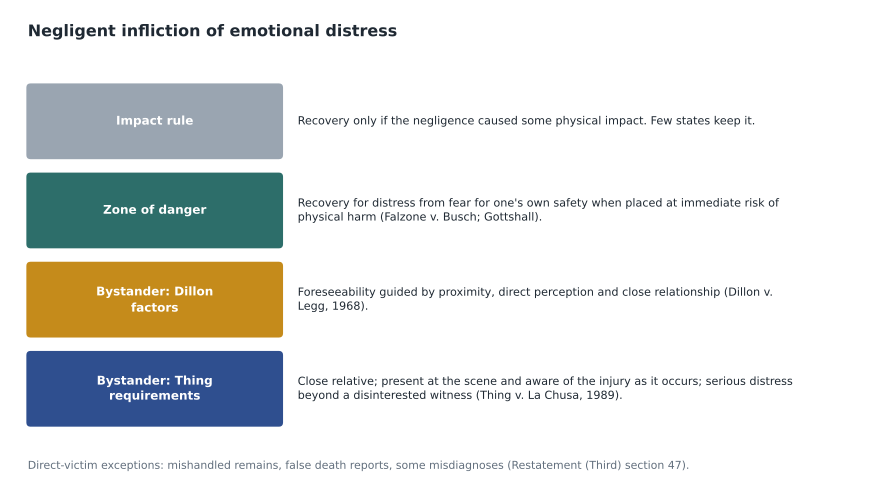
Courts also allow emotional distress claims in some direct relationships where serious distress is especially likely, regardless of physical risk: mishandling of a relative's body by a funeral home or hospital, erroneous reports of a relative's death, and, in some states, a negligent misdiagnosis of a serious disease. The Restatement (Third) section 47 recognizes recovery when the actor's negligence occurs in the course of specified categories of activities, undertakings or relationships in which negligent conduct is especially likely to cause serious emotional harm.
Worked problem
Grace Okoro's emotional distress claim
Grace Okoro was standing next to her daughter Nadia when the burning debris struck Nadia's face and neck. Grace was not burned, but a fragment landed at her feet. She has since been diagnosed with post-traumatic stress disorder and cannot sleep through the night.
Show solution
- Zone of danger: debris landed at Grace's feet, so she was herself at immediate risk of physical harm. In a zone-of-danger state, she can recover for distress from fear for her own safety, and many courts would allow recovery for distress from seeing her daughter hurt as well.
- Bystander recovery under Thing: Grace is Nadia's mother (close relationship), was present at the scene and aware that Nadia was being injured, and has a diagnosed condition beyond what a disinterested witness would suffer.
- Defendant: Brightfall's negligence (and possibly strict liability, Lesson 9) caused both the injury to Nadia and the threat to Grace.
Answer: Grace likely has a strong emotional distress claim under either the zone of danger rule or the bystander rule. Her diagnosis will help satisfy the serious-distress requirement.
Pure economic loss
The last duty problem is economic loss unaccompanied by physical injury or property damage. Courts generally refuse negligence recovery for pure economic loss to strangers. If the fair's fire had closed the county road for a day, the businesses on that road that lost customers could not recover their lost profits from Brightfall, even though the loss was foreseeable. The rule prevents liability from spreading without limit through the economy. In contract settings, the economic loss rule channels disputes about defective products that damage only themselves into warranty law rather than tort, as the class will see in Lesson 10. There are exceptions for negligent misrepresentation by professionals who supply information for the guidance of others, and for some cases of special relationships.
Summary and key terms
- Nonfeasance usually carries no duty to rescue (Yania v. Bigan); misfeasance carries the ordinary duty of care.
- Exceptions include special relationships such as carriers, innkeepers, businesses open to the public and companions (Farwell v. Keaton), creating the risk, and voluntary undertakings.
- Therapists and others who control or care for dangerous people may owe a duty to protect identifiable victims (Tarasoff).
- Traditional land-possessor duties depend on entrant status: trespasser, licensee or invitee; many states have abolished or merged the categories (Rowland v. Christian), and the Restatement (Third) section 51 adopts reasonable care toward most entrants.
- Emotional harm claims are limited by the impact rule, the zone of danger rule and bystander rules (Dillon v. Legg; Thing v. La Chusa).
- Pure economic loss to strangers is generally not recoverable in negligence.
- Nonfeasance
- Failure to act to help another in peril the actor did not create.
- Misfeasance
- Affirmative conduct that creates a risk of harm.
- Special relationship
- A relationship, such as carrier and passenger, that creates an affirmative duty of care.
- Good Samaritan statute
- A statute protecting people who give emergency aid in good faith from liability for ordinary negligence.
- Invitee
- A person on land for the possessor's business purpose or because the land is open to the public.
- Licensee
- A person on land with permission for the person's own purposes, such as a social guest.
- Attractive nuisance
- The doctrine making possessors liable to trespassing children for dangerous artificial conditions children cannot appreciate.
- Zone of danger
- The area of immediate risk of physical harm; people within it may recover for emotional distress from fear for their safety.
- Pure economic loss
- Financial loss without physical injury or property damage.
Practice problems
Work each problem on paper first, then reveal the answer to check.
A lifeguard on duty at a public pool sees a swimmer struggling and does nothing. Does Yania v. Bigan protect the lifeguard?
Show answer
No. The pool, as a possessor holding its premises open to the public, has a special relationship with swimmers, and the lifeguard has undertaken to protect them. Yania applies to strangers with no relationship.
A child climbs a fence into a construction site and falls into an uncovered pit. What doctrine may allow recovery even though the child trespassed?
Show answer
Attractive nuisance, if the owner knew children were likely to trespass, the pit posed a serious risk the child could not appreciate, and covering it would have been a slight burden compared with the risk.
A father learns by phone that his daughter was injured in a crash and rushes to the hospital. In a state following Thing v. La Chusa, can he recover for emotional distress?
Show answer
No. He was not present at the scene and aware of the injury as it happened. Thing requires contemporaneous presence and awareness.
Under the Restatement (Third) section 37, when does an actor who did not create a risk owe a duty to help?
Show answer
Only when one of the recognized affirmative duties applies, such as a special relationship, a voluntary undertaking, or prior conduct creating a continuing risk.
Lesson quiz · 5 questions
Score 60% or more to complete this lesson.
Create a free account to save your progress, take quizzes and earn a certificate.