
LAWU-103 · Lesson 10 of 12 · 21 min
Products liability
▶ Video coming soon A video version of this lesson is on the way.
Products liability is the area of tort law that touches the most people and generates the largest verdicts and settlements. Professor Brenneman tells Section B that he spent half his practice on products cases, first defending manufacturers and then suing them. He starts with two products from the course: the propane regulator that failed at Smoky Joe's food stand and burned Luis Ortega, and, borrowed from Professor Okafor-Bell's Civil Procedure class, the Kestrel Trail 750 e-bike whose battery caught fire in Rosa Delgado's garage. "Civil procedure asked where Delgado could sue," he says. "Torts asks what she has to prove."
In Brenneman's hypothetical, the regulator was a model RG-40 made by Corvane Gas Products, Inc., and sold through restaurant supply stores. The stand's owner, Joe Medeiros, bought it two years ago. After the fire, investigators found that the regulator's diaphragm had ruptured, letting high-pressure gas reach the burner. Luis cannot sue his employer in tort because workers' compensation is his exclusive remedy against Smoky Joe's, but he can sue Corvane and the store that sold the regulator.
From privity to strict liability
For most of the nineteenth century, a person injured by a defective product could sue only the party with whom he had a contract, usually the retailer. In Winterbottom v. Wright (1842), a coachman injured when a mail coach collapsed could not sue the man who had contracted with the postmaster to maintain it, because there was no privity of contract between them.
The privity barrier fell in MacPherson v. Buick Motor Co., 217 N.Y. 382, 111 N.E. 1050 (1916). A wooden wheel on MacPherson's new Buick collapsed, and he was injured. The wheel was made by another company, but Buick could have discovered the defect by reasonable inspection. Judge Cardozo held that a manufacturer owes a duty of care to anyone who will foreseeably use its product, without privity, if the product is reasonably certain to place life and limb in peril when negligently made. MacPherson made negligence the basis of products liability for the next half century.
Courts and commentators then pushed toward liability without fault. In Escola v. Coca-Cola Bottling Co., 24 Cal. 2d 453, 150 P.2d 436 (1944), a waitress was injured when a soda bottle exploded in her hand. The majority upheld her verdict under res ipsa loquitur. Justice Roger Traynor, concurring, argued that a manufacturer should be absolutely liable when an article it places on the market, knowing it will be used without inspection, proves to have a defect that causes injury. The manufacturer is best placed to reduce the hazards and can spread the cost of injuries among the public as a cost of doing business. In Henningsen v. Bloomfield Motors, Inc., 32 N.J. 358, 161 A.2d 69 (1960), the New Jersey Supreme Court reached a similar result through contract law, holding that an implied warranty of merchantability ran to the buyer's wife, who was injured when the steering of a new car failed, and refusing to enforce the manufacturer's disclaimer.
Traynor's view became law in Greenman v. Yuba Power Products, Inc., 59 Cal. 2d 57, 377 P.2d 897 (1963). A man was hurt when a block of wood flew out of a combination power tool his wife had given him. Traynor, now writing for the California Supreme Court, held that a manufacturer is strictly liable in tort when an article it places on the market, knowing that it is to be used without inspection for defects, proves to have a defect that causes injury to a human being. Two years later, the Restatement (Second) of Torts section 402A adopted strict liability for sellers of products in a defective condition unreasonably dangerous to the user or consumer, and nearly every state followed within a decade or two.
Who can be sued
Strict products liability applies to commercial sellers and distributors: manufacturers, component makers, wholesalers and retailers in the chain of distribution. It does not apply to occasional sellers, such as a person selling a used lawnmower at a yard sale, and it usually does not apply to services, though the line between products and services can be hard to draw. Many states have statutes protecting innocent retailers and distributors that did not cause the defect, unless the manufacturer is insolvent or beyond the court's jurisdiction. Courts have divided over whether online marketplaces are sellers subject to strict liability. In Bolger v. Amazon.com, LLC, 53 Cal. App. 5th 431 (2020), a California appellate court held Amazon strictly liable for a defective laptop battery sold by a third party through its site because Amazon was a direct link in the chain of distribution; other courts have reached different conclusions, and several states have addressed the question by statute.
Anyone injured by a defective product can sue, not just the buyer: users, consumers and bystanders. Luis, who used the regulator at work but did not buy it, is a foreseeable user.
Three kinds of defects
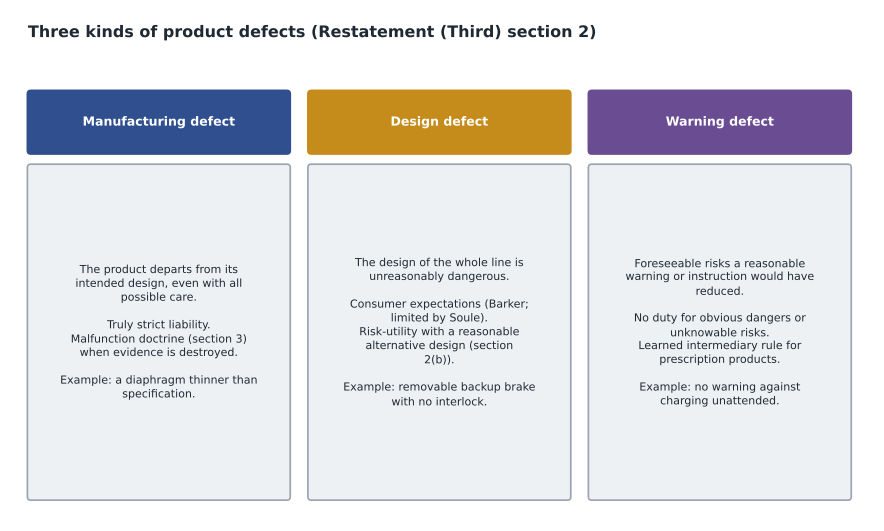
The Restatement (Third) of Torts: Products Liability, published in 1998, abandoned 402A's single formula and recognized that defects come in three kinds, each with its own test (section 2). Courts in many states now analyze defects in these categories, whether or not they adopt the Third Restatement's specific tests.
Manufacturing defects
A product has a manufacturing defect when it departs from its intended design, even though all possible care was exercised in its preparation and marketing (section 2(a)). The exploding bottle in Escola, a contaminated food product, or a part that was assembled wrong are examples. Liability for manufacturing defects is truly strict: the plaintiff need only show that the product departed from the manufacturer's own specifications. When the product is destroyed or the specific defect cannot be identified, the malfunction doctrine (section 3) allows an inference that a defect existed when the incident is of a kind that ordinarily occurs as a result of a product defect and was not solely the result of other causes. If Corvane's engineers find that the diaphragm in Luis's regulator was thinner than the specification because of a faulty production run, Luis has a manufacturing defect claim.
Design defects
A product has a design defect when the design itself, applied across the entire product line, makes it unreasonably dangerous. Two tests compete.
Under the consumer expectations test, derived from comment i to section 402A, a product is defective if it is more dangerous than an ordinary consumer would expect when used in an intended or reasonably foreseeable way. California's Barker v. Lull Engineering Co., 20 Cal. 3d 413, 573 P.2d 443 (1978), adopted two alternative tests: a product is defectively designed if it fails to perform as safely as an ordinary consumer would expect, or if the benefits of the design do not outweigh its risks, with the burden on the defendant to prove the benefits under the second test. In Soule v. General Motors Corp., 8 Cal. 4th 548, 882 P.2d 298 (1994), the California Supreme Court limited the consumer expectations test to cases where the everyday experience of the product's users permits a conclusion that it did not meet minimum safety assumptions, and held it inappropriate for complex technical questions, such as how a car's wheel bracket should behave in a particular kind of crash.
Under the risk-utility test, a product's design is defective when the foreseeable risks of harm could have been reduced or avoided by the adoption of a reasonable alternative design, and the omission of the alternative design renders the product not reasonably safe (Restatement (Third) section 2(b)). The plaintiff ordinarily must prove that a reasonable alternative design existed, considering factors such as the magnitude of the risks, the effectiveness and cost of the alternative, its effect on the product's function, and consumer expectations. Many states use risk-utility as the primary test, and many consider consumer expectations as one factor within it.
Defendants in design cases often point to the state of the art: the technology and knowledge available when the product was made. A design is not defective merely because a safer design became feasible later. Compliance with government safety standards is evidence that a design is not defective, but usually not conclusive.
Worked problem
Was the RG-40 defectively designed?
Suppose instead that the diaphragm in Luis's regulator met Corvane's specification, but the RG-40 design lacked an internal relief valve that would vent excess pressure away from the burner if the diaphragm failed. Competing regulators costing a few dollars more include such a valve. Corvane says its regulator met the applicable industry standard.
Show solution
- Category: if every RG-40 lacks the valve, this is a design defect claim, not a manufacturing defect.
- Risk-utility: the risk of a flash fire burning a worker is severe; the alternative design with a relief valve is feasible, inexpensive and used by competitors without impairing function.
- Consumer expectations: an ordinary restaurant worker expects a regulator not to send a flash of high-pressure gas into the grill; some courts would let a jury use this test, though Soule-type reasoning might limit it for technical questions.
- Industry standard: compliance is evidence against defect but is not conclusive; a jury may find the standard inadequate, as in The T.J. Hooper (Lesson 4).
Answer: Luis has a strong design defect claim under risk-utility, because a safer, inexpensive alternative design existed and was in use.
Warning defects
A product is defective because of inadequate instructions or warnings when the foreseeable risks of harm could have been reduced or avoided by reasonable instructions or warnings, and the omission makes the product not reasonably safe (section 2(c)). The duty extends to risks the seller knew or should have known about, not to unknowable risks; most courts reject strict liability for failure to warn of dangers that were scientifically undiscoverable at the time of sale. In Anderson v. Owens-Corning Fiberglas Corp., 53 Cal. 3d 987, 810 P.2d 549 (1991), the California Supreme Court held that a defendant in a strict liability warning case may show that the particular risk was not known or reasonably knowable by the application of scientific knowledge available at the time of manufacture.
Several rules shape warning claims. There is usually no duty to warn of obvious or generally known dangers. For prescription drugs and medical devices, the learned intermediary doctrine says that the manufacturer satisfies its duty by adequately warning the prescribing doctor rather than the patient. Many courts apply a heeding presumption: if an adequate warning had been given, the plaintiff is presumed to have followed it, which helps on causation. And a seller may have a post-sale duty to warn of risks discovered after sale when a reasonable seller would do so (section 10). Recalls are governed largely by federal agencies such as the Consumer Product Safety Commission and the National Highway Traffic Safety Administration.
Defenses
Products defendants raise several defenses beyond arguing that there was no defect.
- Misuse and alteration. A seller is responsible for reasonably foreseeable uses and misuses, but not for unforeseeable misuse or for substantial alterations after sale that caused the harm. A regulator modified with a homemade fitting would raise this defense.
- Comparative fault. Most states reduce a products plaintiff's recovery by his own share of fault. In Daly v. General Motors Corp., 20 Cal. 3d 725, 575 P.2d 1162 (1978), the California Supreme Court applied comparative fault to strict products liability.
- Statutes of limitations and repose. Many states bar product claims a fixed number of years after the product's first sale, regardless of when the injury occurs.
- Federal preemption. Federal law can displace state tort claims. In Riegel v. Medtronic, Inc., 552 U.S. 312 (2008), the Supreme Court held that the Medical Device Amendments expressly preempt state-law claims challenging the safety of devices that received premarket approval from the FDA. In Wyeth v. Levine, 555 U.S. 555 (2009), the Court held that federal law did not preempt a failure-to-warn claim against a brand-name drug maker, because the maker could have strengthened its label without FDA approval. But in PLIVA, Inc. v. Mensing, 564 U.S. 604 (2011), the Court held that failure-to-warn claims against generic drug makers are preempted, because federal law requires a generic label to match the brand-name label. In Geier v. American Honda Motor Co., 529 U.S. 861 (2000), a claim that a car should have had an airbag was preempted because it conflicted with a federal safety standard that deliberately gave manufacturers a choice of restraint systems.
The economic loss rule
When a defective product damages only itself, without injuring people or other property, most courts hold that the buyer's remedy is in warranty and contract law, not tort. The Supreme Court adopted this rule for admiralty in East River Steamship Corp. v. Transamerica Delaval, Inc., 476 U.S. 858 (1986), where defective turbines on supertankers damaged only themselves. The reasoning is that commercial parties can allocate the risk of a product's failing to perform through warranties and price. If Delgado's e-bike battery had simply died, she would have a warranty claim. Because it burned her and her garage, she has a tort claim.
Back to the e-bike
Brenneman ends with the Delgado case from Civil Procedure. Delgado's lawyer, Ana Whitcomb, will plead manufacturing defect (if the battery's cells were contaminated or damaged in production), design defect (if the battery pack lacked thermal protection that safer designs include), and warning defect (if the charging instructions failed to warn against charging unattended or in garages). Kestrelwerk's earlier recall of a different battery model in 2024 will be relevant to what it knew and when. Marcus Webb, the former battery engineer, says that thermal runaway in lithium-ion cells is exactly the kind of risk a careful designer can reduce with cell spacing, fuses and battery management software. "Then you know what the plaintiff's expert will say," Brenneman replies.
Summary and key terms
- MacPherson v. Buick ended the privity requirement for negligence claims; Escola, Henningsen and Greenman led to strict liability, codified in Restatement (Second) section 402A.
- Commercial sellers in the distribution chain are subject to strict liability; users, consumers and bystanders can sue.
- The Restatement (Third) of Torts: Products Liability distinguishes manufacturing defects (departures from design; truly strict), design defects and warning defects.
- Design defects are judged by consumer expectations (Barker; limited by Soule) or risk-utility with a reasonable alternative design (section 2(b)).
- Defects in warnings concern foreseeable risks that reasonable warnings would have reduced; the learned intermediary doctrine applies to prescription products.
- Defenses include misuse, alteration, comparative fault (Daly), statutes of repose and federal preemption (Riegel; Wyeth; Mensing; Geier); the economic loss rule sends self-damage claims to warranty law (East River).
- Privity
- A direct contractual relationship between parties.
- Section 402A
- The Restatement (Second) provision adopting strict liability for defective, unreasonably dangerous products.
- Manufacturing defect
- A departure from the product's intended design.
- Design defect
- A defect in the design of a whole product line, judged by consumer expectations or risk-utility.
- Warning defect
- Inadequate instructions or warnings about foreseeable risks.
- Reasonable alternative design
- A feasible safer design that a plaintiff typically must prove under the risk-utility test.
- Learned intermediary doctrine
- The rule that drug and device makers warn through the prescribing physician.
- Preemption
- Displacement of state law, including tort claims, by federal law.
- Economic loss rule
- The rule limiting recovery for a product that damages only itself to contract and warranty remedies.
Practice problems
Work each problem on paper first, then reveal the answer to check.
One jar of a company's peanut butter contains a shard of glass that injures a consumer; all other jars are fine. What kind of defect is this, and what must the consumer prove?
Show answer
A manufacturing defect. The consumer must prove that the jar departed from the intended design, which the glass plainly shows; no proof of negligence is required.
A plaintiff claims that an SUV's design made it prone to roll over in sharp turns. In a state following Soule, can the jury use the consumer expectations test?
Show answer
Probably not, if the question requires technical expert analysis of vehicle dynamics. Soule limits the consumer expectations test to cases within ordinary consumers' everyday experience; the plaintiff would use risk-utility.
Why was the failure-to-warn claim in PLIVA v. Mensing preempted when the claim in Wyeth v. Levine was not?
Show answer
Because federal law required the generic maker's label to match the brand-name label, so it could not comply with a state duty to change its warning; the brand-name maker in Wyeth could strengthen its label on its own.
A defective component causes a factory machine to break down, damaging only the machine. Can the buyer sue the manufacturer in tort?
Show answer
Usually not. Under the economic loss rule (East River), damage only to the product itself is remedied through warranty and contract, not tort.
Lesson quiz · 5 questions
Score 60% or more to complete this lesson.
Create a free account to save your progress, take quizzes and earn a certificate.