
LAWU-103 · Lesson 4 of 12 · 24 min
Breach: proving negligence
▶ Video coming soon A video version of this lesson is on the way.
Knowing the standard of care is one thing; proving that a defendant fell below it is another. Professor Brenneman begins the fourth class with the Whirlwind ride. "Kayla Brooks was sitting in a seat with a lap bar," he says. "The bar opened at the top of a loop and she was thrown out. Nobody saw what went wrong inside the machine. Midway Rides says it inspected the ride that morning. How does Kayla prove negligence?" This lesson covers the tools lawyers use to prove breach: cost-benefit reasoning, custom, statutes and the inference of negligence from the accident itself.
Weighing risks and precautions
Courts have long described reasonable care as a balance between the risks an actor's conduct creates and the burden of taking precautions against them. The Restatement (Third) section 3 states the primary factors: the foreseeable likelihood that the conduct will result in harm, the foreseeable severity of any harm that may ensue, and the burden of precautions to eliminate or reduce the risk of harm.
The most famous statement of the balance is Judge Learned Hand's in United States v. Carroll Towing Co., 159 F.2d 169 (2d Cir. 1947). A barge broke loose from its moorings in New York Harbor and sank after colliding with another vessel. The barge's owner had left it without a bargee, an attendant who could have spotted the problem and called for help. Hand wrote that the owner's duty to guard against such accidents was a function of three variables: the probability that the barge would break away (P), the gravity of the resulting injury if it did (L), and the burden of adequate precautions (B). Liability depends on whether B is less than L multiplied by P. Because the barge was left unattended during daylight working hours in a busy wartime harbor, when breakaways were likely, the owner was negligent for not having a bargee aboard.
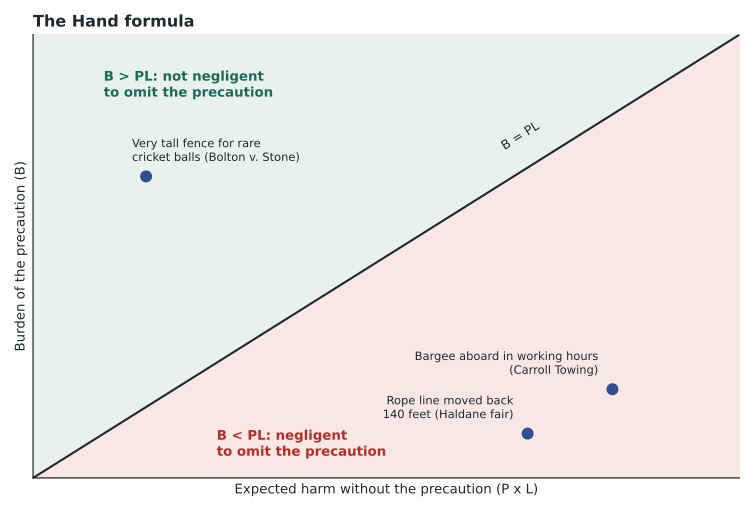
The Hand formula is a way of thinking, not a calculation juries actually perform. Courts rarely have numbers for P, L and B. But the logic explains many cases. In Bolton v. Stone, [1951] A.C. 850, a cricket ball was hit out of a ground and struck a woman on a quiet street. Balls had left the ground only about six times in thirty years. The House of Lords held that the club was not negligent: the risk was so small that a reasonable person could disregard it. In Adams v. Bullock, 227 N.Y. 208, 125 N.E. 93 (1919), a boy swinging an eight-foot wire on a bridge over a trolley line touched the trolley's overhead wire and was burned. The New York Court of Appeals held the trolley company not negligent, because the accident was extraordinary and insulating the wires or putting the system underground would have been very costly. Where the burden of precaution is small and the risk is serious, by contrast, the failure to take it is negligent.
Critics argue that the formula treats human safety as something to be traded for money, and that juries understandably resist the idea that a company can justify a known risk because preventing it costs more than the expected damages. Brenneman tells the class that defense lawyers rarely argue the formula explicitly to juries for exactly that reason. In practice the argument is framed as reasonableness: the precaution was impractical, the risk was remote, or the defendant did what a careful company would do.
Custom
Evidence that a defendant followed, or departed from, the customary practice in an industry is relevant to breach but not conclusive. The leading case is The T.J. Hooper, 60 F.2d 737 (2d Cir. 1932). Two tugboats towing coal barges ran into a storm and lost the barges. They did not carry radio receivers that would have picked up weather warnings. Most tugs at the time did not carry radios. Judge Hand held the tug owners negligent anyway, writing that a whole calling may have unduly lagged in adopting new and available devices, and that courts must in the end say what is required. Compliance with custom is evidence of reasonable care because it reflects the experience of many actors, but an entire industry can be careless.
Departure from custom is usually strong evidence of negligence, because it suggests the defendant failed to take precautions others found practical. If most ride operators in the industry replace a particular latch spring every season, Midway Rides' failure to do so will look careless to a jury. Industry standards written by private bodies, such as the ASTM International standards for amusement rides that many states incorporate into ride inspection laws, function the same way: compliance is evidence of care, and violation is evidence of negligence, unless a statute makes the standard binding.
Medical malpractice is the main exception. Because juries cannot evaluate medical judgment on their own, the standard of care for doctors is defined by the customary practice of reasonably competent practitioners, usually proved by expert testimony. A doctor who follows accepted practice, or a practice accepted by a respectable minority of the profession, is generally not negligent. Most states now measure doctors against a national standard of care, at least for board-certified specialists, rather than the older locality rule. One famous outlier, Helling v. Carey, 83 Wash. 2d 514, 519 P.2d 981 (1974), held ophthalmologists negligent for not giving a simple glaucoma test to a patient under forty, even though the profession's standard did not require it; the Washington legislature responded with a statute restoring the professional standard.
Negligence per se
When a statute or regulation prescribes conduct for the protection of others, a court may adopt it as the standard of care in a negligence case. Under the doctrine of negligence per se, an actor is negligent if, without excuse, the actor violates a statute that is designed to protect against the type of accident the actor's conduct causes, and if the accident victim is within the class of persons the statute is designed to protect (Restatement (Third) section 14).
Martin v. Herzog, 228 N.Y. 164, 126 N.E. 814 (1920), is the classic case. A buggy driving at night without lights, as a statute required, collided with a car. Judge Cardozo held that the unexcused omission of the statutory lights was negligence in itself, not merely evidence for the jury to weigh. Because the statute was meant to protect other travelers on the highway, a jury could not treat the buggy driver's violation as reasonable conduct. The jury still had to decide whether the missing lights caused the accident.
Two limits keep the doctrine tied to the statute's purpose. First, the harm must be of the type the statute was meant to prevent. In Gorris v. Scott (1874), a statute required livestock on ships to be kept in pens to prevent the spread of disease; the defendant's unpenned sheep were washed overboard in a storm. The court held that the statute, aimed at disease, did not establish negligence for drowning. Second, the plaintiff must be in the protected class.
Violations can also be excused. In Tedla v. Ellman, 280 N.Y. 124, 19 N.E.2d 987 (1939), pedestrians walked on the right side of a highway, with traffic, in violation of a statute requiring them to walk facing traffic, because traffic on the other side was much heavier. They were struck from behind. The New York Court of Appeals held that the violation was excused, because complying would have exposed them to greater danger, which the statute's own purpose did not demand. The Restatement (Third) section 15 lists excuses: the violation was reasonable because of the actor's incapacity, the actor neither knew nor should have known of the facts requiring compliance, the actor made a reasonable and diligent attempt to comply, the actor was confronted by an emergency, or compliance would involve a greater risk of harm.
States differ on the effect of a violation. In most states, an unexcused violation is negligence as a matter of law. In some, it creates only a presumption of negligence, or is merely evidence of negligence for the jury. Violations of administrative regulations and local ordinances are often treated as evidence of negligence rather than negligence per se. Compliance with a statute, on the other hand, is generally evidence of reasonable care but does not preclude a finding of negligence, because statutes set minimums.
Worked problem
The fireworks code as negligence per se
In Brenneman's hypothetical, the state has adopted NFPA 1123 by regulation, requiring 70 feet of separation per inch of shell diameter between mortars and spectators. Brightfall used 280 feet for six-inch shells instead of 420. Nadia Okoro was struck by burning debris on the lawn 300 feet from the mortars.
Show solution
- Purpose and type of harm: the separation rule exists to protect spectators from debris and burning fragments from malfunctioning shells, exactly what happened.
- Protected class: spectators at the display. Nadia was one.
- Excuse: Brightfall offers none recognized by section 15. Habit and past luck are not excuses.
- Effect: if the state treats violations of safety regulations as negligence per se, breach is established, leaving causation, damages and defenses. If the state treats regulatory violations only as evidence, the jury will still have strong evidence of breach.
Answer: Nadia can likely establish breach through the code violation. Causation is easier than usual too: she was standing inside the zone the code required to be kept clear.
Res ipsa loquitur
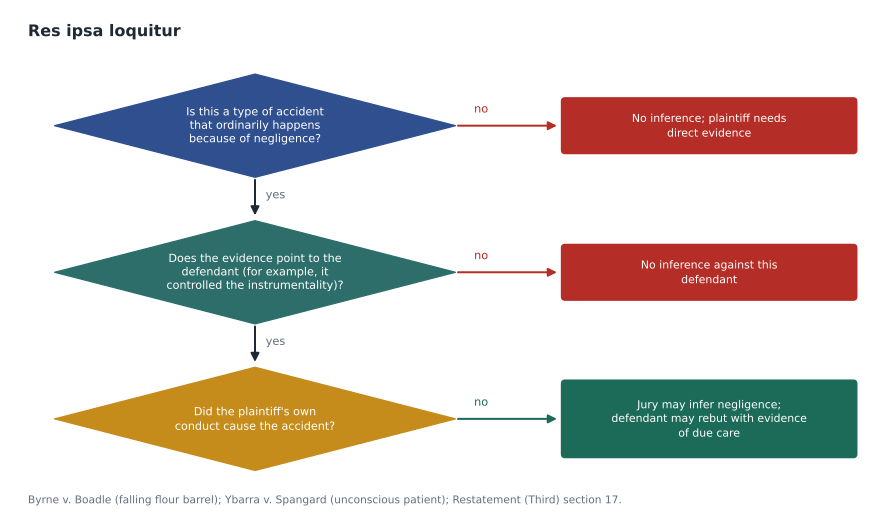
Sometimes the plaintiff cannot show exactly what the defendant did wrong, but the accident itself suggests negligence. The doctrine of res ipsa loquitur ("the thing speaks for itself") allows a jury to infer negligence from the circumstances. It began with Byrne v. Boadle, 2 H. & C. 722, 159 Eng. Rep. 299 (Ex. 1863), in which a barrel of flour fell from a window of the defendant's warehouse onto a man in the street. He could not show why the barrel fell. The court held that barrels do not fall out of windows without negligence, and that the person in control of the warehouse was the one to explain it.
The traditional formulation requires that the event be of a kind that ordinarily does not occur without negligence; that it be caused by an instrumentality within the defendant's exclusive control; and that it not be due to any voluntary action or contribution by the plaintiff. The Restatement (Third) section 17 restates the doctrine more flexibly: the jury may infer negligence when the accident is of a type that ordinarily happens as a result of the negligence of a class of actors of which the defendant is the relevant member. Exclusive control is no longer required as such; it is one way of showing that the defendant, rather than someone else, was probably responsible.
Ybarra v. Spangard, 25 Cal. 2d 486, 154 P.2d 687 (1944), stretched the doctrine. A patient went into surgery for appendicitis and woke with a paralyzed shoulder, an injury unrelated to the operation. He could not identify which of the doctors and nurses who had handled him while unconscious had caused it. The California Supreme Court allowed res ipsa against all of them, reasoning that those in charge of an unconscious patient should have to explain what happened. Ybarra is often explained as a case about the special vulnerability of anesthetized patients and the risk of a conspiracy of silence.
In most states, res ipsa creates a permissible inference: the jury may, but need not, find negligence, and the defendant may offer evidence of due care. A few states give it a stronger effect, shifting the burden of producing evidence to the defendant. Either way, the doctrine gets the plaintiff past summary judgment and to a jury.
Worked problem
Res ipsa and the Whirlwind
Kayla's lap bar opened at the top of the ride's loop. Midway Rides maintained and operated the ride. It says it ran the morning safety checklist. Kayla had not touched the release lever, which is outside riders' reach.
Show solution
- Type of accident: lap bars on properly maintained and operated rides do not ordinarily open mid-ride. An expert can confirm this if a jury would not know it from common experience.
- Responsible actor: Midway Rides owned, maintained and operated the ride and controlled the release mechanism. A defect from the manufacturer is a possibility, which could mean a product claim too, but Midway still had a duty to inspect.
- Plaintiff's conduct: the release lever was out of Kayla's reach, and nothing suggests she caused the opening.
- Effect: the jury may infer that Midway was negligent. Midway can offer its inspection records and testimony, and argue a latent manufacturing defect, but the case goes to the jury.
Answer: Res ipsa likely applies. In discovery, Kayla's lawyer will also seek the inspection logs, maintenance records and state ride inspection reports, which may supply direct evidence of breach and support a claim against the ride's manufacturer.
Proving notice in premises cases
Earlier on the day of the fireworks, a fairgoer named Bev Sandoval slipped on a puddle of melted ice and spilled lemonade near the 4-H barn and broke her wrist. Slip-and-fall cases show a different proof problem. A land possessor is not an insurer; the plaintiff must usually show that the possessor created the dangerous condition, knew of it (actual notice), or should have discovered it through reasonable inspection (constructive notice). Constructive notice usually requires evidence that the condition existed long enough that a reasonable inspection would have found it. Some states, for self-service businesses where spills are foreseeable, apply a mode-of-operation rule that dispenses with proof of notice when the business's method of operation makes such hazards likely. Lesson 5 covers the duties land possessors owe to different entrants.
Summary and key terms
- Breach is judged by the foreseeable likelihood and severity of harm weighed against the burden of precautions (Restatement (Third) section 3).
- The Hand formula (Carroll Towing) says a precaution is required when its burden is less than the probability of harm times the loss.
- Custom is evidence but not conclusive; a whole industry can lag (The T.J. Hooper). Medical malpractice uses professional custom as the standard.
- An unexcused violation of a safety statute is negligence per se if the statute targets the type of harm and protects the plaintiff's class (Martin v. Herzog; Gorris v. Scott; Tedla v. Ellman).
- Res ipsa loquitur permits an inference of negligence when the accident ordinarily results from negligence of a class of actors that includes the defendant (Byrne v. Boadle; Ybarra v. Spangard).
- Premises plaintiffs usually must prove the possessor created, knew of or should have discovered the hazard.
- Hand formula
- The test from Carroll Towing: negligence exists if the burden of precaution is less than the probability of harm multiplied by the gravity of the loss.
- Custom
- The usual practice in a trade or profession, admissible as evidence of the standard of care.
- Negligence per se
- Negligence established by the unexcused violation of a statute designed to protect a class of persons against a type of harm.
- Res ipsa loquitur
- A doctrine allowing a jury to infer negligence from the circumstances of an accident.
- Constructive notice
- Knowledge the law attributes to a person who would have discovered a condition by reasonable inspection.
- Excused violation
- A statutory violation that does not establish negligence because, for example, compliance would have been more dangerous.
- Locality rule
- An older rule measuring a doctor's care by practice in the same or a similar community, now largely replaced by a national standard.
Practice problems
Work each problem on paper first, then reveal the answer to check.
A city ordinance requires dog owners to keep dogs on leashes to prevent dog bites. An unleashed dog runs into the street and causes a bicyclist to swerve and fall. Can the bicyclist use negligence per se?
Show answer
Possibly, but the defendant will argue that the ordinance targeted bites, not traffic accidents. Many courts read leash laws as protecting against a broader range of harms caused by loose dogs, but the type-of-harm requirement is the battleground.
Why did Judge Hand hold the tugboat owners negligent in The T.J. Hooper even though most tugs did not carry radios?
Show answer
Because the precaution was cheap and effective, and an entire industry can lag behind what reasonable care requires. Custom is evidence of care, not a conclusive standard.
A shopper is hit by a falling can from a high shelf in a crowded store where customers handle stock. Does res ipsa apply against the store?
Show answer
It is contested. Cans do not usually fall without someone's negligence, but customers also handle the stock, so the evidence may not point to the store rather than another customer. Under the Restatement (Third) approach, the question is whether the store is probably the responsible actor.
What is the usual effect of res ipsa loquitur in most states?
Show answer
A permissible inference of negligence: it lets the case reach the jury, which may, but need not, find negligence.
Lesson quiz · 5 questions
Score 60% or more to complete this lesson.
Create a free account to save your progress, take quizzes and earn a certificate.