
LAWU-103 · Lesson 11 of 12 · 22 min
Defamation and privacy
▶ Video coming soon A video version of this lesson is on the way.
The morning after the fair, Sunday, August 23, 2026, the Haldane Ledger, a small local news website, posted a photo of Dwayne Pruitt leading Theo Garza across the midway by the arm. The headline read "Teen caught stealing at fair." The short article said that a security source told the Ledger that the boy had been caught taking merchandise from a vendor. It did not name Theo, but the photo showed his face clearly, and by noon classmates had shared it hundreds of times. The same morning, Kim Sorensen, the vendor who had accused him, wrote on her booth's Facebook page: "Thanks to the fair security for catching the kid who stole from us last night. Parents, teach your kids not to steal!" Theo had a receipt for the phone case. His mother, Elena, asked both the Ledger and Sorensen to take the posts down; the Ledger ran a correction a week later.
Professor Brenneman uses these posts to introduce the dignitary torts: defamation, which protects reputation, and the privacy torts, which protect a person's control over information and image. "These torts are different from everything else in the course," he says. "The harm is to reputation and dignity, not to the body or property. And the defendant's conduct is usually speech, which means the Constitution has a lot to say."
The common law of defamation
Defamation is the publication of a false and defamatory statement of fact about the plaintiff to a third person, causing harm to the plaintiff's reputation. The Restatement (Second) section 558 lists the elements: a false and defamatory statement concerning another; an unprivileged publication to a third party; fault amounting at least to negligence on the part of the publisher; and either actionability of the statement irrespective of special harm or the existence of special harm caused by the publication. Each element has its own doctrine.
A statement is defamatory if it tends to harm the plaintiff's reputation so as to lower him in the estimation of the community or deter third persons from associating or dealing with him. Saying that someone committed a crime is the classic example. The statement must be of and concerning the plaintiff, meaning that a reasonable reader would understand it to refer to him; the Ledger article did not name Theo, but the photo identified him to anyone who knew him, which is enough. The statement must be published, meaning communicated to at least one person other than the plaintiff. And every person who repeats a defamatory statement is generally treated as a publisher; it is no defense for the Ledger that it was quoting a security source.
Libel and slander
The common law distinguishes libel, defamation in written or other fixed form, from slander, spoken defamation. Libel is actionable without proof of special harm; damages to reputation are presumed. Slander requires proof of special harm, meaning specific economic loss, unless it falls into one of four categories of slander per se: imputing a serious crime, imputing a loathsome disease, statements injurious to a person's business, trade or profession, and imputing serious sexual misconduct. Broadcasts and internet posts are generally treated as libel. Both posts about Theo, being written and accusing him of theft, would be actionable without proof of specific economic loss under the common law rules, though constitutional rules limit presumed damages, as discussed below.
Truth, opinion and privileges
Truth is a complete defense, and substantial truth is enough: minor inaccuracies do not matter if the gist of the statement is true. Because Theo did not steal, the gist of both posts was false.
Statements of pure opinion cannot be defamatory, because they cannot be proved true or false. But labeling a statement as opinion does not protect it if it implies false facts. In Milkovich v. Lorain Journal Co., 497 U.S. 1 (1990), a newspaper column suggested that a high school wrestling coach had lied under oath at a hearing. The Supreme Court held that there is no wholesale constitutional exemption for anything labeled opinion; the question is whether the statement is sufficiently factual to be proved true or false. "In my opinion, he is a thief" implies facts as surely as "he is a thief."
Some statements are privileged. Absolute privileges protect statements made in judicial proceedings by judges, lawyers, parties and witnesses; in legislative proceedings; and by high executive officials in the course of their duties. Qualified, or conditional, privileges protect statements made to protect a legitimate interest of the speaker or the recipient, such as an employer's reference to a prospective employer or a report to the police, so long as the privilege is not abused by knowing falsity, reckless disregard or excessive publication. The fair report privilege protects accurate and fair reports of official proceedings and public records. Pruitt's report to the fair office about suspecting Theo might be conditionally privileged; the Ledger's report, based on an unnamed source rather than an official record, would not be covered by the fair report privilege.
The constitutional overlay
Until 1964, defamation was a strict liability tort in most states: a publisher who printed a false defamatory statement was liable even if it took every care to get the story right. The Supreme Court then held that the First Amendment requires much more.
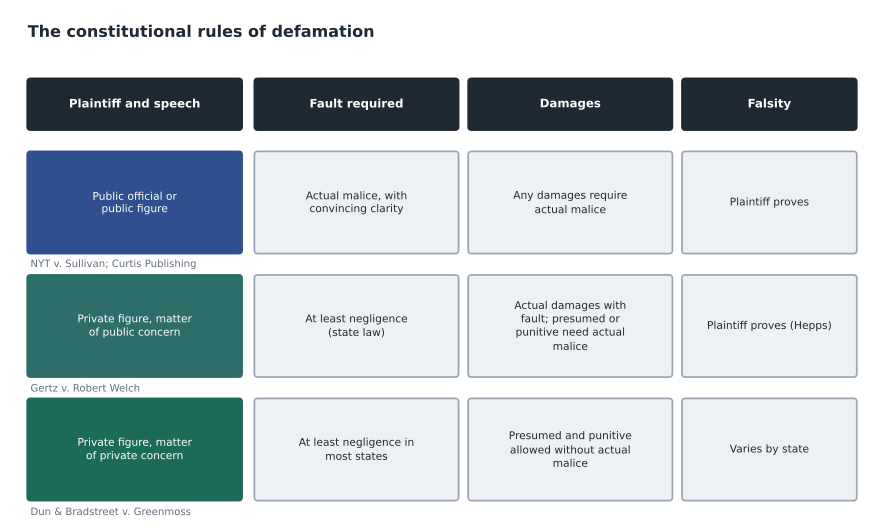
New York Times Co. v. Sullivan, 376 U.S. 254 (1964), arose from the civil rights movement. An advertisement in the New York Times, placed by supporters of Martin Luther King Jr., described police actions against protesters in Montgomery, Alabama, with some minor factual errors. L.B. Sullivan, a Montgomery city commissioner who supervised the police, sued for libel and won 500,000 dollars in an Alabama court. The Supreme Court reversed. It held that a public official may not recover damages for a defamatory falsehood relating to his official conduct unless he proves that the statement was made with actual malice, that is, with knowledge that it was false or with reckless disregard of whether it was false. The Court emphasized the country's profound commitment to the principle that debate on public issues should be uninhibited, robust and wide-open, and recognized that erroneous statement is inevitable in free debate. Actual malice must be shown with convincing clarity, and it means subjective awareness of probable falsity, not ill will; in St. Amant v. Thompson, 390 U.S. 727 (1968), the Court said reckless disregard requires evidence that the defendant in fact entertained serious doubts as to the truth of the publication.
The actual malice rule was extended to public figures, people who have achieved pervasive fame or who have voluntarily thrust themselves into a particular public controversy, in Curtis Publishing Co. v. Butts, 388 U.S. 130 (1967), and its companion case.
Private figures
In Gertz v. Robert Welch, Inc., 418 U.S. 323 (1974), the Court addressed private figures. A magazine falsely described Elmer Gertz, a Chicago lawyer representing the family of a young man killed by a police officer, as a Communist-fronter who had helped frame the officer. The Court held that Gertz was a private figure, not a public figure, even though he was well known in some circles. It reasoned that private individuals have less access to the media to rebut falsehoods and have not voluntarily exposed themselves to scrutiny. States may therefore set their own standard of liability for defamation of private figures, so long as they do not impose liability without fault. Most states require negligence. But a private figure suing on a matter of public concern may not recover presumed or punitive damages without proving actual malice; with only negligence, the plaintiff recovers for actual injury, which the Court said includes impairment of reputation, personal humiliation and mental anguish.
Two later cases refined Gertz. In Dun & Bradstreet, Inc. v. Greenmoss Builders, Inc., 472 U.S. 749 (1985), the Court held that when a private figure sues over speech on a matter of purely private concern, here a false credit report sent to a few subscribers, presumed and punitive damages may be awarded without actual malice. And in Philadelphia Newspapers, Inc. v. Hepps, 475 U.S. 767 (1986), the Court held that a private-figure plaintiff suing a media defendant over speech of public concern bears the burden of proving falsity, reversing the common law presumption that defamatory statements are false.
Calls to reconsider New York Times v. Sullivan have grown louder in recent years. Justice Clarence Thomas, beginning with a concurrence in McKee v. Cosby (2019), and Justice Neil Gorsuch, dissenting from the denial of review in Berisha v. Lawson (2021), have questioned whether the actual malice rule is consistent with the original meaning of the First Amendment and suited to the modern media environment. But the Court has declined invitations to revisit the rule, most recently denying review in a case brought by casino developer Steve Wynn against the Associated Press in March 2025, and the rule remains settled law.
Worked problem
Theo's defamation claims
The Ledger's article and Sorensen's post both said, falsely, that Theo had stolen. Theo is a 16-year-old high school student with no public role. The Ledger relied on an unnamed security source and did not contact Theo, his family or the police before publishing. Sorensen wrote her post knowing that Theo's mother had shown fair officials a receipt the night before.
Show solution
- Defamatory statement of fact: accusing someone of theft is defamatory and a statement of fact, not opinion.
- Of and concerning: the photo identified Theo to anyone who knew him.
- Plaintiff's status: Theo is a private figure; he did not thrust himself into any controversy. Theft at a county fair is arguably a matter of public concern, so Gertz applies to the Ledger.
- Fault: for actual damages, Theo must prove at least negligence. Publishing an accusation of crime against an identifiable minor on the word of one unnamed source, without checking, is likely negligent. To recover presumed or punitive damages, he must prove actual malice, which is harder against the Ledger.
- Sorensen: she posted after learning of the receipt. If she knew or seriously doubted that Theo had stolen, she acted with actual malice, which opens the door to presumed and punitive damages against her.
Answer: Theo has viable defamation claims against both, stronger against Sorensen because the evidence suggests she knew or recklessly disregarded the truth. The Ledger's correction may reduce damages and, in states with retraction statutes, may limit the damages Theo can recover from it.
Online platforms and procedural protections
Theo cannot sue Facebook for hosting Sorensen's post. Section 230 of the Communications Decency Act, 47 U.S.C. section 230(c)(1), provides that no provider or user of an interactive computer service shall be treated as the publisher or speaker of information provided by another information content provider. In Zeran v. America Online, Inc., 129 F.3d 327 (4th Cir. 1997), the Fourth Circuit held that the statute bars defamation claims against online services for content posted by their users, even after the service is notified that the content is false. Sorensen, who wrote the post, remains liable; section 230 protects platforms, not the people who create the content.
Many states have anti-SLAPP statutes (SLAPP stands for strategic lawsuit against public participation) that allow defendants sued over speech on public issues to seek early dismissal, often with an award of attorney's fees, unless the plaintiff shows a probability of prevailing. A number of states have adopted the Uniform Public Expression Protection Act, a model anti-SLAPP law approved in 2020. Some states also have retraction statutes that limit damages against publishers who promptly correct false statements on request. And the Restatement (Third) of Torts: Defamation and Privacy is still being drafted by the American Law Institute, so the Second Restatement remains the main secondary source.
The privacy torts
In 1890, Samuel Warren and Louis Brandeis published an article in the Harvard Law Review titled "The Right to Privacy," arguing that the common law should protect the right to be let alone. Seventy years later, William Prosser surveyed the cases that followed and concluded that privacy was not one tort but four. The Restatement (Second) sections 652A to 652E adopted his classification.
- Intrusion upon seclusion: intentionally intruding, physically or otherwise, upon the solitude or seclusion of another or his private affairs, in a way that would be highly offensive to a reasonable person. Wiretapping, hidden cameras in bathrooms and persistent surveillance are examples. No publication is required.
- Appropriation of name or likeness: using another's name or likeness for one's own benefit, usually commercial. Many states have statutes protecting the right of publicity, which lets people, especially celebrities, control commercial use of their identity.
- Public disclosure of private facts: giving publicity to a matter concerning the private life of another that would be highly offensive to a reasonable person and is not of legitimate concern to the public. Truth is not a defense; the point is that the facts are private. Newsworthiness is a strong defense.
- False light: giving publicity to a matter that places another before the public in a false light that would be highly offensive to a reasonable person, with knowledge or reckless disregard of the falsity. False light overlaps with defamation, and several states, including Florida in Jews for Jesus, Inc. v. Rapp, 997 So. 2d 1098 (Fla. 2008), and Texas in Cain v. Hearst Corp., 878 S.W.2d 577 (Tex. 1994), have refused to recognize it for that reason.
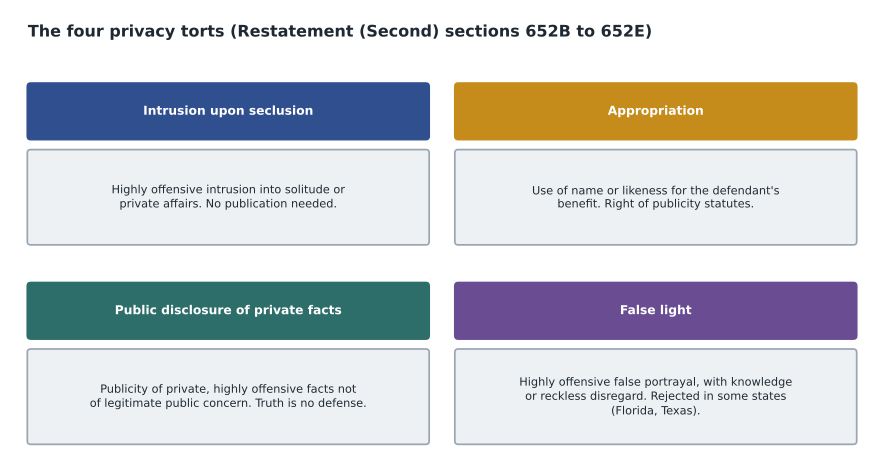
Applied to the Ledger's photo, the privacy torts add little to Theo's defamation claims. The photo was taken in a public place, which defeats intrusion. The Ledger did not use Theo's image to sell a product, which defeats appropriation. The fact that he was detained was not private. False light might apply, in states that recognize it, but would require the same proof of falsity and, under the constitutional cases, likely actual malice for a matter of public concern.
Brenneman closes by noting that privacy law is now shaped as much by statutes as by torts: federal laws on health and financial records, state data breach laws, biometric privacy statutes like Illinois's, which allows private suits, and comprehensive consumer privacy laws in a growing number of states. "The four torts were built for newspapers and photographers," he says. "Much of the privacy law you will practice was written for databases."
Summary and key terms
- Defamation requires a false, defamatory statement of fact about the plaintiff, published to a third party, with fault and, for some slander, special harm.
- Libel is actionable without special harm; slander requires it unless it is slander per se (crime, loathsome disease, business or profession, sexual misconduct).
- Truth and substantial truth are complete defenses; opinions that imply false facts are not protected (Milkovich); absolute and qualified privileges protect some statements.
- Public officials and public figures must prove actual malice (New York Times v. Sullivan; Curtis Publishing); private figures need at least negligence, and actual malice for presumed or punitive damages on public matters (Gertz).
- Dun & Bradstreet relaxes the rules for purely private speech; Hepps puts the burden of proving falsity on plaintiffs in public-concern cases; section 230 protects platforms from liability for users' posts (Zeran).
- The four privacy torts are intrusion, appropriation, public disclosure of private facts and false light, which some states reject.
- Defamation
- A false statement of fact that harms another's reputation, published to a third person.
- Libel
- Defamation in written or other fixed form.
- Slander
- Spoken defamation.
- Slander per se
- Categories of slander actionable without proof of special harm.
- Actual malice
- Knowledge of falsity or reckless disregard of the truth.
- Public figure
- A person with pervasive fame or who voluntarily entered a public controversy.
- Qualified privilege
- A conditional protection for statements serving a legitimate interest, lost if abused.
- Section 230
- The federal statute protecting online services from being treated as publishers of users' content.
- False light
- A privacy tort for highly offensive false portrayals, not recognized in every state.
Practice problems
Work each problem on paper first, then reveal the answer to check.
A coworker tells the boss, falsely, that a colleague has been stealing office supplies. Is this slander, and must the colleague prove economic loss?
Show answer
It is slander, but it is slander per se because it imputes a crime and harms the colleague in her profession, so special harm need not be proved. The coworker may claim a qualified privilege for reports to an employer, which is lost if she knew the statement was false or acted recklessly.
A well-known mayor sues a newspaper that falsely reported he took bribes. What must he prove?
Show answer
Actual malice: that the newspaper knew the report was false or published it with reckless disregard, meaning it had serious doubts about its truth, proved with convincing clarity (New York Times v. Sullivan).
Why can't Theo sue Facebook over Sorensen's post?
Show answer
Section 230 provides that an online service may not be treated as the publisher of content provided by another; Zeran applied it to defamation claims even after notice. Sorensen herself remains liable.
A magazine accurately reports a private citizen's past psychiatric treatment, which has no connection to any public issue. Which tort may apply?
Show answer
Public disclosure of private facts, if the publicity would be highly offensive to a reasonable person and the matter is not of legitimate public concern. Truth is not a defense to this tort.
Lesson quiz · 5 questions
Score 60% or more to complete this lesson.
Create a free account to save your progress, take quizzes and earn a certificate.