
LAWU-103 · Lesson 7 of 12 · 21 min
Proximate cause
▶ Video coming soon A video version of this lesson is on the way.
Cause in fact casts a wide net. Every harm has countless but-for causes, stretching back indefinitely. The fire that burned the Pedersen barn would not have happened but for Brightfall's low-bursting shell, but also not but for the Agricultural Society's decision to hold a fireworks show, the county's decision to build a fairground, and the invention of fireworks in medieval China. "The law has to draw a line somewhere," Professor Brenneman says. "Proximate cause is where it draws it." This lesson covers the doctrines courts use to decide which harms are close enough to the defendant's negligence to count.
The Restatement (Third) renames the concept scope of liability, to make clear that the question is not really about causation at all but about the extent of responsibility. Its central rule, in section 29, is that an actor's liability is limited to those harms that result from the risks that made the actor's conduct tortious. This is called the risk standard, and most modern proximate cause doctrine can be understood through it.
Direct consequences and foreseeability
Two competing tests dominated proximate cause for much of the twentieth century. The first, the directness test, held a negligent defendant liable for all the direct consequences of the negligence, foreseeable or not. In In re Polemis & Furness, Withy & Co., [1921] 3 K.B. 560, workers unloading a ship carelessly let a plank fall into the hold, where it struck something and caused a spark that ignited petrol vapor and destroyed the ship. No one could have foreseen that a falling plank would cause a fire. The English Court of Appeal held the charterers liable anyway, because the fire was a direct result of the negligent act.
Forty years later the Privy Council rejected Polemis in Overseas Tankship (U.K.) Ltd. v. Morts Dock & Engineering Co. (The Wagon Mound No. 1), [1961] A.C. 388. A ship's crew negligently spilled fuel oil into Sydney Harbor, and it drifted under a wharf where workers were welding. The wharf owner, after being assured that the oil would not ignite on water, let the welding continue. Molten metal fell on floating cotton waste, which ignited the oil, and the wharf burned. Evidence showed that the oil was very difficult to ignite on water, so fire damage was not reasonably foreseeable, although fouling of the wharf by oil was. The Privy Council held that the defendant was liable only for damage of a kind that was reasonably foreseeable. It reasoned that it would be unjust to hold a defendant responsible for unforeseeable consequences simply because they were direct, while excusing it for foreseeable ones that were indirect.
American courts generally follow a foreseeability or risk approach today. But foreseeability is applied at a level of generality that matters. Courts ask whether the type of harm, not its precise manner or extent, was foreseeable.
Manner and extent of harm
Hughes v. Lord Advocate, [1963] A.C. 837, illustrates the manner rule. Workmen left an open manhole in an Edinburgh street, surrounded by a tent and paraffin warning lamps, while they took a break. Two boys took one of the lamps into the manhole, knocked it over and caused an unexpected explosion of vaporized paraffin; one boy fell in and was badly burned. The House of Lords held the workmen liable. Burns from the lamp were a foreseeable type of harm; that they came from an explosion rather than an ordinary fire was only the manner, which need not be foreseeable. Contrast Doughty v. Turner Manufacturing Co., [1964] 1 Q.B. 518, where a worker accidentally knocked an asbestos-cement cover into a vat of molten metal. A splash would have been foreseeable, but the cover caused an unexpected chemical reaction and eruption that burned a nearby worker. The court held the employer not liable, treating the eruption as a different kind of risk. The two cases are hard to reconcile, which shows how much turns on how the risk is described.
The extent of harm need not be foreseeable. The eggshell plaintiff rule from Vosburg v. Putney in Lesson 1 applies in negligence too: once the defendant negligently causes some physical harm, it is liable for the full extent of the harm, even if the plaintiff's preexisting condition made it far worse than anyone could expect. In Benn v. Thomas, 512 N.W.2d 537 (Iowa 1994), a man with a heart condition suffered a bruised chest and fractured ankle in a minor rear-end collision and died of a heart attack six days later. The Iowa Supreme Court held that the jury should have been instructed on the eggshell plaintiff rule, so the driver could be liable for the death. For Harold Lindgren, the 71-year-old fairgoer knocked down by the loose steer, the rule means that if a younger person would have only been bruised but Harold suffered a broken hip because of osteoporosis, the responsible defendant pays for the hip.
Palsgraf and the unforeseeable plaintiff
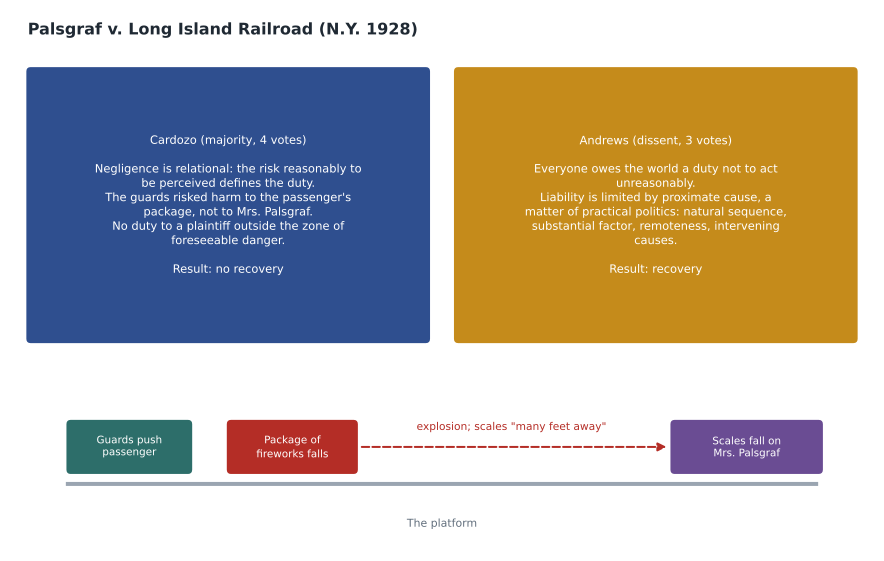
The most famous case in American tort law is about proximate cause, or duty, depending on whose opinion you read. In Palsgraf v. Long Island Railroad Co., 248 N.Y. 339, 162 N.E. 99 (1928), a man carrying a small package wrapped in newspaper ran to board a train that was already moving. Two railroad guards, one on the train and one on the platform, helped push and pull him aboard. The package fell onto the rails. It contained fireworks, which exploded. The shock of the explosion, the court said, threw down some scales at the other end of the platform, many feet away, which struck Helen Palsgraf. Nothing about the package suggested that it contained explosives.
Chief Judge Benjamin Cardozo, writing for a four-to-three majority, held that Mrs. Palsgraf could not recover. The guards' conduct, if negligent at all, was negligent only toward the man with the package, whose property they risked damaging. It was not negligent toward Mrs. Palsgraf, because no hazard to her was apparent to the eye of ordinary vigilance. Negligence, Cardozo wrote, is a relational concept: the risk reasonably to be perceived defines the duty to be obeyed, and risk imports relation. A plaintiff must show a wrong to herself, not merely a wrong to someone else. On this view, Palsgraf is a duty case: the railroad owed no duty to an unforeseeable plaintiff outside the zone of foreseeable danger.
Judge William Andrews, dissenting, argued that everyone owes the world at large a duty to refrain from acts that unreasonably threaten the safety of others. When such an act occurs, the actor is liable to anyone injured by it, subject to a limit drawn by proximate cause, which he described as a matter of practical politics and expediency. He listed factors: whether there was a natural and continuous sequence between cause and effect, whether the act was a substantial factor in producing the result, whether the result was too remote in time and space, and whether there were intervening causes. On the facts, he would have let Mrs. Palsgraf recover.
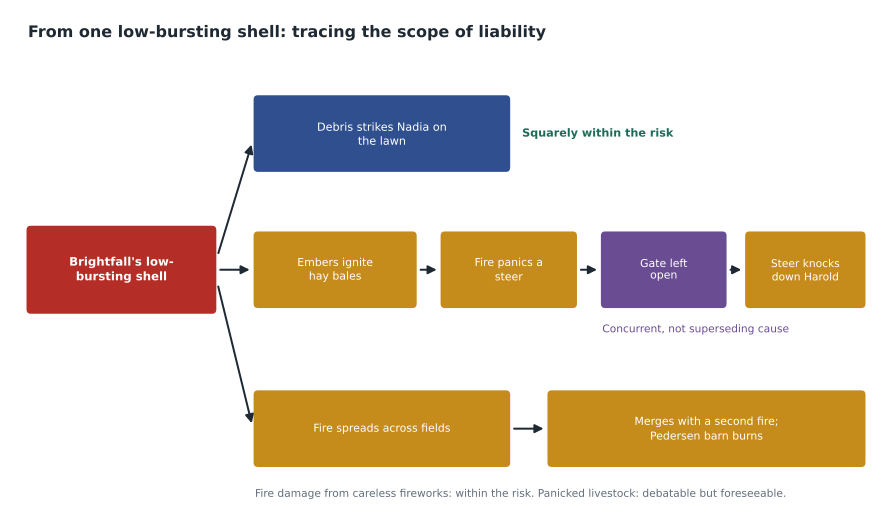
Brenneman points out the irony that Section B cannot miss: the package in Palsgraf contained fireworks. The case nearly a century later still frames the question about the fair. Was the risk of the low-bursting shell a risk to people like Nadia on the lawn? Obviously. Was it a risk to the Pedersens' barn half a mile away? Less obviously, but fire spreading from burning debris into dry hay and fields in August is the kind of harm that makes careless fireworks dangerous. Most courts today follow neither opinion wholesale. They treat the unforeseeable-plaintiff problem as part of proximate cause or scope of liability, and they ask, as Cardozo did, whether the plaintiff's harm was within the risks that made the conduct negligent.
Intervening and superseding causes
Many proximate cause cases involve a second event, often the act of another person, that intervenes between the defendant's negligence and the harm. An intervening cause that relieves the defendant of liability is called a superseding cause. Modern courts ask whether the intervening act was a foreseeable consequence of the risk the defendant created. If it was, the defendant remains liable; if it was extraordinary, the defendant may be relieved.
Derdiarian v. Felix Contracting Corp., 51 N.Y.2d 308, 434 N.Y.S.2d 166 (1980), is a leading example. A construction company working on a road failed to set up a proper barrier around its work site. A driver who had an epileptic seizure because he had not taken his medication crashed into the site and struck a worker, Derdiarian, splashing him with boiling enamel. The contractor argued that the driver's negligence was a superseding cause. The New York Court of Appeals disagreed: the very risk that made the lack of a barrier negligent was that a car would enter the work area and injure a worker. That the driver lost control because of a seizure rather than carelessness did not make the event unforeseeable.
Criminal acts by third parties can be superseding, but often are not when the defendant's negligence created the very opportunity for them. In Watson v. Kentucky & Indiana Bridge & Railroad Co., 137 Ky. 619, 126 S.W. 146 (1910), a railroad negligently spilled gasoline in a street, and a man dropped a lit match into it. The Kentucky court held that if the man dropped the match carelessly, the railroad remained liable, because careless handling of a match near spilled gasoline was foreseeable; but if he threw it intending to cause an explosion, as some evidence suggested, the malicious act was a superseding cause. Modern courts are more willing than the Watson court to hold defendants liable for foreseeable crimes, such as a landlord who fails to fix broken locks in a building where burglaries are common.
Rescuers
Rescue efforts are classic foreseeable intervening events. In Wagner v. International Railway Co., 232 N.Y. 176, 133 N.E. 437 (1921), a passenger was thrown from a train on a high trestle because of the railroad's negligence, and his cousin went looking for him along the trestle in the dark, fell and was injured. Cardozo, writing for the New York Court of Appeals, held that the railroad was liable to the rescuer: danger invites rescue, the cry of distress is the summons to relief, and the law recognizes the normal reaction of normal people. A rescuer can recover from the person whose negligence created the peril, unless the rescue attempt was reckless. Many states, however, limit recovery by professional rescuers, such as firefighters and police, against those whose negligence created the emergency they were paid to address. This firefighter's rule has been abolished or narrowed by statute in some states.
Worked problem
The loose steer and Harold Lindgren
When the hay by the livestock barn caught fire, the smoke and noise panicked a 1,300-pound show steer tied in the barn. The steer pulled free, ran through an open gate and knocked down Harold Lindgren, 71, who was walking to the parking lot. Harold broke his hip. A volunteer had left the gate open earlier in the evening, against fair rules.
Show solution
- Cause in fact: but for the fire, the steer would not have panicked; but for the open gate, it would not have reached the walkway.
- Scope of the risk created by Brightfall: careless fireworks create risks of fire, and fires near livestock foreseeably panic animals that injure people. The harm is within the risk, though Brightfall will argue it is remote.
- Intervening cause: the volunteer's leaving the gate open was negligent but not extraordinary; open gates at a fair are foreseeable. It is a concurrent cause, not a superseding one, and it gives Harold a claim against the Agricultural Society for the volunteer's negligence.
- Extent: Harold's osteoporosis made the injury worse, but the eggshell plaintiff rule makes the responsible defendants liable for the full harm.
Answer: Harold likely has claims against both Brightfall and the Agricultural Society. Neither the panicked steer nor the open gate is a superseding cause. The defendants' relative fault will be apportioned under the rules in Lesson 8.
Proximate cause as a jury question
Proximate cause is usually a question of fact for the jury, decided under instructions that ask whether the harm was a foreseeable result of the defendant's negligence or within the scope of the risk it created. Judges decide it as a matter of law only when reasonable people could reach only one conclusion. That means much of the debate in Palsgraf and the other classic cases plays out today in arguments about jury instructions and motions for summary judgment rather than in appellate pronouncements.
Priya Natarajan asks whether proximate cause is just a way for judges to cut off liability when it seems unfair. Brenneman agrees that it often looks that way, and says that Andrews was candid about it: proximate cause is a policy judgment about how far liability should extend. The Restatement (Third)'s risk standard tries to make that judgment more principled by tying it to the reasons the conduct was negligent in the first place. "Ask why the conduct was careless," he says. "Then ask whether this harm is one of the reasons. If it is, the defendant pays."
Summary and key terms
- Proximate cause, or scope of liability, limits liability to harms that result from the risks that made the conduct tortious (Restatement (Third) section 29).
- Polemis held defendants liable for all direct consequences; The Wagon Mound No. 1 limited liability to foreseeable kinds of harm, the view most courts now follow.
- The type of harm must be foreseeable, but not its precise manner (Hughes v. Lord Advocate) or its extent (the eggshell plaintiff rule; Benn v. Thomas).
- In Palsgraf, Cardozo treated the unforeseeable plaintiff as a no-duty problem; Andrews would have found duty to all and limited liability through proximate cause.
- Intervening acts are superseding only if extraordinary; foreseeable ones, including many crimes and rescues, do not cut off liability (Derdiarian; Watson; Wagner).
- Proximate cause is usually a jury question.
- Proximate cause
- The legal limit on liability for harms that are too remote from the defendant's negligence.
- Scope of liability
- The Restatement (Third)'s term for proximate cause.
- Risk standard
- The rule that liability extends to harms resulting from the risks that made the conduct tortious.
- Directness test
- The Polemis rule imposing liability for all direct consequences of negligence.
- Intervening cause
- An event occurring after the defendant's negligence that contributes to the harm.
- Superseding cause
- An intervening cause so extraordinary that it relieves the defendant of liability.
- Rescue doctrine
- The rule that a negligent defendant is liable to those injured while trying to rescue people the defendant endangered.
- Firefighter's rule
- A rule limiting professional rescuers' recovery from those whose negligence created the emergency.
Practice problems
Work each problem on paper first, then reveal the answer to check.
A driver negligently runs over a fire hydrant. Water floods a basement two blocks away and ruins a stored piano. Under the Wagon Mound approach, is the driver liable for the piano?
Show answer
Likely yes. Flooding is a foreseeable kind of harm from breaking a hydrant, even if the exact path of the water and the piano were not foreseen. The manner and extent need not be foreseeable.
A store negligently leaves a ladder unsecured. A thief uses it to climb into a neighbor's apartment and steal jewelry. Is the theft a superseding cause?
Show answer
It depends on foreseeability. If break-ins in the area were common and an unsecured ladder made them easier, the theft was within the risk and not superseding. If the risk created by the ladder was only that someone would trip over it, the theft is outside the risk.
How would Cardozo and Andrews each analyze a plaintiff injured far from the scene of a negligent act?
Show answer
Cardozo asks whether the defendant's conduct posed a foreseeable risk to the plaintiff; if not, there was no duty to her. Andrews finds duty to everyone and asks whether the harm is too remote under practical factors of proximate cause.
A bystander dives into a river to save a child who fell in because of a negligently maintained railing and is injured. Can the bystander sue the railing's owner?
Show answer
Yes, under the rescue doctrine (Wagner). Danger invites rescue, and the rescuer's injury is within the scope of the risk the owner created, unless the rescue was reckless.
Lesson quiz · 5 questions
Score 60% or more to complete this lesson.
Create a free account to save your progress, take quizzes and earn a certificate.