
LAWU-103 · Lesson 6 of 12 · 23 min
Cause in fact
▶ Video coming soon A video version of this lesson is on the way.
A defendant can be careless without being liable. The plaintiff must also prove that the carelessness caused the harm. Professor Brenneman splits causation into two questions, as most courts do. Cause in fact asks whether the defendant's negligence actually contributed to the harm. Proximate cause, the subject of Lesson 7, asks whether the harm was the kind of harm for which the law should hold the defendant responsible. "The first is a question about the world," he tells Section B. "The second is a question about policy. Keep them apart, and half your causation problems become easy."
The but-for test
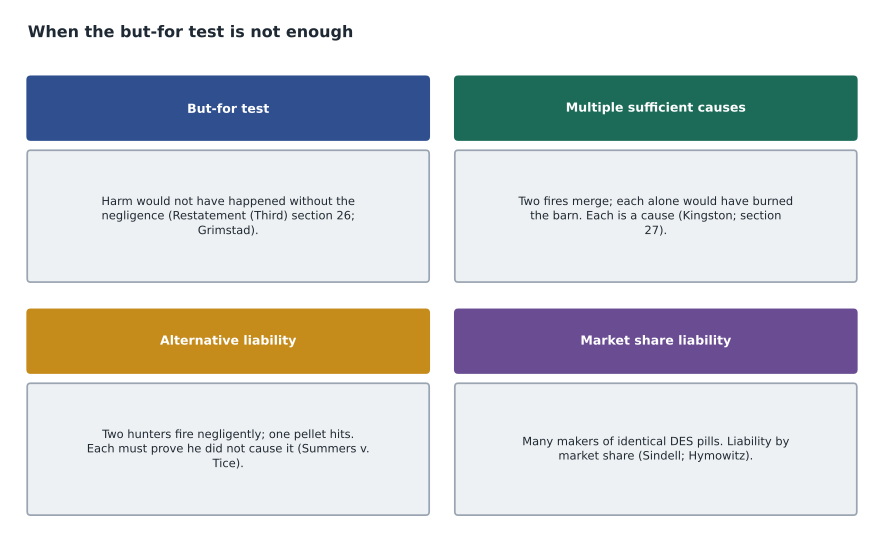
The basic test for cause in fact is the but-for test: the defendant's conduct is a factual cause of the harm if the harm would not have occurred but for the conduct. The Restatement (Third) section 26 adopts this test: tortious conduct must be a factual cause of harm for liability to be imposed, and conduct is a factual cause of harm when the harm would not have occurred absent the conduct.
The test requires the fact-finder to imagine a counterfactual world in which the defendant behaved reasonably and to ask whether the harm would still have happened. In New York Central Railroad v. Grimstad, 264 F. 334 (2d Cir. 1920), a barge captain fell overboard and drowned. His widow argued that the barge owner was negligent for not keeping a life buoy on board. The Second Circuit reversed her verdict: no one could say that a buoy would have saved him, since he could not swim, and his wife had gone for a line and returned too late. Without evidence that the precaution would have made a difference, the jury could only speculate. Brenneman notes that many courts today might let such a case go to a jury, depending on the evidence about rescue time, but Grimstad shows what the plaintiff must prove.
The plaintiff must prove causation by a preponderance of the evidence: more likely than not, the harm would not have happened without the negligence. Circumstantial evidence is enough. In Reynolds v. Texas & Pacific Railway, 37 La. Ann. 694 (1885), an overweight passenger hurrying for a train fell on an unlit stairway. The railroad argued she might have fallen even in good light. The Louisiana court held that where the negligence greatly multiplies the chances of the accident and is of a character naturally leading to its occurrence, the mere possibility that it might have happened anyway does not break the causal connection.
Worked problem
The empty extinguisher at the food stand
When the propane regulator on a grill at Smoky Joe's food stand failed, a flash fire burned employee Luis Ortega's arms. The stand's fire extinguisher, which fair rules required, had not been recharged after an earlier use, and was empty. A coworker grabbed it within seconds and nothing came out. Luis's burns worsened while another worker ran to a neighboring stand for a second extinguisher.
Show solution
- Negligence: keeping an empty extinguisher at a cooking stand is careless, and violated the fair's vendor rules.
- Counterfactual: if the extinguisher had worked, would Luis's injuries have been less severe? Expert testimony about burn depth and exposure time can answer that.
- Scope of the claim: the empty extinguisher did not cause the flash fire; the regulator did. So the employer's negligence is a factual cause only of the additional harm from the delay.
- Luis's claim against his employer will probably be barred by workers' compensation exclusivity, so the causation analysis matters most for his product claim against the regulator's maker (Lesson 10) and for apportioning fault.
Answer: The empty extinguisher was a but-for cause of the incremental injury from the delay, not of the initial burns. Separating the two will require medical evidence.
Proving causation with scientific evidence
Causation is often a scientific question: did the drug cause the birth defect, did the chemical cause the cancer, did the delay in diagnosis cause the death? Such questions require expert testimony, and courts act as gatekeepers. Under Daubert v. Merrell Dow Pharmaceuticals, Inc., 509 U.S. 579 (1993), and Federal Rule of Evidence 702, a federal judge must determine that expert testimony is based on sufficient facts and reliable methods reliably applied. Rule 702 was amended effective December 1, 2023, to make clear that the party offering the expert must show these requirements are met by a preponderance of the evidence. Most states follow Daubert or a similar test; some still use the older general acceptance test of Frye v. United States (D.C. Cir. 1923).
In toxic tort cases, courts usually require proof of both general causation (the substance can cause this kind of disease in humans) and specific causation (it caused this plaintiff's disease). Epidemiological studies showing that exposure more than doubles the risk of a disease are sometimes treated as supporting a finding that exposure more likely than not caused a particular case, though courts disagree about relying on the doubling of risk as a rule.
Zuchowicz v. United States, 140 F.3d 381 (2d Cir. 1998), shows how courts handle uncertainty. A navy hospital pharmacy negligently dispensed twice the maximum dose of the drug Danocrine to a patient, who developed a fatal lung disease. No study had examined overdoses of the drug, so there was no direct evidence that the overdose, rather than the drug at a normal dose, caused the disease. Judge Guido Calabresi held that when a negligent act is deemed wrongful because it increases the chances that a particular type of accident will occur, and such an accident does occur, that is enough to support a finding of causation, unless the defendant shows that the negligence made no difference.
Multiple causes
The but-for test breaks down when two or more causes would each have been sufficient to cause the harm on their own. Suppose two fires, each set by a different negligent defendant, merge and burn a barn that either fire alone would have destroyed. Under a strict but-for test, neither defendant is a cause, since the barn would have burned anyway without either one. Courts reject that absurd result. In Kingston v. Chicago & North Western Railway, 191 Wis. 610, 211 N.W. 913 (1927), two fires, one set by sparks from the railroad's locomotive and the other of unknown origin, merged and burned the plaintiff's property. The Wisconsin Supreme Court held the railroad liable for the whole loss, adding that a defendant could escape only by proving that the other fire was of natural origin, in which case the property would have burned anyway.
Courts have traditionally handled such cases with the substantial factor test: conduct is a cause if it was a substantial factor in bringing about the harm. The Restatement (Third) section 27 replaces that language with a direct rule: when multiple acts each alone would have been a factual cause of the harm at the same time, each act is regarded as a factual cause. The Restatement (Third) criticizes the substantial factor phrase as confusing, because juries may read substantial as setting a threshold of significance, but many courts and pattern jury instructions still use it.
Worked problem
Two fires and the Pedersen barn
The fire that reached the Pedersen barn came from two directions. One fire started when burning debris from Brightfall's low-bursting shell landed in hay bales by the livestock barn. The other started when the flash fire at Smoky Joe's stand ignited dry grass behind vendor row. Fire investigators conclude that the two fires merged in a field and that either alone would have reached the barn within minutes.
Show solution
- But-for test: neither fire was a but-for cause, because the other would have burned the barn anyway.
- Multiple sufficient causes: under Kingston and Restatement (Third) section 27, each negligently set fire is a factual cause.
- Defendants: Brightfall (for the fireworks fire), and whoever is responsible for the vendor-row fire, which could be the regulator's manufacturer if the regulator was defective, or the stand's operator if it was careless.
- Result: each defendant is a cause of the whole loss. How liability is divided between them is a question of joint and several liability and apportionment (Lesson 8).
Answer: Both fires are factual causes of the barn loss. The Pedersens can sue both responsible parties, and the defendants will fight over the shares between themselves.
Alternative liability
Sometimes the plaintiff can show that one of two or more negligent defendants caused the harm but cannot show which one. In Summers v. Tice, 33 Cal. 2d 80, 199 P.2d 1 (1948), two hunters both negligently fired their shotguns in the plaintiff's direction while hunting quail, and a pellet struck him in the eye. He could not prove which hunter's gun it came from. The California Supreme Court shifted the burden of proof on causation to the defendants: each had to prove that he did not cause the injury, and if neither could, both were liable. The court reasoned that the defendants, both of whom were negligent, were in a better position to know what happened than the innocent plaintiff, and that it would be unjust to let both escape. The Restatement (Third) section 28(b) adopts this approach when the plaintiff sues all the multiple actors, each of whom acted tortiously, and proves that one of them caused the harm.
Market share liability
A related problem arises with mass-produced products that are identical across manufacturers. From the 1940s to the early 1970s, hundreds of companies made the drug diethylstilbestrol, or DES, which was prescribed to pregnant women to prevent miscarriage. It caused cancer and other harms in their daughters, often decades later. The daughters usually could not identify which company made the pills their mothers took. In Sindell v. Abbott Laboratories, 26 Cal. 3d 588, 607 P.2d 924 (1980), the California Supreme Court held that a plaintiff who joined manufacturers of a substantial share of the DES market could recover, with each defendant liable for the proportion of the judgment represented by its share of the market, unless it proved it could not have made the product that caused the injury.
New York went further in Hymowitz v. Eli Lilly & Co., 73 N.Y.2d 487, 539 N.E.2d 1069 (1989). It based liability on each manufacturer's share of the national market and did not allow a defendant to escape by proving it did not make the particular pills, reasoning that liability was based on the overall risk each company created for the public. Many other states have rejected market share liability altogether, and courts have generally declined to extend it beyond fungible products like DES, refusing it, for example, for lead paint pigment in most states, because lead pigments differed in formulation and the products were sold over a much longer period.
Loss of chance
Medical malpractice raises a distinct problem. Suppose a doctor negligently fails to diagnose a patient's cancer, and the delay reduces the patient's chance of survival from forty in a hundred to twenty-five in a hundred. The patient then dies. Under the but-for test applied strictly, the doctor is not liable for the death, because even with a timely diagnosis the patient more likely than not would have died. Many courts think that result lets negligent doctors off whenever patients were already likely to die.
In Herskovits v. Group Health Cooperative, 99 Wash. 2d 609, 664 P.2d 474 (1983), the Washington Supreme Court allowed recovery for the reduction in a patient's chance of survival from 39 to 25 in a hundred. In Matsuyama v. Birnbaum, 452 Mass. 1, 890 N.E.2d 819 (2008), the Massachusetts Supreme Judicial Court recognized the lost chance itself as a compensable injury and adopted a proportional measure of damages: the full value of the death multiplied by the percentage-point reduction in the chance of survival, which the court described as the difference between the chance before and after the negligence. A substantial number of states recognize loss of chance in medical cases; others reject it as an evasion of the preponderance standard. Courts rarely apply it outside medical malpractice.
| Doctrine | Problem it solves | Leading case |
|---|---|---|
| But-for test | The ordinary case: would the harm have happened anyway? | New York Central R.R. v. Grimstad |
| Multiple sufficient causes | Two causes, each enough alone | Kingston v. Chicago & N.W. Ry. |
| Increased risk inference | The negligence increased the very risk that materialized | Zuchowicz v. United States |
| Alternative liability | Two negligent actors; plaintiff cannot tell which caused the harm | Summers v. Tice |
| Market share liability | Identical products from many makers; plaintiff cannot identify the maker | Sindell v. Abbott Labs; Hymowitz v. Eli Lilly |
| Loss of chance | Negligence reduced an already less-than-even chance of a good outcome | Herskovits; Matsuyama v. Birnbaum |
Causation and the Haldane injuries
By the end of class, Section B has worked through causation for several of the fair injuries. For Nadia Okoro, causation looks straightforward: if Brightfall had set the rope line at the code distance, she would have been standing outside the zone where debris fell. Brightfall will argue that debris from a low break can travel farther than the code distance, so she might have been hit anyway; the jury will weigh the debris pattern evidence. For Harold Lindgren, knocked down by a loose steer, the question is whether the steer broke loose because of the fire, which is easy, and whether the fair's failure to secure the livestock area adequately also contributed. For Kayla Brooks, causation turns on what made the lap bar open.
Hannah Lindqvist asks how a jury decides what would have happened in a world that never existed. Brenneman says that is the central difficulty of cause in fact, and that the law answers it the way it answers most uncertain questions: with evidence, inference and the burden of proof. "Juries are not asked for certainty," he says. "They are asked what is more likely than not."
Summary and key terms
- Conduct is a factual cause if the harm would not have occurred without it (Restatement (Third) section 26); the plaintiff must prove this more likely than not.
- Speculation is not enough (Grimstad), but circumstantial evidence and an increased-risk inference can be (Reynolds; Zuchowicz).
- When multiple causes are each sufficient, each is a factual cause (Kingston; Restatement (Third) section 27).
- Alternative liability shifts the burden to negligent defendants when the plaintiff cannot tell which caused the harm (Summers v. Tice).
- Market share liability apportions liability among makers of identical products (Sindell; Hymowitz), but many states reject it.
- Loss of chance allows recovery in some states when medical negligence reduces a less-than-even chance of a better outcome (Herskovits; Matsuyama).
- Cause in fact
- Actual causation: whether the defendant's conduct contributed to the harm.
- But-for test
- The test asking whether the harm would have occurred without the defendant's conduct.
- Substantial factor test
- A traditional causation test, still common in jury instructions, used especially for multiple causes.
- Alternative liability
- The doctrine shifting the burden of proof on causation to multiple negligent defendants when only one could have caused the harm.
- Market share liability
- Liability apportioned by each manufacturer's share of the market for an identical product.
- Loss of chance
- A doctrine allowing recovery for negligence that reduced a patient's chance of a better outcome.
- General causation
- Whether a substance or product can cause a type of harm.
- Specific causation
- Whether it caused this plaintiff's harm.
Practice problems
Work each problem on paper first, then reveal the answer to check.
A driver runs a red light and hits a pedestrian who was crossing against a Don't Walk signal. Is the driver's red-light violation a cause in fact?
Show answer
Probably yes. But for the driver's running the light, the car would not have been in the intersection to hit the pedestrian. The pedestrian's own fault is a separate question for comparative negligence.
Three companies negligently dumped the same solvent into a river; the plaintiff's well was contaminated, and the amount from any one company alone would have contaminated it. Is each a cause?
Show answer
Yes. Each discharge was independently sufficient, so each is a factual cause under the multiple sufficient causes rule (Restatement (Third) section 27; Kingston).
Why did the court in Summers v. Tice shift the burden of proof to the defendants?
Show answer
Because both were negligent and one of them certainly caused the injury, the defendants were better placed to show what happened, and it would be unjust to let both escape because the innocent plaintiff could not identify which one.
A doctor's negligence reduced a patient's survival chance from 30 in a hundred to 10 in a hundred. In a state following Matsuyama, how are damages measured?
Show answer
Proportionally: the full value of the death multiplied by the 20-point reduction in the chance of survival.
Lesson quiz · 5 questions
Score 60% or more to complete this lesson.
Create a free account to save your progress, take quizzes and earn a certificate.