
LAWU-102 · Lesson 9 of 12 · 27 min
Performance and breach
▶ Video coming soon A video version of this lesson is on the way.
June 1, 2026 came and went. Calloway's crews had delivered the equipment in mid-May, but the electrical upgrade delayed installation, and Calloway's own crew was pulled to another job for two weeks in June. Lena's emails grew sharper. On June 22, Calloway's project manager wrote that completion was "looking like late July" and asked for the second progress payment. Lena withheld it and wrote back that Juniper Hill was "evaluating its options, including terminating the contract." Calloway replied that if the payment did not arrive, it would stop work and remove its equipment.
On July 8, during a heat wave, the creamery's temporary storage failed, and about 2,600 pounds of young cheese that should have gone into the new aging room spoiled. The system was finally started on July 20. Within a week it became clear that it could hold 55 degrees but not 90 percent humidity on hot days; Calloway's engineers traced the problem to evaporator coils one size smaller than the specification Juniper Hill had approved. Calloway offered to replace the coils within three weeks. Lena wanted to know whether she could refuse the whole system.
Professor Ashgrove maps the questions on the whiteboard. Was the June 1 date a promise, a condition, or both? Did Calloway's delay justify Juniper Hill in withholding payment, or did withholding payment put Juniper Hill in breach? Was Calloway's threat to stop work a repudiation? And what rights does a buyer of goods have when the goods turn out not to conform? This lesson covers conditions, substantial performance and material breach under the common law, anticipatory repudiation, and Article 2's rules on tender, rejection, acceptance and cure.
Promises and conditions
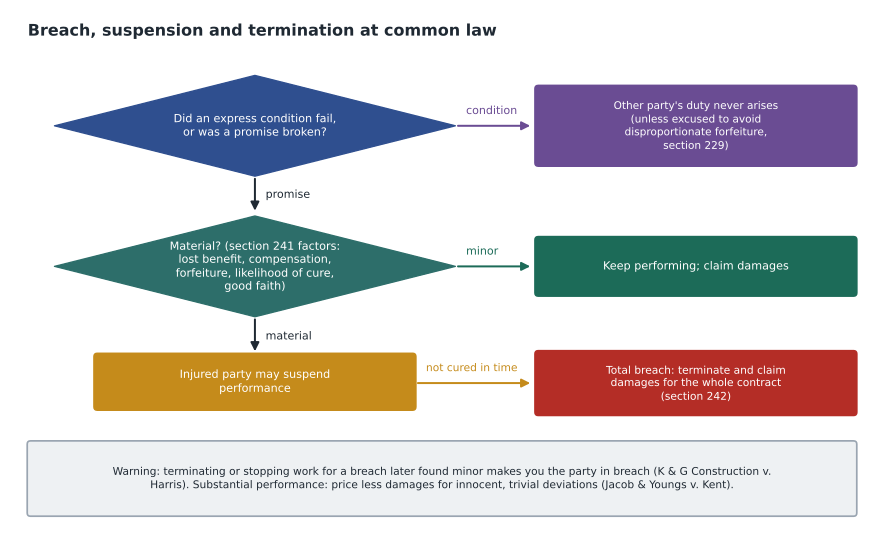
A promise is a commitment; failure to keep it is a breach that gives the other party a claim for damages. A condition is an event, not certain to occur, which must occur, unless its non-occurrence is excused, before performance under a contract becomes due (Restatement (Second) section 224). Failure of a condition is not itself a breach. It means that the other party's duty to perform never arises. A term can be both: a promise to deliver by June 1 can also be a condition of the buyer's duty to pay on time.
Express conditions are created by the parties' language, usually with words like "if," "provided that," "on condition that" or "only when." Courts enforce express conditions strictly; substantial compliance is not enough. Because strict enforcement can cause forfeiture, courts prefer to interpret ambiguous language as a promise rather than a condition (section 227). In Howard v. Federal Crop Insurance Corp., 540 F.2d 695 (4th Cir. 1976), a crop insurance policy said the tobacco stalks on any acreage with a claimed loss "shall not be destroyed" until the insurer inspected. The farmers plowed under the stalks before inspection, and the insurer denied the claim. The Fourth Circuit read the clause as a promise, not a condition, because it lacked conditional language, so the farmers' breach did not automatically forfeit coverage. Section 229 adds that a court may excuse the non-occurrence of a condition if it would cause disproportionate forfeiture, unless its occurrence was a material part of the agreed exchange.
Constructive conditions and the order of performance
Many contracts say nothing about whose performance comes first. Courts supply constructive conditions, based on what the parties would have intended. The foundational case is the English decision Kingston v. Preston (1773), in which Lord Mansfield held that a buyer's promise to provide security for payment was a condition of the seller's promise to transfer his business, so the buyer could not sue without first providing it. Modern rules follow from that idea. Where performances can be exchanged at the same time, as in a sale of goods for cash, each party's performance is a constructive condition of the other's (section 234). Where one performance takes time, such as construction work, that performance generally must come before payment for it, unless the parties agree to progress payments.
Each party's duty is therefore subject to the constructive condition that the other party has not committed an uncured material failure to perform. That principle connects conditions to breach. A minor breach gives the other party a claim for damages but does not excuse its own performance. A material breach suspends the other party's duty to perform and, if not cured in time, discharges it.
Substantial performance
The doctrine of substantial performance applies the constructive condition to construction and service contracts. A party who has substantially performed may recover the contract price, less damages for the deficiency, even though performance was not perfect. The landmark case is Jacob & Youngs, Inc. v. Kent, 230 N.Y. 239, 129 N.E. 889 (1921). The contract for a country residence required that all wrought-iron pipe be of Reading manufacture. Through the oversight of a subcontractor, some of the pipe was made by other manufacturers; it was of the same quality, appearance, market value and cost. By the time the owner discovered the discrepancy, the pipe was sealed inside the walls, and replacing it would have required demolishing large parts of the finished house. The owner refused to make the final payment. Judge Cardozo, writing for the New York Court of Appeals, held that the builder had substantially performed and could recover the balance, less damages measured by the difference in value, which was nominal or nothing, rather than the cost of replacing the pipe. He emphasized that the omission was trivial and innocent and that the owner could have made the brand an express condition if it mattered to him.
Substantial performance is not available for willful deviations, and it does not apply to express conditions. It is primarily a construction doctrine; for sales of goods, Article 2's perfect tender rule applies instead, as discussed below.
Material breach
Whether a breach is material determines whether the injured party may suspend its own performance and, eventually, terminate the contract. Section 241 lists factors: (a) the extent to which the injured party will be deprived of the benefit which he reasonably expected; (b) the extent to which the injured party can be adequately compensated for the part of that benefit of which he will be deprived; (c) the extent to which the party failing to perform will suffer forfeiture; (d) the likelihood that the party failing to perform will cure his failure, taking account of the circumstances including any reasonable assurances; and (e) the extent to which the behavior of the party failing to perform comports with standards of good faith and fair dealing.
Timing matters. A material breach first justifies suspension: the injured party can stop performing while giving the breaching party a chance to cure. If the breach is not cured within an appropriate time, it becomes a total breach, discharging the injured party's remaining duties and allowing it to terminate and claim damages for the whole contract (section 242). Delay is the classic case: a short delay in a construction contract is usually not material, but delay that goes on long enough, or that defeats a purpose of the contract, becomes material. A clause making time of the essence signals that even a short delay is material.
Getting this wrong is costly. In K & G Construction Co. v. Harris, 223 Md. 305, 164 A.2d 451 (1960), a subcontractor's bulldozer operator negligently damaged the general contractor's house. The general contractor withheld a progress payment while the subcontractor's insurer considered the claim, and the subcontractor quit the job. The Maryland Court of Appeals held that the subcontractor's damage to the house was a material breach that justified withholding payment, so the subcontractor's refusal to continue was itself a breach. A party who stops performing because of a breach that turns out to be minor becomes the breaching party.
Restitution for the party in breach
A party who materially breaches after partly performing loses the right to the contract price, but it may still recover the value of the benefit it conferred, minus the damages it caused. In Britton v. Turner, 6 N.H. 481 (1834), a farmhand hired for a year quit without cause after about nine and a half months. The New Hampshire court allowed him to recover the reasonable value of his work, less the employer's damages from his departure, to prevent the employer from getting a windfall. Restatement (Second) section 374 adopts that approach.
Anticipatory repudiation
A party may breach before its performance is due by repudiating: stating that it will not perform, or taking a voluntary act that makes it unable to perform (section 250). In the English case Hochster v. De La Tour (1853) 2 El. & Bl. 678, an employer told a courier in May that it would not need his services on a trip to begin in June. The court allowed the courier to sue immediately rather than waiting until June. A repudiation must be definite and unequivocal; expressing doubts about one's ability to perform, or demanding concessions without refusing to perform, is not enough. A repudiating party may retract the repudiation until the injured party has materially changed position in reliance or indicated that it considers the repudiation final.
When a party's conduct creates reasonable grounds for insecurity but is not a clear repudiation, the other party may demand adequate assurance of due performance and, if commercially reasonable, suspend its own performance until it receives it. UCC section 2-609 established that right for sales of goods, and Restatement (Second) section 251 extends it to contracts generally. Under section 2-609(4), between merchants, failure to provide adequate assurance within a reasonable time not exceeding 30 days after receipt of a justified demand is a repudiation. Section 2-610 lets the aggrieved party, upon repudiation, await performance for a commercially reasonable time or resort to any remedy for breach, and in either case suspend its own performance. Section 2-611 allows retraction until the aggrieved party has canceled, materially changed position or otherwise indicated that it considers the repudiation final.
Worked problem
Who breached in June?
The contract required completion by June 1 with time of the essence (from Juniper Hill's purchase order) or an estimated completion of June 1 (from Calloway's acknowledgment). By June 22 Calloway said completion would be late July and requested the second progress payment. Juniper Hill withheld it. Calloway threatened to stop work and remove its equipment. Analyze.
Show solution
- Terms: under section 2-207(3) (Lesson 3), conflicting time terms likely knock out, leaving delivery within a reasonable time (section 2-309). A reasonable time is informed by the parties' communications, which repeatedly targeted June 1.
- Calloway's delay: a delay of seven weeks on a project whose purpose was to be ready for summer production, partly caused by its own decision to pull its crew, is a strong candidate for a material breach under section 241(a) and (e). But part of the delay came from the electrical upgrade, which was the creamery's responsibility.
- Juniper Hill's response: withholding a progress payment while performance was materially behind is the kind of suspension that is justified if the breach is material, but risky if it is not (K & G Construction).
- Calloway's threat: a threat to stop work and remove equipment unless paid could be a repudiation if definite. A safer step for Calloway would have been a demand for adequate assurance under section 2-609.
- Juniper Hill's statement that it was evaluating its options, including termination, expressed doubt but was not itself a repudiation.
Answer: Calloway's own crew decision makes its delay look material, which would justify Juniper Hill's suspension of payment, but the shared responsibility for the electrical delay makes the question close. Both sides would have been better protected by a written demand for adequate assurance than by threats.
Performance under Article 2
The perfect tender rule
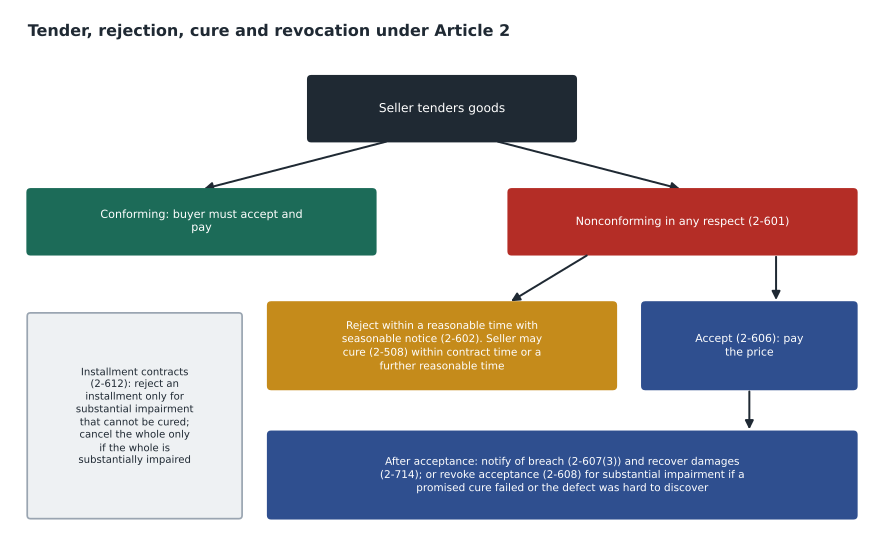
Article 2 replaces substantial performance with a stricter starting rule. Section 2-601 provides that, subject to exceptions, if the goods or the tender of delivery fail in any respect to conform to the contract, the buyer may (a) reject the whole, (b) accept the whole, or (c) accept any commercial unit or units and reject the rest. The buyer need not show a material breach. But rejection must be made within a reasonable time after delivery or tender and is ineffective unless the buyer seasonably notifies the seller (section 2-602). After rejection, the buyer must hold the goods with reasonable care for the seller's disposition, and a merchant buyer must follow the seller's reasonable instructions (sections 2-602 and 2-603).
The perfect tender rule has several important limits. Installment contracts, which require or authorize delivery in separate lots to be separately accepted, use a substantial-impairment standard instead: a buyer may reject an installment only if the nonconformity substantially impairs its value and cannot be cured, and may cancel the whole contract only if the defect substantially impairs the value of the whole (section 2-612). Shipment contracts have their own rule on the seller's duties (section 2-504). And the obligation of good faith limits rejection for trivial defects used as a pretext to escape a contract that has become unprofitable.
Cure
The most important limit is the seller's right to cure. Under section 2-508(1), where a tender is rejected because nonconforming and the time for performance has not yet expired, the seller may seasonably notify the buyer of its intention to cure and may then make a conforming delivery within the contract time. Under section 2-508(2), where the buyer rejects a nonconforming tender which the seller had reasonable grounds to believe would be acceptable with or without money allowance, the seller may, if it seasonably notifies the buyer, have a further reasonable time to substitute a conforming tender. In Ramirez v. Autosport, 88 N.J. 277, 440 A.2d 1345 (1982), buyers of a camper van rejected it when it was delivered with problems including scratches, missing hookups and a missing awning. The seller tried to fix the problems over the following weeks, and the buyers eventually canceled. The New Jersey Supreme Court held that the perfect tender rule survived the Code, subject to the seller's right to cure, and that the buyers could cancel because the seller had not cured within a reasonable time.
Acceptance and revocation of acceptance
A buyer accepts goods when, after a reasonable opportunity to inspect, it signifies that the goods are conforming or that it will take them despite nonconformity, fails to make an effective rejection, or does any act inconsistent with the seller's ownership (section 2-606). Once the buyer accepts, it must pay at the contract rate, it cannot reject, and it must notify the seller of any breach within a reasonable time after it discovers or should have discovered it or be barred from any remedy (section 2-607(3)(a)). It can still recover damages for the nonconformity under section 2-714.
A buyer may revoke acceptance of goods whose nonconformity substantially impairs their value to the buyer, if it accepted them either on the reasonable assumption that the nonconformity would be cured and it has not been seasonably cured, or without discovering the nonconformity because of the difficulty of discovery or the seller's assurances (section 2-608). Revocation must occur within a reasonable time after the buyer discovers or should have discovered the ground for it and before any substantial change in the condition of the goods not caused by their own defects. Revocation puts the buyer in the same position as if it had rejected.
Worked problem
The undersized coils
Calloway started the system on July 20. A week later, testing showed that it could not hold 90 percent humidity on hot days because the evaporator coils were one size smaller than the specification Juniper Hill approved. Juniper Hill had begun loading cheese into the room. Calloway offers to replace the coils within three weeks. Can Juniper Hill reject the whole system?
Show solution
- The coils do not conform to the specification, so under section 2-601 the tender failed to conform in a respect that would allow rejection if made within a reasonable time with seasonable notice.
- But Juniper Hill may already have accepted. It had a reasonable opportunity to inspect and began using the room for its cheese, an act that may signify acceptance under section 2-606.
- If it accepted, it can revoke acceptance under section 2-608 only if the nonconformity substantially impairs the system's value to it. A cheese aging room that cannot hold the humidity needed to age cheese properly in summer is substantially impaired; the defect was also hard to discover until the system ran in hot weather.
- Cure: Calloway had reasonable grounds to believe its tender conformed, and it promptly offered to replace the coils. Under section 2-508(2) or, after acceptance, as a practical matter under section 2-608's assumption-of-cure language, a court would likely give Calloway a reasonable time to cure before allowing Juniper Hill to unwind the deal.
- Damages: whatever happens to the system, Juniper Hill keeps its claims for damages from the delay and the defect, discussed in Lesson 11.
Answer: Juniper Hill probably accepted the system and could revoke only for substantial impairment; given Calloway's prompt offer to replace the coils, the creamery should allow the cure while reserving its damages claims in writing. If Calloway fails to cure within a reasonable time, revocation becomes available.
Common mistakes
MistakeFailure of a condition is a breach of contract.
InsteadFailure of a condition means the other party's duty does not arise; it is a breach only if a party also promised that the condition would occur.
MistakeAny breach lets the other party stop performing.
InsteadOnly a material breach justifies suspension, and termination requires that it become total. Stopping for a minor breach is itself a breach (K & G Construction).
MistakeSubstantial performance applies to sales of goods.
InsteadArticle 2 uses the perfect tender rule, softened by cure, installment rules and good faith.
MistakeA buyer who has accepted goods has no remedy for defects.
InsteadThe buyer may recover damages under 2-714 after timely notice, and may revoke acceptance under 2-608 for substantial impairment.
Summary and key terms
- Conditions are events that must occur before a duty arises; express conditions are enforced strictly, but courts prefer to read ambiguous terms as promises and may excuse conditions to avoid disproportionate forfeiture.
- Constructive conditions make each party's performance depend on the other's not committing an uncured material breach.
- Substantial performance lets a builder recover the price less damages for trivial, innocent deviations (Jacob & Youngs v. Kent).
- Materiality is judged by the section 241 factors; a material breach justifies suspension, and an uncured one becomes total.
- Anticipatory repudiation allows immediate suit; reasonable insecurity justifies a demand for adequate assurance (UCC 2-609; section 251).
- Article 2's perfect tender rule lets a buyer reject nonconforming goods, subject to cure (2-508), installment rules (2-612), acceptance (2-606) and revocation for substantial impairment (2-608).
- Condition
- An event, not certain to occur, that must occur before a party's performance becomes due.
- Constructive condition
- A condition supplied by the court, such as the requirement that the other party not be in uncured material breach.
- Substantial performance
- Performance that falls short only in minor ways, entitling the performing party to the price less damages.
- Material breach
- A breach serious enough to justify the injured party in suspending, and eventually terminating, its own performance.
- Anticipatory repudiation
- A definite statement or act showing that a party will not perform when performance comes due.
- Adequate assurance
- Assurance of due performance that a party with reasonable grounds for insecurity may demand.
- Perfect tender rule
- The UCC rule allowing a buyer to reject goods that fail to conform in any respect.
- Cure
- A seller's right, in some circumstances, to correct a nonconforming tender.
- Revocation of acceptance
- A buyer's undoing of acceptance for a substantial impairment that was hidden or not cured as expected.
Practice problems
Work each problem on paper first, then reveal the answer to check.
A home renovation contract requires Kohler fixtures. The contractor installs American Standard fixtures of equal quality and price. The owner discovers this after the tile is finished. Can the owner refuse to pay the balance?
Show answer
Under Jacob & Youngs v. Kent, the contractor likely substantially performed if the deviation was innocent and trivial, so the owner must pay the balance less damages measured by any difference in value.
A seller of 1,000 chairs, due June 30, delivers on June 10 chairs with the wrong finish. The buyer rejects. What can the seller do?
Show answer
Under 2-508(1), the seller may seasonably notify the buyer of its intent to cure and deliver conforming chairs by June 30.
A supplier hears credible reports that its buyer is insolvent. What may the supplier do under UCC 2-609?
Show answer
Demand adequate assurance of performance in writing and, if commercially reasonable, suspend its own performance until it receives assurance; between merchants, failure to respond within 30 days is a repudiation.
What is the difference between rejection and revocation of acceptance?
Show answer
Rejection occurs before acceptance and is allowed for any nonconformity under 2-601; revocation undoes an acceptance and requires substantial impairment plus either a failed expected cure or a hidden defect under 2-608.
Lesson quiz · 5 questions
Score 60% or more to complete this lesson.
Create a free account to save your progress, take quizzes and earn a certificate.