
LAWU-102 · Lesson 2 of 12 · 25 min
Formation: mutual assent, offer and acceptance
▶ Video coming soon A video version of this lesson is on the way.
In February 2026, Lena Marsh met with a sales engineer from Calloway Refrigeration Systems at the creamery. Two days later Calloway emailed a six-page quotation for the new aging room and cold-storage system. The first page listed the equipment and the price. A line at the bottom read: "Quotation valid for 30 days. Prices subject to change without notice. All orders subject to acceptance by Calloway at its home office." Lena replied the same afternoon: "Looks good, we're very interested. Can you do the install by June 1?" The sales engineer answered: "June 1 should work. Send us a PO when you're ready."
Professor Ashgrove puts the three messages on the screen and asks Section B whether Juniper Hill and Calloway have a contract yet. Hands go up on both sides. Daniel Reyes says yes: the quote had a price, the equipment and a date, and Lena said it looked good. Hannah Lindqvist says no: the quote itself said orders were subject to acceptance at the home office, and nobody had ordered anything. "This lesson is about how to decide who is right," Ashgrove says. "The answer turns on offer and acceptance, and on what the parties' words would mean to a reasonable person in their position."
Mutual assent and the objective theory
A contract requires mutual assent, often described as a meeting of the minds. Despite the phrase, American law does not ask what each party secretly intended. It applies the objective theory of contract: a party's words and conduct are given the meaning a reasonable person in the other party's position would give them. The Restatement (Second) of Contracts puts it this way in section 18: manifestation of mutual assent requires that each party either make a promise or begin or render a performance.
The classic illustration is Lucy v. Zehmer, 196 Va. 493, 84 S.E.2d 516 (1954). Over drinks in a restaurant, A. H. Zehmer wrote on the back of a guest check an agreement to sell his farm to W. O. Lucy for 50,000 dollars, and Zehmer and his wife signed it. Zehmer later claimed he had been joking and that both men were drinking. The Supreme Court of Appeals of Virginia enforced the agreement. The discussion had gone on for a long time, the writing was redrafted to add Mrs. Zehmer's signature, and Lucy reasonably believed the offer was serious. A person cannot say one thing and then escape liability by claiming a secret intention to mean something else. The court added that if Zehmer's words and acts, judged by a reasonable standard, manifested an intention to agree, his unexpressed state of mind was immaterial.
An older case makes the same point in employment. In Embry v. Hargadine, McKittrick Dry Goods Co., 127 Mo. App. 383, 105 S.W. 777 (1907), an employee told his boss he would quit unless his contract was renewed, and the boss replied, "Go ahead, you're all right. Get your men out and don't let that worry you." The boss later said he had not meant to renew. The court held that the question was what the words would mean to a reasonable person in the employee's position, not what the boss privately intended.
The objective theory does not ignore subjective understanding entirely. If both parties actually share a meaning, that shared meaning controls even if a stranger would read the words differently. And if one party knows the other is not serious, as when an offer is plainly made in jest, there is no contract. The question is always what the party seeking enforcement knew or had reason to know.
What counts as an offer
Section 24 of the Restatement (Second) defines an offer as the manifestation of willingness to enter into a bargain, so made as to justify another person in understanding that his assent to that bargain is invited and will conclude it. The key idea is the power of acceptance: an offer gives the offeree the power to create a contract simply by accepting. If a reasonable person in the recipient's position would understand that more is needed from the sender before a deal exists, the communication is not an offer.
Section 26 adds that a manifestation is not an offer if the person to whom it is addressed knows or has reason to know that the sender does not intend to conclude a bargain until it has made a further manifestation of assent. Communications that invite offers rather than make them are called preliminary negotiations or invitations to deal.
Advertisements, catalogs and price quotes
Advertisements are ordinarily not offers. They are treated as invitations for customers to make offers, mainly because a seller with limited stock cannot sensibly be bound to sell to everyone who responds. The exception is an advertisement that is clear, definite and explicit and leaves nothing open for negotiation. In Lefkowitz v. Great Minneapolis Surplus Store, Inc., 251 Minn. 188, 86 N.W.2d 689 (1957), a store advertised one black lapin stole, worth 139.50 dollars, for 1 dollar, "first come, first served." When Lefkowitz arrived first and tendered his dollar, the store refused, citing a house rule that the offer was for women only. The Minnesota Supreme Court held the advertisement was an offer because it specified the item, the price, the quantity and the method of acceptance, and the store could not add new conditions after the fact.
Leonard v. Pepsico, Inc., 88 F. Supp. 2d 116 (S.D.N.Y. 1999), aff'd, 210 F.3d 88 (2d Cir. 2000), shows the limit. A television commercial for a Pepsi points promotion ended with a teenager landing a Harrier fighter jet at school and a caption showing the jet for seven million Pepsi Points. John Leonard assembled the equivalent of seven million points and demanded the jet. The court granted Pepsico summary judgment: the commercial was an advertisement, not an offer, the promotional catalog that served as the real offer did not include a jet, and in any event no objective person could have reasonably concluded that the commercial actually offered a military aircraft.
Price quotations raise the same issue. Most quotations are invitations for the buyer to place an order, which then becomes the offer. But a quotation can be an offer if it is detailed, addressed to a specific buyer, and reasonably signals that the buyer's order will close the deal without further action by the seller. Courts look at the language used, the detail provided, the past dealings of the parties and trade practice.
Worked problem
Was Calloway's quotation an offer?
Calloway's quotation described the equipment and price in detail and was sent only to Juniper Hill, but it said that prices were subject to change without notice and that all orders were subject to acceptance by Calloway at its home office. Lena replied that it looked good and asked about a June 1 installation date. Is there a contract?
Show solution
- Ask whether the quotation was an offer: would a reasonable buyer understand that its assent alone would conclude the deal?
- The detail and personal address point toward an offer, but the express reservation that orders are subject to acceptance at the home office tells the buyer that Calloway intends to make a further manifestation of assent (Restatement (Second) section 26).
- Conclude that the quotation was an invitation to deal. A purchase order from Juniper Hill would be the offer.
- Even if the quote were an offer, Lena's reply expressed interest and asked a question rather than unequivocally accepting.
Answer: No contract yet. The quotation reserved Calloway's right to accept orders, so it was not an offer, and Lena's reply was an inquiry, not an acceptance. The next step, a purchase order, is where formation will happen, and Lesson 3 follows it.
Definiteness
An offer must be definite enough that a court can tell what the parties agreed to and fashion a remedy. Section 33 of the Restatement (Second) asks whether the terms provide a basis for determining the existence of a breach and for giving an appropriate remedy. Courts have grown more willing to fill gaps with reasonable terms, especially in commercial settings. Article 2 goes further. Section 2-204(3) provides that even though one or more terms are left open, a contract for sale does not fail for indefiniteness if the parties intended to make a contract and there is a reasonably certain basis for giving an appropriate remedy. Section 2-305 allows a contract with an open price, which is then a reasonable price at the time for delivery, and other sections supply delivery, payment and quality terms. Quantity is the one term Article 2 will not supply, because there is no way to measure a reasonable quantity without the parties' agreement.
How offers end
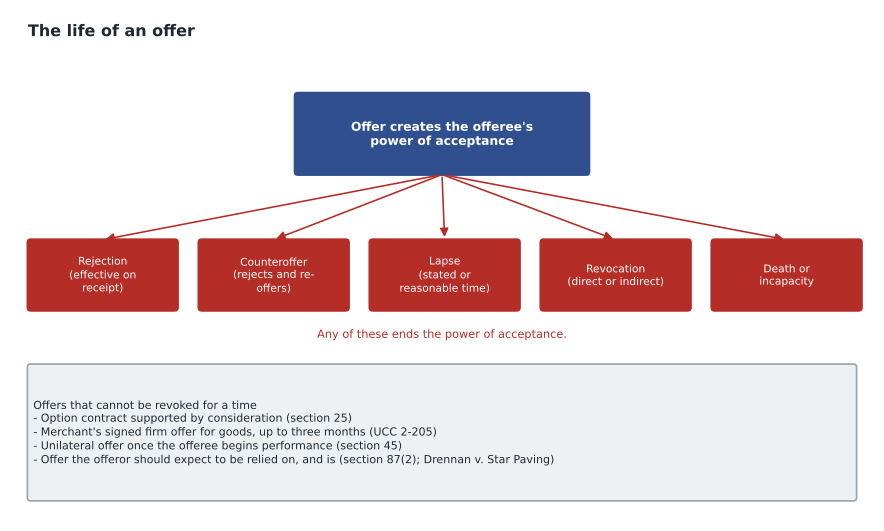
An offer does not last forever. The offeree's power of acceptance can end in five main ways.
- Rejection. A rejection ends the power of acceptance when the offeror receives it (section 38). A later attempt to accept is at most a new offer.
- Counteroffer. A counteroffer, which proposes a different bargain on the same subject, is both a rejection and a new offer (section 39), unless the offeree says it is keeping the original offer under consideration. A mere inquiry, such as asking whether the seller would take less, is not a counteroffer.
- Lapse. An offer lapses at the time it specifies, or if none, after a reasonable time (section 41). In face-to-face or phone conversations, an offer usually lapses when the conversation ends unless the parties indicate otherwise.
- Revocation. An ordinary offer can be revoked at any time before acceptance, even if the offeror promised to keep it open, because that promise was not supported by consideration. A revocation is effective when the offeree receives it (section 42). It can also happen indirectly: if the offeree learns from a reliable source that the offeror has taken definite action inconsistent with the offer, such as selling the property to someone else, the offer is revoked (section 43). That is the rule of Dickinson v. Dodds (1876) 2 Ch. D. 463, an English case still taught in American courses.
- Death or incapacity. Under the traditional rule, which the Restatement keeps in section 48, an offer ends when the offeror or offeree dies or loses legal capacity, even if the other party does not know. Many scholars criticize the rule, but it remains the majority position.
Offers that cannot be revoked
Several doctrines make an offer irrevocable for some period.
An option contract is a promise to keep an offer open that is itself an enforceable contract, usually because the offeree paid something for it (section 25). A buyer who pays 1,000 dollars for a 60-day option to buy land has bought the right to decide. Section 87(1) also treats a signed written offer that recites a purported consideration and proposes an exchange on fair terms within a reasonable time as a binding option, though courts divide on whether a recited but unpaid nominal consideration is enough.
Under UCC section 2-205, an offer by a merchant to buy or sell goods in a signed writing that by its terms gives assurance it will be held open is not revocable for lack of consideration during the time stated, or for a reasonable time if none is stated, but in no event longer than three months. If the assurance appears on a form supplied by the offeree, the offeror must separately sign it. Calloway's quotation said it was valid for 30 days, but because it was not an offer at all, the firm offer rule does not help Juniper Hill. Had it been a signed offer, its 30-day validity statement could have made it irrevocable for those 30 days.
Reliance can also make an offer irrevocable. Section 87(2) provides that an offer the offeror should reasonably expect to induce substantial action or forbearance before acceptance, and which does induce it, is binding as an option to the extent necessary to avoid injustice. The leading case is Drennan v. Star Paving Co., 51 Cal. 2d 409, 333 P.2d 757 (1958). A general contractor used a paving subcontractor's bid in computing its own bid for a school project and won the job. The next day the subcontractor said its bid contained a mistake and refused to perform at that price. Justice Traynor held that the subcontractor's bid was irrevocable once the general contractor relied on it by submitting its own bid, because the subcontractor knew that general contractors use subcontractor bids that way. Drennan departed from Judge Learned Hand's earlier decision in James Baird Co. v. Gimbel Bros., 64 F.2d 344 (2d Cir. 1933), which held that a supplier's bid could be withdrawn before acceptance. Most courts now follow Drennan.
Acceptance
Acceptance is a manifestation of assent to the terms of an offer made by the offeree in the manner invited or required by the offer (section 50). Three principles govern.
First, the offeror is the master of the offer. An offeror can specify exactly how acceptance must occur: by signing and returning a form, by a particular date, or only by performance. If the offer requires a particular method, no other method works. If it merely suggests a method, any reasonable method is fine.
Second, the acceptance must be unequivocal and, at common law, must match the offer. Under the mirror image rule, a reply that adds or changes terms is a counteroffer, not an acceptance. Lesson 3 examines how Article 2 changed that rule for goods.
Third, the offeree must know of the offer. A person who returns a lost dog without knowing about a posted reward has not accepted the reward offer, though many courts and statutes have softened this result in reward cases involving public bodies.
Bilateral and unilateral contracts
Most offers invite a return promise, creating a bilateral contract: a promise for a promise. Some offers invite only performance: "I will pay you 500 dollars if you paint my fence by Friday." The resulting contract is unilateral: a promise for an act. The classic problem with unilateral offers is revocation in the middle of performance. If the painter has finished half the fence, can the owner revoke?
Section 45 answers no. When an offer invites acceptance only by performance, an option contract is created when the offeree tenders or begins the invited performance. The offeror's duty to pay is conditional on completion, but the offeror cannot revoke while the offeree is completing. Section 32 adds that in case of doubt, an offer is interpreted as inviting the offeree to accept either by promising or by performing, as the offeree chooses. True unilateral offers are therefore rare outside rewards, prizes and some employment bonuses.
Article 2 contains its own flexible acceptance rule. Under section 2-206(1)(a), unless otherwise unambiguously indicated, an offer is construed as inviting acceptance in any manner and by any medium reasonable in the circumstances. Under section 2-206(1)(b), an order for prompt or current shipment invites acceptance either by a prompt promise to ship or by prompt shipment of conforming or nonconforming goods. A seller that ships nonconforming goods accepts the order and breaches the contract at the same time, unless it seasonably notifies the buyer that the shipment is offered only as an accommodation, in which case the shipment is a counteroffer.
Silence
As a general rule, silence is not acceptance. An offeror cannot say, "If I don't hear from you by Friday, we have a deal," and bind an offeree who simply ignores the message. Section 69 recognizes narrow exceptions: where the offeree takes the benefit of offered services with a reasonable opportunity to reject them and reason to know they were offered with the expectation of compensation; where the offeror has given the offeree reason to understand that silence will be acceptance and the offeree, by remaining silent, intends to accept; and where previous dealings make it reasonable for the offeree to notify the offeror if it does not intend to accept. A customer who has accepted monthly shipments for years without objecting may be bound by silence when the next shipment arrives.
Jordan Kimura asks how all this applies when the creamery sends a purchase order and Calloway answers with its own form. "That," Ashgrove says, "is next week's battle, and it is literally called the battle of the forms."
Common mistakes
MistakeA contract exists only if both parties subjectively intended to agree.
InsteadUnder the objective theory, assent is judged by what a reasonable person in the other party's position would understand from words and conduct (Lucy v. Zehmer).
MistakeEvery advertisement or price quote is an offer.
InsteadAds and quotes are usually invitations to deal. They are offers only if they are definite and reasonably signal that assent alone will close the deal (Lefkowitz).
MistakeA promise to keep an offer open always prevents revocation.
InsteadWithout consideration, such a promise is revocable, unless it is an option contract, a merchant's firm offer under UCC 2-205, or an offer made irrevocable by reliance under section 87(2).
MistakeA reply that adds terms is still an acceptance at common law.
InsteadUnder the mirror image rule, a reply that changes or adds terms is a counteroffer that rejects the original offer.
Summary and key terms
- Mutual assent is judged objectively, by how a reasonable person in the other party's position would understand words and conduct.
- An offer creates a power of acceptance; preliminary negotiations, most advertisements and most price quotes do not.
- Offers end by rejection, counteroffer, lapse, revocation (including indirect revocation) and death or incapacity.
- Options, merchant firm offers under UCC 2-205, unilateral offers once performance begins (section 45) and offers relied on under section 87(2) and Drennan can be irrevocable.
- Acceptance must follow the offeror's terms; the offeror is the master of the offer, and silence is not acceptance except in narrow cases.
- Article 2 relaxes definiteness (section 2-204(3)) and allows acceptance by any reasonable manner, including shipment (section 2-206).
- Objective theory of contract
- The rule that assent is judged by the reasonable meaning of a party's words and conduct, not secret intentions.
- Offer
- A manifestation of willingness to enter a bargain that justifies the other person in understanding that assent will conclude it.
- Power of acceptance
- The offeree's legal ability, created by an offer, to form a contract by accepting.
- Counteroffer
- A reply proposing a different bargain, which rejects the original offer and makes a new one.
- Option contract
- An enforceable promise to keep an offer open, usually supported by consideration.
- Firm offer
- A merchant's signed written offer for goods that assures it will be held open; irrevocable for up to three months under UCC 2-205.
- Unilateral contract
- A contract formed by a promise in exchange for performance rather than a return promise.
- Mirror image rule
- The common law rule that an acceptance must match the offer exactly.
Practice problems
Work each problem on paper first, then reveal the answer to check.
A store's website lists a laptop at 49 dollars instead of 949 dollars because of a typo, with no stated quantity limit. A customer places an order. Has a contract formed when the order is submitted?
Show answer
Usually not. Website listings, like ads, are generally invitations to deal, and the customer's order is the offer. Many retailers' terms also state that orders are accepted only on shipment.
On May 1, Ana offers to sell her truck to Ben for 18,000 dollars and says the offer is open until May 10. On May 5, Ben learns from a reliable friend that Ana sold the truck to Cara. On May 6 Ben accepts. Is there a contract?
Show answer
No. Ana's promise to hold the offer open was not supported by consideration, and Ben's reliable knowledge of the inconsistent sale revoked the offer indirectly before he accepted (Dickinson v. Dodds; section 43).
Why did the court in Drennan v. Star Paving hold the subcontractor's bid irrevocable?
Show answer
The subcontractor should have expected the general contractor to rely on its bid in bidding the project, and the general contractor did rely, so the bid was binding as an option to avoid injustice.
A buyer orders 100 blue widgets for prompt shipment. The seller ships 100 green widgets without comment. What is the legal effect?
Show answer
Under UCC 2-206(1)(b), the shipment accepts the order and is also a breach, because the seller did not notify the buyer that the shipment was only an accommodation.
Lesson quiz · 5 questions
Score 60% or more to complete this lesson.
Create a free account to save your progress, take quizzes and earn a certificate.