
LAWU-102 · Lesson 11 of 12 · 26 min
Remedies
▶ Video coming soon A video version of this lesson is on the way.
By September 2026, Juniper Hill's lawyer had assembled a list of the creamery's losses. About 2,600 pounds of young cheese had spoiled during the July heat wave while waiting for the late aging room, cheese the creamery had expected to sell for roughly 14 dollars a pound once aged. The creamery had rented a refrigerated trailer for three weeks in late June at 2,100 dollars. It had paid overtime to move product twice. Its first deliveries to Northgate would be short in October because the spoiled batch was meant for them. And the aging room, now running with replacement coils, had cost the creamery several weeks of humidity problems that left one batch of cheddar drier and less valuable than it should have been.
Calloway's response was blunt: its form excluded consequential damages, the spoiled cheese was the creamery's own fault for not arranging better temporary storage, and nobody had told Calloway that a few weeks' delay would destroy thousands of pounds of cheese. Professor Ashgrove says the exchange captures almost every important question in the law of contract remedies. What interest does the law protect when a contract is broken? What limits keep damages within reason? When will a court order performance instead of money? And how does Article 2 adjust these rules for sales of goods?
The three interests
Contract remedies protect three interests, described in Restatement (Second) section 344. The expectation interest is the promisee's interest in having the benefit of the bargain by being put in as good a position as it would have been in had the contract been performed. The reliance interest is the interest in being reimbursed for loss caused by reliance on the contract by being put in as good a position as it would have been in had the contract not been made. The restitution interest is the interest in having restored any benefit the promisee conferred on the other party.
Expectation is the normal measure. Section 347 expresses it as a formula: the injured party may recover the loss in value to it of the other party's performance caused by its failure or deficiency, plus any other loss, including incidental or consequential loss, caused by the breach, less any cost or other loss that it has avoided by not having to perform. In plain terms, the court asks what the injured party would have had if the contract had been performed and gives it the money to get there.
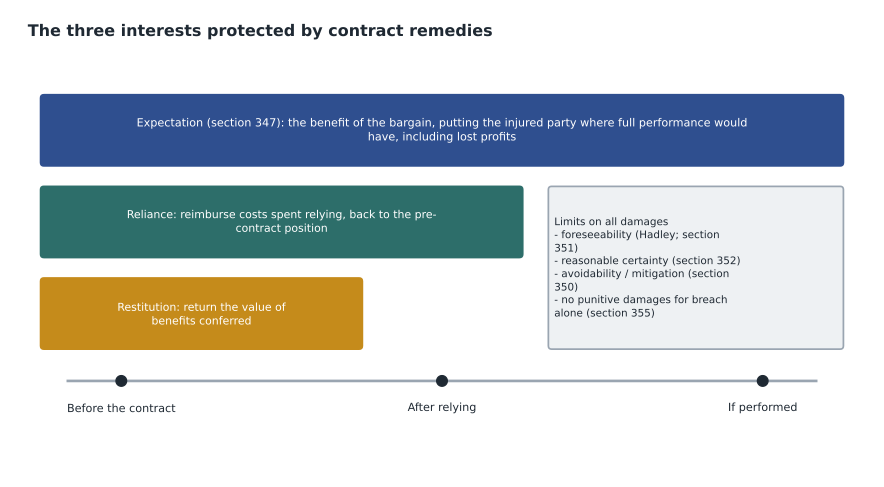
Hawkins v. McGee, 84 N.H. 114, 146 A. 641 (1929), the "hairy hand" case, is the traditional starting point. A doctor promised a young man that surgery to graft skin onto his scarred hand would produce a hundred percent perfect hand. Instead, the graft, taken from his chest, grew hair and left the hand worse than before. The New Hampshire Supreme Court held that the measure of damages was the difference between the value of a perfect hand, as promised, and the value of the hand he actually got, plus incidental losses, rather than the pain and suffering of the operation, which he would have endured anyway. The case shows that expectation damages look forward to the promised result.
Reliance damages are used when expectation is too uncertain to measure, or when a court thinks full expectation is inappropriate, as with promissory estoppel (Lesson 4). In Sullivan v. O'Connor, 363 Mass. 586, 296 N.E.2d 183 (1973), a professional entertainer sued a surgeon who had promised to improve her nose in two operations; after three operations her nose looked worse. The Supreme Judicial Court of Massachusetts allowed damages measured by reliance, including her payments, her pain and suffering from the third operation, and the worsening of her appearance, while expressing caution about enforcing doctors' promises of results.
Limits on damages
Foreseeability
The most famous limit comes from Hadley v. Baxendale (1854) 9 Ex. 341. The Hadleys operated a mill whose crankshaft broke. They hired Baxendale's carrier company to take the broken shaft to an engineering firm in Greenwich as a model for a new one. The carrier delayed delivery by several days, and the mill sat idle longer. The court held that the Hadleys could not recover their lost profits for the extra days of idleness, because the carrier was not told that the mill would be stopped until the shaft returned. Damages are recoverable only if they arise naturally, according to the usual course of things, from the breach, or are such as may reasonably be supposed to have been in the contemplation of both parties at the time they made the contract as the probable result of the breach.
Restatement (Second) section 351 adopts the rule: damages are not recoverable for loss that the party in breach did not have reason to foresee as a probable result of the breach when the contract was made. Losses that follow in the ordinary course of events are general damages and are always foreseeable. Losses that result from special circumstances, such as lost profits or harm to other business, are consequential damages and are recoverable only if the breaching party had reason to know of those circumstances. Section 351(3) adds that a court may limit damages for foreseeable loss to avoid disproportionate compensation.
Certainty
Damages are not recoverable beyond an amount that the evidence permits to be established with reasonable certainty (section 352). The rule mainly affects lost profits, especially for new businesses without a track record. Courts used to apply a strict new business rule barring lost profits for new enterprises; most courts now allow them if they can be proven with reasonable certainty through expert testimony, comparable businesses or the plaintiff's own later experience.
Avoidability and mitigation
Damages are not recoverable for loss that the injured party could have avoided without undue risk, burden or humiliation (section 350). This is often called the duty to mitigate, though it is not really a duty; it is a limit on recovery. In Rockingham County v. Luten Bridge Co., 35 F.2d 301 (4th Cir. 1929), a county contracted for a bridge, then repudiated the contract before much work had been done, in part because the road leading to the bridge would not be built. The company kept building anyway and sued for the full price. The Fourth Circuit held that it could recover only its costs up to the repudiation plus the profit it would have made, not the costs of building a bridge to nowhere after it knew the county did not want it.
Mitigation does not require accepting just anything. In Parker v. Twentieth Century-Fox Film Corp., 3 Cal. 3d 176, 474 P.2d 689 (1970), the studio canceled a musical, Bloomer Girl, that Shirley MacLaine Parker had contracted to star in, and offered her instead a western, Big Country, Big Man, to be filmed in Australia, with fewer approval rights. The California Supreme Court held that she did not have to accept the substitute to recover her full fee, because the offered employment was different and inferior. The burden is on the breaching party to show that the injured party could have mitigated.
Costs incurred in reasonable efforts to mitigate are themselves recoverable, even if the efforts fail. Juniper Hill's rented refrigerated trailer is a mitigation cost.
Cost of completion or diminution in value?
When a contractor fails to complete work, the usual measure is the cost to complete it. But where that cost is grossly disproportionate to the increase in value the work would produce, courts sometimes award only the diminution in value. In Peevyhouse v. Garland Coal & Mining Co., 1962 OK 267, 382 P.2d 109 (Okla. 1962), a coal company leased a family's farm for strip-mining and promised to restore the land afterward. It did not. Restoration would have cost about 29,000 dollars, but would have increased the farm's value by only about 300 dollars. The Oklahoma Supreme Court limited damages to 300 dollars, reasoning that the restoration was incidental to the main purpose of the lease. The decision has been widely criticized, partly because the Peevyhouses had specifically bargained for restoration. In Groves v. John Wunder Co., 205 Minn. 163, 286 N.W. 235 (1939), by contrast, the Minnesota Supreme Court awarded the cost of grading land as promised, about 60,000 dollars, even though the graded land would have been worth only about 12,000 dollars. Jacob & Youngs v. Kent (Lesson 9) fits within the same debate: Cardozo used diminution in value for an innocent, trivial deviation.
Emotional distress, punitive damages and attorney's fees
Damages for emotional disturbance are generally excluded unless the breach also caused bodily harm or the contract or breach is of a kind that makes serious emotional disturbance a particularly likely result, such as contracts for funeral services or the carriage of a corpse (section 353). Punitive damages are not recoverable for breach of contract unless the conduct is also a tort for which punitive damages are recoverable (section 355). Under the American rule, each party pays its own attorney's fees unless a contract clause or statute provides otherwise, so a party that wins a contract case often recovers less than its real loss. Many commercial contracts include fee-shifting clauses for that reason.
Agreed remedies
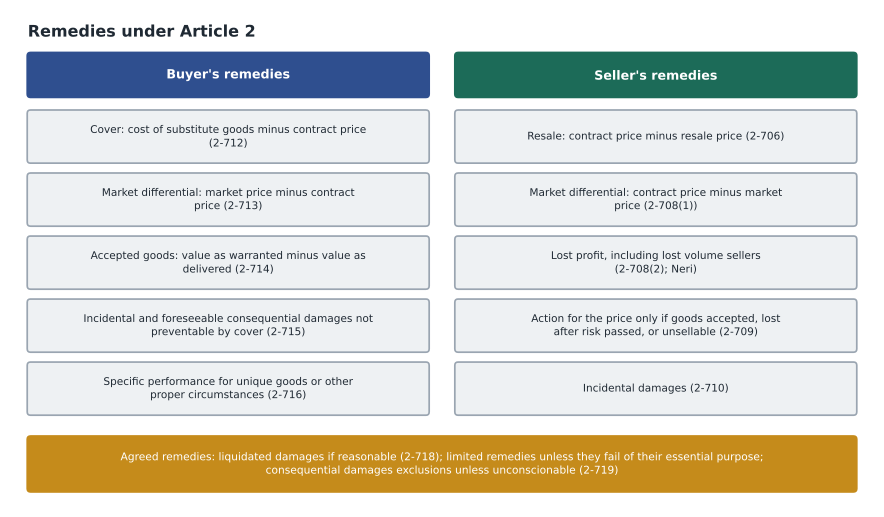
Parties may agree in advance on damages. Section 356 and UCC section 2-718(1) enforce a liquidated damages clause if the amount is reasonable in light of the anticipated or actual loss caused by the breach and the difficulties of proof of loss. A clause fixing unreasonably large liquidated damages is unenforceable as a penalty. Courts ask whether damages were hard to estimate when the contract was made and whether the amount was a reasonable forecast, not a sum designed to punish or deter breach.
Article 2 also allows parties to limit or modify remedies. Section 2-719(1) permits an agreement providing for remedies in addition to or in substitution for those in Article 2, such as limiting the buyer's remedies to repair or replacement. But where circumstances cause an exclusive or limited remedy to fail of its essential purpose, for example because the seller cannot or will not repair the defect, the buyer may use the Code's other remedies (section 2-719(2)). Consequential damages may be limited or excluded unless the limitation is unconscionable, and limitation of consequential damages for injury to the person in the case of consumer goods is prima facie unconscionable (section 2-719(3)). Courts divide on whether a consequential damages exclusion survives when a limited repair remedy fails of its essential purpose; many treat the two clauses as independent.
Damages under Article 2
Article 2 sets out each side's remedies in detail. A buyer whose seller fails to deliver or repudiates, or who rightfully rejects or revokes acceptance, may cancel and recover any price paid, and then either cover, by buying substitute goods in good faith and without unreasonable delay, and recover the difference between the cost of cover and the contract price (section 2-712), or recover the difference between the market price when the buyer learned of the breach and the contract price (section 2-713), plus in either case incidental and consequential damages, less expenses saved. A buyer who has accepted goods and given notice may recover for the nonconformity the loss resulting in the ordinary course, which for breach of warranty is the difference between the value of the goods accepted and the value they would have had if they had been as warranted (section 2-714). For unique goods or in other proper circumstances, the buyer may get specific performance (section 2-716).
Section 2-715 defines the buyer's incidental damages as expenses reasonably incurred in inspection, receipt, transportation, care and custody of goods rightfully rejected, and other reasonable expenses incident to the breach. Consequential damages include any loss resulting from general or particular requirements and needs of which the seller at the time of contracting had reason to know and which could not reasonably be prevented by cover or otherwise, and injury to person or property proximately resulting from any breach of warranty. The cover requirement builds mitigation into the Code: a buyer cannot recover consequential losses it could have avoided by buying substitutes.
A seller whose buyer wrongfully rejects, revokes or repudiates may resell the goods in a commercially reasonable manner and recover the difference between the contract price and the resale price (section 2-706), or recover the difference between the contract price and the market price at the time and place for tender (section 2-708(1)). If those measures are inadequate to put the seller in as good a position as performance would have, the seller may recover its lost profit (section 2-708(2)). That subsection protects the lost volume seller, a seller with an unlimited supply that would have made both the original sale and the resale. In Neri v. Retail Marine Corp., 30 N.Y.2d 393, 285 N.E.2d 311 (1972), a buyer canceled an order for a boat; the dealer sold the boat to someone else at the same price, but New York's highest court allowed it to recover its lost profit, because it would have made both sales. The seller can recover the full price only in limited cases: when the buyer has accepted the goods, when conforming goods were lost or damaged after risk passed to the buyer, or when the seller cannot reasonably resell identified goods (section 2-709).
Specific performance and injunctions
Equitable remedies are the exception in American contract law. A court will order specific performance or an injunction only when damages would not adequately protect the injured party's expectation interest (section 359). Factors include the difficulty of proving damages with reasonable certainty, the difficulty of procuring a suitable substitute with damages, and the likelihood that damages could not be collected. Land is treated as unique, so buyers of real property routinely get specific performance. Unique goods, such as works of art, heirlooms and some custom equipment, can qualify too.
Section 2-716 broadened specific performance for goods, allowing it where the goods are unique or in other proper circumstances. Comment 2 explains that inability to cover is strong evidence of other proper circumstances. In Laclede Gas Co. v. Amoco Oil Co., 522 F.2d 33 (8th Cir. 1975), the Eighth Circuit ordered specific performance of a long-term contract to supply propane to a gas utility's residential developments, because a substitute long-term supply was hard to find during the energy shortages of the 1970s and damages would be difficult to measure.
Courts will not order specific performance of contracts for personal services, because forcing someone to work raises concerns about involuntary servitude and supervision, and because a court cannot easily judge the quality of a performance. They may, however, enjoin the breaching party from working for a competitor if the contract contains a valid negative promise. The classic illustration is the English case Lumley v. Wagner (1852), which enjoined an opera singer from performing for a rival theater during her engagement.
Restitution
Restitution protects against unjust enrichment. An injured party may choose restitution instead of damages, recovering the reasonable value of what it conferred on the breaching party, which can matter when the contract was a losing one. As Lesson 9 showed, even a party in breach may recover restitution for benefits conferred, minus the harm it caused (section 374). And where a contract is unenforceable, for example under the statute of frauds or because of mistake or excuse, restitution remains available to return benefits conferred. The Restatement (Third) of Restitution and Unjust Enrichment governs these claims in many courts.
Worked problem
Juniper Hill's damages
Juniper Hill seeks (1) the value of 2,600 pounds of cheese that spoiled on July 8 during the delay; (2) the 2,100-dollar cost of the refrigerated trailer rented in late June; (3) overtime costs for moving product; (4) lost profits on short deliveries to Northgate in October; and (5) the reduced value of a batch of cheddar aged in the room before the coils were replaced. Calloway argues its consequential damages exclusion applies, the creamery failed to mitigate, and the losses were unforeseeable. Analyze.
Show solution
- Exclusion: under section 2-207(3) (Lesson 3), Calloway's exclusion of consequential damages is probably not part of the contract. If it were, the creamery would argue it is unconscionable or that the repair remedy failed of its essential purpose, though many courts treat the exclusion as independent.
- Foreseeability: Juniper Hill's purchase order stated the purpose of aging cheese and the June 1 date. Calloway, a commercial refrigeration seller, had reason to know that a creamery building a cold room needed it for perishable product and that summer delay risked spoilage. Under Hadley and section 2-715(2)(a), the spoiled cheese is a foreseeable consequential loss.
- Mitigation: section 2-715(2)(a) bars consequential losses that could reasonably have been prevented by cover or otherwise. Juniper Hill rented a trailer in late June; the question is whether it acted reasonably when its temporary storage failed during the heat wave. Its mitigation costs (items 2 and 3) are recoverable as incidental or consequential damages.
- Lost profits on Northgate: foreseeable in general if Calloway knew the room was for production to sell, but the creamery must prove them with reasonable certainty, and it must not double count the value of the spoiled cheese and the profits on the same cheese.
- Defective coils: the reduced value of the affected batch is recoverable under section 2-714 as damages for accepted nonconforming goods, or under 2-715(2)(b) as injury to property proximately resulting from breach of warranty.
- Shared causation: the part of the delay caused by the creamery's own electrical upgrade may reduce what it can claim.
Answer: Juniper Hill should recover its mitigation costs and the reduced value of the affected batch, and probably the spoiled cheese, as foreseeable consequential damages that the exclusion does not bar. Lost profits require careful proof and must not duplicate the cheese claim, and any delay attributable to the electrical upgrade will reduce the recovery.
Common mistakes
MistakeContract damages aim to punish the breaching party.
InsteadThey compensate, usually by giving the expectation measure; punitive damages are not available for breach alone (section 355).
MistakeAll losses caused by a breach are recoverable.
InsteadDamages are limited by foreseeability (Hadley), certainty and avoidability, and emotional distress damages are usually excluded.
MistakeA liquidated damages clause is always enforceable because the parties agreed to it.
InsteadIt is enforceable only if reasonable in light of anticipated or actual loss and difficulty of proof; otherwise it is a penalty.
MistakeSpecific performance is available whenever the injured party prefers it.
InsteadIt requires that damages be inadequate, as with land, unique goods or inability to cover, and is not available for personal services.
Summary and key terms
- Contract remedies protect the expectation, reliance and restitution interests; expectation is the normal measure (sections 344 and 347; Hawkins v. McGee).
- Damages are limited by foreseeability (Hadley v. Baxendale; section 351), reasonable certainty (section 352) and avoidability (section 350; Luten Bridge; Parker v. Twentieth Century-Fox).
- Courts choose between cost of completion and diminution in value (Peevyhouse; Groves); emotional distress and punitive damages are rarely available, and each side usually pays its own fees.
- Liquidated damages are enforceable if reasonable; Article 2 allows limited remedies unless they fail of their essential purpose, and consequential exclusions unless unconscionable (2-718, 2-719).
- Article 2 gives buyers cover, market, accepted-goods, incidental and consequential damages, and gives sellers resale, market, lost-profit and price remedies.
- Specific performance requires inadequate damages and is common for land and unique goods (2-716; Laclede Gas); restitution prevents unjust enrichment.
- Expectation interest
- The interest in being put in the position performance would have produced.
- Reliance interest
- The interest in being restored to the position before the contract was made.
- Restitution interest
- The interest in recovering a benefit conferred on the other party.
- Consequential damages
- Losses from the injured party's special circumstances, recoverable if foreseeable to the breaching party at contracting.
- Incidental damages
- Reasonable expenses incurred because of the breach, such as storing rejected goods or arranging cover.
- Mitigation
- Reasonable steps to avoid loss; losses that could have been avoided are not recoverable.
- Cover
- A buyer's good-faith purchase of substitute goods after the seller's breach (UCC 2-712).
- Liquidated damages
- A contract term fixing damages in advance, enforceable only if reasonable.
- Lost volume seller
- A seller with enough supply to have made both the breached sale and the resale, entitled to lost profits.
- Specific performance
- A court order requiring a party to perform its contract.
Practice problems
Work each problem on paper first, then reveal the answer to check.
A painter agrees to paint a house for 8,000 dollars, then backs out. The owner hires another painter for 9,500 dollars. What are the owner's expectation damages?
Show answer
1,500 dollars, the extra cost of obtaining the promised performance, plus any foreseeable incidental losses.
A carrier delays delivering a machine part, and the factory loses 50,000 dollars of profits. The carrier did not know the factory had no spare part. Can the factory recover the lost profits?
Show answer
Not under Hadley v. Baxendale, unless the loss followed in the ordinary course or the carrier had reason to know of the special circumstances when contracting.
A buyer contracted to buy steel at 700 dollars a ton. The seller repudiated when the market price was 800, and the buyer covered at 820 a week later. What can the buyer recover under 2-712?
Show answer
The difference between the cover price and the contract price, 120 dollars a ton, plus incidental and consequential damages, less expenses saved, if the cover was in good faith and without unreasonable delay.
Why did the court in Neri v. Retail Marine allow the dealer to recover lost profits even though it resold the boat at the same price?
Show answer
Because the dealer was a lost volume seller: it would have made both sales, so the resale did not replace the profit lost on the breached sale (2-708(2)).
Lesson quiz · 5 questions
Score 60% or more to complete this lesson.
Create a free account to save your progress, take quizzes and earn a certificate.