
LAWU-102 · Lesson 7 of 12 · 23 min
Mistake, misrepresentation and nondisclosure
▶ Video coming soon A video version of this lesson is on the way.
Three things went wrong at Juniper Hill in the spring of 2026 that had nothing to do with conflicting forms. First, when Calloway's electrician arrived in May to wire the compressors, he discovered that the creamery's barn, which both sides had assumed had three-phase electrical service because a previous owner had run a sawmill there, actually had only single-phase power. The upgrade would cost the creamery about 18,000 dollars and take weeks. Second, Calloway discovered that its estimator had left the refrigerant piping off the quotation entirely, a 7,500-dollar error. Third, Lena remembered that the sales engineer had told her in February that Calloway's system "will hold 55 degrees and 90 percent humidity even in a heat wave, guaranteed," a claim that turned out to be optimistic for a room of that size.
Professor Ashgrove uses the three problems to frame this lesson. Each involves a contract formed with assent and consideration, but on the basis of a wrong belief. When does a mistake about the facts let a party out of a contract, and when does one side's statement or silence about the facts give the other side a remedy?
Mutual mistake
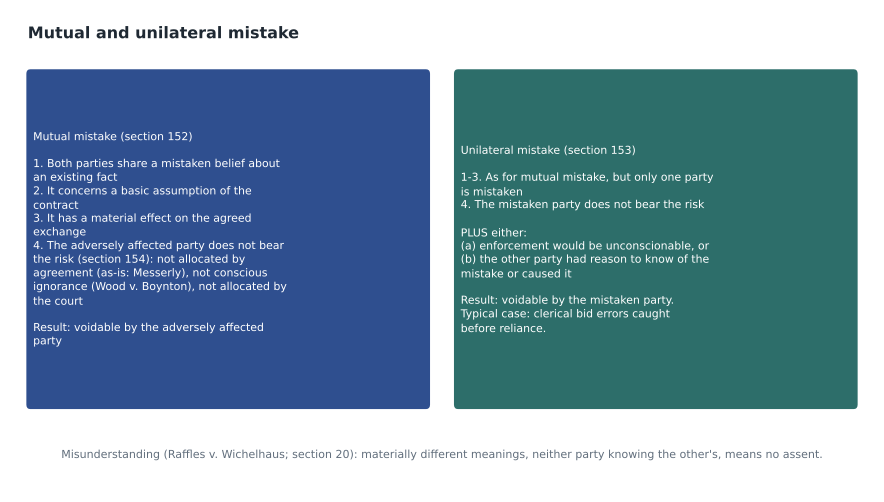
A mistake, in contract law, is a belief that is not in accord with the facts (Restatement (Second) section 151). It is a belief about facts existing when the contract is made, not a wrong prediction about the future. If both parties share the same mistaken belief, the mistake is mutual. Section 152 provides that a contract is voidable by the adversely affected party when (1) the mistake was made by both parties at the time the contract was made, (2) it concerns a basic assumption on which the contract was made, (3) it has a material effect on the agreed exchange of performances, and (4) the adversely affected party does not bear the risk of the mistake under section 154.
The classic cases
In Sherwood v. Walker, 66 Mich. 568, 33 N.W. 919 (1887), a farmer agreed to sell a cow named Rose 2d of Aberlone to a banker for about 80 dollars, a price based on the belief of both parties that she was barren and good only for beef. Before delivery, the seller discovered that Rose was pregnant and worth perhaps 750 to 1,000 dollars as a breeding cow, and refused to deliver. The Michigan Supreme Court allowed the seller to rescind: the parties had contracted for a barren cow, and a breeding cow was a substantially different thing. The court distinguished mistakes that go to the very nature of the thing from mistakes about its mere quality or value.
Compare Wood v. Boynton, 64 Wis. 265, 25 N.W. 42 (1885). A woman sold a small stone to a jeweler for 1 dollar. Neither knew what it was; she thought it might be a topaz. It turned out to be an uncut diamond worth about 700 dollars. The Wisconsin Supreme Court refused rescission. Both parties knew they did not know what the stone was, and the sale was made with that uncertainty. There was no mistake about a fact both assumed; there was conscious ignorance, and the seller took the risk.
Modern courts have moved away from Sherwood's distinction between the nature and the quality of the thing, which is hard to apply. In Lenawee County Board of Health v. Messerly, 417 Mich. 17, 331 N.W.2d 203 (1982), buyers purchased a rental property that, unknown to anyone, had an illegally installed septic system that made the property unfit for human habitation. The Michigan Supreme Court acknowledged a mutual mistake about a basic assumption with a material effect, but refused rescission because the contract contained an "as is" clause that allocated the risk of such defects to the buyers. The court said that Sherwood's nature-versus-quality test was confusing and adopted the Restatement's risk-allocation approach.
Who bears the risk
Section 154 says a party bears the risk of a mistake when (a) the risk is allocated to him by agreement of the parties, (b) he is aware, at the time the contract is made, that he has only limited knowledge with respect to the facts to which the mistake relates but treats his limited knowledge as sufficient, or (c) the risk is allocated to him by the court on the ground that it is reasonable in the circumstances to do so. As-is clauses and warranties allocate risk by agreement, as in Messerly. Conscious ignorance, as in Wood v. Boynton, allocates risk to the party who chose to proceed without knowing. And courts sometimes allocate the risk to the party better able to discover or bear it.
Worked problem
The single-phase barn
Both Juniper Hill and Calloway assumed when contracting that the barn had three-phase power. It did not, and the creamery must spend about 18,000 dollars on an upgrade before the system can run. The purchase order said nothing about electrical service, but Calloway's quotation stated: "Buyer responsible for providing adequate electrical service to equipment." Can Juniper Hill avoid the contract?
Show solution
- Mistake: both parties believed, at the time of contracting, a fact that was false: that three-phase power was available.
- Basic assumption: arguably yes, since the system was designed on that assumption.
- Material effect: an 18,000-dollar cost on a roughly 220,000-dollar project, plus delay, is significant but does not destroy the value of the exchange; courts might find it insufficiently material.
- Risk allocation: the quotation's clause put responsibility for electrical service on the buyer. Even if that clause is not part of the contract under section 2-207 (Lesson 3), a court could reasonably allocate the risk to the creamery, which owned the building and was better placed to know its electrical service.
Answer: Juniper Hill probably cannot avoid the contract. The mistake may not be material enough, and the risk of the building's electrical condition likely falls on the owner of the building, either by agreement or by the court's allocation.
Unilateral mistake
When only one party is mistaken, relief is harder to get. Section 153 makes a contract voidable by the mistaken party if the elements of section 152 are met (basic assumption, material effect, mistaken party does not bear the risk), and in addition either (a) enforcement of the contract would be unconscionable, or (b) the other party had reason to know of the mistake or his fault caused the mistake.
Most unilateral mistake cases involve computational errors in bids. Courts are more willing to grant relief when the mistake is clerical or arithmetical rather than an error of judgment, when the other party knew or should have known of it, for example because the bid was far below all others, and when the mistaken party acted promptly before the other party relied. A contractor who misplaces a decimal point in its bid and notifies the owner before the owner accepts or relies will often be released; a contractor who simply underestimates the difficulty of the work will not. Recall Drennan v. Star Paving from Lesson 2: the subcontractor's mistake did not excuse it, because the general contractor had no reason to know of it and had already relied by using the bid.
Calloway's omitted refrigerant piping is a clerical error, but the 7,500-dollar omission was not so large that Juniper Hill should have noticed it, the creamery had already relied by turning down another supplier and signing the Northgate deal, and Calloway was careless in its own estimating. Calloway would likely bear the loss. Its request in April for a price increase, discussed in Lesson 4, rested on the supplier's price increase, not on this error, and Calloway would be wise not to mix the two.
Misunderstanding
A different problem arises when the parties attach different meanings to the same words. In Raffles v. Wichelhaus (1864) 2 H. & C. 906, a buyer agreed to buy cotton arriving "ex Peerless" from Bombay. There were two ships named Peerless, one sailing in October and one in December. The buyer meant the first; the seller meant the second. The English court held there was no contract. Restatement (Second) section 20 now states the rule: if the parties attach materially different meanings to their manifestations and neither knows or has reason to know the meaning attached by the other, there is no mutual assent. But if one party knows or has reason to know the other's meaning and the other does not, the contract is formed on the innocent party's meaning. Lesson 8 returns to interpretation disputes like this one.
Misrepresentation
Misrepresentation is an assertion that is not in accord with the facts (section 159). A contract is voidable for misrepresentation under section 164 if a party's manifestation of assent is induced by either a fraudulent or a material misrepresentation by the other party upon which the recipient is justified in relying. Four elements stand out.
- An assertion of fact. Statements of opinion, predictions and sales talk, sometimes called puffery, are generally not assertions of fact. But an opinion can carry an implied assertion that the speaker knows facts justifying it, and section 169 allows reliance on opinions where the speaker stands in a relation of trust, has special skill or judgment, or the recipient is especially susceptible.
- Fraudulent or material. A misrepresentation is fraudulent if the maker intends it to induce assent and knows or believes it is false, or does not have the confidence in its truth that the maker states or implies, or knows it has no basis (section 162). It is material if it would be likely to induce a reasonable person to assent, or the maker knows it would be likely to induce the recipient to do so. An innocent misrepresentation can still make a contract voidable if it is material.
- Inducement. The misrepresentation must have contributed substantially to the decision to contract.
- Justified reliance. The recipient must be justified in relying. A recipient need not investigate the truth of a factual statement, but cannot rely on an assertion it knows to be false or that is obviously false.
The line between opinion and fact is tested in Vokes v. Arthur Murray, Inc., 212 So. 2d 906 (Fla. Dist. Ct. App. 1968). A 51-year-old widow without family was persuaded by a dance studio, through constant flattery about her talent and potential, to buy 14 dance courses totaling 2,302 hours of lessons for about 31,000 dollars, even though she had no dance aptitude. The court held that she stated a claim for rescission. Statements that she was a gifted dancer would ordinarily be opinion, but the studio had superior knowledge and its statements were made to induce her to keep buying, so they could be treated as misrepresentations of fact.
The remedies differ depending on the claim. A party may avoid the contract and recover restitution for misrepresentation, whether fraudulent or innocent but material. A party defrauded may also sue in tort for damages for fraud, which requires scienter, the knowledge of falsity. And when a statement of fact by a seller about the goods becomes part of the basis of the bargain, it is an express warranty under UCC section 2-313, enforceable as a contract term without proof of fraud. Lena's claim about the guaranteed 55 degrees and 90 percent humidity may be most valuable as an express warranty claim, discussed again in Lesson 8, because the words "will hold" and "guaranteed" sound like an affirmation of fact about the system's performance rather than mere sales talk.
Nondisclosure
Silence is different from a false statement. The traditional common law rule was caveat emptor: a party has no general duty to disclose facts the other party does not know. In Laidlaw v. Organ, 15 U.S. (2 Wheat.) 178 (1817), a buyer in New Orleans learned early one morning that the Treaty of Ghent had ended the War of 1812, which meant the British blockade would end and tobacco prices would rise. He bought 111 hogsheads of tobacco from a seller who did not know the news. Chief Justice Marshall wrote that the buyer had no duty to disclose information equally accessible to both parties, but that each party must take care not to say or do anything tending to impose upon the other. The Court sent the case back for a new trial because the seller had asked whether there was any news and the buyer's response was disputed.
Modern law has carved out many duties to disclose. Section 161 treats nondisclosure as equivalent to an assertion that the fact does not exist (a) where the party knows that disclosure is necessary to prevent a previous assertion from being a misrepresentation, (b) where the party knows that disclosure would correct a mistake of the other party as to a basic assumption on which that party is making the contract and nondisclosure amounts to a failure to act in good faith, (c) where disclosure would correct a mistake as to the contents or effect of a writing, or (d) where the other person is entitled to know because of a relation of trust and confidence. Active concealment, such as painting over water damage, and half-truths are treated as misrepresentations.
Real estate cases show the trend. In Hill v. Jones, 151 Ariz. 81, 725 P.2d 1115 (Ct. App. 1986), the Arizona Court of Appeals held that a seller who knew of past termite damage had a duty to disclose it to buyers when the facts were material and not readily observable. In Stambovsky v. Ackley, 169 A.D.2d 254, 572 N.Y.S.2d 672 (App. Div. 1991), a seller who had publicized her house in a village on the Hudson River as haunted, in national magazines and local walking tours, could not hide that reputation from an out-of-town buyer, who was allowed to rescind. Most states now have statutes requiring residential sellers to fill out disclosure forms listing known defects.
Merger and nonreliance clauses
Many contracts contain clauses saying that the written contract is the entire agreement and that neither party relied on statements not in the writing. Courts generally hold that a general merger clause does not bar a fraud claim, because fraud vitiates the agreement. But a specific nonreliance clause, in which a party expressly disclaims reliance on the very representations it later claims were false, can bar the claim, especially between sophisticated parties. The leading case is Danann Realty Corp. v. Harris, 5 N.Y.2d 317, 157 N.E.2d 597 (1959). Lesson 8 takes up how such clauses interact with the parol evidence rule.
Common mistakes
MistakeAny mistake about value lets a party out of a contract.
InsteadMutual mistake requires a basic assumption, a material effect and that the adversely affected party not bear the risk. Mistakes about value and consciously accepted uncertainty usually do not qualify (Wood v. Boynton).
MistakeA party who makes a unilateral computational error can always withdraw.
InsteadRelief also requires that enforcement be unconscionable or that the other party knew, had reason to know or caused the mistake, and courts weigh reliance by the other party.
MistakeOnly knowingly false statements make a contract voidable.
InsteadAn innocent misrepresentation also makes a contract voidable if it is material and the recipient justifiably relied.
MistakeSilence can never be misrepresentation.
InsteadConcealment, half-truths and nondisclosure in the situations listed in section 161 are treated as assertions that the fact does not exist.
Summary and key terms
- Mutual mistake makes a contract voidable when both parties were mistaken about a basic assumption with a material effect, and the adversely affected party does not bear the risk (sections 152 and 154).
- Risk is allocated by agreement (as-is clauses, Messerly), by conscious ignorance (Wood v. Boynton) or by the court.
- Unilateral mistake also requires unconscionability or that the other party knew, had reason to know or caused the mistake (section 153).
- Misunderstanding about materially different meanings, unknown to both, prevents assent (Raffles v. Wichelhaus; section 20).
- A contract induced by a fraudulent or material misrepresentation on which the recipient justifiably relied is voidable (section 164); opinions can sometimes count (Vokes).
- Nondisclosure is actionable in the situations in section 161 and through concealment and half-truths; modern law has eroded caveat emptor, especially for real estate.
- Mistake
- A belief not in accord with the facts existing when the contract is made.
- Basic assumption
- A belief on which the contract was made, so central that its falsity undermines the exchange.
- Conscious ignorance
- Proceeding with a contract while aware of limited knowledge, which allocates the risk of mistake to that party.
- Misrepresentation
- An assertion that is not in accord with the facts.
- Fraudulent misrepresentation
- A misrepresentation made with knowledge or belief that it is false, or without confidence or basis, intended to induce assent.
- Material misrepresentation
- A misrepresentation likely to induce a reasonable person, or known to be likely to induce the recipient, to assent.
- Puffery
- Vague sales talk or opinion that is not treated as an assertion of fact.
- Caveat emptor
- Let the buyer beware: the traditional rule that sellers need not disclose defects.
- Nonreliance clause
- A contract term in which a party disclaims reliance on representations outside the writing.
Practice problems
Work each problem on paper first, then reveal the answer to check.
A collector buys a painting at a yard sale for 20 dollars. Both the seller and the buyer believe it is a cheap print. It is an original worth 200,000 dollars. Can the seller rescind?
Show answer
Probably not if the parties knowingly dealt with uncertainty about its nature or the seller bore the risk; courts often treat yard-sale sellers as accepting that risk. A court applying section 152 would ask about basic assumption, material effect and risk allocation.
A contractor bids 150,000 dollars on a job when all other bids are about 300,000 dollars, because it omitted a page of costs. The owner accepts immediately. The contractor discovers the error the next day. Can it avoid the contract?
Show answer
Likely yes under section 153(b): the owner had reason to know of the mistake given the huge gap, the error is clerical, and the contractor acted promptly before significant reliance.
Why was the dance studio's flattery in Vokes v. Arthur Murray treated as a possible misrepresentation rather than opinion?
Show answer
The studio had superior knowledge of her ability and made the statements to induce more purchases, so a jury could treat them as misrepresentations of fact.
Under section 161(b), when must a party disclose a fact?
Show answer
When it knows disclosure would correct the other party's mistake about a basic assumption and nondisclosure amounts to a failure to act in good faith and in accordance with reasonable standards of fair dealing.
Lesson quiz · 5 questions
Score 60% or more to complete this lesson.
Create a free account to save your progress, take quizzes and earn a certificate.