
LAWU-102 · Lesson 8 of 12 · 28 min
Interpretation, gap fillers and the parol evidence rule
▶ Video coming soon A video version of this lesson is on the way.
By late summer, Juniper Hill had two interpretation disputes on its hands. The first was with Northgate Grocers. The parties had agreed to sales of "aged cheddar," and Northgate's new cheese buyer argued that in the grocery trade, aged cheddar means cheese aged at least twelve months. Juniper Hill had always sold its aged cheddar at about nine months. The second dispute was with Calloway. The creamery wanted to rely on the sales engineer's February statement that the system would hold 55 degrees and 90 percent humidity "even in a heat wave, guaranteed." Calloway's lawyer answered that the statement appeared nowhere in the written documents, and that the parties' writings were the whole deal.
Professor Ashgrove calls interpretation "where most contract litigation actually happens." Lawyers rarely argue about whether a contract was formed. They argue about what it means, what it leaves out, and whether evidence outside the writing can be used to answer those questions. This lesson covers interpretation, the terms courts supply when parties are silent, including warranties and good faith, and the parol evidence rule.
The goal of interpretation
Interpretation is the ascertainment of the meaning of a promise or agreement (Restatement (Second) section 200). The goal is to find the meaning the parties attached to their words, judged objectively. Section 201 restates the rules you saw in Lesson 7: where the parties attach the same meaning, that meaning controls; where they attach different meanings, the agreement is interpreted in accordance with the meaning of one party if the other knew or had reason to know that meaning and the first party did not know or have reason to know the other's.
Plain meaning and context
Courts disagree about how much context to consider. Under the plain meaning rule, if the words of a written contract are clear and unambiguous on their face, the court enforces them as written and does not look at outside evidence of what the parties meant. Many courts, including New York's, still follow a version of that rule, especially for sophisticated commercial contracts.
Other courts take a contextual approach. In Pacific Gas & Electric Co. v. G. W. Thomas Drayage & Rigging Co., 69 Cal. 2d 33, 442 P.2d 641 (1968), a contractor agreed to replace the cover on a steam turbine and to indemnify the utility against all loss, damage, expense and liability resulting from injury to property arising out of the performance of the contract. When the cover fell and damaged the turbine, the utility claimed indemnity. The contractor offered evidence that the parties meant the clause to cover only damage to third parties' property, not the utility's own. Justice Traynor held that the trial court should have considered the evidence. The test, he wrote, is not whether the writing appears to the court to be plain and unambiguous on its face, but whether the offered evidence is relevant to prove a meaning to which the language of the instrument is reasonably susceptible. Words, he said, do not have absolute and constant meanings independent of context.
Frigaliment Importing Co. v. B.N.S. International Sales Corp., 190 F. Supp. 116 (S.D.N.Y. 1960), shows how courts handle ambiguity once they find it. A Swiss importer ordered "chicken" from a New York seller. The buyer meant young chickens suitable for broiling and frying; the seller shipped older stewing chickens, which it said were also chicken. Judge Friendly opened his opinion with the question, "What is chicken?" He examined the contract's language, the parties' negotiations in German and English, trade usage, government regulations, and the prices: the contract price was below the market price of broilers, which made it unlikely the seller had promised broilers. The buyer, who bore the burden of proving that "chicken" had the narrower meaning, lost.
Canons and tie-breakers
Courts use a set of interpretive maxims to resolve ambiguities. A contract is read as a whole, and an interpretation that gives effect to every term is preferred to one that makes some term meaningless. Specific terms control general ones, and separately negotiated or handwritten terms control standard printed ones (section 203). Under the rule of contra proferentem, ambiguous language is construed against the party that drafted it (section 206), a principle that is especially strong in insurance and consumer contracts. These canons are tools, not mechanical rules, and courts use them after examining the language and context.
Course of performance, course of dealing and usage of trade
Context comes partly from how the parties and others in their trade behave. UCC section 1-303 defines three sources. A course of performance is a sequence of conduct between the parties to a particular transaction that exists if the agreement involves repeated occasions for performance and the other party accepts or acquiesces in it with knowledge of its nature. A course of dealing is a sequence of conduct concerning previous transactions between the parties that establishes a common basis of understanding. A usage of trade is any practice or method of dealing having such regularity of observance in a place, vocation or trade as to justify an expectation that it will be observed with respect to the transaction in question.
These sources are relevant to interpreting the parties' agreement and may give particular meaning to specific terms. When they conflict with express terms or with each other, section 1-303(e) sets a hierarchy: express terms prevail over course of performance, course of dealing and usage of trade; course of performance prevails over course of dealing and usage of trade; and course of dealing prevails over usage of trade. The common law follows the same approach (Restatement (Second) sections 202 and 203).
Worked problem
What is aged cheddar?
Juniper Hill and Northgate agreed to sales of "aged cheddar." Northgate claims that in the grocery trade aged cheddar means at least twelve months of aging. Juniper Hill always sold its aged cheddar at about nine months, and Northgate's previous buyer had bought nine-month cheddar under that label for two years. How should a court interpret the term?
Show solution
- Start with the express term: "aged cheddar" does not specify an aging period, so it is reasonably susceptible to more than one meaning.
- Course of dealing: two years of prior transactions in which Northgate bought nine-month cheese labeled aged cheddar from Juniper Hill establish a common basis of understanding between these parties.
- Usage of trade: Northgate must prove a twelve-month usage regular enough in the trade to justify an expectation that it would apply. Even if it does, course of dealing prevails over usage of trade under section 1-303(e).
- Section 201: if Northgate's buyer knew of Juniper Hill's meaning, Juniper Hill's meaning controls.
Answer: The term most likely means cheddar aged about nine months, the meaning established by the parties' course of dealing, which outranks any contrary trade usage.
Gap fillers
No contract covers everything. When the parties are silent on a matter, courts supply a term. Restatement (Second) section 204 says that when the parties have not agreed on a term essential to determining their rights and duties, the court supplies a term which is reasonable in the circumstances. Article 2 supplies many specific gap fillers. If the price is not settled, it is a reasonable price at the time for delivery (section 2-305). The place for delivery is the seller's place of business if not otherwise agreed (section 2-308). The time for shipment or delivery is a reasonable time (section 2-309). Payment is due at the time and place at which the buyer is to receive the goods (section 2-310).
Warranties
The most important gap fillers concern quality. Article 2 creates three warranties.
- Express warranties (section 2-313). Any affirmation of fact or promise made by the seller to the buyer which relates to the goods and becomes part of the basis of the bargain creates an express warranty that the goods shall conform to it. Any description of the goods and any sample or model that is part of the basis of the bargain create express warranties too. No formal words such as warrant or guarantee are needed, but an affirmation merely of the value of the goods or a statement purporting to be merely the seller's opinion or commendation of the goods does not create a warranty.
- The implied warranty of merchantability (section 2-314). Unless excluded or modified, a warranty that the goods shall be merchantable is implied in a contract for their sale if the seller is a merchant with respect to goods of that kind. Merchantable goods must, among other things, pass without objection in the trade under the contract description and be fit for the ordinary purposes for which such goods are used.
- The implied warranty of fitness for a particular purpose (section 2-315). Where the seller at the time of contracting has reason to know any particular purpose for which the goods are required and that the buyer is relying on the seller's skill or judgment to select or furnish suitable goods, there is an implied warranty that the goods shall be fit for such purpose. Any seller can give this warranty, not only a merchant.
Sellers can disclaim implied warranties, but section 2-316 sets formal requirements. To exclude or modify the implied warranty of merchantability, the language must mention merchantability and, in the case of a writing, must be conspicuous. To exclude the implied warranty of fitness, the exclusion must be by a writing and conspicuous. Expressions like "as is" or "with all faults" can exclude all implied warranties if they make plain that there is no implied warranty. Express warranties are harder to disclaim: section 2-316(1) says words creating an express warranty and words negating it are construed as consistent where reasonable, but negation is inoperative to the extent that such construction is unreasonable. Consumer sales also face the federal Magnuson-Moss Warranty Act, which bars a supplier that gives a written warranty on consumer products from disclaiming implied warranties, and some states forbid disclaimers in consumer sales altogether.
Good faith and fair dealing
Every contract imposes on each party a duty of good faith and fair dealing in its performance and enforcement (Restatement (Second) section 205; UCC section 1-304). The Code defines good faith as honesty in fact and the observance of reasonable commercial standards of fair dealing (section 1-201(b)(20)). The duty does not create new obligations inconsistent with the express terms. It protects the reasonable expectations of the parties when one party has discretion or the contract does not address a situation. Courts find breaches when a party uses its discretion to deprive the other of the fruits of the bargain, evades the spirit of the deal or takes opportunistic advantage of a gap.
In Market Street Associates Ltd. Partnership v. Frey, 941 F.2d 588 (7th Cir. 1991), a lease gave the tenant a right to buy the property if the landlord, a pension fund, unreasonably refused to finance improvements. The tenant asked for financing in a letter that did not mention the purchase option, hoping the fund would refuse without noticing the consequences. Judge Posner held that if the tenant deliberately tried to take advantage of the landlord's oversight, that could breach the duty of good faith, which forbids a party from taking deliberate advantage of an oversight by its contract partner concerning his rights under the contract.
The parol evidence rule
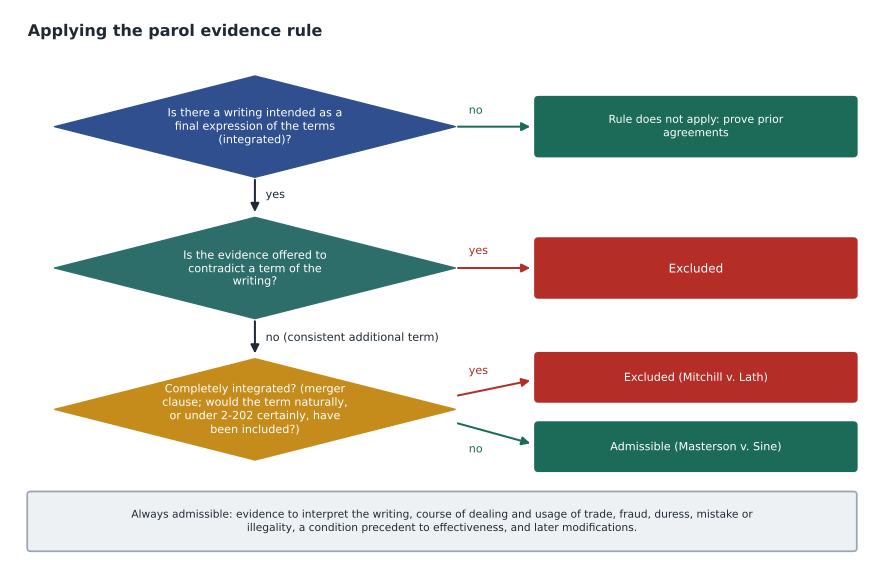
The parol evidence rule addresses a specific question: when the parties have put their agreement in a writing, can a party introduce evidence of agreements made before or at the same time as the writing to add to, vary or contradict it? Despite its name, the rule is not limited to oral evidence; it applies to earlier written drafts, letters and emails too. And despite its placement in evidence courses, it is a rule of substantive contract law: it defines what the contract is.
Integration
The rule depends on integration. An integrated agreement is a writing or writings constituting a final expression of one or more terms of an agreement (section 209). A completely integrated agreement is one adopted by the parties as a complete and exclusive statement of the terms (section 210). A partially integrated agreement is final as to the terms it contains but not complete. The consequences, in sections 213 and 216, are these: a binding integrated agreement discharges prior agreements to the extent that it is inconsistent with them; a completely integrated agreement also discharges prior agreements within its scope, even consistent additional terms; and a partially integrated agreement can be supplemented by consistent additional terms.
Courts differ on how to decide whether a writing is completely integrated. The traditional four corners approach looks only at the writing itself: if it appears complete on its face, it is completely integrated. The modern approach, associated with Arthur Corbin and the Restatement, considers all relevant evidence, including the circumstances of the negotiations. A merger clause stating that the writing is the parties' entire agreement is strong evidence of complete integration and is often decisive, though some courts treat it as rebuttable, especially in standard forms.
Collateral agreements
A recurring question is whether a separate agreement on a related subject is one the parties would naturally have included in the writing. In Mitchill v. Lath, 247 N.Y. 377, 160 N.E. 646 (1928), buyers of a farm claimed that the sellers had orally promised to remove an unsightly ice house on neighboring land as part of the deal. The written contract of sale was detailed but silent about the ice house. New York's highest court refused to admit the evidence, reasoning that an agreement so closely connected to the transaction would ordinarily have been included in the writing. Compare Masterson v. Sine, 68 Cal. 2d 222, 436 P.2d 561 (1968), where a deed reserved an option to repurchase the property, and the grantees offered evidence that the parties had agreed the option was personal to the grantors and could not be assigned. Justice Traynor admitted the evidence, holding that such a term might naturally have been made as a separate agreement, given that deeds are formal documents that rarely include such details.
Article 2 takes a similar line. Section 2-202 provides that terms set forth in a writing intended by the parties as a final expression of their agreement may not be contradicted by evidence of any prior agreement or of a contemporaneous oral agreement, but may be explained or supplemented (a) by course of performance, course of dealing or usage of trade, and (b) by evidence of consistent additional terms unless the court finds the writing to have been intended also as a complete and exclusive statement of the terms of the agreement. Comment 3 adds that if the additional terms are such that, if agreed upon, they would certainly have been included in the document in the view of the court, then evidence of their alleged making must be kept from the trier of fact. Courts read the "certainly" standard as more open to additional terms than the common law's "naturally" standard.
Evidence the rule does not exclude
The parol evidence rule has important limits. It does not bar evidence offered to interpret the writing, under the contextual approach of Pacific Gas & Electric and the Code's express allowance for trade usage and course of dealing. It does not bar evidence that the writing is not an enforceable contract at all because of fraud, duress, mistake or illegality, although nonreliance clauses can complicate fraud claims (Lesson 7). It does not bar evidence of a condition precedent to the agreement taking effect, such as an oral agreement that a signed contract would not become binding until a lender approved financing. And it does not apply to agreements made after the writing, which are governed by the rules on modification.
Worked problem
The guaranteed 55 degrees
In February, Calloway's sales engineer told Lena that the system would hold 55 degrees and 90 percent humidity even in a heat wave, guaranteed. Calloway's acknowledgment form says that it is the entire agreement and that the seller makes no warranties except those stated in it. The contract arose by conduct under section 2-207(3) (Lesson 3). Can Juniper Hill prove the statement?
Show solution
- Is there an integrated writing? The contract was formed by conduct; there is no single writing that both parties adopted as a final expression of their agreement. Calloway's merger clause is part of its own form, which Juniper Hill never accepted.
- If there is no integrated writing, the parol evidence rule does not apply, and Juniper Hill can prove the February statement.
- Express warranty: a specific statement about temperature and humidity performance, made to induce the purchase, is an affirmation of fact relating to the goods. Under section 2-313 it becomes part of the basis of the bargain unless Calloway shows otherwise, and words like "guaranteed" reinforce that it is not mere opinion.
- Disclaimer: even if Calloway's disclaimer were part of the contract, section 2-316(1) makes a negation of an express warranty inoperative where reading the two as consistent is unreasonable.
Answer: Juniper Hill can likely prove the statement and enforce it as an express warranty. The parol evidence rule does not bar it because no integrated writing exists, and the disclaimer probably is not part of the contract.
Common mistakes
MistakeIf the words seem clear to the judge, outside evidence is never admissible.
InsteadCourts following Pacific Gas & Electric admit evidence relevant to a meaning to which the language is reasonably susceptible. Plain meaning jurisdictions are stricter.
MistakeTrade usage overrides the parties' own course of dealing.
InsteadUnder UCC 1-303(e), express terms prevail over course of performance, which prevails over course of dealing, which prevails over usage of trade.
MistakeThe parol evidence rule bars any evidence of earlier oral statements.
InsteadIt bars only evidence that contradicts an integrated writing, or that adds to a completely integrated writing. Evidence of fraud, conditions precedent, interpretation and later modifications remains admissible.
MistakeA seller can disclaim the implied warranty of merchantability with any general statement.
InsteadSection 2-316 requires mention of merchantability and, in a writing, conspicuousness, or language like as is that makes the exclusion plain.
Summary and key terms
- Interpretation seeks the parties' meaning, judged objectively; courts divide between plain meaning and contextual approaches (Pacific Gas & Electric; Frigaliment).
- Canons such as reading the contract as a whole and contra proferentem help resolve ambiguity.
- Course of performance, course of dealing and usage of trade inform meaning, in a hierarchy below express terms (UCC 1-303).
- Courts and Article 2 supply gap fillers, including express and implied warranties of merchantability and fitness, which can be disclaimed only in specified ways.
- Every contract carries a duty of good faith and fair dealing that protects reasonable expectations without overriding express terms (Market Street Associates).
- The parol evidence rule bars evidence contradicting an integrated writing and, for completely integrated writings, consistent additional terms, subject to exceptions for interpretation, invalidity, conditions precedent and later agreements.
- Plain meaning rule
- The approach that enforces unambiguous written terms without considering outside evidence of meaning.
- Contra proferentem
- The canon that ambiguous language is construed against the drafter.
- Course of dealing
- Conduct in previous transactions between the parties establishing a common basis of understanding.
- Usage of trade
- A practice regularly observed in a place, vocation or trade.
- Express warranty
- An affirmation of fact, promise, description or sample that becomes part of the basis of the bargain (UCC 2-313).
- Implied warranty of merchantability
- A merchant seller's implied promise that goods are fit for their ordinary purposes and pass without objection in the trade (UCC 2-314).
- Integrated agreement
- A writing intended as a final expression of one or more terms of an agreement.
- Merger clause
- A clause stating that the writing is the parties' complete and exclusive agreement.
- Parol evidence rule
- The rule limiting evidence of prior or contemporaneous agreements that contradict or add to an integrated writing.
Practice problems
Work each problem on paper first, then reveal the answer to check.
A written contract for a bakery's flour says "Grade A flour." The seller wants to introduce evidence that in the milling trade Grade A refers to a specific protein range. Is the evidence admissible?
Show answer
Yes. Usage of trade may explain or supplement written terms under UCC 2-202(a), and it is relevant to interpretation.
A used car contract states the car is sold "as is." The buyer later claims the dealer impliedly warranted merchantability. Result?
Show answer
Under UCC 2-316(3)(a), an as is clause that makes plain there is no implied warranty excludes implied warranties, subject to consumer protection statutes such as Magnuson-Moss if the dealer gave a written warranty.
A detailed, signed land sale contract with a merger clause says nothing about the seller's promise to repave the driveway. Can the buyer prove the oral promise?
Show answer
Probably not. The writing appears completely integrated, and a promise so closely tied to the sale would naturally have been included, as in Mitchill v. Lath.
Why is evidence of a condition precedent to effectiveness outside the parol evidence rule?
Show answer
Because it shows the writing never became a binding agreement, rather than varying the terms of an effective one.
Lesson quiz · 5 questions
Score 60% or more to complete this lesson.
Create a free account to save your progress, take quizzes and earn a certificate.