
LAWU-102 · Lesson 10 of 12 · 22 min
Excuse: impracticability and frustration
▶ Video coming soon A video version of this lesson is on the way.
When Juniper Hill's lawyer sent Calloway a letter in August 2026 claiming damages for the delay and the spoiled cheese, Calloway's answer raised two new arguments. First, it said the delay was excused because the fire at its compressor supplier's plant in March had disrupted its supply chain, and because the July heat wave was an act of God. Second, it pointed to the force majeure clause on the back of its acknowledgment form, which excused delays "caused by fire, flood, extreme weather, supplier failure, labor disputes or any other cause beyond Seller's reasonable control."
Meanwhile, Northgate Grocers had found a new argument of its own. Cheddar prices in its markets had fallen by about a quarter since March, so the fixed price it had agreed to pay Juniper Hill was now well above what it could pay other suppliers. Northgate's new management claimed that the market collapse frustrated the purpose of the deal.
Professor Ashgrove tells Section B that excuse doctrines are where contract law admits that the world does not always cooperate. "Every contract is a bet about the future," he says. "These doctrines decide when a party can walk away because the future turned out differently from what both sides assumed. The answer is: rarely, and almost never because the deal just became more expensive."
From absolute liability to excuse
For centuries, the common law treated contractual duties as absolute. In Paradine v. Jane (1647), an English court held a tenant liable for rent even though an invading army had driven him off the land, reasoning that he could have protected himself by contract. The modern doctrine began with Taylor v. Caldwell (1863) 3 B. & S. 826. The defendants agreed to let the plaintiffs use the Surrey Gardens music hall for four days of concerts. Before the first concert, the hall burned down without either party's fault. The court held that both parties were excused, because the contract depended on the continued existence of the hall, and implied a condition that performance would be excused if the hall ceased to exist without fault.
Courts later stopped relying on implied conditions and asked more directly whether an unexpected event had made performance impracticable or had destroyed its purpose. The Restatement (Second) and Article 2 now state the doctrines in similar terms.
Impracticability
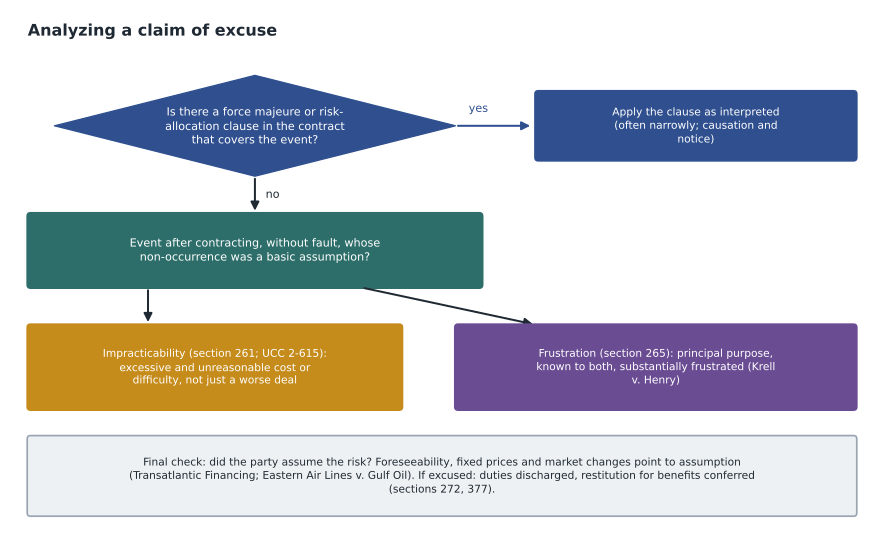
Restatement (Second) section 261 provides that where, after a contract is made, a party's performance is made impracticable without his fault by the occurrence of an event the non-occurrence of which was a basic assumption on which the contract was made, his duty to render that performance is discharged, unless the language or the circumstances indicate the contrary. Its elements are therefore: (1) an event occurring after the contract was made; (2) whose non-occurrence was a basic assumption of the contract; (3) that makes performance impracticable, meaning not literally impossible but possible only at excessive and unreasonable cost or with extreme difficulty; (4) without the fault of the party seeking excuse; and (5) the party has not assumed the risk, by contract language or the circumstances.
Sections 262 to 264 address three recurring cases: the death or incapacity of a person necessary for performance, the destruction or deterioration of a specific thing necessary for performance (Taylor v. Caldwell is the model), and a governmental regulation or order that prevents performance.
How much hardship is enough?
The hardest question is how severe the burden must be. Increased cost alone almost never suffices. In Mineral Park Land Co. v. Howard, 172 Cal. 289, 156 P. 458 (1916), defendants agreed to take from the plaintiff's land all the gravel and earth they needed for a bridge project. After taking what was above water, they found that the remaining gravel was below the water level and could be extracted only at roughly ten times the usual cost. The California Supreme Court excused them, saying a thing is impossible in legal contemplation when it is not practicable, and it is impracticable when it can only be done at an excessive and unreasonable cost. Mineral Park represents the outer edge; later courts rarely find cost increases sufficient.
Transatlantic Financing Corp. v. United States, 363 F.2d 312 (D.C. Cir. 1966), is the leading modern case. A ship operator contracted to carry wheat from Texas to Iran in 1956. During the Suez crisis, Egypt closed the Suez Canal, and the ship had to sail around the Cape of Good Hope, adding about 3,000 miles and some 44,000 dollars to the cost of a roughly 306,000-dollar voyage. The operator sought extra compensation, arguing that the usual and customary route through Suez had become impossible. Judge Skelly Wright held that the canal's closure was an unexpected event, but the operator had not shown that performance by another route was commercially impracticable. The risk of closure was foreseeable given the tensions of the time, the ship and crew were fit for the longer voyage, and an increase of about 14 percent was not severe enough. The court treated foreseeability as relevant to whether the operator had assumed the risk, not as an automatic bar.
The same reasoning has defeated claims based on market price changes. In Eastern Air Lines, Inc. v. Gulf Oil Corp., 415 F. Supp. 429 (S.D. Fla. 1975), Gulf argued that the oil embargo and price increases of 1973 made its long-term contract to supply jet fuel at prices tied to a government-regulated index commercially impracticable. The court rejected the argument: Gulf had not shown how much the contract actually cost it, energy price changes were foreseeable, and a long-term supply contract exists precisely to allocate the risk of market changes.
Commercial impracticability under Article 2
Section 2-615 states the doctrine for sales of goods. Except so far as a seller may have assumed a greater obligation, delay in delivery or non-delivery is not a breach if performance as agreed has been made impracticable by the occurrence of a contingency the non-occurrence of which was a basic assumption on which the contract was made, or by compliance in good faith with any applicable governmental regulation or order. Comment 4 explains that increased cost alone does not excuse performance unless the rise in cost is due to some unforeseen contingency which alters the essential nature of the performance, and that a rise or collapse in the market is exactly the type of business risk which business contracts made at fixed prices are intended to cover. The comment gives as examples of qualifying contingencies a severe shortage of raw materials or supplies due to a contingency such as war, embargo, local crop failure or unforeseen shutdown of major sources of supply, which either causes a marked increase in cost or altogether prevents the seller from securing supplies.
Section 2-615 adds two practical rules. If the contingency affects only part of the seller's capacity, the seller must allocate production and deliveries among its customers in any manner that is fair and reasonable (section 2-615(b)). And the seller must notify the buyer seasonably of the delay or non-delivery and, when allocation is required, of the estimated quota (section 2-615(c)). The buyer may then terminate or modify the contract as to the affected deliveries (section 2-616).
Article 2 also has two related rules. Under section 2-613, when goods identified when the contract is made suffer casualty without fault of either party before the risk of loss passes to the buyer, the contract is avoided if the loss is total; if partial, the buyer may take the goods with an allowance. Under section 2-614, when an agreed means of delivery becomes unavailable but a commercially reasonable substitute is available, the substitute must be tendered and accepted.
Courts are skeptical of supply-chain excuses. A seller that relied on a single supplier generally bears the risk that supplier fails, unless the contract specified that source or both parties understood that the goods would come only from it. A failure of a particular source that both parties contemplated as exclusive can qualify; a seller's own choice of supplier usually cannot.
Frustration of purpose
Frustration addresses a different problem. Performance remains possible, but an event has destroyed the reason one party entered the contract. Restatement (Second) section 265 provides that where, after a contract is made, a party's principal purpose is substantially frustrated without his fault by the occurrence of an event the non-occurrence of which was a basic assumption on which the contract was made, his remaining duties to render performance are discharged, unless the language or the circumstances indicate the contrary.
The classic case is Krell v. Henry [1903] 2 K.B. 740, one of the English coronation cases. Henry rented a flat on Pall Mall for two days in June 1902 to watch the coronation procession of Edward VII. The king fell ill with appendicitis, and the procession was postponed. The court excused Henry from paying the balance of the rent, because the viewing of the procession was the foundation of the contract, recognized by both parties, even though the contract itself did not mention it. Frustration requires that the purpose was so completely the basis of the contract that, as both parties understood, without it the transaction would make little sense, and that the frustration be substantial. A party whose deal has simply become less profitable is not frustrated.
Northgate's argument fails on these terms. A fixed-price supply contract for cheese has the obvious purpose of supplying cheese, which can still happen. The fall in market prices is exactly the risk a fixed price allocates. Northgate gets a worse deal than it hoped; it is not frustrated.
Force majeure clauses
Because the default doctrines are narrow and unpredictable, sophisticated parties often draft force majeure clauses that list events excusing performance, such as natural disasters, war, terrorism, epidemics, government orders, strikes and supplier failures. Courts interpret these clauses as contract terms. Many courts read them narrowly, requiring that the event fall within the listed categories, and apply the ejusdem generis canon to catch-all language, so that "any other cause beyond the party's control" covers only events similar to those listed. Clauses often require that the event actually cause the nonperformance and that the affected party give prompt notice and try to mitigate.
The COVID-19 pandemic produced a wave of litigation over such clauses. In JN Contemporary Art LLC v. Phillips Auctioneers LLC, 29 F.4th 118 (2d Cir. 2022), an auction house terminated its agreement to auction a painting in May 2020 after the pandemic forced it to postpone its sales. The Second Circuit held that the pandemic and the related government shutdown orders fell within the contract's force majeure clause, which covered "natural disaster" and "circumstances beyond our reasonable control." Other courts, applying narrower clauses or different facts, refused to excuse performance, for example where a party could still perform but found it less profitable.
Worked problem
Calloway's excuse arguments
Calloway claims its June delay was excused by (1) the March fire at its compressor supplier, which raised its costs and slowed deliveries, and (2) the July heat wave, as an act of God; it also invokes the force majeure clause in its acknowledgment form. The contract arose under section 2-207(3). Evaluate.
Show solution
- Force majeure clause: under section 2-207(3), only terms on which the writings agree become part of the contract. Juniper Hill's purchase order had no force majeure clause, so Calloway's clause is probably not part of the deal, and the default rules apply.
- Supplier fire: the fire occurred in March, after contracting, but Calloway already responded to it by obtaining a price increase in April and then promised completion on time. Its later delay came mainly from the electrical upgrade and its own decision to move its crew. The fire's effect on the June schedule appears small, and a seller generally bears the risk of its chosen supplier's failure.
- Cost increase: comment 4 to section 2-615 says increased cost alone does not excuse, and Calloway was already compensated for it.
- Heat wave: the heat wave did not make Calloway's performance impracticable; it was the reason timely performance mattered. Summer heat in July is foreseeable, and it occurred after the June 1 date had passed.
Answer: Calloway's excuse arguments are weak. Its force majeure clause probably is not part of the contract, and neither the supplier fire nor the heat wave made performance impracticable within section 2-615. The delay was Calloway's risk, apart from the part caused by the creamery's electrical upgrade.
What happens after excuse
When a party's duty is discharged by impracticability or frustration, the other party's duties are usually discharged too, because the excused party's performance was a condition of them. Neither party owes damages. But one party may have already performed in part, and courts prevent unjust enrichment through restitution. Section 272 allows either party to claim relief, including restitution, and section 377 provides that a party whose duty is discharged by impracticability or frustration is entitled to restitution for any benefit it has conferred on the other party by way of part performance or reliance. In some cases, section 272(2) lets a court supply a term to avoid injustice, which allows it to adjust the parties' obligations rather than simply ending them, though courts rarely use that power.
Jordan Kimura sums up the lesson for the study group: "Excuse is for the hall burning down, not for a bad deal. And if you care about something going wrong, write it down." Ashgrove adds one more line to the board: "And make sure your clause actually ends up in the contract."
Common mistakes
MistakeA significant increase in the cost of performance excuses a seller.
InsteadIncreased cost alone does not excuse unless caused by an unforeseen contingency that alters the essential nature of the performance (UCC 2-615, comment 4; Transatlantic Financing).
MistakeImpracticability requires that performance be literally impossible.
InsteadIt requires excessive and unreasonable cost or difficulty caused by an unexpected event, but courts set the bar high.
MistakeFrustration applies whenever a party no longer wants or benefits from the contract.
InsteadThe principal purpose, understood by both parties, must be substantially frustrated by an event whose non-occurrence was a basic assumption (Krell v. Henry).
MistakeAny force majeure clause on a party's form excuses its performance.
InsteadThe clause must be part of the contract, cover the event as interpreted, and usually requires causation and notice.
Summary and key terms
- Excuse doctrines discharge duties when an unexpected event, whose non-occurrence was a basic assumption, makes performance impracticable or frustrates its purpose, without the party's fault and without its having assumed the risk.
- Impracticability requires excessive and unreasonable cost or difficulty; increased cost and market shifts rarely qualify (Transatlantic Financing; Eastern Air Lines v. Gulf Oil).
- UCC 2-615 excuses sellers for unforeseen contingencies and requires fair allocation and seasonable notice; 2-613 and 2-614 address casualty to identified goods and substituted performance.
- Frustration of purpose requires substantial frustration of a principal purpose known to both parties (Krell v. Henry).
- Force majeure clauses allocate risk by agreement and are interpreted as contract terms, often narrowly.
- After excuse, restitution prevents unjust enrichment for part performance and reliance (sections 272 and 377).
- Impracticability
- Excuse of performance made excessively and unreasonably burdensome by an unexpected event.
- Commercial impracticability
- The UCC 2-615 version of impracticability for sales of goods.
- Frustration of purpose
- Excuse when an unexpected event substantially frustrates a principal purpose of the contract known to both parties.
- Basic assumption
- A belief or expectation on which the contract was made, whose failure supports excuse.
- Force majeure clause
- A contract term listing events that excuse or suspend performance.
- Ejusdem generis
- The canon that general words following specific ones cover only things of the same kind.
- Allocation
- A seller's duty under 2-615(b) to divide limited supply fairly among customers.
Practice problems
Work each problem on paper first, then reveal the answer to check.
A wedding venue burns down a week before the wedding, without anyone's fault. Must the couple pay the balance, and must the venue pay damages?
Show answer
Both are likely discharged under section 263 and Taylor v. Caldwell; the couple can recover any deposit in restitution, subject to the contract's terms.
A grain supplier agreed to deliver corn at a fixed price. A drought across the country doubles corn prices. Is the supplier excused?
Show answer
Probably not. Price increases from foreseeable weather and market changes are the risk a fixed-price contract allocates, unless the contract specified a particular crop source that failed.
A company rents a hotel ballroom for a product launch. Its product is delayed, so the launch is pointless. Can it claim frustration?
Show answer
Unlikely. The hotel's purpose was to rent a ballroom; the company's product delay is its own risk, not an event whose non-occurrence was a basic assumption shared by both parties.
What two duties does UCC 2-615 impose on a seller whose capacity is partly affected by a qualifying contingency?
Show answer
To allocate production and deliveries among customers fairly and reasonably, and to notify buyers seasonably of the delay or non-delivery and their estimated quota.
Lesson quiz · 5 questions
Score 60% or more to complete this lesson.
Create a free account to save your progress, take quizzes and earn a certificate.