
LAWU-102 · Lesson 6 of 12 · 25 min
Defenses: capacity, duress, undue influence and unconscionability
▶ Video coming soon A video version of this lesson is on the way.
Professor Ashgrove opens the sixth week of class with three short stories, all of them invented. In the first, a 17-year-old who works weekends at Juniper Hill's farm stand buys a used pickup truck from a local dealer, drives it for five months, crashes it, and then tells the dealer he wants his money back because he was a minor. In the second, Calloway's project manager phones Lena Marsh in May and says, "Pay us another 15,000 dollars on top of the 9,000 or we stop work tomorrow, and good luck finding anyone to finish a half-built cold room before your fall cheese is ready." In the third, the creamery's new point-of-sale software comes with a license that lets the vendor raise prices at will and requires every dispute to be arbitrated in a distant state, with the creamery paying the vendor's legal fees whatever the outcome.
Each story involves a contract that was formed with apparent assent and consideration. The question is whether one party can avoid it anyway. This lesson covers the defenses that look at the process by which a contract was made and at its substance: lack of capacity, duress, undue influence, unconscionability and public policy. Lesson 7 covers mistake and misrepresentation.
Void and voidable
Before looking at individual defenses, students need two terms. A void contract is no contract at all; neither party can enforce it, and nothing either party does later can ratify it. A voidable contract is a valid contract that one party has the power to avoid. Until that party exercises the power, the contract binds both sides, and the party with the power can instead choose to ratify it, expressly or by conduct. Most of the defenses in this lesson make contracts voidable rather than void. The distinction matters for third parties too: a person who buys goods from someone who obtained them under a voidable contract can get good title as a good faith purchaser for value under UCC section 2-403, while a contract obtained by physical compulsion is void and passes nothing.
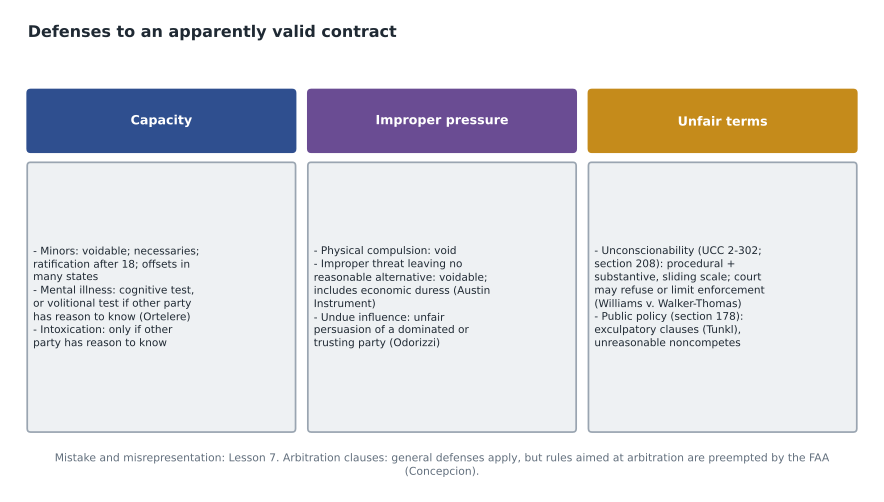
Capacity
Minors
In nearly every state, a person under 18 has the capacity to incur only voidable contractual duties (Restatement (Second) section 14). The minor may disaffirm the contract before reaching majority or within a reasonable time afterward. The adult party is bound unless the minor chooses to avoid. The rule protects minors from their own inexperience and from adults who would take advantage of it, and it applies even when the adult acted fairly and did not know the person was a minor. In Kiefer v. Fred Howe Motors, Inc., 39 Wis. 2d 20, 158 N.W.2d 288 (1968), a 20-year-old, then a minor under Wisconsin law, bought a car, had trouble with it and disaffirmed. The Wisconsin Supreme Court allowed him to avoid the contract and declined to abolish the infancy doctrine, saying that any change was for the legislature.
When a minor disaffirms, the minor must return whatever remains of what he received. The harder question is whether the minor must pay for use or depreciation. The traditional rule allowed full refunds even if the goods were damaged or used up. Many courts now reduce the refund. In Dodson v. Shrader, 824 S.W.2d 545 (Tenn. 1992), a 16-year-old bought a pickup truck, drove it for about nine months, damaged it, and sought a full refund. The Tennessee Supreme Court held that where the minor has not been overreached and the contract was fair, the seller may deduct the value of the minor's use and the depreciation or damage to the truck. Two other limits matter. A minor is liable in restitution for the reasonable value of necessaries, such as food, shelter and medical care actually furnished. And a minor who ratifies after turning 18, expressly or by keeping and using what was bought for an unreasonable time, loses the power to disaffirm. Statutes also make some contracts binding on minors, such as student loans and court-approved entertainment contracts.
Applied to Ashgrove's first story, the 17-year-old can probably disaffirm the truck purchase. Whether he gets a full refund depends on the state: under the traditional rule he would, while under Dodson the dealer could subtract the value of five months' use and the crash damage.
Mental illness and intoxication
Restatement (Second) section 15 makes a contract voidable by a person who, because of mental illness or defect, (a) is unable to understand in a reasonable manner the nature and consequences of the transaction, or (b) is unable to act in a reasonable manner in relation to the transaction and the other party has reason to know of the condition. The first is the cognitive test, the traditional standard. The second is a volitional test that reaches people who understand but cannot control their conduct, such as some people in a manic episode, but only when the other party has reason to know. The volitional approach comes from Ortelere v. Teachers' Retirement Board, 25 N.Y.2d 196, 250 N.E.2d 460 (1969), where a schoolteacher suffering from severe depression and cerebral arteriosclerosis elected a retirement option that maximized her lifetime payments but left nothing for her husband, and died two months later. New York's highest court allowed the election to be avoided because her illness prevented her from acting reasonably and the retirement system knew she was on leave for mental illness. Where the contract was made on fair terms and the other party had no reason to know of the condition, the power of avoidance ends to the extent the contract has been performed or circumstances have changed so that avoidance would be unjust.
Intoxication works similarly. Under section 16, a person who contracts while intoxicated can avoid the contract only if the other party has reason to know that, because of intoxication, the person is unable to understand the nature and consequences of the transaction or to act reasonably in relation to it. Recall Lucy v. Zehmer: Zehmer had been drinking, but the court found he understood what he was doing.
Duress
Duress comes in two forms. If a person is physically compelled to manifest assent, for example by someone guiding her hand to sign, the contract is void (section 174). More commonly, a party assents because of an improper threat that leaves no reasonable alternative, and the contract is voidable (section 175).
Section 176 lists threats that are improper. They include threats of a crime or tort, threats of criminal prosecution, threats to use civil process in bad faith, and a threat that is a breach of the duty of good faith and fair dealing under a contract with the recipient. A threat is also improper if the resulting exchange is not on fair terms and the threatened act would harm the recipient without significantly benefiting the party making the threat, or the threat is otherwise a use of power for illegitimate ends.
Economic duress is the modern battleground. In Austin Instrument, Inc. v. Loral Corp., 29 N.Y.2d 124, 272 N.E.2d 533 (1971), Loral had a contract to make radar sets for the Navy and subcontracted precision gear components to Austin. When Loral sought bids for a second Navy contract, Austin demanded a price increase on the first subcontract and an award of the second, and it threatened to stop deliveries unless Loral agreed. Loral could not find another qualified supplier in time to meet its Navy schedule and faced heavy liquidated damages, so it gave in, then sued to recover the increase. New York's highest court held the agreement voidable for economic duress, because Austin's threat to breach left Loral no reasonable alternative and it could not obtain the goods elsewhere in time.
Economic duress requires more than hard bargaining. Courts generally require a wrongful threat, such as a threat to breach an existing contract, a lack of any reasonable alternative, such as replacement goods or an adequate legal remedy, and actual inducement. A party facing a threatened breach that could readily buy elsewhere and sue for damages usually cannot claim duress. The party claiming duress must also act promptly; a party who accepts the benefits of the new deal for a long time may be found to have ratified it.
Worked problem
Calloway's second demand
In May, after Juniper Hill had already agreed to pay 9,000 dollars more because of the compressor price increase, Calloway's project manager demanded another 15,000 dollars, threatening to stop work immediately and pointing out that the creamery could not find another contractor in time for its fall cheese. Calloway gave no business reason. Lena paid under protest and wrote that she was doing so only to keep the project moving. Can Juniper Hill recover the 15,000 dollars?
Show solution
- The modification is under Article 2, so consideration is not required, but good faith is (section 2-209, comment 2). A demand with no legitimate commercial reason, backed by a threat to breach, fails the good-faith test of Roth Steel.
- Independently, the threat to stop work was a threat to breach the existing contract, which is an improper threat under section 176 when made in bad faith.
- Juniper Hill had no reasonable alternative: a substitute contractor could not finish in time, and damages after the fact would not save the fall production. The facts resemble Austin Instrument.
- Lena paid under written protest and acted promptly, which helps rebut any claim that the creamery ratified the increase.
Answer: The 15,000-dollar modification is likely unenforceable for lack of good faith and voidable for economic duress, and Juniper Hill can likely recover the payment. The earlier 9,000-dollar increase, based on a real cost increase and agreed without a threat, likely stands.
Undue influence
Undue influence is unfair persuasion of a party who is under the domination of the person exercising the persuasion or who, by virtue of the relation between them, is justified in assuming that the other will not act in a manner inconsistent with his welfare (section 177). It is common in cases involving elderly people and their caregivers, family members or advisers, and in relationships of trust such as lawyer and client.
The leading teaching case is Odorizzi v. Bloomfield School District, 246 Cal. App. 2d 123, 54 Cal. Rptr. 533 (1966). A teacher was arrested on criminal charges, which were later dismissed. After he had gone without sleep for about 40 hours, the school superintendent and principal came to his apartment and urged him to resign at once, warning that otherwise he would be dismissed and the publicity would make it impossible to find another teaching job. He signed a resignation. The California Court of Appeal held that he had stated a claim for undue influence. The court identified signs of overpersuasion: discussion at an unusual or inappropriate time and place, insistent demands that the matter be finished at once, extreme emphasis on the consequences of delay, multiple persuaders against a single weakened party, absence of third-party advisers, and statements that there was no time to consult a lawyer.
Unconscionability
Unconscionability lets a court refuse to enforce a contract or a term that is grossly unfair. UCC section 2-302(1) provides that if the court as a matter of law finds the contract or any clause of the contract to have been unconscionable at the time it was made, the court may refuse to enforce the contract, may enforce the remainder of the contract without the unconscionable clause, or may so limit the application of any unconscionable clause as to avoid any unconscionable result. Restatement (Second) section 208 adopts the same approach for contracts generally. Unconscionability is decided by the judge, not the jury, and is measured at the time the contract was made.
The landmark case is Williams v. Walker-Thomas Furniture Co., 350 F.2d 445 (D.C. Cir. 1965). Ora Lee Williams, a mother of seven on public assistance, bought furniture and household goods from a store under a series of installment contracts over several years. Each contract contained a clause, in fine print, that kept a balance due on every item until all items were paid for. When she bought a stereo and fell behind, the store sought to repossess everything she had bought since 1957. Judge J. Skelly Wright held that courts may refuse to enforce unconscionable contracts and remanded for findings. He described unconscionability as an absence of meaningful choice on the part of one of the parties together with contract terms which are unreasonably favorable to the other party.
That formulation gives the two parts courts still use. Procedural unconscionability concerns the bargaining process: unequal bargaining power, lack of meaningful choice, hidden or confusing terms, high-pressure tactics and the absence of a real opportunity to understand. Substantive unconscionability concerns the terms themselves: terms that are overly harsh, one-sided or that shock the conscience. Most courts require both, but they use a sliding scale, so that a strong showing of one requires less of the other. Unconscionability claims rarely succeed between commercial parties of roughly equal sophistication; they succeed mainly in consumer and employment cases.
Arbitration and the Federal Arbitration Act
Many modern unconscionability cases involve arbitration clauses. The Federal Arbitration Act, 9 U.S.C. section 2, makes arbitration agreements valid, irrevocable and enforceable, save upon such grounds as exist at law or in equity for the revocation of any contract. General contract defenses such as unconscionability therefore apply to arbitration clauses, but state rules that single out arbitration or interfere with its fundamental attributes are preempted. In AT&T Mobility LLC v. Concepcion, 563 U.S. 333 (2011), the Supreme Court held that the FAA preempted California's rule treating most class-action waivers in consumer arbitration agreements as unconscionable. In Rent-A-Center, West, Inc. v. Jackson, 561 U.S. 63 (2010), the Court held that parties can delegate questions of an arbitration agreement's enforceability, including unconscionability, to the arbitrator, unless the challenge is aimed at the delegation clause itself.
Courts still strike particular arbitration terms that are one-sided, such as clauses that require the weaker party to pay prohibitive fees, shorten limitations periods drastically, deny remedies available by statute, or bind only the weaker party. In Armendariz v. Foundation Health Psychcare Services, Inc., 24 Cal. 4th 83, 6 P.3d 669 (2000), decided before Concepcion, the California Supreme Court set minimum fairness requirements for mandatory employment arbitration of statutory claims. The creamery's software license in Ashgrove's third story, with price changes at the vendor's will, fee-shifting regardless of outcome and a distant forum, would face a serious unconscionability challenge if the creamery could show it had no meaningful choice. As a business buying commercial software, though, it would have a harder time than a consumer.
Public policy
A court will not enforce a promise or term if the interest in its enforcement is clearly outweighed by a public policy against it (section 178). Contracts to commit crimes or torts are unenforceable. Other examples include agreements to restrain trade unreasonably, contracts that induce a breach of fiduciary duty and some exculpatory clauses. In Tunkl v. Regents of the University of California, 60 Cal. 2d 92, 383 P.2d 441 (1963), the California Supreme Court refused to enforce a hospital admission form releasing the hospital from liability for its employees' negligence, because the hospital provided an essential public service, dealt with patients from a position of great bargaining strength and used a standardized adhesion contract. Courts more often enforce releases for voluntary recreational activities.
Noncompetition agreements are a prominent public policy area. Most states enforce employee noncompetes only if they protect a legitimate business interest and are reasonable in duration, geography and scope. California, by statute, voids almost all of them, and several other states have banned them for lower-wage workers. In April 2024 the Federal Trade Commission adopted a rule banning most noncompetes nationwide, but a federal district court in Texas set the rule aside in August 2024 in Ryan, LLC v. FTC, and in September 2025 the Commission voted to dismiss its appeals and accede to the vacatur. Noncompetes therefore remain a matter of state law, with the FTC pursuing case-by-case enforcement.
When a contract is unenforceable on public policy grounds, courts generally leave the parties where they found them, but a party who is less at fault or who is in the class the policy protects may recover restitution. Courts may also enforce the rest of a contract without an offending term, and many states allow courts to narrow, or blue pencil, an overbroad noncompete.
Common mistakes
MistakeA minor's contract is void.
InsteadIt is voidable at the minor's option. The adult party is bound unless the minor disaffirms.
MistakeAny hard bargaining that leaves a party unhappy is economic duress.
InsteadDuress requires an improper threat, typically a bad-faith threat to breach, that leaves no reasonable alternative and actually induces assent (Austin Instrument).
MistakeUnconscionability is decided by the jury based on whether the terms seem unfair today.
InsteadThe court decides it as a matter of law, measured when the contract was made, usually requiring both procedural and substantive unfairness.
MistakeState courts may refuse to enforce any arbitration clause they consider unwise.
InsteadUnder the FAA, general contract defenses apply to arbitration clauses, but rules that single out arbitration are preempted (Concepcion).
Summary and key terms
- Void contracts are nullities; voidable contracts bind until the protected party avoids them and can be ratified.
- Minors may disaffirm most contracts, subject to liability for necessaries, ratification after majority and, in many states, offsets for use and damage (Dodson v. Shrader).
- Mental incapacity uses a cognitive test and, under section 15(1)(b) and Ortelere, a volitional test if the other party has reason to know; intoxication requires the other party's reason to know.
- Physical compulsion makes a contract void; an improper threat leaving no reasonable alternative makes it voidable, including economic duress (Austin Instrument).
- Undue influence is unfair persuasion of a dominated or trusting party (Odorizzi).
- Unconscionability under UCC 2-302 and section 208 lets courts refuse to enforce grossly unfair contracts or terms, usually requiring procedural and substantive unfairness; the FAA limits rules aimed at arbitration.
- Terms contrary to public policy, such as some exculpatory clauses and unreasonable noncompetes, are unenforceable.
- Void contract
- An agreement with no legal effect, which cannot be enforced or ratified.
- Voidable contract
- A valid contract that one party may avoid or ratify.
- Disaffirmance
- A minor's act of avoiding a voidable contract.
- Necessaries
- Goods and services such as food, shelter and medical care for which a minor is liable in restitution.
- Economic duress
- An improper threat, usually a bad-faith threat to breach, that leaves the victim no reasonable alternative but to agree.
- Undue influence
- Unfair persuasion of a party under the domination of, or in a relationship of trust with, the persuader.
- Procedural unconscionability
- Unfairness in the bargaining process, such as lack of meaningful choice or hidden terms.
- Substantive unconscionability
- Unfairness in the terms themselves, such as harsh or one-sided provisions.
- Exculpatory clause
- A term releasing a party from liability for its own negligence or other wrongdoing.
Practice problems
Work each problem on paper first, then reveal the answer to check.
A 17-year-old buys a laptop on an installment plan, uses it for a year, turns 18 and keeps using it and making payments for eight more months. Can he now disaffirm?
Show answer
Probably not. By keeping the laptop and continuing to pay for an unreasonable time after reaching majority, he likely ratified the contract.
A supplier tells a buyer, "Raise the price 10 percent or we will stop shipping," when the buyer could easily buy the same goods from other suppliers at the original price. Is there economic duress?
Show answer
No. The buyer had reasonable alternatives: it could buy elsewhere and sue for any loss. Duress requires the absence of a reasonable alternative.
Identify the two parts of unconscionability described in Williams v. Walker-Thomas Furniture.
Show answer
An absence of meaningful choice by one party (procedural) together with terms unreasonably favorable to the other party (substantive).
Why did the court in Tunkl refuse to enforce the hospital's release?
Show answer
The release affected the public interest: the hospital provided an essential service, had superior bargaining power and used a standardized adhesion contract, so the clause was contrary to public policy.
Lesson quiz · 5 questions
Score 60% or more to complete this lesson.
Create a free account to save your progress, take quizzes and earn a certificate.