
LAWU-102 · Lesson 3 of 12 · 24 min
Acceptance in practice: the mailbox rule, the battle of the forms and online terms
▶ Video coming soon A video version of this lesson is on the way.
On March 3, 2026, Juniper Hill Creamery sent Calloway Refrigeration a purchase order for the aging room and cold-storage system at the quoted price. Owen Marsh, who handles the creamery's paperwork, used a form a lawyer had drafted for the business years ago. The front listed the equipment, the price and a completion date of June 1, 2026. The back, in small print, said that time was of the essence, that the seller warranted the goods fit for the buyer's purpose of aging cheese, and that the buyer reserved all remedies, including consequential damages.
On March 6, Calloway's order desk emailed back an order acknowledgment on its own form. The front confirmed the equipment and price and gave an "estimated completion" of June 1. The back, also in small print, said that Calloway's acceptance was "expressly conditioned on Buyer's assent to the terms and conditions stated herein," that delivery dates were estimates only, that the seller's only obligation for defects was repair or replacement, that the seller disclaimed all implied warranties, that the seller would not be liable for consequential damages such as spoiled product or lost profits, and that disputes would go to arbitration. Neither Lena nor Owen read the back of the acknowledgment. Calloway began manufacturing the equipment, and Juniper Hill paid the deposit.
Professor Ashgrove calls this "the most common contract problem in American business." Each side's form says the other side's terms do not count, both sides perform, and nobody notices the conflict until something goes wrong. This lesson covers when an acceptance takes effect, how Article 2 resolves conflicting forms, and how courts decide whether consumers have agreed to terms they never read online.
When acceptance takes effect: the mailbox rule
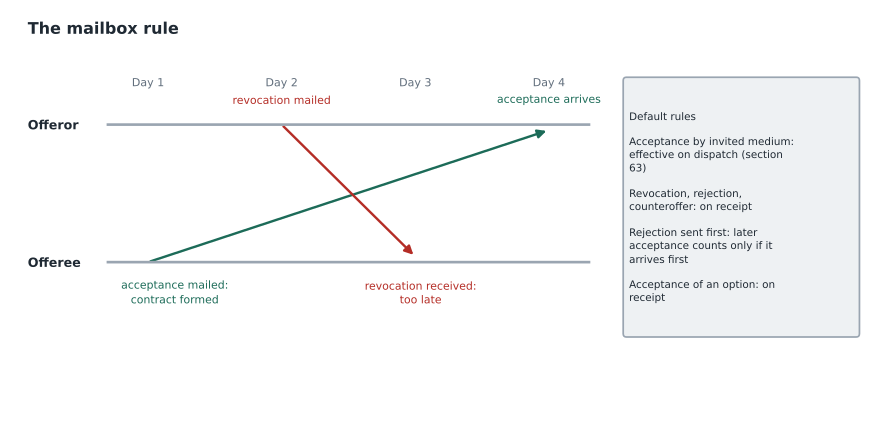
When parties deal at a distance, timing matters. What if an offeror revokes after the offeree has mailed an acceptance but before it arrives? The common law answer, dating from the English case Adams v. Lindsell (1818) 1 B. & Ald. 681, is the mailbox rule. Restatement (Second) section 63 provides that, unless the offer provides otherwise, an acceptance made in a manner and by a medium invited by an offer is operative and completes the contract as soon as it is put out of the offeree's possession, without regard to whether it ever reaches the offeror. A contract formed by mailed acceptance exists from the moment of dispatch, even if the letter is lost.
The rule is a default allocation of risk. Someone has to bear the risk of the gap between sending and receipt, and the mailbox rule places it on the offeror, who controls the offer and can avoid the rule by requiring receipt. Several related rules complete the picture.
- Revocations, rejections and counteroffers take effect only on receipt (sections 40 to 42).
- If the offeree first sends a rejection and then an acceptance, the acceptance is effective only if it arrives before the rejection (section 40). This prevents an offeree from speculating at the offeror's expense.
- Acceptance of an option contract is effective only on receipt (section 63(b)), because the offeror has already bought protection and the reasons for the mailbox rule do not apply.
- An offer may specify that acceptance is effective only on receipt, and then it is.
Modern communication has made the mailbox rule less important. Section 64 provides that acceptance given by telephone or another medium of substantially instantaneous two-way communication is governed by the principles applicable to acceptances where the parties are in each other's presence. Email is not quite instantaneous, and courts have not settled on a single approach, but the practical question is usually when the email was received. Section 15 of the Uniform Electronic Transactions Act treats an electronic record as received when it enters an information processing system the recipient has designated or uses for receiving such records, in a form capable of being processed, even if no one reads it. Calloway's acknowledgment was received when it reached the creamery's inbox on March 6.
The battle of the forms
Under the common law's mirror image rule, Calloway's acknowledgment would be a counteroffer, because it added and changed terms. If Juniper Hill then accepted the equipment without objecting, most courts would say it accepted the counteroffer by conduct. That is the last shot rule: whoever sends the last form before performance wins. The drafters of the UCC thought the last shot rule rewarded accident and form-drafting rather than real agreement, and they wrote section 2-207 to change it for sales of goods.
Section 2-207(1): is there a contract?
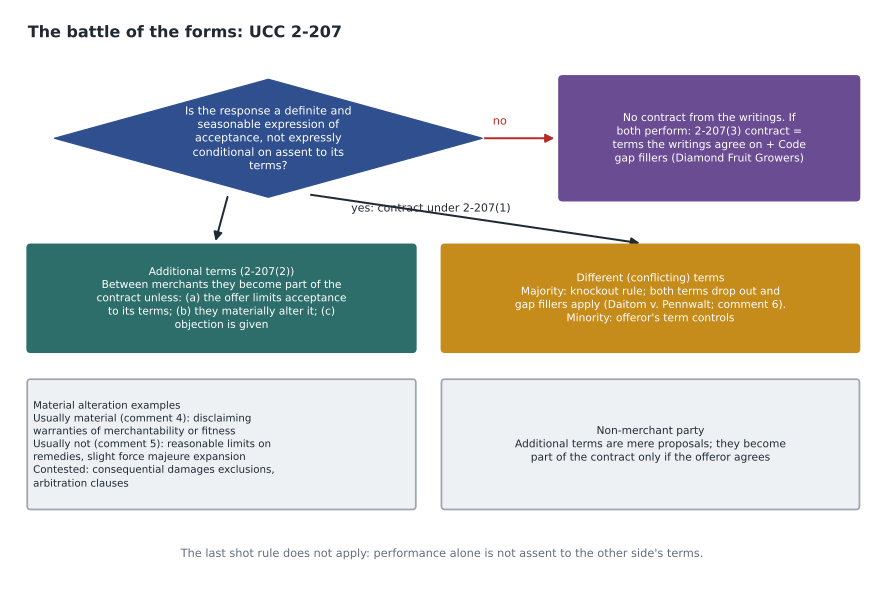
Section 2-207(1) provides that a definite and seasonable expression of acceptance or a written confirmation which is sent within a reasonable time operates as an acceptance even though it states terms additional to or different from those offered or agreed upon, unless acceptance is expressly made conditional on assent to the additional or different terms.
Two points stand out. First, a response can be an acceptance under Article 2 even though it does not mirror the offer, as long as it is a definite expression of acceptance. A response that differs on a dickered term, such as price, quantity or description of the goods, is usually not a definite expression of acceptance at all. Second, a response that is expressly conditional on the offeror's assent to its terms is a counteroffer, not an acceptance.
Courts read the expressly conditional language narrowly. In Dorton v. Collins & Aikman Corp., 453 F.2d 1161 (6th Cir. 1972), a seller's acknowledgment said that acceptance was "subject to all of the terms and conditions on the face and reverse side hereof." The Sixth Circuit held that this was not enough; the proviso applies only when the offeree clearly shows that it is unwilling to proceed with the transaction unless it is assured of the offeror's assent to the new terms. Calloway's form uses stronger language: acceptance expressly conditioned on the buyer's assent to the seller's terms, which tracks the statute. Many courts would treat that as a counteroffer.
Section 2-207(3): contract by conduct
If the writings do not form a contract, because the response was expressly conditional or was not a definite acceptance, but the parties behave as if they have a contract, section 2-207(3) applies. Conduct by both parties which recognizes the existence of a contract is sufficient to establish one. The terms of that contract consist of those terms on which the writings of the parties agree, together with any supplementary terms incorporated under any other provisions of the Code, which means Article 2's gap fillers.
This is the most important difference from the last shot rule. In Diamond Fruit Growers, Inc. v. Krack Corp., 794 F.2d 1440 (9th Cir. 1986), a seller's acknowledgment was expressly conditional on assent to its limitation of liability, and the buyer accepted and used the goods without ever agreeing to that term. The Ninth Circuit held that the buyer's conduct did not amount to assent to the seller's terms. The contract arose under section 2-207(3), and the seller's disclaimer was not part of it. A party that wants its terms to govern must actually obtain the other side's agreement, not just send the last form.
Section 2-207(2): additional terms
If the response is an acceptance under subsection (1), the next question is what happens to its additional terms. Section 2-207(2) treats them as proposals for addition to the contract. Between merchants, such terms become part of the contract unless (a) the offer expressly limits acceptance to the terms of the offer, (b) they materially alter the contract, or (c) notification of objection to them has already been given or is given within a reasonable time after notice of them is received. If either party is not a merchant, additional terms are only proposals, and they do not become part of the contract unless the offeror agrees.
Whether a term materially alters the contract depends on whether incorporating it without express awareness would result in surprise or hardship. The official comments give examples. Comment 4 lists terms that would normally materially alter, including a clause negating standard warranties such as merchantability, and a clause requiring a guaranty of 90 or 100 percent deliveries where trade usage allows greater leeway. Comment 5 lists terms that would not, such as a clause setting forth and perhaps enlarging slightly the seller's exemption due to supervening causes beyond his control, or otherwise limiting remedy in a reasonable manner. Courts are divided about clauses excluding consequential damages and about arbitration clauses. New York's highest court, in Marlene Industries Corp. v. Carnac Textiles, Inc., 45 N.Y.2d 327 (1978), held that an arbitration clause materially alters a contract, while other courts look at whether arbitration is customary in the trade.
Different terms and the knockout rule
Section 2-207(2) speaks only of additional terms. What about different terms, where the forms conflict? Courts divide into three camps. The majority applies the knockout rule: conflicting terms cancel each other out, and the Code's gap fillers take their place. Daitom, Inc. v. Pennwalt Corp., 741 F.2d 1569 (10th Cir. 1984), adopted that rule, relying in part on comment 6 to section 2-207, which says that conflicting terms in confirming forms are assumed to be objected to by each party. A second group treats different terms like additional terms, so they drop out if they materially alter the contract, leaving the offeror's terms in place. A third view, now rare, holds that the offeror's terms control because the offeree's different terms never become part of the contract.
Worked problem
The Juniper Hill and Calloway forms
Juniper Hill's purchase order (the offer) promised June 1 completion with time of the essence, an express warranty of fitness for aging cheese, and all remedies including consequential damages. Calloway's acknowledgment accepted on the front but said on the back that acceptance was expressly conditioned on the buyer's assent to its terms, which disclaimed implied warranties, limited remedies to repair or replacement, excluded consequential damages, made delivery dates estimates and required arbitration. Both sides then performed. What are the terms of the contract?
Show solution
- Section 2-207(1): Calloway's acknowledgment expressly conditions its acceptance on the buyer's assent to its terms, in language tracking the statute, so it is likely a counteroffer, not an acceptance.
- Juniper Hill never expressly agreed to Calloway's terms. Under Diamond Fruit Growers, paying a deposit and allowing manufacture is conduct recognizing a contract, not assent to Calloway's terms.
- Section 2-207(3): a contract exists by conduct. Its terms are those on which the writings agree: the equipment, the price and, arguably, a June 1 target date that both forms mention, though one calls it firm and the other an estimate.
- Gap fillers supply the rest: the implied warranties of merchantability (section 2-314) and possibly fitness for a particular purpose (section 2-315) apply, the buyer has the Code's full remedies including consequential damages (section 2-715), and there is no arbitration clause.
- If a court instead found that Calloway's form was an acceptance under 2-207(1), its additional terms would face 2-207(2): the warranty disclaimer would likely be a material alteration (comment 4), the consequential damages exclusion and arbitration clause would be contested, and conflicting terms would be knocked out in most courts.
Answer: Most likely the contract arose under section 2-207(3) and consists of the agreed terms plus the Code's gap fillers. Calloway's disclaimer, remedy limitation, consequential damages exclusion and arbitration clause probably are not part of the deal, which matters greatly when the cheese spoils in July.
Priya Natarajan notices that Calloway would have been better off with weaker language that made its form an acceptance with proposals, rather than a counteroffer. Ashgrove smiles. "Many seller's lawyers have learned that the hard way," he says. "The real lesson for practice is that the forms rarely protect anyone. If a term matters, negotiate it and get the other side to sign."
Terms that arrive later and online contracts
A related problem arises when terms come with the product, after the buyer has paid. In ProCD, Inc. v. Zeidenberg, 86 F.3d 1447 (7th Cir. 1996), a buyer purchased database software in a store. The box said a license was inside; the license, displayed on screen whenever the program ran, limited use to noncommercial purposes. Judge Easterbrook held the license enforceable. The vendor, as master of the offer, could invite acceptance by conduct, and the buyer accepted by using the software after having a chance to read the terms and return it. In Hill v. Gateway 2000, Inc., 105 F.3d 1147 (7th Cir. 1997), the same court enforced an arbitration clause in terms shipped in the box with a computer ordered by phone, because the buyers kept the computer beyond the 30-day return period. These are called rolling contracts or terms-later contracts.
Not every court agrees. In Klocek v. Gateway, Inc., 104 F. Supp. 2d 1332 (D. Kan. 2000), the court reasoned that the buyer made the offer when ordering, the seller accepted by shipping, and the terms in the box were at most proposals for additional terms under section 2-207(2), which a consumer does not accept by keeping the computer. The split persists, though many courts follow Hill.
Online, courts sort agreements by how terms are presented. A clickwrap agreement requires the user to click a box or button saying "I agree" after the terms are presented or linked, and courts almost always enforce it. A browsewrap agreement posts terms on a website, usually through a link at the bottom of the page, and claims that using the site means agreeing; courts enforce it only if the user had actual or constructive notice. In Specht v. Netscape Communications Corp., 306 F.3d 17 (2d Cir. 2002), the Second Circuit refused to enforce an arbitration clause in license terms visible only if users scrolled below the download button. In Nguyen v. Barnes & Noble Inc., 763 F.3d 1171 (9th Cir. 2014), a link to terms of use at the bottom of every page was not enough to bind a customer who bought on the site without any affirmative assent.
Between those poles lie sign-in wraps and similar designs, where a user clicks a button such as "Sign up" or "Place order" near a notice that doing so means agreeing to linked terms. Courts enforce them when the notice is reasonably conspicuous and the user takes an action that unambiguously manifests assent. In Meyer v. Uber Technologies, Inc., 868 F.3d 66 (2d Cir. 2017), the Second Circuit enforced Uber's terms because the registration screen was uncluttered and the notice appeared directly below the button. In Berman v. Freedom Financial Network, LLC, 30 F.4th 849 (9th Cir. 2022), the Ninth Circuit refused to enforce terms whose notice was in tiny gray text that a reasonable user would not notice, and held that the user must take some action, such as clicking a button, that unambiguously manifests assent to the terms. Design details such as font size, color, contrast and placement now decide cases.
Marcus Webb asks whether that means a company can bind customers to almost anything as long as the button is clear. Ashgrove answers that assent is only the first hurdle. Terms that are enforceable as a matter of formation can still be struck down as unconscionable, contrary to public policy or deceptive, topics in Lesson 6.
Common mistakes
MistakeAn acceptance is effective only when the offeror receives it.
InsteadUnder the mailbox rule, an acceptance sent by an invited medium is effective on dispatch; revocations and rejections are effective on receipt.
MistakeUnder Article 2, whoever sends the last form wins.
InsteadSection 2-207 rejects the last shot rule. Even an expressly conditional acceptance followed by performance yields a contract under 2-207(3) on the terms the writings share plus gap fillers.
MistakeAdditional terms in a merchant's acceptance always become part of the contract.
InsteadThey do not if the offer limited acceptance to its terms, if they materially alter the contract, or if the offeror objects.
MistakeTerms posted anywhere on a website bind every user.
InsteadCourts require reasonably conspicuous notice and an action that unambiguously manifests assent; bare browsewrap links are often unenforceable.
Summary and key terms
- Acceptances sent by an invited medium are effective on dispatch; revocations, rejections and acceptances of options are effective on receipt.
- Instantaneous communications are treated like face-to-face dealings; electronic records are generally received when they enter the recipient's system.
- Section 2-207(1) lets a definite expression of acceptance form a contract despite different or additional terms, unless acceptance is expressly conditional on assent.
- If the writings do not form a contract but the parties perform, section 2-207(3) creates a contract consisting of the agreed terms plus Code gap fillers.
- Between merchants, additional terms become part of the contract unless barred by section 2-207(2); conflicting terms are usually knocked out.
- Rolling contracts and online terms are enforced when the buyer had reasonable notice and manifested assent; courts scrutinize design and presentation.
- Mailbox rule
- The rule that an acceptance sent by an invited medium is effective when dispatched.
- Battle of the forms
- The conflict that arises when buyer and seller exchange standard forms with inconsistent terms.
- Last shot rule
- The common law result that the last form sent before performance governs, because performance accepts it.
- Expressly conditional acceptance
- A response stating that acceptance depends on the offeror's assent to the responder's terms; a counteroffer under section 2-207(1).
- Material alteration
- An additional term that would cause surprise or hardship if incorporated without express awareness.
- Knockout rule
- The majority rule that conflicting terms in the parties' forms cancel out and are replaced by gap fillers.
- Clickwrap
- An online agreement requiring the user to click to agree to presented or linked terms.
- Browsewrap
- Terms posted on a website that claim to bind users through use alone, without an affirmative click.
Practice problems
Work each problem on paper first, then reveal the answer to check.
On June 1 Seller mails an offer. On June 3 Buyer mails an acceptance. On June 4 Seller emails a revocation, which Buyer reads that day. On June 6 the acceptance arrives. Is there a contract?
Show answer
Yes. The acceptance was effective on dispatch on June 3, before the revocation was received on June 4.
A buyer's purchase order says nothing about interest on late payments. The seller's acknowledgment, a definite acceptance, adds a term charging 1.5 percent interest per month on late payments. Both are merchants. Is the interest term part of the contract?
Show answer
Under section 2-207(2) it becomes part of the contract unless the offer limited acceptance, the buyer objected, or the term materially alters the contract. Courts often find reasonable interest terms not material, though the result depends on surprise and hardship.
Why did the court in Diamond Fruit Growers refuse to enforce the seller's limitation of liability?
Show answer
The seller's acknowledgment was expressly conditional, so no contract formed from the writings; the buyer's performance created a contract under 2-207(3), whose terms included only the agreed terms and gap fillers, not the seller's limitation.
A shopping app shows a large "Buy now" button with a line directly below in clear type: "By tapping Buy now you agree to our Terms," with a working link. Are the terms likely enforceable as a matter of assent?
Show answer
Yes. The notice is reasonably conspicuous and tapping the button unambiguously manifests assent, as in Meyer v. Uber.
Lesson quiz · 5 questions
Score 60% or more to complete this lesson.
Create a free account to save your progress, take quizzes and earn a certificate.