
LAWU-102 · Lesson 1 of 12 · 26 min
Sources of contract law and the scope of Article 2
▶ Video coming soon A video version of this lesson is on the way.
Professor Theodore Ashgrove begins the first Contracts class at Larkhaven Law School by holding up a grocery receipt. "This is a contract," he says. "So is the lease on your apartment, the terms of service you accepted without reading when you joined the law school's Wi-Fi, the bar-prep course some of you have already signed up for, and the loan that is paying for all of this." He spent fourteen years as in-house counsel for a regional food distributor before he started teaching, and he likes to say that he has read more purchase orders than casebooks. "Most of the law you will study this year is about what happens when something goes wrong. Contract law is about what people promise each other before anything goes wrong, and which of those promises the law will enforce."
Section B will follow one running problem through the whole course. It is invented, but it is built from the kinds of disputes Ashgrove saw in practice. Juniper Hill Creamery is a family dairy and cheese maker in farm country two hours north of the law school, run by Lena Marsh and her brother Owen. In early 2026 the creamery decided to build a new aging room and cold-storage space for its cheese. It began negotiating with Calloway Refrigeration Systems, Inc., a manufacturer that sells and installs commercial refrigeration equipment. Over the coming weeks the class will see the parties exchange a price quote, a purchase order and an order acknowledgment with conflicting terms, argue about what they agreed, suffer a missed delivery date and a July heat wave, and fight about who pays for spoiled cheese.
This first lesson asks two questions that come before every other question in the course. Where does contract law come from? And which body of contract law governs a particular deal: the common law of contracts, or Article 2 of the Uniform Commercial Code?
What a contract is
The Restatement (Second) of Contracts defines a contract in its first section as a promise or a set of promises for the breach of which the law gives a remedy, or the performance of which the law in some way recognizes as a duty. Two features of that definition matter from the start. First, a contract is built from promises: commitments about the future. Second, not every promise is a contract. A promise to meet a friend for dinner is a promise, but no court will award damages if you cancel. The central work of contract law is sorting enforceable promises from unenforceable ones, and then deciding what the remedy should be when an enforceable promise is broken.
Why should the law enforce promises at all? Scholars offer several overlapping answers. One is autonomy: people should be able to bind themselves by choice, and the law respects that choice by holding them to it. Another is reliance: people change their positions because of promises, and it would be unfair to let the promisor walk away after the other party has acted. A third is economic: enforceable promises let strangers trade over time, plan production and invest, which makes everyone better off. Priya Natarajan, an economics major, likes the third answer. Hannah Lindqvist, a former history teacher, points out that the answers sometimes pull in different directions. "They do," Ashgrove says, "and you will see each of them winning in different cases this semester."
The common law of contracts
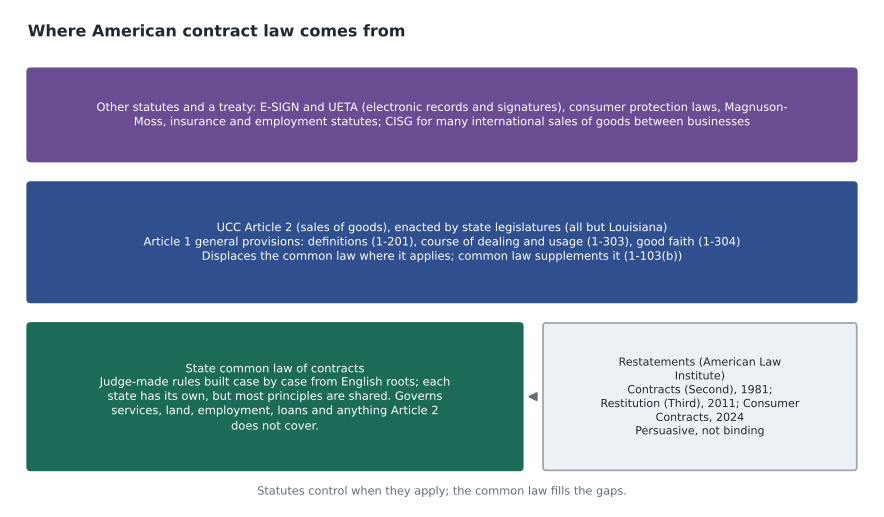
Most American contract law is state law, and most of it is common law: rules developed by judges deciding cases, one dispute at a time, building on English decisions that predate American independence. There is no single national law of contracts. Each state has its own, and a contract dispute is decided under the law of a particular state. In practice, the states agree on most basic principles, and law school courses teach the majority approach while pointing out where the states divide.
Because common law is spread across thousands of decisions, lawyers and judges rely heavily on secondary sources that organize it. The most important is the Restatement (Second) of Contracts, published by the American Law Institute in 1981. The American Law Institute is a private organization of judges, practitioners and professors. Its Restatements describe what the reporters and members believe the law is, or in some places what they think it should be. A Restatement is not binding law. A court is free to reject a section. But courts cite the Restatement (Second) constantly, and many have adopted particular sections as the law of their state. Throughout this course you will see section numbers such as section 90 on promissory estoppel and section 205 on good faith, because that is how American lawyers talk about contract doctrine.
Two newer Restatements also matter. The Restatement (Third) of Restitution and Unjust Enrichment, published in 2011, governs claims to recover benefits when there is no enforceable contract or when a contract fails, which comes up in Lesson 11. The Restatement of the Law, Consumer Contracts, which the American Law Institute made available in June 2024, addresses how courts apply contract principles to standard-form consumer deals, especially online terms, including assent to standard terms, modification of terms, unconscionability and deception. It is controversial, and its influence on courts is still developing.
The Uniform Commercial Code
Common law worked reasonably well for land, services and personal agreements, but by the twentieth century commercial sellers and buyers were trading goods across state lines in enormous volumes, and differences among state rules created friction. The answer was the Uniform Commercial Code, a joint project of the American Law Institute and the Uniform Law Commission (formally the National Conference of Commissioners on Uniform State Laws). The first official text appeared in 1952, and by the late 1960s every state except Louisiana had enacted the Code. Louisiana, with its civil law tradition, has enacted most of the Code but not Article 2; its sales law remains in its Civil Code.
The Code is not federal law. It is a model statute that each state legislature enacts, sometimes with local variations. Once enacted, it is a state statute, and it displaces common law rules where it applies. Section 1-103(b) of the Code adds that unless displaced by particular provisions, the principles of law and equity, including the law of contract, capacity, fraud, duress, mistake and estoppel, supplement its provisions. So even in a sale of goods, common law doctrines continue to operate in the background wherever Article 2 is silent.
Article 2 governs sales of goods. Article 1 contains general provisions that apply throughout the Code, including definitions in section 1-201 and the obligation of good faith in section 1-304, which provides that every contract or duty within the Code imposes an obligation of good faith in its performance and enforcement. Other articles cover leases of goods (Article 2A), negotiable instruments, bank deposits, letters of credit, documents of title, investment securities and secured transactions (Article 9), which you will study in a later course.
The Code is revised from time to time. A set of amendments to Article 2 proposed in 2003 was never enacted by any state and was withdrawn in 2011, so the Article 2 you will apply is essentially the original text. In 2022 the sponsors approved amendments addressing emerging technologies, including a new Article 12 on controllable electronic records and changes to several other articles. Those amendments also revised section 2-102 to address hybrid transactions that combine goods with services or other property, a problem discussed below. More than half the states have enacted the 2022 amendments since then, but enactment is not universal, and the hybrid-transaction language matters only in states that adopted it.
Other statutes and a treaty
Several other bodies of law touch contracts. The federal Electronic Signatures in Global and National Commerce Act of 2000, usually called E-SIGN, and the Uniform Electronic Transactions Act, adopted in almost every state, provide that a record or signature may not be denied legal effect solely because it is electronic. Consumer protection statutes, including state laws against unfair and deceptive practices and the federal Magnuson-Moss Warranty Act, add rules that ordinary contract law does not. Specialized regimes govern insurance, employment and real estate.
One treaty matters for international sales. The United Nations Convention on Contracts for the International Sale of Goods, known as the CISG, took effect for the United States in 1988. As a treaty, it is federal law and binds state and federal courts. It generally applies to sales of goods between parties whose places of business are in different countries that have joined the Convention, unless the parties exclude it, and it does not apply to purchases of goods for personal, family or household use. If Juniper Hill had bought its compressors directly from a manufacturer in Germany or Italy, the CISG, not Article 2, would presumptively govern. Lawyers who draft international sales contracts often exclude the CISG expressly, sometimes without thinking about whether it would serve their client better.
Does Article 2 apply? Goods and merchants
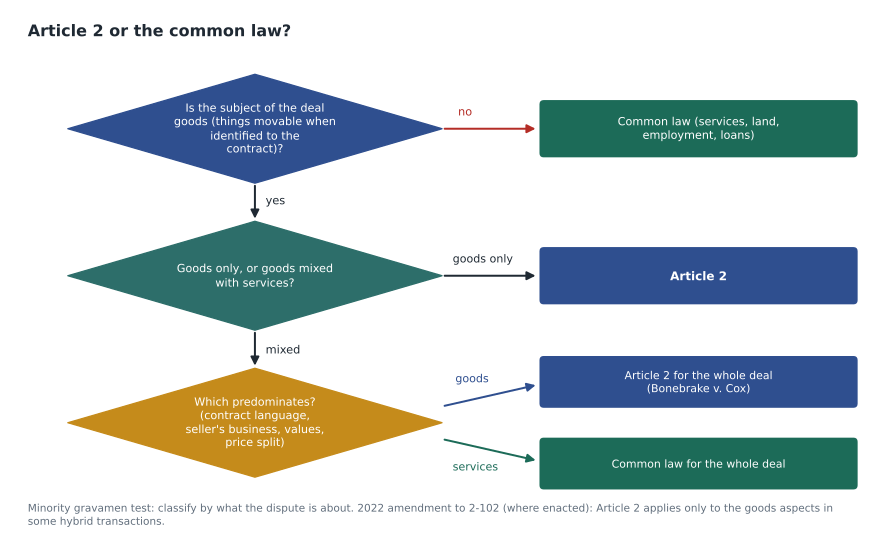
Section 2-102 says Article 2 applies to transactions in goods. Section 2-105 defines goods as all things, including specially manufactured goods, that are movable at the time of identification to the contract for sale, with some exclusions such as money in which the price is paid, investment securities and things in action. Most courts read Article 2 as applying to sales of goods, even though the scope section speaks more broadly of transactions. Cars, crops, refrigeration compressors, cheese, books and bicycles are goods. Land, buildings, services, employment, loans and intellectual property licenses are not. Growing crops and timber to be cut can be goods, and section 2-107 addresses minerals and structures to be removed from land.
Some Article 2 rules apply only to merchants. Section 2-104 defines a merchant as a person who deals in goods of the kind or otherwise by occupation holds itself out as having knowledge or skill peculiar to the practices or goods involved. Calloway Refrigeration is a merchant in commercial refrigeration equipment. Juniper Hill is a merchant in cheese, and courts would probably treat it as a merchant for many purposes in buying equipment, since the Code's comments explain that almost every person in business counts as a merchant for rules that turn on general business practices, such as answering mail. Merchant status triggers special rules on firm offers (section 2-205), additional terms in acceptances (section 2-207), the written confirmation exception to the statute of frauds (section 2-201(2)) and the implied warranty of merchantability (section 2-314).
Mixed contracts and the predominant purpose test
Many deals combine goods and services. A homeowner buys a furnace and pays for installation. A hospital buys an imaging machine and a maintenance plan. A business licenses software that arrives with a laptop. Juniper Hill's deal with Calloway is a classic mixed contract: compressors, evaporator coils, insulated panels, doors and controls, plus design work, installation and start-up. Which body of law applies?
Most courts use the predominant purpose test. The leading case is Bonebrake v. Cox, 499 F.2d 951 (8th Cir. 1974), which involved the sale and installation of bowling alley equipment. The court asked whether the predominant factor, thrust or purpose of the contract, reasonably stated, was the rendition of service with goods incidentally involved, or a transaction of sale with labor incidentally involved. If goods predominate, Article 2 governs the whole contract; if services predominate, the common law governs the whole contract. Courts look at the language of the contract, the nature of the supplier's business, the relative value of the goods and services, and how the price is allocated. Under the predominant purpose test, the answer is all or nothing.
A minority of courts use a gravamen test, asking whether the dispute concerns the goods or the services. In Anthony Pools v. Sheehan, 295 Md. 285, 455 A.2d 434 (1983), Maryland's high court allowed an implied warranty claim about a diving board, a good, even though the larger contract to build a swimming pool was mainly for services. The gravamen approach can apply Article 2 to one part of a deal and the common law to another.
The 2022 amendments to section 2-102 take a position on hybrid transactions in the states that have enacted them. If the sale-of-goods aspects predominate, Article 2 applies to the transaction but does not govern aspects of it that relate only to the non-goods part. If the sale-of-goods aspects do not predominate, only the Article 2 provisions that relate primarily to the goods aspects apply. The amendment preserves the predominant purpose inquiry while softening its all-or-nothing results.
Software is the hardest modern case. When software is delivered on a physical medium or embedded in a device, many courts have treated the transaction as a sale of goods. When it is downloaded or accessed online, some courts treat it as a license of intangible property outside Article 2, and others apply Article 2 by analogy. Marcus Webb, who worked at a battery-storage startup, says the controllers in a modern refrigeration system are mostly software. Ashgrove agrees that this is exactly where the old categories strain, and says that courts still resolve most such cases by asking what the parties were really buying.
Why the classification matters
Jordan Kimura, an Army veteran who leads the section's study group, asks why anyone should care which body of law applies if the two are similar. Ashgrove answers with a list, and promises that every item will return later in the course.
- Formation. The common law's mirror image rule requires an acceptance to match the offer exactly; section 2-207 lets a contract form despite different terms (Lessons 2 and 3).
- Firm offers. At common law an offer can be revoked unless the offeree paid for an option; section 2-205 makes a merchant's signed written promise to hold an offer open binding without consideration (Lesson 2).
- Modification. The common law traditionally requires new consideration to modify a contract; section 2-209 does not (Lesson 4).
- Writing requirements. The statute of frauds in section 2-201 covers sales of goods for 500 dollars or more and has its own exceptions (Lesson 5).
- Gap fillers. Article 2 supplies terms for price, delivery, payment and quality when the parties leave them open, including implied warranties (Lesson 8).
- Performance. Article 2's perfect tender rule lets a buyer reject goods that fail in any respect, subject to cure; the common law uses substantial performance and material breach (Lesson 9).
- Remedies and limitations. Article 2 has its own remedy provisions, including cover and resale, and a four-year statute of limitations in section 2-725 that the parties can shorten to one year (Lessons 11 and 12).
| Issue | Common law | UCC Article 2 |
|---|---|---|
| Acceptance with different terms | Counteroffer (mirror image rule) | Can still be an acceptance (section 2-207) |
| Promise to hold an offer open | Revocable unless an option is paid for | Merchant's signed firm offer binding up to three months (section 2-205) |
| Modification | Usually needs new consideration | Needs only good faith (section 2-209) |
| Writing requirement | Specific categories (land, one-year contracts and others) | Sales of goods for 500 dollars or more (section 2-201) |
| Standard of performance | Substantial performance; material breach | Perfect tender, with cure and limits (sections 2-601, 2-508) |
| Limitations period | Set by state statute, often six years for written contracts | Four years from breach (section 2-725) |
Worked problem
Classifying the Juniper Hill deal
Calloway Refrigeration quoted Juniper Hill a total price of about 212,000 dollars: about 168,000 dollars for compressors, coils, insulated panels, doors and controls, and about 44,000 dollars for design, installation, refrigerant charging and start-up. Calloway manufactures most of the equipment and treats installation as part of selling it. Is the contract governed by Article 2 or the common law?
Show solution
- Identify the goods: the compressors, coils, panels, doors and controls are movable things identified to the contract, so they are goods under section 2-105.
- Identify the services: design, installation, charging and start-up are services.
- Apply the predominant purpose test. The goods account for roughly four-fifths of the price, Calloway is primarily a manufacturer and seller of equipment, and the services exist to make the equipment work.
- Conclude: the predominant purpose is a sale of goods with labor incidentally involved, as in Bonebrake v. Cox.
- Consider the 2022 amendment: in a state that enacted it, Article 2 governs the transaction but not aspects that relate solely to the services, so a dispute purely about the quality of the installation labor could still be decided under common law principles.
Answer: Article 2 governs the contract as a whole under the predominant purpose test. The parties' price split, Calloway's business and the purpose of the deal all point toward a sale of goods.
Freedom of contract and its limits
American contract law starts from freedom of contract: competent adults may make the bargains they choose, and courts generally enforce them as written. Most of Article 2's rules are default rules that the parties can change by agreement. Section 1-302 says the effect of the Code's provisions may be varied by agreement, but the obligations of good faith, diligence, reasonableness and care may not be disclaimed, although the parties may set reasonable standards for measuring them. Other limits come from doctrines you will meet later: unconscionability, public policy, duress and the rules protecting minors and people who lack capacity.
The tension between freedom and fairness runs through the whole course. Standard-form contracts drafted by one side and accepted without negotiation make the tension sharper. Most consumers never read the terms they accept, and businesses know it. Courts generally enforce such terms anyway, as long as the consumer had reasonable notice and a chance to read them, but they police the worst abuses. Ashgrove ends the class by asking the students to look at the terms of the last app they downloaded. "Count how many of those terms you would have agreed to if anyone had asked," he says.
Common mistakes
MistakeThere is a single national law of contracts.
InsteadContract law is mainly state law. The states agree on most principles, but each decides cases under its own common law and its own enactment of the UCC.
MistakeThe Restatement (Second) of Contracts is binding on courts.
InsteadRestatements are persuasive secondary sources. Courts often adopt their sections, but they are not statutes.
MistakeArticle 2 applies to any commercial contract.
InsteadArticle 2 applies to sales of goods. Services, land, employment and loans are governed by the common law and other statutes.
MistakeIf a contract includes any goods, Article 2 applies to all of it.
InsteadMost courts ask whether goods or services predominate. A mainly-services contract with incidental goods is governed by the common law.
Summary and key terms
- A contract is a promise or set of promises the law will enforce; contract law decides which promises are enforceable and what remedies follow breach.
- Most contract law is state common law, organized by the Restatement (Second) of Contracts, which courts treat as persuasive authority.
- UCC Article 2, enacted by every state except Louisiana, governs sales of goods and displaces the common law where it applies; common law principles supplement it under section 1-103(b).
- Goods are things movable when identified to the contract; some Article 2 rules apply only to merchants.
- Mixed goods-and-services contracts are classified by the predominant purpose test in most states; the 2022 amendments to section 2-102 adjust the result for hybrid transactions where enacted.
- The classification affects formation, firm offers, modification, writing requirements, gap fillers, performance standards, remedies and limitations periods.
- Contract
- A promise or set of promises for whose breach the law gives a remedy (Restatement (Second) of Contracts section 1).
- Restatement (Second) of Contracts
- The American Law Institute's 1981 statement of contract doctrine, widely cited as persuasive authority.
- Uniform Commercial Code
- A model statute enacted by state legislatures governing commercial transactions; Article 2 covers sales of goods.
- Goods
- All things movable at the time of identification to the contract for sale (UCC section 2-105).
- Merchant
- A person who deals in goods of the kind or holds itself out as having special knowledge or skill about them (UCC section 2-104).
- Predominant purpose test
- The majority test for mixed contracts, asking whether the main thrust of the deal is a sale of goods or the provision of services.
- Gravamen test
- A minority approach that applies Article 2 or the common law depending on whether the dispute concerns the goods or the services.
- CISG
- The UN Convention on Contracts for the International Sale of Goods, a treaty that governs many international sales of goods between businesses.
- Default rule
- A rule that applies unless the parties agree otherwise.
Practice problems
Work each problem on paper first, then reveal the answer to check.
A dentist buys a dental chair for 9,000 dollars and pays 600 dollars to have it installed. Which law governs a dispute about a defect in the chair?
Show answer
Article 2. The goods predominate in value and purpose, so the contract is a sale of goods with incidental services.
A software company sends an Ohio customer a signed letter promising to hold its price quote open for 30 days. Under what rule is the promise binding, and what must be true of the company?
Show answer
UCC section 2-205 makes a merchant's signed written firm offer for goods binding without consideration for the stated time, up to three months. The company must be a merchant and the transaction must be a sale of goods.
Why might a lawyer care whether the CISG applies to a sale between a US buyer and an Italian seller?
Show answer
The CISG, not Article 2, would govern unless excluded, and its rules on formation, writing and remedies differ from Article 2's.
What does UCC section 1-103(b) do?
Show answer
It keeps common law and equitable principles, such as fraud, duress, mistake and estoppel, in force to supplement the Code unless a particular provision displaces them.
Lesson quiz · 5 questions
Score 60% or more to complete this lesson.
Create a free account to save your progress, take quizzes and earn a certificate.