
LAWU-102 · Lesson 12 of 12 · 26 min
Third parties and a capstone problem
▶ Video coming soon A video version of this lesson is on the way.
On the last day of the semester, Professor Ashgrove brings Juniper Hill's story to a close and then hands out a fresh problem. Before the capstone, though, the course has one more topic: contracts that affect people who did not make them. By November 2026, Juniper Hill's dispute had pulled in several outsiders. Northgate Grocers claimed it should be able to sue Calloway for the short October deliveries, since the spoiled cheese had been destined for its stores. Juniper Hill's bank, which had financed the aging room, held an assignment of the creamery's right to payments from Northgate. And Calloway had subcontracted the electrical work to an outside electrician, whose poor coordination had added to the June delay.
Each of these situations raises a version of the same question. Contract rights and duties belong, at first, only to the parties who made the contract. When can a stranger to the contract enforce it, and when can a party transfer its rights or hand off its duties to someone else?
Third-party beneficiaries
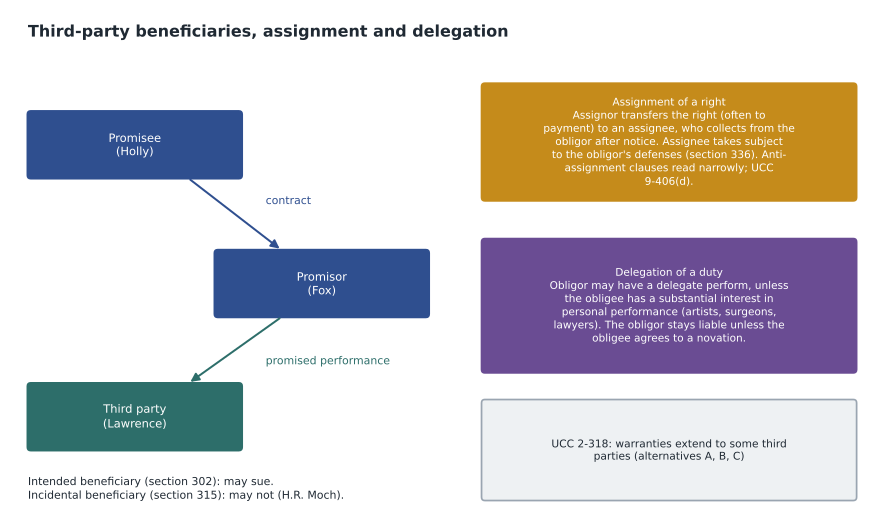
The traditional rule of privity of contract said that only parties could sue on a contract. American law broke from that rule early. In Lawrence v. Fox, 20 N.Y. 268 (1859), Holly owed Lawrence 300 dollars. Holly lent 300 dollars to Fox, who promised Holly to pay the money to Lawrence the next day. Fox did not pay, and Lawrence sued Fox. The New York Court of Appeals allowed the suit, even though Lawrence was not a party to the promise and gave no consideration for it, because the promise was made for his benefit. Later, in Seaver v. Ransom, 224 N.Y. 233, 120 N.E. 639 (1918), the same court allowed a niece to enforce her uncle's promise to his dying wife that he would leave the niece a house in his own will, in exchange for the wife's signing a will that left him her property.
The early cases sorted beneficiaries into creditor beneficiaries, like Lawrence, and donee beneficiaries, like the niece. Restatement (Second) section 302 replaced those categories with a single test. A beneficiary of a promise is an intended beneficiary if recognition of a right to performance in the beneficiary is appropriate to effectuate the intention of the parties and either (a) the performance of the promise will satisfy an obligation of the promisee to pay money to the beneficiary, or (b) the circumstances indicate that the promisee intends to give the beneficiary the benefit of the promised performance. Any other beneficiary is an incidental beneficiary, who acquires no rights against the promisor (section 315).
The line between intended and incidental beneficiaries is often hard to draw. Courts look at the contract's language, whether performance runs directly to the third party, and the parties' purposes. In H.R. Moch Co. v. Rensselaer Water Co., 247 N.Y. 160, 159 N.E. 896 (1928), a water company contracted with a city to supply water, including water for fire hydrants. When a warehouse burned because of inadequate water pressure, the warehouse owner sued the water company. Judge Cardozo held that the owner was an incidental beneficiary: the city made the contract to perform its own governmental functions, not to make the water company an insurer of every resident's property. Government contracts are generally treated as creating no rights in members of the public unless the contract clearly says otherwise (section 313).
Once a beneficiary's rights vest, the original parties cannot change them without the beneficiary's consent. Under section 311, vesting occurs when the beneficiary, before receiving notice of a discharge or modification, materially changes position in justifiable reliance on the promise, brings suit on it, or manifests assent at the request of the promisor or promisee. The promisor may assert against the beneficiary any defense it would have had against the promisee, such as fraud, failure of consideration or the promisee's own breach (section 309).
Worked problem
Can Northgate sue Calloway?
Northgate Grocers argues that the cheese spoiled by Calloway's delay was meant for its October deliveries, so it should be able to recover its losses directly from Calloway. Calloway's contract with Juniper Hill said nothing about Northgate. Is Northgate an intended beneficiary?
Show solution
- Performance under the Calloway contract ran to Juniper Hill, not to Northgate: Calloway promised to build Juniper Hill an aging room.
- Juniper Hill did not owe Northgate the benefit of Calloway's performance itself, so section 302(1)(a) does not apply.
- Nothing indicates that Juniper Hill intended to give Northgate the benefit of Calloway's promise; Northgate benefits only indirectly, through Juniper Hill's separate contract.
- Northgate is therefore an incidental beneficiary under section 315, like the warehouse owner in H.R. Moch.
Answer: Northgate cannot sue Calloway on the contract. Its claim, if any, is against Juniper Hill under the Northgate supply contract, and Juniper Hill may then seek to recover foreseeable resulting losses from Calloway as consequential damages.
Warranties and third parties under Article 2
A related question arises when defective goods injure someone other than the buyer. Section 2-318 extends a seller's warranties beyond the immediate buyer, and the Code offers states three alternatives. Alternative A, adopted in a plurality of states, extends warranties to any natural person who is in the family or household of the buyer or who is a guest in the buyer's home, if it is reasonable to expect that person may use, consume or be affected by the goods and is injured in person. Alternative B extends them to any natural person who may reasonably be expected to use, consume or be affected by the goods and who is injured in person. Alternative C extends them to any person who may reasonably be expected to use, consume or be affected by the goods and who is injured, and it is not limited to personal injury. Many states have modified the alternatives, and product liability law in tort now covers much of the same ground; the students saw this in Civil Procedure, where Rosa Delgado's e-bike claims ran against a manufacturer with which she had no contract.
Assignment of rights
An assignment transfers a contract right from the original holder, the assignor, to someone else, the assignee, who can then enforce it directly against the obligor. Rights to payment are assigned constantly; banks and finance companies buy and lend against accounts receivable every day. Restatement (Second) section 317 allows assignment of contract rights unless (a) the substitution of a right of the assignee for the right of the assignor would materially change the duty of the obligor, or materially increase the burden or risk imposed on him, or materially impair his chance of obtaining return performance, or materially reduce its value to him; (b) the assignment is forbidden by statute or is otherwise inoperative on grounds of public policy; or (c) assignment is validly precluded by contract.
Once the obligor receives notice of the assignment, it must pay the assignee; payment to the assignor after notice does not discharge the debt. The assignee takes subject to the defenses the obligor had against the assignor, and to claims arising from the contract itself (section 336). If Juniper Hill's bank, as assignee of the right to Northgate's payments, sues Northgate, Northgate can raise any defense it has against Juniper Hill under the supply contract, such as short delivery.
Contract clauses prohibiting assignment are common, but the law limits them. Section 322 reads such clauses narrowly, generally as barring delegation of duties rather than assignment of the right to payment. For rights to payment for goods sold or services rendered, UCC section 9-406(d) makes a term that prohibits or restricts assignment ineffective, so that receivables financing can work. Under Article 2, section 2-210(2) provides that rights can be assigned unless the assignment would materially change the other party's duty or increase its burden or risk, and section 2-210(4) treats a clause prohibiting assignment of the contract as barring only the delegation of performance, unless the circumstances indicate otherwise.
Delegation of duties
A party may usually delegate performance of its duties to someone else, but the delegating party remains liable if the delegate does not perform properly (section 318; UCC 2-210(1)). Delegation is not allowed where the other party has a substantial interest in having the original promisor perform, as with personal services that depend on individual skill, judgment or character, such as a portrait painter, a surgeon or a lawyer. A general contractor can delegate electrical work to a subcontractor; a famous singer cannot send a substitute to the concert.
The original obligor is released only if the obligee agrees to a novation, a new contract substituting the delegate for the original obligor. Calloway's decision to subcontract the electrical work was permitted, but Calloway remains responsible to Juniper Hill for the subcontractor's failures. Under Article 2, a party who receives notice of a delegation may treat it as creating reasonable grounds for insecurity and demand assurances from the delegate (section 2-210(6)).
Capstone: Brightwater Bakery and Fennimore Ovens
Ashgrove distributes the final problem, which the class works through in an IRAC format: issue, rule, application and conclusion. The facts are invented. Students are told to assume the jurisdiction follows the Restatement (Second) and has enacted Article 2 without the 2022 hybrid-transaction amendment.
Brightwater Bakery, a wholesale bakery that supplies bread to schools and hospitals, needed a new tunnel oven. On August 3, Fennimore Ovens, a manufacturer, emailed Brightwater's owner, Dana Price, a signed price quote for a tunnel oven at 340,000 dollars, plus installation at 22,000 dollars, stating: "This price is firm until September 1." On August 20, Fennimore emailed that because of rising steel prices it was withdrawing the quote. On August 22, Dana emailed back: "We accept your August 3 quote for the oven and installation, delivery and installation by November 1." Fennimore replied: "We will honor the quote. Acknowledgment form attached." The attached form stated that acceptance was subject to Fennimore's terms on the back, which included a clause excluding consequential damages and a clause stating that Fennimore's warranty was limited to repair or replacement of defective parts. Dana did not read the back.
In October Fennimore's sales manager told Dana that Fennimore needed another 30,000 dollars because its steel supplier had raised prices by about 12 percent since August. Dana, worried about her school contracts, agreed on a phone call, but nothing was put in writing. Fennimore installed the oven on November 1. Within two weeks the oven's conveyor began to jam repeatedly. Fennimore's technicians made four repair visits over six weeks but could not fix the problem. Brightwater lost a hospital contract worth 60,000 dollars a year in profit because it could not deliver reliably, and it spent 18,000 dollars renting oven time from another bakery. In January, Brightwater notified Fennimore that it was revoking acceptance, refused to pay the 30,000-dollar increase, and demanded damages.
Worked problem
Model answer: Brightwater Bakery v. Fennimore Ovens
Advise Brightwater on (1) whether a contract was formed despite Fennimore's attempted withdrawal; (2) whether Fennimore's form terms are part of the contract; (3) whether Brightwater must pay the extra 30,000 dollars; (4) whether Brightwater may revoke acceptance; and (5) what damages Brightwater can recover.
Show solution
- Governing law. The contract combines a 340,000-dollar oven with 22,000 dollars of installation; goods predominate, so Article 2 governs under the predominant purpose test (Lesson 1). Both parties are merchants for purposes of Article 2's business rules.
- Formation. Fennimore's August 3 email was a signed writing by a merchant that gave assurance the offer would be held open until September 1. Under section 2-205 it was a firm offer, irrevocable for that period without consideration, so the August 20 withdrawal was ineffective (Lesson 2). Dana's August 22 acceptance formed a contract. Dana added a delivery and installation date of November 1; under section 2-207(1) a definite expression of acceptance operates as an acceptance even with additional terms, so the date was a proposal that became part of the contract between merchants unless it materially altered the deal, and Fennimore in fact delivered by November 1 (Lesson 3).
- Fennimore's form. Fennimore's reply was not an acceptance; the contract had already formed when Dana accepted the firm offer. Its form was at most a proposal for additional terms to an existing contract, or a written confirmation under section 2-207(1). Between merchants, additional terms become part of the contract unless they materially alter it. The exclusion of consequential damages and the limitation of the warranty to repair are contested under comments 4 and 5. Brightwater's strongest position is that excluding consequential damages for a production oven would cause surprise and hardship and so materially alters the contract. If a court disagreed, the repair-only remedy would still face section 2-719(2).
- The 30,000-dollar increase. Under section 2-209(1), a modification needs no consideration if made in good faith for a legitimate commercial reason (Roth Steel), and a 12 percent steel price increase may qualify (Lesson 4). But the contract price, even as modified, is far above 500 dollars, so section 2-209(3) requires that the modified contract satisfy the statute of frauds (Lesson 5). The oral agreement does not, and nothing in the facts supplies a signed writing or exception for the increase. A court might treat the oral modification as a waiver under section 2-209(4), but Brightwater can argue that Fennimore did not materially change its position in reliance. Brightwater likely need not pay the increase. Separately, increased steel costs do not excuse Fennimore under section 2-615 (Lesson 10).
- Revocation of acceptance. Brightwater accepted the oven by using it after a reasonable opportunity to inspect (section 2-606). It may revoke under section 2-608 if the nonconformity substantially impairs the oven's value to it and it accepted on the reasonable assumption that the defect would be cured and it has not been seasonably cured. A conveyor that jams repeatedly substantially impairs a production oven, and four failed repair visits over six weeks show that cure has failed (Lesson 9). Brightwater revoked within a reasonable time after the failed repairs. Revocation is likely effective.
- Damages. After revocation, Brightwater may cancel, recover payments made, and cover (section 2-712) or claim market damages (section 2-713), plus incidental and consequential damages under section 2-715 (Lesson 11). If the repair-only limitation is part of the contract, it failed of its essential purpose after repeated unsuccessful repairs, so section 2-719(2) opens the Code's general remedies. The 18,000 dollars of rented oven time is a reasonable mitigation expense. The lost hospital contract profits are consequential damages: they are foreseeable if Fennimore knew Brightwater would use the oven to fulfill institutional supply contracts, which a seller of tunnel ovens to a wholesale bakery likely did, but Brightwater must prove them with reasonable certainty and show it could not have prevented them by cover. If the consequential damages exclusion is part of the contract, Brightwater must argue that it is unconscionable or that it falls with the failed repair remedy, a point on which courts divide.
Answer: A contract formed on August 22 because Fennimore's firm offer was irrevocable. Fennimore's form terms were proposals that likely did not become part of the contract to the extent they materially altered it. Brightwater probably need not pay the oral 30,000-dollar increase because the modification fails the statute of frauds. Brightwater can likely revoke acceptance for substantial impairment after failed cure, and recover its payments, its rental costs and, if proven with reasonable certainty and not validly excluded, its lost profits.
Looking back over the course
Ashgrove ends with a summary of how the semester fits together. Lessons 1 through 5 asked whether there is an enforceable contract at all: which law applies, whether there was assent, whether there was consideration or reliance, and whether the statute of frauds is satisfied. Lessons 6 and 7 asked whether a party can avoid an apparently valid contract because of incapacity, pressure, unfairness, mistake or misrepresentation. Lesson 8 asked what the contract means. Lessons 9 and 10 asked whether a party has performed, breached or been excused. Lesson 11 asked what remedy follows. This lesson asked who else the contract reaches.
Hannah Lindqvist asks what happened to Juniper Hill in the end. Ashgrove says the story is still unfolding: mediation between the creamery and Calloway is scheduled for January 2027, and Northgate's new management has hinted that it would rather renegotiate than litigate. "Most contract disputes end that way," he says. "But they end on terms shaped by what a court would do, which is why you spent a semester learning it."
Common mistakes
MistakeAnyone who benefits from a contract can sue to enforce it.
InsteadOnly intended beneficiaries under section 302 can sue; incidental beneficiaries, like the warehouse owner in H.R. Moch, cannot.
MistakeAn assignee takes free of the obligor's defenses.
InsteadThe assignee generally takes subject to defenses and claims the obligor has against the assignor arising from the contract (section 336).
MistakeA clause prohibiting assignment always bars assigning the right to payment.
InsteadSuch clauses are read narrowly (section 322; UCC 2-210(4)), and UCC 9-406(d) makes restrictions on assigning rights to payment largely ineffective.
MistakeDelegating a duty releases the original party.
InsteadThe delegating party remains liable unless the obligee agrees to a novation.
Summary and key terms
- Intended beneficiaries may enforce promises made for their benefit (Lawrence v. Fox; Seaver v. Ransom; section 302); incidental beneficiaries may not (section 315; H.R. Moch).
- Beneficiaries' rights vest on reliance, suit or assent at the parties' request, and the promisor may raise defenses it has against the promisee.
- UCC 2-318 extends warranties to some third parties under alternatives A, B and C.
- Contract rights are generally assignable unless assignment materially changes the obligor's position, is barred by law or is validly precluded; assignees take subject to defenses.
- Duties may be delegated except where the obligee has a substantial interest in personal performance; the delegating party remains liable absent a novation.
- The capstone integrates Article 2 scope, firm offers, section 2-207, modification and the statute of frauds, excuse, revocation of acceptance and remedies.
- Privity of contract
- The relationship between the parties to a contract, traditionally required to sue on it.
- Intended beneficiary
- A third party whom the contracting parties intended to benefit and who may enforce the promise.
- Incidental beneficiary
- A third party who benefits from a contract without being intended to, and who has no right to enforce it.
- Vesting
- The point at which a beneficiary's rights can no longer be changed without its consent.
- Assignment
- The transfer of a contract right from the assignor to an assignee.
- Delegation
- The transfer of a duty to perform to another person, who performs on the obligor's behalf.
- Novation
- A new contract substituting a new party and releasing the original obligor.
- IRAC
- A method for analyzing legal problems: issue, rule, application, conclusion.
Practice problems
Work each problem on paper first, then reveal the answer to check.
A homeowner hires a contractor to build a fence and the contract says the contractor will also repair the neighbor's damaged gate. Can the neighbor enforce the promise?
Show answer
Yes, likely as an intended beneficiary under section 302(1)(b): performance runs directly to the neighbor and the circumstances show the homeowner intended to give the neighbor the benefit.
A city contracts with a company to maintain streetlights. A resident trips on a dark street when the company fails to replace a bulb. Can the resident sue on the contract?
Show answer
Usually not. Members of the public are incidental beneficiaries of government contracts unless the contract clearly provides otherwise (section 313; H.R. Moch). Tort claims are a separate question.
A supplier assigns to a bank its right to receive payment from a buyer. The buyer, before notice of the assignment, pays the supplier. Must the buyer pay again to the bank?
Show answer
No. Payment to the assignor before the obligor receives notice of the assignment discharges the obligation.
A celebrity chef who contracted to cater a wedding sends a junior cook instead. Can the couple object?
Show answer
Yes. Duties that depend on personal skill or reputation cannot be delegated without consent, and the couple has a substantial interest in the chef's personal performance.
Lesson quiz · 5 questions
Score 60% or more to complete this lesson.
Create a free account to save your progress, take quizzes and earn a certificate.