
LAWU-102 · Lesson 4 of 12 · 26 min
Consideration and promissory estoppel
▶ Video coming soon A video version of this lesson is on the way.
In mid-April 2026, Calloway's project manager phoned Lena Marsh with bad news. The company that supplied Calloway's compressors had raised its prices sharply, and Calloway wanted another 9,000 dollars to complete the Juniper Hill job. "We're losing money on it as it is," he said. Lena was angry, but the creamery had already sold part of its fall production to a regional grocery chain on the strength of the new aging room. She did not want to start over with another supplier. That evening she emailed: "Fine. We'll pay the extra 9,000. Just get it done on time."
Two weeks later, the creamery received more welcome news. The chair of a county agricultural development board, who had toured the farm, wrote to Lena: "The board will contribute 25,000 dollars toward your new aging room so the creamery can expand and hire. Go ahead with the project." Relying partly on that letter, Juniper Hill hired two new cheese makers. In June the board's funding fell through and the chair wrote that the board would not pay.
Professor Ashgrove asks Section B two questions. Is Juniper Hill bound by its promise to pay Calloway an extra 9,000 dollars? And can Juniper Hill enforce the board's promise of 25,000 dollars? The first is a question about consideration and contract modification. The second is a question about promissory estoppel. Both turn on the same basic issue: what makes a promise enforceable?
The bargain theory of consideration
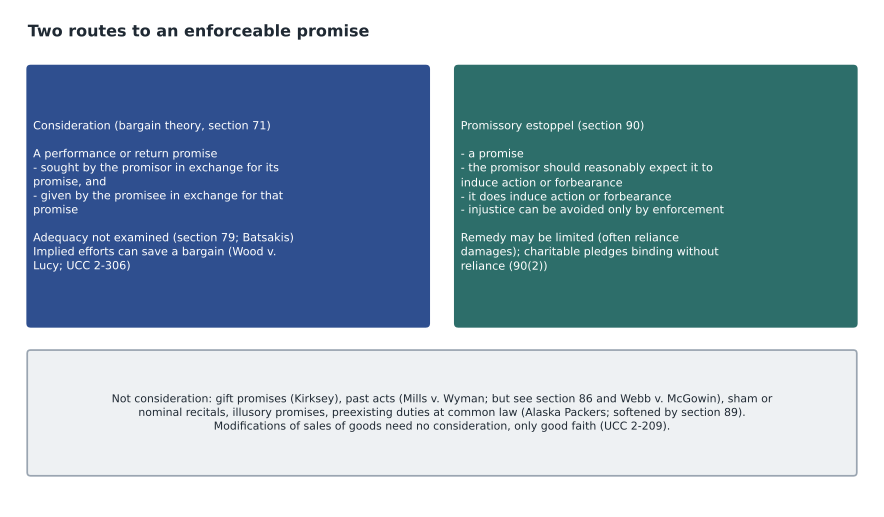
American law enforces promises that are part of a bargain. Restatement (Second) section 71 says that to constitute consideration, a performance or a return promise must be bargained for, and that a performance or return promise is bargained for if it is sought by the promisor in exchange for his promise and is given by the promisee in exchange for that promise. The performance may be an act, a forbearance, or the creation, modification or destruction of a legal relation.
The bargain test focuses on exchange: each side's promise or performance must be the price of the other's. It does not require that either party benefit or that the other suffer a detriment, although older cases spoke in those terms. In Hamer v. Sidway, 124 N.Y. 538, 27 N.E. 256 (1891), an uncle promised his nephew 5,000 dollars if the nephew refrained from drinking, using tobacco, swearing and playing cards or billiards for money until he turned 21. The nephew complied. The uncle's estate argued that the nephew had actually benefited from clean living, so there was no consideration. The New York Court of Appeals disagreed: the nephew had a legal right to do those things and gave it up at the uncle's request, which was enough.
Gifts and conditional gifts
A promise to make a gift is not enforceable as a contract, because nothing is bargained for in exchange. The hard cases involve promises with conditions that look like exchanges. In Kirksey v. Kirksey, 8 Ala. 131 (1845), a man wrote to his widowed sister-in-law that if she would come and see him, he would let her have a place to raise her family. She gave up her home and moved about sixty miles; he housed her for two years and then forced her out. The Alabama Supreme Court held his promise an unenforceable gratuitous promise; moving was merely a condition of receiving the gift, not the price of it. The distinction asks whether the promisor wanted the act for its own sake or merely set it as a condition of a gift. Today, the sister-in-law would have a strong argument under promissory estoppel, discussed below.
Adequacy and sham consideration
Courts generally do not ask whether the exchange is fair. Section 79 says that if the requirement of consideration is met, there is no additional requirement of equivalence in the values exchanged. In Batsakis v. Demotsis, 226 S.W.2d 673 (Tex. Civ. App. 1949), a woman in German-occupied Greece during World War II signed an instrument promising to repay 2,000 dollars in exchange for drachmas then worth about 25 dollars. The Texas court enforced the promise to repay 2,000 dollars, with interest. Inadequacy of consideration can be evidence of fraud, duress or unconscionability, but it does not defeat a contract on its own.
Courts do, however, look past form to substance. If the consideration is a sham, recited but not actually bargained for, or purely nominal, such as a promise to give a house in exchange for 1 dollar that the promisor never wanted, the Restatement treats the promise as a gift promise. Most courts agree, though some still enforce promises supported by nominal consideration, especially in option contracts.
Promises that are not consideration
Past consideration and moral obligation
Something already done cannot be bargained for. In Mills v. Wyman, 20 Mass. (3 Pick.) 207 (1825), a stranger cared for a sick 25-year-old man, who later died. The man's father wrote promising to pay for the care, then refused. The court held that the father's promise, made after the services were rendered, was unsupported by consideration, and a moral obligation alone could not make it enforceable.
Some courts have recognized an exception for promises to pay for past benefits. In Webb v. McGowin, 27 Ala. App. 82, 168 So. 196 (1935), Joe Webb, a mill worker, saved his employer J. Greeley McGowin from death or serious injury by diverting a falling 75-pound pine block, and was permanently crippled himself. McGowin promised to pay him 15 dollars every two weeks for life and paid until his death; his estate then stopped. The Alabama court enforced the promise because McGowin received a material benefit. Restatement (Second) section 86 adopts a material benefit rule: a promise made in recognition of a benefit previously received by the promisor from the promisee is binding to the extent necessary to prevent injustice, but not if the promisee conferred the benefit as a gift or the promisor has not been unjustly enriched, or to the extent the promise is disproportionate to the benefit. Many states have not adopted section 86, and it remains a minority position.
Illusory promises
A promise that commits the promisor to nothing is illusory and cannot serve as consideration. "I will buy as many widgets as I want to buy" is illusory. But courts strive to find a real commitment when parties plainly intended a deal. In Wood v. Lucy, Lady Duff-Gordon, 222 N.Y. 88, 118 N.E. 214 (1917), a fashion designer gave Otis Wood the exclusive right to place her endorsements and market her designs in exchange for half the profits. When she endorsed products behind his back, she argued that Wood had promised nothing, because the contract did not require him to do anything. Judge Cardozo held that a promise to use reasonable efforts was implied, because without it the transaction could not have the business efficacy both parties intended. In his words, the promise was "instinct with an obligation," imperfectly expressed.
Article 2 codifies the same idea. Section 2-306(1) makes output and requirements contracts enforceable, measuring quantity by the output or requirements that actually occur in good faith, with no quantity unreasonably disproportionate to any stated estimate or to normal prior output or requirements. Section 2-306(2) implies best efforts in exclusive dealing arrangements.
Modifying a contract
The common law preexisting duty rule
Under the traditional common law rule, a promise to pay more for something the other party is already obligated to do lacks consideration. The leading example is Alaska Packers' Ass'n v. Domenico, 117 F. 99 (9th Cir. 1902). Fishermen signed on in San Francisco to work a salmon season in Alaska for a fixed wage. Once they reached the remote cannery, where replacements were impossible to find, they refused to work unless their pay was increased. The superintendent agreed, then paid only the original wage when the season ended. The Ninth Circuit held the promise of extra pay unenforceable, because the fishermen gave nothing new in exchange. The rule protects against exactly what happened there: holdup, in which one party exploits the other's vulnerability midway through performance.
The preexisting duty rule also sweeps in fair modifications, so modern law has softened it. Restatement (Second) section 89 provides that a promise modifying a duty under a contract not fully performed on either side is binding if the modification is fair and equitable in view of circumstances not anticipated by the parties when the contract was made, or to the extent provided by statute, or to the extent that justice requires enforcement in view of material change of position in reliance on the promise. A builder who strikes unexpected rock and gets the owner's agreement to pay more for the excavation may enforce the promise under section 89(a).
Modification under Article 2
Article 2 abandons the consideration requirement for modifications altogether. Section 2-209(1) provides that an agreement modifying a contract within this Article needs no consideration to be binding. The safeguard is good faith. Comment 2 explains that modifications must meet the test of good faith imposed by the Code, and that extortion of a modification without legitimate commercial reason is ineffective. In Roth Steel Products v. Sharon Steel Corp., 705 F.2d 134 (6th Cir. 1983), the Sixth Circuit applied a two-part test: the party seeking modification must act in good faith, including observing reasonable commercial standards of fair dealing, and must have a legitimate commercial reason, such as an unforeseen increase in costs. A modification obtained by threatening to breach, without a legitimate reason, is unenforceable. Economic duress, discussed in Lesson 6, provides a further check.
Section 2-209 adds three further rules. A signed agreement that excludes modification or rescission except by a signed writing cannot be otherwise modified or rescinded, and between a merchant and a non-merchant such a clause on a form supplied by the merchant must be separately signed by the non-merchant (section 2-209(2)). The statute of frauds must be satisfied if the contract as modified is within its provisions (section 2-209(3)). And an attempt at modification that fails the writing requirements can still operate as a waiver (section 2-209(4)), which can be retracted by reasonable notification unless retraction would be unjust in view of a material change of position in reliance on the waiver (section 2-209(5)).
Worked problem
The extra 9,000 dollars
Calloway asked Juniper Hill for an extra 9,000 dollars because its compressor supplier had raised prices sharply. Lena agreed by email. The contract is governed by Article 2 (Lesson 1). Is Juniper Hill bound?
Show solution
- At common law, Calloway's preexisting duty to deliver and install the system at the agreed price would mean no consideration for the extra payment, as in Alaska Packers, unless section 89 applied.
- Under section 2-209(1), no consideration is needed to modify a sale of goods. The question is good faith.
- Apply Roth Steel: Calloway's reason, an unexpected supplier price increase, is a legitimate commercial reason, if it is true and the increase was not foreseeable or already priced into its bid.
- Look for coercion. If Calloway threatened to walk away unless paid, knowing the creamery could not find a substitute in time, a court could find bad faith or economic duress.
- Check formalities: the modified price is still above 500 dollars, so the statute of frauds applies (section 2-209(3)), but Lena's email is likely a sufficient signed record (Lesson 5).
Answer: Probably yes. If Calloway's cost increase was real and unforeseen, the modification was made in good faith and binds Juniper Hill without new consideration. The creamery's best argument would be that Calloway exploited its timing to extract the increase.
Promissory estoppel
Consideration explains most enforceable promises, but not all. Courts long ago recognized that a promise can become enforceable because the promisee reasonably relied on it. Early cases involved family promises. In Ricketts v. Scothorn, 57 Neb. 51, 77 N.W. 365 (1898), a grandfather gave his granddaughter a promissory note so that she would not have to work, and she quit her job as a bookkeeper. After his death, his estate refused to pay. The Nebraska Supreme Court held the estate estopped from denying the promise, because she had changed her position in reliance on it.
The rule was generalized in section 90 of the first Restatement in 1932 and refined in the second. Restatement (Second) section 90(1) provides: a promise which the promisor should reasonably expect to induce action or forbearance on the part of the promisee or a third person and which does induce such action or forbearance is binding if injustice can be avoided only by enforcement of the promise. The remedy granted for breach may be limited as justice requires.
The elements are therefore a promise; reasonable expectation by the promisor that the promise will induce reliance; actual reliance; and injustice unless the promise is enforced. The last clause of section 90 is important: courts may award reliance damages, putting the promisee back where it was, rather than the full value of the promise.
Promissory estoppel grew far beyond family cases. In Feinberg v. Pfeiffer Co., 322 S.W.2d 163 (Mo. Ct. App. 1959), an employer's board promised a long-serving employee a lifetime pension of 200 dollars a month when she chose to retire; she retired in reliance and the company later stopped paying. The court enforced the promise. In Hoffman v. Red Owl Stores, Inc., 26 Wis. 2d 683, 133 N.W.2d 267 (1965), a supermarket chain repeatedly assured a baker that he could have a franchise store if he raised a certain amount of capital. On its advice he sold his bakery, bought and then sold a small grocery, and moved, only for the chain to keep raising its demands until negotiations collapsed. The Wisconsin Supreme Court allowed recovery of his reliance losses even though the parties had never agreed on the essential terms of a franchise contract. Hoffman is controversial because it applied promissory estoppel to negotiations that never produced a definite promise, and most courts require a clear and definite promise.
Section 90(2) relaxes the rules for two special categories: a charitable subscription or a marriage settlement is binding under subsection (1) without proof that the promise induced action or forbearance. Before that rule, courts sometimes strained to find consideration in charitable pledges. In Allegheny College v. National Chautauqua County Bank, 246 N.Y. 369, 159 N.E. 173 (1927), Judge Cardozo found consideration in a pledge to a college because the donor asked that the gift be named after her, an implied promise by the college to perpetuate her name. Not every state follows section 90(2); some still require reliance for charitable pledges.
Worked problem
The development board's promise
The county agricultural development board's chair wrote that the board would contribute 25,000 dollars toward the aging room so the creamery could expand and hire, and told Lena to go ahead. Juniper Hill hired two cheese makers. The board later withdrew. Can Juniper Hill recover?
Show solution
- Consideration: the board sought nothing in exchange; expansion and hiring were the purpose of a grant, not its price. This looks like a conditional gift, as in Kirksey.
- Promissory estoppel: the letter was a clear and definite promise of a specific amount for a specific purpose.
- The board should reasonably have expected the creamery to rely; it told the creamery to go ahead and stated the purpose was hiring.
- Juniper Hill actually relied by hiring two employees, though it was building the aging room anyway, so causation for the room itself is weak.
- Injustice and remedy: a court might enforce the promise in full or limit recovery to reliance losses, such as the costs of hiring that would not otherwise have been incurred. Questions about the chair's authority to bind a public board, and any statutes limiting claims against public bodies, would also need research.
Answer: Juniper Hill has a promissory estoppel claim, but its recovery may be limited to its reliance on the hiring promise, and authority and public-entity issues could defeat it.
Common mistakes
MistakeConsideration requires a fair exchange of value.
InsteadCourts do not weigh adequacy (section 79; Batsakis v. Demotsis), though a gross imbalance may signal fraud, duress or unconscionability.
MistakeA promise to pay for a past favor is always enforceable because it rests on gratitude.
InsteadPast consideration is no consideration (Mills v. Wyman). Only some states recognize the material benefit rule of section 86 and Webb v. McGowin.
MistakeAny modification of a sale of goods needs new consideration.
InsteadUCC 2-209(1) requires no consideration, only good faith and compliance with any writing requirements.
MistakePromissory estoppel always gives the promisee the full value of the promise.
InsteadSection 90 allows the remedy to be limited as justice requires, and courts often award reliance damages.
Summary and key terms
- Consideration is a performance or return promise bargained for in exchange for a promise (section 71); courts do not judge adequacy.
- Gifts, past acts, sham recitals and illusory promises are not consideration, though courts imply obligations such as reasonable efforts to save real bargains (Wood v. Lucy; UCC 2-306).
- The common law preexisting duty rule blocks one-sided modifications (Alaska Packers), softened by section 89 for fair modifications after unanticipated circumstances.
- UCC 2-209 allows modifications of sales of goods without consideration if made in good faith for a legitimate commercial reason.
- Promissory estoppel under section 90 enforces a promise that the promisor should expect to induce reliance and that does induce reliance, when injustice can be avoided only by enforcement; the remedy may be limited.
- Charitable subscriptions are binding without proof of reliance under section 90(2) in states that follow it.
- Consideration
- A performance or return promise bargained for in exchange for a promise.
- Bargain theory
- The view that a promise is enforceable as a contract when it is part of an exchange sought by each side.
- Illusory promise
- A promise that does not commit the promisor to anything and so cannot be consideration.
- Preexisting duty rule
- The common law rule that performing or promising what one is already obligated to do is not consideration.
- Material benefit rule
- Section 86's rule enforcing some promises to pay for benefits previously received, to prevent injustice.
- Promissory estoppel
- The doctrine in section 90 that enforces a promise reasonably relied on when injustice can be avoided only by enforcement.
- Reliance damages
- Damages that restore the promisee to the position it was in before relying on the promise.
- Requirements contract
- A contract to buy all of the buyer's good-faith requirements of goods from a seller (UCC 2-306).
Practice problems
Work each problem on paper first, then reveal the answer to check.
Aunt May promises her niece 10,000 dollars as a graduation gift. The niece graduates. May refuses to pay. Is the promise enforceable?
Show answer
Not as a contract: graduating was not bargained for as the price of the promise. Promissory estoppel would require reasonable, induced reliance, such as the niece incurring obligations because of the promise.
A contractor halfway through building a house demands an extra 20,000 dollars to finish, with no change in circumstances. The owner agrees to avoid delay. Is the promise enforceable at common law?
Show answer
No. The contractor had a preexisting duty, and section 89 does not apply because there were no unanticipated circumstances. The facts resemble Alaska Packers.
Why did Judge Cardozo enforce the contract in Wood v. Lucy, Lady Duff-Gordon?
Show answer
He implied a promise by Wood to use reasonable efforts, which supplied the consideration that made the exclusive arrangement enforceable.
Under section 90(2), what must a college prove to enforce a donor's written pledge?
Show answer
Only the pledge; a charitable subscription is binding without proof of reliance in states that follow section 90(2).
Lesson quiz · 5 questions
Score 60% or more to complete this lesson.
Create a free account to save your progress, take quizzes and earn a certificate.