
LAWU-102 · Lesson 5 of 12 · 23 min
The statute of frauds
▶ Video coming soon A video version of this lesson is on the way.
While the aging room was being built, Owen Marsh negotiated the deal that justified it. On a phone call in late March 2026, the cheese buyer for Northgate Grocers, a regional supermarket chain, agreed to buy 400 pounds of Juniper Hill's aged cheddar every month from October 2026 through September 2027 at a fixed price per pound. Owen was thrilled. The next morning Northgate's buyer sent a short email from her company account: "Confirming our agreement for 400 lbs/month of aged cheddar, Oct 2026 through Sept 2027, at the price discussed. Looking forward to it. - Carla Brandt, Northgate Grocers." Owen read it, forwarded it to Lena with three exclamation points, and never replied to Northgate.
In September, Northgate's new management told Juniper Hill that it would not take the cheese. There was, it said, no signed contract. Professor Ashgrove uses the dispute to introduce one of the oldest rules in contract law: the statute of frauds, which makes certain contracts unenforceable unless there is a writing, or another substitute, signed by the party against whom enforcement is sought.
Origins and purpose
The original Statute of Frauds was enacted by the English Parliament in 1677 as "An Act for Prevention of Frauds and Perjuries." At the time, parties to a lawsuit could not testify in their own cases, and juries had little supervision, so a fabricated claim that someone had orally agreed to sell land could easily succeed. The statute required a signed writing for several important categories of contracts. Every American state adopted some version of it, and it remains in force, although England repealed most of its provisions in 1954.
Modern justifications are different from the original ones. A writing provides evidence that a contract was made, warns parties that they are making a serious commitment, and channels important deals into a form that encourages careful thought. Critics argue that the statute lets parties who really did make an oral deal escape it on a technicality. Courts have responded by reading the statute narrowly and by developing many exceptions. A first principle is worth stating plainly: the statute of frauds does not make an oral contract void. It makes it unenforceable against a party who raises the defense. Oral contracts outside the statute's categories are perfectly enforceable, and most everyday oral contracts are.
Which contracts are covered
Restatement (Second) section 110 lists the classes of contracts traditionally within the statute. Students often remember them with the mnemonic MY LEGS.
- Marriage: a contract made upon consideration of marriage, such as a promise to transfer property if someone marries, but not the mutual promises to marry themselves.
- Year: a contract that cannot be performed within one year from the time it is made.
- Land: a contract for the sale of an interest in land, including sales, long-term leases (usually more than one year), easements and mortgages.
- Executor: a contract of an executor or administrator to answer personally for a duty of the decedent.
- Goods: a contract for the sale of goods for the price of 500 dollars or more, under UCC section 2-201.
- Suretyship: a contract to answer for the duty of another, such as a promise to a creditor to pay a friend's debt if the friend does not.
States add other categories by statute. Many require a writing for promises to pay commissions to real estate brokers, for promises to pay debts discharged in bankruptcy, and for loan agreements above a certain amount. Lawyers must always check the specific statute of the state whose law governs.
The one-year provision
The one-year provision covers only contracts that cannot possibly be performed within one year from the date they are made. Courts read the word possibly literally. A contract to build a skyscraper expected to take three years is not within the provision, because it is theoretically possible, however unlikely, to finish within a year. A contract for lifetime employment is usually outside it, because the employee could die within the year, which would complete performance. By contrast, a contract made on March 1, 2026 to work from April 1, 2026 through March 31, 2027 cannot be performed within one year of its making, so it is within the provision.
Some courts have criticized the provision as arbitrary. In C.R. Klewin, Inc. v. Flagship Properties, Inc., 220 Conn. 569, 600 A.2d 772 (1991), the Connecticut Supreme Court held that an oral agreement to build a large project in phases over several years was not covered, because nothing in the agreement made performance within a year impossible, and the court observed that the provision's original purposes no longer supported broad application.
Northgate's oral deal runs from October 2026 through September 2027, a full year of deliveries that begins seven months after the March phone call. It cannot be performed within one year from its making. But it is also a sale of goods, so Article 2's rule matters more.
Suretyship and the main purpose rule
A promise to pay another person's debt if that person fails to pay is within the statute. A promise to pay a debt as one's own, not as backup for someone else, is not. The main purpose or leading object rule, recognized in Restatement (Second) section 116, takes a surety promise outside the statute when the promisor's main purpose is to secure an advantage for itself rather than to benefit the debtor. A general contractor who orally promises a lumber supplier to pay a subcontractor's bill so that the supplier will keep delivering to the contractor's own job is acting mainly for its own benefit, so its oral promise may be enforceable.
What kind of writing satisfies the statute
Under Restatement (Second) section 131, a contract within the statute is enforceable if it is evidenced by any writing, signed by or on behalf of the party to be charged, which reasonably identifies the subject matter of the contract, is sufficient to indicate that a contract has been made between the parties or offered by the signer, and states with reasonable certainty the essential terms of the unperformed promises. The writing need not be a formal contract. Letters, notes, receipts, checks and several related documents read together can be enough, and the writing need not have been intended as a contract or delivered to the other party.
The signature requirement is applied generously. Any symbol made or adopted with an intention to authenticate the writing as that of the signer counts, including initials, a printed letterhead in some cases, or a typed name. Electronic records are fully effective. The federal E-SIGN Act and state versions of the Uniform Electronic Transactions Act provide that a contract or signature may not be denied legal effect or enforceability solely because it is in electronic form, and that if a law requires a writing or signature, an electronic record or signature satisfies it. Courts have frequently found that an email with a typed name at the end can be a signed writing, though results depend on whether the sender intended to authenticate it, and some courts have found an automatically generated signature block insufficient.
The statute of frauds for goods: UCC section 2-201
Section 2-201(1) provides that a contract for the sale of goods for the price of 500 dollars or more is not enforceable unless there is some writing sufficient to indicate that a contract for sale has been made between the parties and signed by the party against whom enforcement is sought. A writing is not insufficient because it omits or incorrectly states a term agreed upon, but the contract is not enforceable beyond the quantity of goods shown in the writing. The Code's test is lenient: the writing must show that a contract was made and state a quantity; price, delivery and other terms can be proven by other evidence or supplied by gap fillers.
The merchant confirmation rule
Section 2-201(2) contains a rule designed for business practice. Between merchants, if within a reasonable time a writing in confirmation of the contract and sufficient against the sender is received and the party receiving it has reason to know its contents, it satisfies the requirements of subsection (1) against the receiving party unless written notice of objection to its contents is given within 10 days after it is received. In effect, a merchant who receives a confirmation and stays silent loses the statute of frauds defense, even though the merchant never signed anything. The confirmation does not prove that a contract exists; the sender must still prove the oral agreement. It removes only the statute of frauds defense.
Exceptions in section 2-201(3)
Section 2-201(3) makes an otherwise unenforceable contract enforceable in three situations.
- Specially manufactured goods (2-201(3)(a)): if the goods are to be specially manufactured for the buyer and are not suitable for sale to others in the ordinary course of the seller's business, and the seller, before notice of repudiation is received and under circumstances which reasonably indicate that the goods are for the buyer, has made either a substantial beginning of their manufacture or commitments for their procurement.
- Admissions (2-201(3)(b)): if the party against whom enforcement is sought admits in its pleading, testimony or otherwise in court that a contract for sale was made, but not beyond the quantity of goods admitted.
- Goods paid for or accepted (2-201(3)(c)): with respect to goods for which payment has been made and accepted or which have been received and accepted.
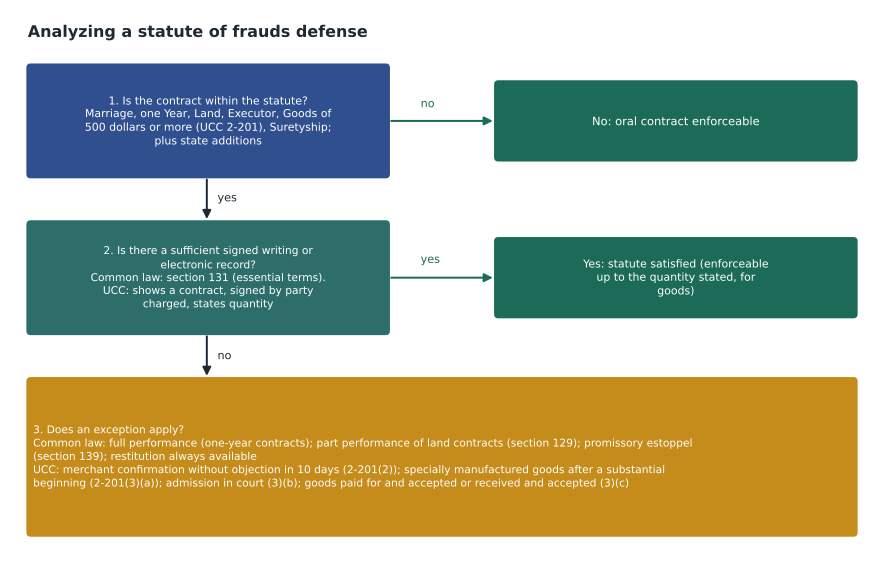
Worked problem
Juniper Hill v. Northgate Grocers
Owen and Northgate's buyer orally agreed in March 2026 to monthly sales of 400 pounds of aged cheddar from October 2026 through September 2027. The next day the buyer emailed a confirmation from her company account, with her typed name and the quantity and term. Owen never responded. In September Northgate refused to perform and raised the statute of frauds. Can Juniper Hill enforce the contract?
Show solution
- The contract is a sale of goods for far more than 500 dollars, so section 2-201 applies. It also cannot be performed within one year, so the common law provision may apply too, depending on the state; most courts hold that if section 2-201 is satisfied, the one-year provision does not separately bar a sale of goods, but some states apply both.
- Section 2-201(1): Northgate's own email is a writing that indicates a contract and states the quantity, and her typed name at the end is likely a signature adopted to authenticate it, made by an agent of Northgate. It is signed by the party to be charged.
- Even without that, section 2-201(2) would not help Northgate: its email was a confirmation sufficient against itself, but the merchant confirmation rule binds the receiver who fails to object, not the sender. Here the sender is the party resisting enforcement, so subsection (1) does the work.
- Juniper Hill must still prove the oral agreement and its terms, including the price discussed, at trial.
Answer: The statute of frauds is satisfied by Northgate's own signed email. Northgate cannot use the statute as a defense; whether a contract was made and on what terms is a question of proof.
Hannah Lindqvist asks what would happen if the roles were reversed: if Owen had sent the confirming email and Northgate had remained silent. "Then 2-201(2) would be Juniper Hill's friend," Ashgrove says. "Northgate, a merchant, received a confirmation sufficient against Owen, had reason to know its contents and did not object within 10 days. It would lose the statute of frauds defense, though not the right to deny that any deal was made."
Common law exceptions
Outside Article 2, courts recognize several ways to enforce an oral contract within the statute.
- Full performance. Most courts hold that once one party has fully performed a contract within the one-year provision, the other cannot invoke the statute. A service provider who completes an 18-month oral contract can sue for the agreed price.
- Part performance of land contracts. A buyer under an oral contract for land who takes possession and pays all or part of the price, or makes valuable improvements, can often obtain specific performance. Restatement (Second) section 129 allows specific enforcement when the party seeking enforcement, in reasonable reliance on the contract and on the continuing assent of the other party, has so changed its position that injustice can be avoided only by specific enforcement.
- Promissory estoppel. Restatement (Second) section 139 provides that a promise which the promisor should reasonably expect to induce action or forbearance, and which does induce it, is enforceable notwithstanding the statute of frauds if injustice can be avoided only by enforcement. Courts consider the availability of other remedies such as restitution, the definite and substantial character of the reliance, the extent to which the reliance corroborates the making of the promise, its reasonableness and its foreseeability. In Monarco v. Lo Greco, 35 Cal. 2d 621, 220 P.2d 737 (1950), the California Supreme Court enforced an oral promise to leave a farm to a young man who had stayed and worked on it for some twenty years at the parents' request instead of pursuing his own career. Many states accept section 139, but some reject promissory estoppel as a way around the statute, especially for land.
Restitution is always available. A party who has conferred a benefit under an unenforceable oral contract can usually recover the value of that benefit, even if it cannot enforce the promise itself.
Modifications and the statute
Section 2-209(3) requires that the statute of frauds be satisfied if the contract as modified is within its provisions. Lena's April email agreeing to pay Calloway another 9,000 dollars is a writing signed with her name that shows the modified price; it would satisfy the statute even if the original contract had not. At common law, the rules vary: a modification of a contract within the statute generally must itself satisfy the statute if the contract as modified falls within it, and an oral modification can sometimes be enforced on a waiver or estoppel theory.
Priya Natarajan points out that Calloway, too, has a statute of frauds advantage: the insulated panels were cut and fabricated to fit Juniper Hill's building. "Exactly," Ashgrove says. "If Juniper Hill had backed out in May, after Calloway made a substantial beginning on panels nobody else could use, section 2-201(3)(a) would have let Calloway enforce the deal even without a signed writing from the creamery."
Common mistakes
MistakeOral contracts are generally unenforceable.
InsteadMost oral contracts are enforceable. The statute of frauds applies only to listed categories, and even then makes contracts unenforceable rather than void.
MistakeAny contract that takes more than a year to perform must be in writing.
InsteadThe one-year provision covers only contracts that cannot possibly be performed within one year from their making.
MistakeA writing under 2-201 must state every material term.
InsteadIt need only indicate that a contract was made, be signed by the party to be charged and state a quantity; the contract is enforceable only up to that quantity.
MistakeA merchant confirmation under 2-201(2) proves the contract exists.
InsteadIt only removes the receiving merchant's statute of frauds defense if it fails to object within 10 days; the sender must still prove the agreement.
Summary and key terms
- The statute of frauds requires a signed writing for contracts in certain categories: marriage, one year, land, executor, goods of 500 dollars or more, and suretyship, plus state-specific categories.
- The one-year provision is read narrowly to cover only contracts that cannot possibly be performed within a year of their making.
- A sufficient writing under section 131 identifies the parties and subject matter, shows a contract was made, states essential terms and is signed by the party to be charged; electronic records and signatures count.
- Under UCC 2-201, a writing need only indicate a contract, be signed by the party to be charged and state a quantity.
- The merchant confirmation rule, specially manufactured goods, admissions and goods paid for or accepted are exceptions under 2-201(2) and (3).
- At common law, full performance, part performance of land contracts and promissory estoppel under section 139 can overcome the statute, and restitution remains available.
- Statute of frauds
- A statute making certain categories of contracts unenforceable unless evidenced by a signed writing or an exception applies.
- Party to be charged
- The party against whom enforcement is sought, whose signature the statute requires.
- One-year provision
- The rule covering contracts that cannot be performed within one year from their making.
- Main purpose rule
- The rule taking a promise to pay another's debt outside the statute when the promisor acts mainly for its own advantage.
- Merchant confirmation rule
- UCC 2-201(2): a merchant who receives a confirmation and fails to object within 10 days loses the statute of frauds defense.
- Specially manufactured goods exception
- UCC 2-201(3)(a): enforcement without a writing when the seller has substantially begun goods unsuitable for others.
- Part performance
- Conduct, such as taking possession and making improvements, that allows enforcement of an oral land contract.
Practice problems
Work each problem on paper first, then reveal the answer to check.
On January 10, an employer orally hires a manager for a term from February 1 of that year through January 31 of the next year. Is the contract within the one-year provision?
Show answer
Yes. Performance cannot be completed within one year of January 10, so the contract is within the statute and needs a writing unless an exception applies.
A buyer and seller, both merchants, make an oral deal for 1,000 units. The seller sends a signed confirmation stating 1,000 units. The buyer receives it and says nothing for three weeks, then refuses delivery, citing the statute of frauds. Result?
Show answer
Under 2-201(2) the buyer lost the defense by failing to object within 10 days. The seller must still prove the oral contract.
In a lawsuit, the defendant testifies that it did agree to buy 300 chairs but denies agreeing to buy 500. How many chairs can the plaintiff enforce under the statute of frauds?
Show answer
Up to 300, under the admission exception in 2-201(3)(b), which applies only to the quantity admitted.
What does section 139 of the Restatement (Second) allow?
Show answer
Enforcement of a promise despite the statute of frauds when reasonable, foreseeable reliance makes enforcement necessary to avoid injustice.
Lesson quiz · 5 questions
Score 60% or more to complete this lesson.
Create a free account to save your progress, take quizzes and earn a certificate.