
LAWU-101 · Lesson 9 of 12 · 25 min
Joinder and class actions
▶ Video coming soon A video version of this lesson is on the way.
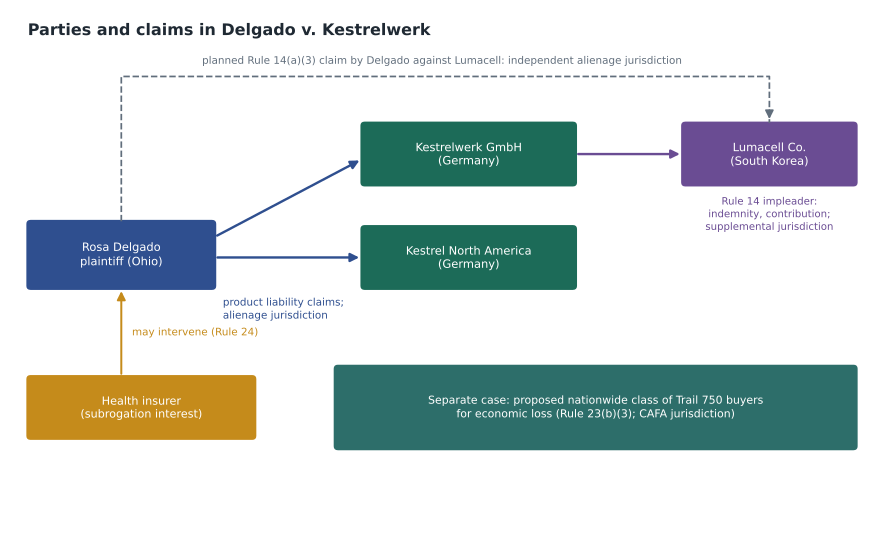
By the week before Thanksgiving, the Delgado case is starting to grow. Kestrelwerk's answer, filed November 19, 2026, announces that it will file a third-party complaint against Lumacell Co., the South Korean company that made the lithium-ion cells inside the KX48 pack, claiming that if the pack was defective, the fault lay in Lumacell's cells and Lumacell must reimburse Kestrelwerk. Delgado's health insurer, which paid most of her medical bills, has written to Whitcomb about its right to be repaid from any recovery. And in October a Columbus law firm filed a separate lawsuit in the same federal court on behalf of a proposed nationwide class of everyone who bought a Trail 750, seeking the cost of replacing the battery packs.
"Lawsuits are not always two people in a room," Okafor-Bell tells Section B. "Modern litigation involves many parties and many claims, sometimes thousands of people who never set foot in court. Joinder rules decide who can be brought into a case and which claims can be heard together. For every one of them, keep asking two questions: does a rule allow the joinder, and does the court have jurisdiction over the claim?" This lesson covers both questions for claims, parties and class actions.
Joinder of claims
Rule 18(a) is generous: a party asserting a claim may join, as independent or alternative claims, as many claims as it has against an opposing party. The claims need not be related. Delgado could join a claim against Kestrelwerk arising from a completely different transaction if she had one. Rule 18 says only that joinder is permitted; the court still needs subject-matter jurisdiction over each claim, and it can order separate trials under Rule 42(b).
Counterclaims, claims by a defending party against an opposing party, come in two kinds under Rule 13. A counterclaim is compulsory under Rule 13(a) if it arises out of the transaction or occurrence that is the subject matter of the opposing party's claim and does not require adding a party over whom the court cannot acquire jurisdiction. A compulsory counterclaim must be asserted in the pleading, or it is lost: the party will be barred from bringing it in a later suit. Courts often apply a logical relationship test to decide whether claims arise from the same transaction. Any other counterclaim is permissive under Rule 13(b) and may be asserted or saved for another day. Compulsory counterclaims fall within supplemental jurisdiction because they share a common nucleus of operative fact with the main claim; permissive counterclaims usually need an independent basis of jurisdiction.
A crossclaim, under Rule 13(g), is a claim by one party against a coparty, such as one defendant against another, arising out of the same transaction or occurrence as the original action. Crossclaims are always optional. Had Ridgeline stayed in the case, Ridgeline and Kestrelwerk might have filed crossclaims against each other for contribution or indemnity, each blaming the other for the fire.
Joinder of parties
Permissive joinder
Rule 20 allows plaintiffs to join together, and defendants to be joined together, if the claims by or against them arise out of the same transaction, occurrence, or series of transactions or occurrences, and any question of law or fact common to all of them will arise in the action. Delgado's joinder of Ridgeline and Kestrelwerk in her original complaint fit easily: both claims arose from the same fire and shared common questions about the battery. Rule 20 does not require joinder; a plaintiff may sue joint tortfeasors separately.
Required parties
Rule 19 identifies people who must be joined if feasible. Under Rule 19(a), a person is a required party if, in that person's absence, the court cannot accord complete relief among the existing parties, or if the person claims an interest relating to the subject of the action and is so situated that disposing of the action without the person may impair the person's ability to protect that interest or leave an existing party at substantial risk of incurring multiple or inconsistent obligations. If a required party can be joined, the court orders joinder. If joinder is not feasible, for example because the party is not subject to personal jurisdiction or would destroy diversity, Rule 19(b) directs the court to decide whether, in equity and good conscience, the action should proceed without that person or be dismissed, considering prejudice, ways to lessen it, the adequacy of a judgment without the party and whether the plaintiff would have an adequate remedy if the action were dismissed.
Joint tortfeasors are not required parties. In Temple v. Synthes Corp., 498 U.S. 5 (1990), a patient sued the maker of a plate and screw device implanted in his spine in federal court, and separately sued the doctor and hospital in state court. The Court held that the doctor and hospital, as potential joint tortfeasors, were merely permissive parties, not required ones. That is why Delgado's dismissal of Ridgeline raised no Rule 19 problem. Rule 19(b) dismissals are rare, but they happen: in Republic of the Philippines v. Pimentel, 553 U.S. 851 (2008), the Court ordered dismissal of an interpleader action over assets once held by Ferdinand Marcos because the Republic of the Philippines, a required party, was immune from suit and could not be joined.
Impleader
Rule 14 lets a defending party, as a third-party plaintiff, serve a summons and complaint on a nonparty who is or may be liable to it for all or part of the claim against it. Impleader is for derivative liability: indemnity, contribution, subrogation or warranty. A defendant may not use it simply to point at someone else and say "he did it, not me"; that is a defense, not a third-party claim. A defendant may implead without leave within 14 days after serving its original answer and needs the court's leave after that. Once a third party is joined, the plaintiff may assert claims against it that arise from the same transaction or occurrence, and the third-party defendant may assert claims against the plaintiff, under Rule 14(a)(2) and (3).
Kestrelwerk's claim against Lumacell is classic impleader: Kestrelwerk says that if it is liable to Delgado for a defective pack, Lumacell must reimburse it, because Lumacell's cells were the cause. Kestrelwerk answered on November 19 and plans to file its third-party complaint within 14 days, so it will need no leave. The court has supplemental jurisdiction over the third-party claim under section 1367(a), because it arises from the same fire. Lumacell must be served in South Korea, which, like Germany, is a party to the Hague Service Convention.
Priya Natarajan raises the jurisdictional twist from Lesson 5. If Delgado wants to sue Lumacell directly, section 1367(b) bars supplemental jurisdiction over claims by plaintiffs against persons made parties under Rule 14, when that would be inconsistent with the diversity statute, as in Owen Equipment v. Kroger. But Delgado does not need supplemental jurisdiction: she is an Ohio citizen and Lumacell is a South Korean citizen, so her claim against Lumacell has its own basis in alienage jurisdiction. Whitcomb plans to assert a claim against Lumacell under Rule 14(a)(3) once Lumacell has been served.
Intervention and interpleader
Rule 24 lets nonparties join a case on their own initiative. Intervention of right under Rule 24(a) is available to a person who claims an interest relating to the subject of the action and is so situated that disposing of the action may impair its ability to protect that interest, unless existing parties adequately represent it, or to anyone given an unconditional right to intervene by a federal statute. Permissive intervention under Rule 24(b) is available to anyone with a claim or defense that shares a common question of law or fact with the main action, at the court's discretion. Delgado's health insurer, which has a right to be repaid from her recovery, might seek to intervene to protect that interest, although insurers often rely instead on liens and agreements with the plaintiff's lawyer.
Interpleader solves a different problem: a stakeholder holding money or property claimed by several people who fears being sued by each and paying twice. Interpleader lets the stakeholder deposit the property with the court and require the claimants to fight among themselves. Rule 22 interpleader requires an ordinary basis of jurisdiction. Statutory interpleader under 28 U.S.C. § 1335 requires only minimal diversity among the claimants and a stake of 500 dollars or more, and it allows nationwide service of process. Insurance companies facing more claims than their policy limits are common users.
Class actions
A class action lets one or more people sue on behalf of a large group of people with similar claims who are not individually before the court. It can make small claims worth bringing and resolve thousands of similar claims at once. Because absent class members will be bound by the result, due process requires that they be adequately represented. In Hansberry v. Lee, 311 U.S. 32 (1940), the Court held that Black homebuyers in Chicago could not be bound by an earlier class judgment upholding a racially restrictive covenant, because the earlier plaintiffs' interests conflicted with theirs and they had not been adequately represented.
Requirements of Rule 23
A class may be certified only if all four requirements of Rule 23(a) are met: numerosity, meaning the class is so numerous that joinder of all members is impracticable; commonality, meaning there are questions of law or fact common to the class; typicality, meaning the representative parties' claims or defenses are typical of the class; and adequacy, meaning the representatives will fairly and adequately protect the interests of the class. The class must also fit one of the categories in Rule 23(b). Rule 23(b)(1) covers cases where separate actions would risk inconsistent standards for the defendant or would impair absent members' interests, such as claims to a limited fund. Rule 23(b)(2) covers cases seeking injunctive or declaratory relief for the class as a whole. Rule 23(b)(3), the damages class action, requires that common questions predominate over individual ones and that a class action be superior to other methods of resolving the controversy.
Members of a Rule 23(b)(3) class must receive the best notice practicable under the circumstances and may opt out under Rule 23(c)(2)(B); members of (b)(1) and (b)(2) classes generally cannot. The court appoints class counsel under Rule 23(g). Any settlement, voluntary dismissal or compromise of a certified class's claims requires court approval after a hearing and a finding that the deal is fair, reasonable and adequate, under factors that a 2018 amendment to Rule 23(e) spelled out. Under Rule 23(f), a court of appeals may permit an immediate appeal from an order granting or denying class certification, an exception to the final judgment rule studied in Lesson 12.
| Requirement | Question asked |
|---|---|
| Numerosity, 23(a)(1) | Is joinder of all members impracticable? |
| Commonality, 23(a)(2) | Is there a common question whose answer will drive the resolution of the litigation? |
| Typicality, 23(a)(3) | Do the representatives' claims arise from the same course of conduct and legal theory? |
| Adequacy, 23(a)(4) | Are the representatives and class counsel free of conflicts and able to protect the class? |
| Predominance, 23(b)(3) | Do common questions outweigh individual ones, including damages and causation? |
| Superiority, 23(b)(3) | Is a class action better than individual suits or other methods? |
The Supreme Court's modern class action cases
In Wal-Mart Stores, Inc. v. Dukes, 564 U.S. 338 (2011), the Court reversed certification of a class of about one and a half million current and former female employees alleging sex discrimination in pay and promotion. Commonality requires more than raising common questions; the class's claims must depend on a common contention whose truth or falsity will resolve an issue central to the validity of each claim in one stroke. Because pay and promotion decisions were left to the discretion of thousands of local managers, there was no glue holding together the reasons for all those decisions. The Court also held that individualized claims for back pay could not be certified under Rule 23(b)(2).
Earlier, in Amchem Products, Inc. v. Windsor, 521 U.S. 591 (1997), the Court rejected a nationwide settlement class covering people exposed to asbestos, both those already sick and those not yet sick. Settlement does not excuse compliance with Rule 23's requirements, the Court held: the class failed predominance because members' exposure, illnesses and applicable law varied enormously, and it failed adequacy because currently injured and future claimants had conflicting interests that one set of representatives could not serve. In Comcast Corp. v. Behrend, 569 U.S. 27 (2013), the Court held that a damages model offered to show predominance must measure damages attributable to the plaintiffs' theory of liability. In TransUnion LLC v. Ramirez, 594 U.S. 413 (2021), it held that every class member must have Article III standing to recover individual damages; class members whose inaccurate credit files were never disclosed to third parties had suffered no concrete harm. Whether a class may be certified when it includes uninjured members remains contested: in Laboratory Corp. of America Holdings v. Davis (2025), the Court agreed to decide that question but then dismissed the case without deciding it, over a dissent by Justice Kavanaugh.
The Class Action Fairness Act
The Class Action Fairness Act of 2005 expanded federal jurisdiction over large class actions. Under 28 U.S.C. § 1332(d), federal courts have jurisdiction over class actions in which the aggregate amount in controversy exceeds 5 million dollars, any class member is diverse from any defendant (minimal diversity) and the class has at least 100 members, subject to exceptions for primarily local controversies. Under section 1453, any defendant may remove such a class action without the consent of other defendants, the forum-defendant rule does not apply and the one-year limit does not apply. In Standard Fire Insurance Co. v. Knowles, 568 U.S. 588 (2013), the Court held that a named plaintiff's stipulation, before certification, that the class would seek less than 5 million dollars could not bind the absent class members and so could not defeat federal jurisdiction.
The Trail 750 class action
The class action against Kestrelwerk, filed by a Trail 750 buyer from Cincinnati, seeks to represent everyone in the United States who bought a Trail 750 with a KX48 pack, roughly 18,000 people according to the complaint, and asks for the cost of a replacement pack and the reduced value of the bikes. Federal jurisdiction rests on CAFA: more than 100 members, more than 5 million dollars in total, and minimal diversity. Okafor-Bell asks the class whether it could be certified. Numerosity is easy. Commonality is plausible: whether the KX48's design is defective is a question whose answer would resolve a central issue for every member in one stroke, unlike the scattered decisions in Wal-Mart. Predominance is harder. The claims of buyers in 50 states may be governed by different states' consumer and warranty laws, and some buyers may have bikes that never overheated. Under Comcast, the plaintiffs will need a damages model tied to their theory of a design defect.
Jordan Kimura asks why Delgado does not simply join the class. Okafor-Bell explains that personal-injury claims are rarely certified as class actions, because causation and damages differ so much from one injured person to the next, which is exactly what doomed predominance in Amchem. Economic-loss classes like this one are more common. The class definition excludes claims for personal injury, so Delgado keeps her own case. If many injury cases like hers were filed across the country, the defendants might ask the Judicial Panel on Multidistrict Litigation to consolidate them for pretrial proceedings under 28 U.S.C. § 1407 and new Rule 16.1.
Worked problem
Can Kestrelwerk implead Ridgeline?
After Delgado dismisses Ridgeline, Kestrelwerk wants to bring Ridgeline back into the federal case, arguing that Ridgeline's unapproved charger caused the fire and that under Ohio law Ridgeline must contribute to any judgment against Kestrelwerk. Analyze joinder and jurisdiction.
Show solution
- Joinder: a claim for contribution is a claim that Ridgeline is or may be liable to Kestrelwerk for part of Delgado's claim, which Rule 14(a)(1) permits. Simply arguing that the charger, not the battery, caused the fire would be a defense, not impleader.
- Jurisdiction over Kestrelwerk's claim: supplemental jurisdiction under section 1367(a), because the claim arises from the same fire. Section 1367(b) restricts claims by plaintiffs, not by defendants, so it does not bar the claim, and Ridgeline's Ohio citizenship does not destroy the existing diversity between Delgado and Kestrelwerk.
- Delgado's possible claim against Ridgeline: she settled and released it. Even if she had not, section 1367(b) would bar supplemental jurisdiction over a claim by an Ohio plaintiff against an Ohio third-party defendant (Kroger), and there is no independent basis.
- State law matters too: whether Ohio law allows contribution from a party that has already settled with the plaintiff is a substantive question under Erie.
Answer: The rules allow Kestrelwerk to implead Ridgeline for contribution, and the court would have supplemental jurisdiction over that claim. Whether Kestrelwerk can actually recover depends on Ohio contribution law, including the effect of Ridgeline's settlement.
Common mistakes
MistakeA defendant may implead anyone it thinks is really to blame.
InsteadRule 14 is for derivative liability, such as indemnity or contribution, owed to the defendant. Blaming someone else is a defense.
MistakeAll counterclaims are optional.
InsteadCompulsory counterclaims under Rule 13(a), which arise from the same transaction or occurrence, are lost if not asserted.
MistakeJoint tortfeasors are required parties under Rule 19.
InsteadTemple v. Synthes holds they are merely permissive parties.
MistakeIf a class action raises any common question, commonality is satisfied.
InsteadWal-Mart requires a common contention whose resolution will decide a central issue for every member in one stroke.
Summary and key terms
- Rule 18 allows any claims against an opposing party; Rule 13 makes same-transaction counterclaims compulsory and allows crossclaims against coparties.
- Rule 20 allows permissive joinder of parties; Rule 19 requires joinder of necessary parties if feasible and calls for an equity-and-good-conscience decision if not; joint tortfeasors are not required (Temple).
- Rule 14 impleader covers derivative liability; section 1367(b) limits plaintiffs' claims against third-party defendants in diversity cases unless an independent basis exists.
- Intervention (Rule 24) and interpleader (Rule 22 and 28 U.S.C. § 1335) bring in interested nonparties and resolve competing claims to a fund.
- Rule 23 requires numerosity, commonality, typicality and adequacy plus a (b) category; (b)(3) classes need predominance, superiority, notice and opt-out (Wal-Mart, Amchem, Comcast, TransUnion).
- CAFA gives federal courts jurisdiction over class actions above 5 million dollars with minimal diversity and at least 100 members, with relaxed removal rules.
- Compulsory counterclaim
- A counterclaim arising from the same transaction or occurrence as the opposing party's claim, which is lost if not asserted.
- Crossclaim
- A claim against a coparty arising from the same transaction or occurrence.
- Permissive joinder
- Joining parties under Rule 20 when claims share a transaction and a common question.
- Required party
- A person who must be joined under Rule 19 if feasible.
- Impleader
- A defendant's joinder under Rule 14 of a third party who may be liable to it for the plaintiff's claim.
- Intervention
- A nonparty's entry into a case under Rule 24 to protect its interest.
- Interpleader
- A procedure letting a stakeholder make competing claimants litigate their claims to a fund.
- Class action
- A suit by representatives on behalf of a class of similarly situated people under Rule 23.
Practice problems
Work each problem on paper first, then reveal the answer to check.
Why could Delgado sue Lumacell directly despite section 1367(b)?
Show answer
Her claim against Lumacell has an independent basis in alienage jurisdiction, since she is an Ohio citizen and Lumacell is a South Korean citizen, so she does not need supplemental jurisdiction.
Kestrelwerk has a claim against Delgado arising from an unrelated contract dispute. Must it assert the claim in this case?
Show answer
No. It is a permissive counterclaim under Rule 13(b), and it would need its own basis of jurisdiction.
Why did commonality fail in Wal-Mart v. Dukes?
Show answer
Pay and promotion decisions were made by thousands of managers using their own discretion, so there was no common contention, no glue, capable of resolving the reason for each decision in one stroke.
Name the three CAFA jurisdictional requirements.
Show answer
An aggregate amount in controversy over 5 million dollars, minimal diversity and at least 100 class members.
Lesson quiz · 5 questions
Score 60% or more to complete this lesson.
Create a free account to save your progress, take quizzes and earn a certificate.