
LAWU-101 · Lesson 12 of 12 · 27 min
Preclusion, appeals and a capstone problem
▶ Video coming soon A video version of this lesson is on the way.
On the last day of class, Okafor-Bell projects the Delgado case to its end. Suppose, she says, that the case is tried in 2028, that the jury finds the KX48's design defective and awards Delgado damages, and that Kestrelwerk appeals. Two questions follow. What can the Sixth Circuit review, and how? And what does the judgment mean for everyone else: for Delgado if she later wants to sue again, for Kestrelwerk if another rider sues, and for the 18,000 Trail 750 owners in the class action? The rules of preclusion and appeal answer those questions. Then Section B will put the whole course together on a new problem.
Claim preclusion
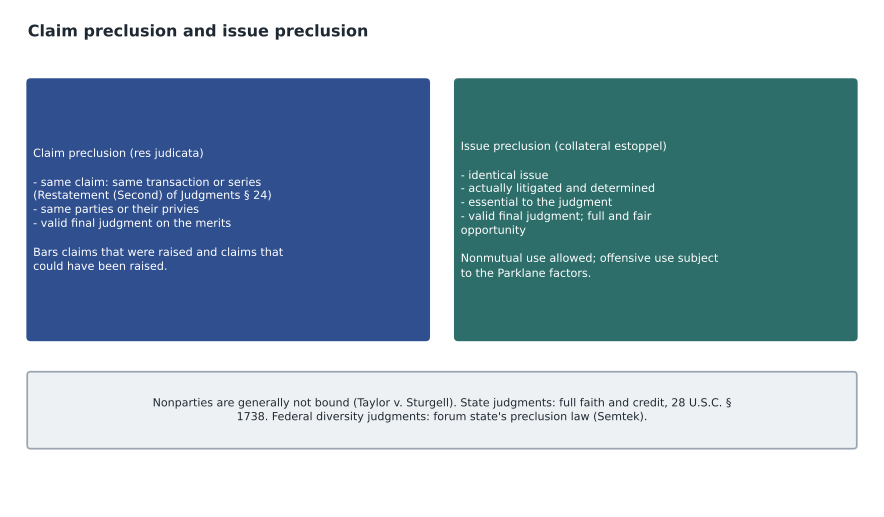
Claim preclusion, traditionally called res judicata, prevents a party from relitigating a claim that has been decided, and also from litigating claims that could have been raised in the earlier suit but were not. It applies when three conditions are met: the earlier suit ended in a valid final judgment on the merits; the later suit involves the same claim; and the parties are the same, or in privity with the earlier parties.
Most American courts define the same claim transactionally, following the Restatement (Second) of Judgments § 24: a claim includes all rights to remedies against the defendant with respect to all or any part of the transaction, or series of connected transactions, out of which the action arose. Whether facts form a transaction depends on whether they are related in time, space, origin or motivation, whether they form a convenient trial unit, and whether treating them as a unit conforms to the parties' expectations. Delgado's personal injuries, her damaged car and her burned garage all arose from the same fire. If she sues only for her injuries and loses or wins, she cannot later bring a second suit for the property damage. Claim preclusion forces plaintiffs to bring all their claims from a transaction at once.
Claim preclusion does not reach claims based on events after the first suit. In Lucky Brand Dungarees, Inc. v. Marcel Fashions Group, Inc., 590 U.S. 405 (2020), the Court held that a defendant could raise a defense in a second trademark suit that it had not pressed in the first, because the two suits involved different conduct occurring at different times; they did not share a common nucleus of operative fact.
A judgment on the merits includes a judgment after trial, summary judgment, a dismissal for failure to state a claim and a default judgment. Under Rule 41(b), an involuntary dismissal, other than for lack of jurisdiction, improper venue or failure to join a party under Rule 19, operates as an adjudication on the merits unless the dismissal order states otherwise. A voluntary dismissal with prejudice, often entered after a settlement, also has preclusive effect. Delgado's dismissal of Ridgeline after their settlement was with prejudice, so she cannot sue Ridgeline again over the fire.
Issue preclusion
Issue preclusion, also called collateral estoppel, is narrower but can reach further. It prevents relitigation of an issue of fact or law that was actually litigated and determined in an earlier action, by a valid and final judgment, when the determination was essential to the judgment. It applies even if the later case involves a different claim. Issue preclusion requires that the issue be identical, that it was actually litigated, not merely pleaded or conceded, and that deciding it was necessary to the result. A general verdict can make the last element hard to prove: if a jury could have found for the plaintiff on either of two grounds, it may be impossible to tell which issue it decided. That is one reason a special verdict in Delgado's case would matter.
Traditionally, issue preclusion required mutuality: only the parties to the earlier action, who would have been bound by it, could use it. Courts have largely abandoned that requirement. In Bernhard v. Bank of America, 19 Cal. 2d 807 (1942), Justice Traynor of the California Supreme Court allowed a defendant to use an earlier judgment against a plaintiff who had lost the same issue against someone else. The Supreme Court approved defensive nonmutual issue preclusion, where a new defendant uses a prior judgment against a plaintiff who lost, in Blonder-Tongue Laboratories, Inc. v. University of Illinois Foundation, 402 U.S. 313 (1971), a patent case.
Offensive nonmutual issue preclusion, where a new plaintiff uses a prior judgment against a defendant who lost, raises more concern. In Parklane Hosiery Co. v. Shore, 439 U.S. 322 (1979), the SEC had obtained a judgment that Parklane issued a misleading proxy statement, and shareholders then sued Parklane over the same statement and sought to preclude it from denying that it was misleading. The Court allowed offensive use, but gave trial courts broad discretion to refuse it, identifying factors that weigh against it: the plaintiff could easily have joined the earlier action but chose to wait and see; the defendant had little incentive to defend the first action vigorously, for example because damages were small or future suits not foreseeable; the judgment is inconsistent with earlier judgments in the defendant's favor; or the second action offers procedural opportunities unavailable in the first that could produce a different result. Nonmutual issue preclusion is not available against the United States government (United States v. Mendoza, 464 U.S. 154 (1984)).
Who is bound
Preclusion binds parties, but nonparties are generally not bound by a judgment, because due process entitles everyone to their own day in court. In Taylor v. Sturgell, 553 U.S. 880 (2008), the Court rejected a broad doctrine of virtual representation, under which a nonparty could be bound because its interests were closely aligned with a losing party's. The Court identified six recognized exceptions: the nonparty agreed to be bound; a pre-existing substantive legal relationship, such as assignee and assignor; adequate representation in certain proceedings, such as properly conducted class actions and suits by trustees; the nonparty assumed control over the earlier litigation; the nonparty is relitigating through a proxy; and special statutory schemes, such as bankruptcy, that expressly foreclose later litigation.
So if Kestrelwerk wins Delgado's case, the jury's finding that the KX48 was not defective would not bind other injured riders, who were not parties. But if Delgado wins, Kestrelwerk, which was a party with every incentive to defend, could face offensive nonmutual issue preclusion in later suits on the design-defect issue. A later court would apply the Parklane factors and ask whether the issue is truly identical, for example whether the later case involves the same pack design and a similar legal standard of defect. Members of a certified class are bound by the class judgment, which is why Rule 23 insists on adequate representation, notice and, for damages classes, the right to opt out.
Which jurisdiction's preclusion law applies? Under the Full Faith and Credit Act, 28 U.S.C. § 1738, federal courts must give a state court judgment the same preclusive effect that the courts of the rendering state would give it. For federal judgments, preclusion is governed by federal common law. In Semtek International Inc. v. Lockheed Martin Corp., 531 U.S. 497 (2001), the Court held that in diversity cases federal common law generally adopts the preclusion rules of the state where the federal court sits, unless they are incompatible with federal interests. A federal court in California had dismissed a claim as barred by California's two-year statute of limitations; because California would not have treated that dismissal as barring a suit in another state with a longer limitations period, the plaintiff could sue again in Maryland. The Delgado judgment, entered by a federal court in Ohio sitting in diversity, would therefore generally have the effect that Ohio preclusion law gives judgments.
Appeals
The final judgment rule
Under 28 U.S.C. § 1291, the courts of appeals have jurisdiction of appeals from all final decisions of the district courts. A final decision is one that ends the litigation on the merits and leaves nothing for the court to do but execute the judgment. The rule avoids piecemeal appeals, respects the trial judge's role and lets appellate courts see the whole case. It means that most rulings during a case, including denials of motions to dismiss, discovery orders and denials of summary judgment, can be reviewed only after final judgment. Kestrelwerk cannot appeal the district court's denial of its personal jurisdiction motion now; it must wait and raise the issue after a final judgment, if it loses.
Exceptions
Several exceptions allow earlier appeals. Rule 54(b) allows a district court in a case with multiple claims or parties to enter final judgment on fewer than all of them, if it expressly determines that there is no just reason for delay. Under 28 U.S.C. § 1292(a)(1), orders granting, refusing or modifying injunctions are immediately appealable. Under section 1292(b), a district judge may certify that an order involves a controlling question of law as to which there is substantial ground for difference of opinion and that an immediate appeal may materially advance the end of the litigation; the court of appeals then has discretion to accept the appeal, if a petition is filed within ten days. Rule 23(f), from Lesson 9, allows discretionary appeals of class certification orders. In Microsoft Corp. v. Baker, 582 U.S. 23 (2017), the Court held that plaintiffs could not create a final judgment, and so an appeal of the denial of class certification, by voluntarily dismissing their individual claims.
The collateral order doctrine, from Cohen v. Beneficial Industrial Loan Corp., 337 U.S. 541 (1949), treats a small class of rulings as final decisions: those that conclusively determine a disputed question, resolve an important issue completely separate from the merits, and would be effectively unreviewable on appeal from a final judgment. Orders denying claims of immunity from suit, such as qualified immunity or foreign sovereign immunity, are the main examples, because the immunity is a right not to stand trial at all. In Mohawk Industries, Inc. v. Carpenter, 558 U.S. 100 (2009), the Court held that orders requiring disclosure of material claimed to be privileged are not immediately appealable under the doctrine, because they can be reviewed adequately after final judgment or through other means, such as section 1292(b) certification or, in extraordinary cases, a petition for a writ of mandamus. A denial of a motion to dismiss for lack of personal jurisdiction also does not qualify, because the defendant can obtain review after final judgment.
Timing and standards of review
Under Federal Rule of Appellate Procedure 4(a)(1), a notice of appeal in a civil case must be filed within 30 days after entry of the judgment, or 60 days if the United States or its officer or agency is a party. A timely post-judgment motion under Rule 50(b), 52(b), 59 or certain Rule 60 motions resets the clock until the motion is decided. The 30-day period is also set by statute, 28 U.S.C. § 2107, and the Supreme Court has treated statutory appeal deadlines as jurisdictional, so a court cannot excuse a late notice of appeal outside the narrow extensions the rules allow (Bowles v. Russell, 551 U.S. 205 (2007)). By contrast, a time limit found only in a court rule is a mandatory claim-processing rule that can be forfeited if not raised (Hamer v. Neighborhood Housing Services of Chicago, 583 U.S. 17 (2017)).
The standard of review determines how much deference an appellate court gives the trial court. Questions of law, including the grant of summary judgment and the interpretation of the Federal Rules, are reviewed de novo, without deference. Findings of fact by a judge are reviewed for clear error under Rule 52(a)(6), which the Court described in Anderson v. City of Bessemer City, 470 U.S. 564 (1985), as requiring a definite and firm conviction that a mistake has been made, not merely a belief that the appellate court would have decided differently. Jury verdicts are reviewed only to see whether legally sufficient evidence supports them. Discretionary rulings, such as most discovery orders, decisions on new trial motions and Rule 702 rulings, are reviewed for abuse of discretion. And even errors do not justify reversal unless they affected a party's substantial rights; harmless errors are disregarded under 28 U.S.C. § 2111 and Rule 61. Above the courts of appeals, the Supreme Court reviews cases by writ of certiorari, which it grants in a small fraction of cases, usually to resolve conflicts among the circuits or decide important federal questions.
| Ruling | Standard | Deference |
|---|---|---|
| Grant of summary judgment; question of law | De novo | None |
| Judge's findings of fact | Clear error | High |
| Jury verdict | Legally sufficient evidence | Very high |
| Discovery orders, new trial rulings, Rule 702 rulings | Abuse of discretion | High |
| Any error | Harmless error rule | Reversal only if substantial rights were affected |
Capstone problem
Okafor-Bell hands out the final problem, written, she says, to touch every lesson. Section B works through it in groups and then compares answers with her model analysis.
Lena Kowalski, a graphic designer who lives in Ann Arbor, Michigan, bought an Arvenne Glide electric scooter from Arvenne Mobility, Inc.'s website, which shipped it to her home. Arvenne is incorporated in Delaware and runs the company from its headquarters in Austin, Texas. It sells the Glide in all fifty states through its website and through sporting-goods chains, including fourteen stores in Indiana, and runs advertising campaigns aimed at Midwestern college towns. In September 2026, while visiting a friend in Indianapolis, Kowalski was riding the Glide when its folding latch released, collapsing the scooter and throwing her onto the pavement. She broke her wrist and jaw. The latch was designed and made by Brightfast Components, Inc., a Michigan corporation headquartered in Grand Rapids, which sells latches only to Arvenne, delivering them to Arvenne's warehouse in Texas. In 2025, a jury in a Texas state court found, in a suit by a different rider against Arvenne alone, that the Glide's latch design was defective.
Kowalski sues Arvenne and Brightfast in the United States District Court for the Southern District of Indiana, claiming damages of 600,000 dollars under Indiana product liability law. Identify the issues and analyze them.
Worked problem
Model analysis: Kowalski v. Arvenne Mobility and Brightfast Components
Work through subject-matter jurisdiction, personal jurisdiction, venue, governing law, pleading and joinder, preclusion and appeal.
Show solution
- Subject-matter jurisdiction (Lesson 5). The claims arise under state law, so only diversity is available. Kowalski is a Michigan citizen. Arvenne is a citizen of Delaware and Texas (incorporation and nerve center, Hertz). Brightfast is a Michigan citizen, which destroys complete diversity (Strawbridge). The court must dismiss Brightfast or the whole case. Kowalski can preserve federal jurisdiction by dropping Brightfast, which Rule 21 allows and Temple v. Synthes confirms is permissible because a joint tortfeasor is not a required party under Rule 19. Against Arvenne alone, there is complete diversity and more than 75,000 dollars in controversy.
- Personal jurisdiction over Arvenne in Indiana (Lessons 2 and 3). Arvenne is not at home in Indiana (Daimler). For specific jurisdiction, it purposefully availed itself of the Indiana market through fourteen retail stores, website sales and targeted advertising. Kowalski bought her scooter in Michigan, not Indiana, but under Ford the claim relates to Arvenne's Indiana contacts: Arvenne serves an Indiana market for the very model that malfunctioned and injured her there. Bristol-Myers Squibb is distinguishable because the injury occurred in the forum. Jurisdiction is reasonable for a national company. Specific jurisdiction likely exists.
- Personal jurisdiction over Brightfast (if it remained). Brightfast delivers latches only to Arvenne in Texas. Its awareness that scooters reach Indiana is a pure stream-of-commerce argument, which would fail under the Asahi plurality and Nicastro, and likely fails under Justice Breyer's Nicastro concurrence too, absent evidence of Brightfast's own efforts directed at Indiana. A second reason, beyond diversity, to sue Brightfast elsewhere, such as in Michigan state court, where it is at home.
- Venue (Lesson 6). Under 28 U.S.C. § 1391(b)(2), venue is proper in the Southern District of Indiana because the accident, a substantial part of the events, occurred in Indianapolis. Arvenne could seek transfer under section 1404(a) to the Eastern District of Michigan, where Kowalski lives and was treated, but the law of the original forum would travel with the case (Van Dusen) and Kowalski's choice deserves weight.
- Governing law (Lesson 7). Under Klaxon, the federal court applies Indiana's choice-of-law rules, which may point to Indiana law, where the injury occurred, or Michigan law, where Kowalski lives and bought the scooter. Substantive standards of defect, limitations periods and any damages caps come from the chosen state's law; pleading, discovery, summary judgment and the jury right are federal, and under Berk v. Choy any state requirement to file an expert certificate with the complaint would not apply.
- Pleading and joinder (Lessons 8 and 9). The complaint must plausibly allege a defect with facts, such as the latch design, the failure mode and the prior Texas verdict, not merely conclusions (Twombly, Iqbal). If Brightfast is dropped, Arvenne may implead it under Rule 14 for indemnity or contribution, with supplemental jurisdiction under section 1367(a); section 1367(b) would bar Kowalski's own claim against Brightfast, a Michigan citizen, as in Owen Equipment v. Kroger, and personal jurisdiction over Brightfast in Indiana would remain a problem, although Rule 4(k)(1)(B)'s 100-mile bulge would not reach Grand Rapids from Indianapolis.
- Preclusion (Lesson 12). Kowalski may try to use the Texas finding that the latch design was defective through offensive nonmutual issue preclusion against Arvenne, which was a party with every incentive to defend. Under the Full Faith and Credit Act, 28 U.S.C. § 1738, the Indiana federal court must give the Texas state judgment the effect Texas courts would give it, so Texas preclusion law decides whether and when nonmutual offensive use is allowed. The court would also ask whether the Texas jury's finding was essential to its verdict, whether the defect standard and the latch design are the same, and whether fairness concerns like those in Parklane weigh against preclusion.
- Appeal (Lesson 12). If the court denies Arvenne's personal jurisdiction motion, Arvenne cannot appeal immediately; the order is not final under section 1291, does not fit the collateral order doctrine and is reviewable after final judgment, unless the district court certifies it under section 1292(b) and the Seventh Circuit accepts the appeal.
Answer: The federal case can proceed against Arvenne alone: diversity requires dropping Brightfast, specific jurisdiction over Arvenne in Indiana is strong under Ford, and venue is proper. Brightfast is better pursued in Michigan or through impleader if jurisdiction can be established. The Texas verdict offers Kowalski a possible issue-preclusion argument, but its availability depends on Texas preclusion law and the Parklane factors. Any jurisdictional ruling against Arvenne waits for final judgment unless certified.
Okafor-Bell closes the course where she started, with Rosa Delgado. Every rule Section B studied, she says, exists to answer a practical question for a real person: where she can sue, how she tells the defendant, what she must say, what she can learn, who decides, and when it is over. "Procedure is not the boring part of law," she says. "It is the part that decides whether the law you learn in your other courses ever reaches the people it is supposed to protect."
Common mistakes
MistakeClaim preclusion bars only claims that were actually litigated.
InsteadIt bars all claims arising from the same transaction that were or could have been raised in the earlier suit.
MistakeIssue preclusion requires the same parties in both cases.
InsteadMutuality is largely abandoned; nonmutual defensive use is generally allowed and offensive use is allowed subject to the Parklane factors.
MistakeA nonparty whose interests were represented by a similar party is bound by the judgment.
InsteadTaylor v. Sturgell rejected virtual representation; nonparties are bound only under recognized exceptions.
MistakeA defendant can immediately appeal the denial of its motion to dismiss for lack of personal jurisdiction.
InsteadSuch an order is not final and is reviewable after final judgment; it does not fit the collateral order doctrine.
Summary and key terms
- Claim preclusion bars relitigation of the same claim, defined transactionally, between the same parties or privies after a final judgment on the merits, including claims that could have been raised.
- Issue preclusion bars relitigation of issues actually litigated, decided and essential to a valid final judgment; nonmutual use is allowed, with offensive use subject to the Parklane factors.
- Nonparties are generally not bound (Taylor v. Sturgell); state judgments get full faith and credit under 28 U.S.C. § 1738; federal diversity judgments generally carry the forum state's preclusion law (Semtek).
- Appeals generally require a final decision under 28 U.S.C. § 1291, with exceptions for Rule 54(b), injunctions, section 1292(b) certification, Rule 23(f) and collateral orders (Cohen, Mohawk).
- A notice of appeal is due within 30 days of judgment (60 if the United States is a party), extended by timely post-judgment motions; statutory deadlines are jurisdictional.
- Standards of review range from de novo for law to clear error for a judge's findings and abuse of discretion for discretionary rulings; harmless errors do not require reversal.
- Claim preclusion
- The rule (res judicata) barring relitigation of a claim, and of claims that could have been raised, after a final judgment on the merits.
- Issue preclusion
- The rule (collateral estoppel) barring relitigation of an issue actually litigated and necessarily decided.
- Transactional test
- The approach defining a claim by the transaction or series of connected transactions from which it arose.
- Mutuality
- The old requirement that only parties bound by a judgment could invoke it.
- Offensive nonmutual issue preclusion
- A new plaintiff's use of a prior judgment against a defendant who lost the issue.
- Final judgment rule
- The principle that appeals generally await a decision ending the litigation on the merits.
- Collateral order doctrine
- The rule treating certain conclusive, separate and effectively unreviewable orders as immediately appealable.
- Standard of review
- The degree of deference an appellate court gives a lower court's ruling.
Practice problems
Work each problem on paper first, then reveal the answer to check.
Delgado wins a judgment for her injuries. Later she sues Kestrelwerk for the value of her burned car. What result?
Show answer
Claim preclusion bars the second suit, because the property damage arose from the same transaction, the fire, and could have been included in the first suit.
Name two Parklane factors that weigh against offensive nonmutual issue preclusion.
Show answer
Any two of: the plaintiff could easily have joined the earlier action; the defendant had little incentive to litigate vigorously; the judgment conflicts with earlier judgments; the second action offers procedural opportunities unavailable in the first.
Why are orders denying qualified immunity immediately appealable when orders compelling disclosure of privileged documents are not?
Show answer
Immunity is a right not to stand trial, which would be lost if review waited for final judgment; privilege rulings can be reviewed adequately after judgment or by other means (Mohawk).
What standard of review applies to a district court's grant of summary judgment?
Show answer
De novo review.
Lesson quiz · 5 questions
Score 60% or more to complete this lesson.
Create a free account to save your progress, take quizzes and earn a certificate.