
LAWU-101 · Lesson 7 of 12 · 23 min
The Erie doctrine
▶ Video coming soon A video version of this lesson is on the way.
Now that Delgado v. Kestrelwerk GmbH is in federal court in Columbus, Hannah Lindqvist asks the question that sets up the hardest week of the semester. "The case is in a federal court, but every claim is an Ohio claim. Whose law does the judge apply? And if the answer is Ohio's, what about the federal rules? Which ones still apply?" Okafor-Bell smiles. "That," she says, "is the Erie doctrine. It has occupied the Supreme Court for almost ninety years, and it still produces a major case every few terms. One came down in January."
The short answer is that a federal court hearing state-law claims applies state substantive law and federal procedural law. The long answer, which fills this lesson, is that the line between substance and procedure is not always clear, and the Court has developed different tests depending on whether a federal statute or Federal Rule speaks to the question.
Swift v. Tyson and general common law
The Rules of Decision Act, enacted as part of the Judiciary Act of 1789 and now codified at 28 U.S.C. § 1652, provides that the laws of the several states, except where the Constitution, treaties or statutes of the United States otherwise require, shall be regarded as rules of decision in civil actions in federal courts in cases where they apply. In Swift v. Tyson, 41 U.S. (16 Pet.) 1 (1842), Justice Story read "laws" to mean only state statutes and local matters such as real property. On questions of general commercial law, federal courts were free to apply their own judgment of what the general common law required, even if the state's courts disagreed.
Over the next century, federal courts developed their own general common law on many subjects, including torts. The result was two bodies of law in the same state, and litigants learned to exploit the difference. The notorious example is Black & White Taxicab & Transfer Co. v. Brown & Yellow Taxicab & Transfer Co., 276 U.S. 518 (1928). A Kentucky taxi company wanted to enforce an exclusive contract with a railroad, but Kentucky courts held such contracts invalid. So the company dissolved and reincorporated in Tennessee to create diversity, sued in federal court, and won under federal general common law.
Erie Railroad Co. v. Tompkins
In 1934, Harry Tompkins was walking along a footpath beside the Erie Railroad's tracks in Hughestown, Pennsylvania, at night when something projecting from a passing freight train, he said an open door, struck him and threw him under the wheels, severing his arm. He sued the railroad, a New York corporation, in federal court in New York. Under Pennsylvania decisions, a person walking along the tracks was a trespasser to whom the railroad owed only a duty to avoid wanton or wilful harm. Under the federal general common law, the railroad owed him ordinary care. The trial judge applied general law, and the jury awarded him 30,000 dollars.
In Erie Railroad Co. v. Tompkins, 304 U.S. 64 (1938), the Supreme Court overruled Swift. Justice Brandeis wrote that except in matters governed by the federal Constitution or acts of Congress, the law to be applied in any case is the law of the state, whether declared by its legislature in a statute or by its highest court in a decision. "There is no federal general common law." The opinion gave three reasons. Historical research suggested that Swift had misread the Rules of Decision Act. Swift had produced the forum shopping and discrimination against in-state citizens illustrated by the taxicab case. And, most famously, the Court said the Swift doctrine was unconstitutional, because Congress has no power to declare substantive rules of common law applicable in a state, and federal courts have no greater power. The case was sent back for application of Pennsylvania law.
Erie's consequences for a case like Delgado's are direct. The federal court in Columbus must apply Ohio's law of product liability, including the Ohio Product Liability Act, Ohio Revised Code §§ 2307.71 to 2307.80, and Ohio Supreme Court decisions interpreting it. When the Ohio Supreme Court has not decided a question, the federal court must predict how it would decide, looking at intermediate appellate decisions and other signals. Many state supreme courts, including Ohio's, also accept certified questions from federal courts, so a federal judge facing a genuinely unsettled and important question of state law can ask the state's highest court to answer it.
Erie also governs choice of law. In Klaxon Co. v. Stentor Electric Manufacturing Co., 313 U.S. 487 (1941), the Court held that a federal court in a diversity case must apply the choice-of-law rules of the state in which it sits. A federal court in Ohio decides which state's law governs the same way an Ohio state court would. Because Delgado lives in Ohio, bought the bike there and was injured there, Ohio's choice-of-law rules will almost certainly point to Ohio substantive law.
Substance or procedure: York and Byrd
Erie made state substantive law govern but left federal courts free to use their own procedure. The question became how to tell the two apart. In Guaranty Trust Co. v. York, 326 U.S. 99 (1945), a bondholder sued in federal court on an equitable claim that New York's statute of limitations would have barred in state court. The Court held that the federal court had to apply the state limitations period. The test was outcome determination: in a diversity case, a federal court should reach substantially the same outcome as a state court would, so a state rule that would determine the outcome must be followed. A statute of limitations decides whether a claim can be brought at all.
Taken literally, York would turn almost every state procedural rule into substance, since nearly any rule can affect an outcome. Byrd v. Blue Ridge Rural Electric Cooperative, Inc., 356 U.S. 525 (1958), added balance. An injured worker sued an electric cooperative in federal court in South Carolina. Under South Carolina practice, a judge, not a jury, decided whether the worker was a statutory employee whose only remedy was workers' compensation. The Supreme Court held that the federal court could let a jury decide. The South Carolina rule was not bound up with the state-created rights, and the federal system's strong interest in jury trial, reflected in the Seventh Amendment, outweighed the possibility that the choice of decision-maker might affect the result.
Hanna v. Plumer and the two tracks
Hanna v. Plumer, 380 U.S. 460 (1965), reorganized the field. An Ohio citizen sued the executor of a Massachusetts estate in federal court over a car accident. The plaintiff served the executor by leaving the papers with his wife at his home, as the federal rules then allowed. Massachusetts law required that an executor be served by delivery in hand within one year after he gave his bond. Under York's outcome test, the state rule would have controlled and ended the case, because the limitations period had run. The Supreme Court held that the federal rule applied.
Chief Justice Warren's opinion created two tracks that courts still use. On the first track, when a Federal Rule of Civil Procedure is sufficiently broad to control the issue, the court applies the Federal Rule, unless it is invalid. A Federal Rule is valid if it is within the Rules Enabling Act, meaning it really regulates procedure and does not abridge, enlarge or modify substantive rights, and within Congress's constitutional power over the procedure of federal courts. The Supreme Court has never held a Federal Rule of Civil Procedure invalid under this test. On the second track, when no federal rule or statute speaks to the issue, the court follows Erie itself, which Hanna said should be applied in light of its twin aims: discouraging forum shopping and avoiding inequitable administration of the laws. A difference matters under this unguided Erie analysis if it would lead a plaintiff to prefer federal court at the outset.
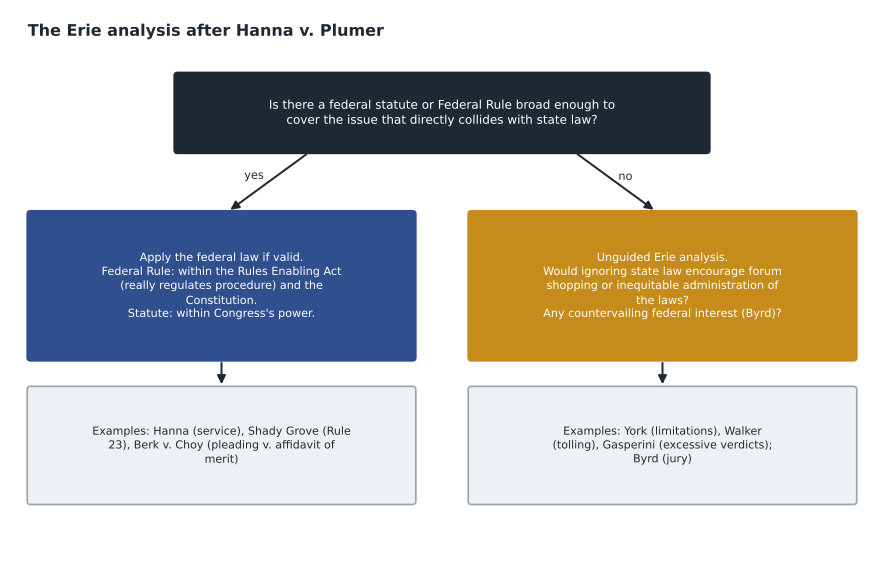
Applying the two tracks
The first step on either track is deciding whether a Federal Rule actually covers the issue. In Walker v. Armco Steel Corp., 446 U.S. 740 (1980), the plaintiff filed in federal court within Oklahoma's limitations period but served the defendant after it ran; Oklahoma law treated a case as commenced, for limitations purposes, only upon service. The plaintiff argued that Rule 3, which says an action is commenced by filing a complaint, controlled. The Court disagreed, reading Rule 3 as governing only the start of the federal timetable, not as displacing state tolling rules. With no collision, the unguided Erie analysis applied, and the state rule, an integral part of the state's limitations policy, controlled.
In Gasperini v. Center for Humanities, Inc., 518 U.S. 415 (1996), a journalist sued over lost photographic slides and won a 450,000 dollar jury verdict. New York law directed appellate courts to order a new trial if an award deviated materially from what would be reasonable compensation, a stricter standard than the traditional federal test of whether an award shocks the conscience. The Court held that New York's standard was substantive for Erie purposes, because it was designed to control the size of damages awards, but that it should be applied in federal court by the trial judge on a motion for a new trial, with appellate review only for abuse of discretion, to respect the Seventh Amendment.
Shady Grove Orthopedic Associates, P.A. v. Allstate Insurance Co., 559 U.S. 393 (2010), shows the first track at work. A New York statute barred class actions seeking statutory penalties or minimum damages unless the statute creating the penalty authorized them. A medical practice brought a class action in federal court seeking statutory interest from an insurer. The Court held that Rule 23 controlled: it answers the question whether a class action may proceed, so it collided with the state statute, and the federal court must follow it. The justices split on how to judge the rule's validity. A plurality led by Justice Scalia said the question is whether the Federal Rule really regulates procedure, regardless of the state law's purpose; Justice Stevens, concurring, would have asked whether applying the Federal Rule would displace a state law so intertwined with a state right or remedy that it functions to define the scope of the state-created right.
The newest case continues Shady Grove's approach. In Berk v. Choy, decided January 20, 2026, a patient sued a doctor for medical malpractice in federal court in Delaware but did not file the affidavit of merit, signed by an expert, that a Delaware statute required with any malpractice complaint. The lower courts dismissed the case. A unanimous Supreme Court, in an opinion by Justice Barrett, reversed. The Federal Rules, beginning with Rule 8's requirement of a short and plain statement of the claim, answer the question of what a complaint must contain to proceed, and they do not require a plaintiff to submit evidence such as an expert's affidavit with the complaint. Because the federal rules covered the issue and were valid, the Delaware requirement did not apply in federal court. Justice Jackson concurred in the judgment on different reasoning. The decision affects similar certificate-of-merit statutes in many states, including those for professional negligence claims against engineers and architects.
| Case | Issue | Result |
|---|---|---|
| Erie (1938) | Duty owed to a pedestrian on a railroad path | State substantive law applies; no federal general common law |
| Klaxon (1941) | Choice-of-law rules | Forum state's choice-of-law rules apply |
| York (1945) | Statute of limitations | State law, under the outcome-determination test |
| Byrd (1958) | Judge or jury decides an immunity defense | Federal practice: jury, given the federal interest |
| Hanna (1965) | Method of service | Federal Rule applies when valid and on point |
| Walker (1980) | When filing tolls the limitations period | State law; Rule 3 does not cover the question |
| Gasperini (1996) | Standard for excessive verdicts | State standard, applied by the federal trial judge |
| Shady Grove (2010) | State bar on certain class actions | Rule 23 controls |
| Berk v. Choy (2026) | State affidavit-of-merit requirement | Federal pleading rules control; the state requirement does not apply |
Erie in the Delgado case
Okafor-Bell asks the class to sort issues in Delgado's case. The elements of a product liability claim under Ohio law are substantive, so Ohio law governs whether the battery was defective in design or manufacture, whether its warnings were adequate, and whether a defect proximately caused the fire. Ohio's two-year statute of limitations for bodily injury applies, under York; Delgado sued within weeks of the fire, so it causes no problem. Ohio's damages rules apply as well. Ohio Revised Code § 2315.18 generally caps noneconomic damages, such as pain and suffering, at the greater of 250,000 dollars or three times economic losses, up to 350,000 dollars per plaintiff, but the cap does not apply to certain catastrophic injuries, including a permanent and substantial physical deformity or the permanent loss of use of a limb. Whether Delgado's scarring and loss of hand function meet that exception is a question of Ohio law the federal court must decide as an Ohio court would.
By contrast, the form of the complaint, the scope of discovery, the standards for summary judgment and the right to a jury are federal. Rule 8 governs pleading. Rule 26 governs discovery, even if Ohio's discovery rules differ. Rule 56 governs summary judgment. The Seventh Amendment governs the jury right in federal court, and Rule 48 the size of the jury and the requirement of unanimity, unless the parties stipulate otherwise. Marcus Webb asks about expert testimony. Federal Rule of Evidence 702, which was amended in December 2023 to emphasize that the proponent must show the expert's opinion is more likely than not reliable, governs admissibility in federal court as a procedural rule enacted by Congress and the Supreme Court. Whether expert testimony is required to prove a design defect at all, though, is part of the substantive state claim.
Worked problem
A state certificate requirement
Suppose Ohio enacted a statute requiring any plaintiff in a product liability case to file, with the complaint, a certificate from a qualified engineer stating that the product was likely defective, and requiring dismissal if no certificate is filed. Kestrelwerk moves to dismiss Delgado's federal complaint because she filed no certificate. What result?
Show solution
- Identify the question: what must a plaintiff file with a complaint to proceed?
- Is there a Federal Rule broad enough to answer it? Yes. Under Berk v. Choy, the Federal Rules, including Rule 8, govern what a complaint must contain and do not require evidence with it.
- Is the Federal Rule valid? The Rules Enabling Act question is whether the rule really regulates procedure; rules about the content of pleadings do. No Federal Rule of Civil Procedure has ever been held invalid.
- Because the Federal Rule controls, the state certificate requirement does not apply in federal court. Ohio's substantive product liability standards still apply to the merits.
Answer: The motion should be denied. Under Hanna, Shady Grove and Berk v. Choy, the federal pleading rules control in federal court, so a state certificate-of-merit requirement does not apply there.
Common mistakes
MistakeFederal courts apply federal law in every case they hear.
InsteadIn cases based on state claims, federal courts apply state substantive law, including state court decisions, under Erie.
MistakeA federal court sitting in diversity uses its own choice-of-law rules.
InsteadUnder Klaxon, it uses the choice-of-law rules of the state where it sits.
MistakeIf a state rule could affect the outcome, it always applies in federal court.
InsteadWhen a valid Federal Rule covers the issue, the Federal Rule applies (Hanna, Shady Grove, Berk). The outcome test applies only in the unguided Erie analysis.
MistakeEvery Federal Rule automatically displaces any related state law.
InsteadThe court must first decide whether the Federal Rule is broad enough to cover the issue; Walker held that Rule 3 did not govern state limitations tolling.
Summary and key terms
- Swift v. Tyson let federal courts apply general common law; Erie (1938) overruled it, holding that there is no federal general common law and that state substantive law governs state claims.
- Federal courts follow the forum state's choice-of-law rules (Klaxon) and predict, or certify questions about, unsettled state law.
- York's outcome-determination test and Byrd's balancing of federal interests shaped the substance-procedure line.
- Hanna created two tracks: a valid Federal Rule that covers the issue controls; otherwise, apply Erie in light of forum shopping and inequitable administration.
- Walker and Gasperini applied state law; Shady Grove and Berk v. Choy (2026) applied Federal Rules over conflicting state requirements.
- In Delgado's case, Ohio law governs liability, limitations and damages caps; federal law governs pleading, discovery, summary judgment and the jury.
- Rules of Decision Act
- 28 U.S.C. § 1652, directing federal courts to apply state law as rules of decision where it applies.
- General common law
- Under Swift v. Tyson, judge-made law that federal courts applied independently of state courts.
- Erie doctrine
- The principle that federal courts apply state substantive law and federal procedural law to state claims.
- Outcome determination
- York's test treating a state rule as substantive if ignoring it would substantially change the result.
- Twin aims of Erie
- Discouraging forum shopping and avoiding inequitable administration of the laws.
- Certification
- A federal court's request that a state's highest court answer an unsettled question of state law.
- Choice of law
- The rules deciding which jurisdiction's law governs a dispute.
- Affidavit of merit
- An expert statement some states require with certain complaints; Berk v. Choy held it inapplicable in federal court.
Practice problems
Work each problem on paper first, then reveal the answer to check.
What were the three reasons Erie gave for overruling Swift v. Tyson?
Show answer
Swift misread the Rules of Decision Act; it produced forum shopping and unequal treatment; and it was unconstitutional because neither Congress nor federal courts can declare general substantive common law for the states.
Why did the federal rule control in Hanna but not in Walker?
Show answer
In Hanna, Rule 4 directly covered the method of service. In Walker, the Court read Rule 3 as not covering when a state limitations period is tolled, so there was no collision and state law applied.
Which state's choice-of-law rules will the federal court in Columbus use for Delgado's claims?
Show answer
Ohio's, under Klaxon.
Is Ohio's cap on noneconomic damages applied in federal court? Why?
Show answer
Yes. It defines the amount of the state-created remedy, so it is substantive under Erie, and no Federal Rule governs the measure of damages.
Lesson quiz · 5 questions
Score 60% or more to complete this lesson.
Create a free account to save your progress, take quizzes and earn a certificate.