
LAWU-101 · Lesson 8 of 12 · 24 min
Pleadings
▶ Video coming soon A video version of this lesson is on the way.
Three weeks after removal, Kestrelwerk files a motion to dismiss. It makes two arguments. First, under Rule 12(b)(2), it says the federal court in Ohio lacks personal jurisdiction over it, attaching a declaration from its general counsel that it has no office, employees or bank accounts in Ohio and sells only to its Delaware subsidiary. Second, under Rule 12(b)(6), it says Delgado's complaint fails to state a claim, because her allegation that the battery was "defectively designed and unreasonably dangerous" is a bare legal conclusion with no facts behind it. Ana Whitcomb reads the motion to Section B with a rueful smile. "The jurisdiction argument I expected," she says. "The second one is fair. I wrote that complaint fast, for an Ohio state court. Federal court is a different world."
This lesson covers pleadings: the documents that frame a lawsuit. It examines what a complaint must contain after the Supreme Court's decisions in Twombly and Iqbal, how defendants respond, the responsibilities that Rule 11 imposes on everyone who signs a pleading, and how pleadings can be amended. It ends with Whitcomb's amended complaint.
The complaint
Rule 8(a) requires a pleading that states a claim for relief to contain three things: a short and plain statement of the grounds for the court's jurisdiction; a short and plain statement of the claim showing that the pleader is entitled to relief; and a demand for the relief sought, which may include relief in the alternative or of different types. Rule 8(d) allows claims to be stated in the alternative and even inconsistently, so a plaintiff can allege that a product was defective in design and, alternatively, in manufacture. Rule 10 adds formal requirements: a caption with the court's name, the parties and the file number, and claims set out in numbered paragraphs, each limited as far as practicable to a single set of circumstances.
The 1938 rules deliberately rejected the code pleading of the nineteenth century, which required plaintiffs to plead the ultimate facts and punished them for pleading evidence or legal conclusions. The new system was called notice pleading: the complaint needed only to give the defendant fair notice of the claim, and discovery and summary judgment would sort out the facts. In Conley v. Gibson, 355 U.S. 41 (1957), the Court said a complaint should not be dismissed for failure to state a claim unless it appeared beyond doubt that the plaintiff could prove no set of facts in support of the claim. As late as Swierkiewicz v. Sorema N.A., 534 U.S. 506 (2002), the Court unanimously reversed the dismissal of an employment discrimination complaint that did not plead every element of a prima facie case.
Rule 9 creates exceptions. Under Rule 9(b), a party alleging fraud or mistake must state with particularity the circumstances constituting the fraud or mistake, usually meaning who said what, when, where and how, though malice, intent and knowledge may be alleged generally. Under Rule 9(g), items of special damage must be specifically stated. Only Congress or the rulemaking process can add heightened pleading requirements; courts may not invent them for particular kinds of cases, as the Court held in Leatherman v. Tarrant County Narcotics Intelligence & Coordination Unit, 507 U.S. 163 (1993).
Plausibility: Twombly and Iqbal
Bell Atlantic Corp. v. Twombly, 550 U.S. 544 (2007), changed federal pleading. Consumers brought an antitrust class action against the regional telephone companies that emerged from the breakup of AT&T, alleging that they had conspired not to compete in each other's territories. The complaint's factual allegations described parallel conduct: each company stayed out of the others' regions. It then alleged, in conclusory terms, that the companies had agreed to do so. The Court held that the complaint failed. Under the Sherman Act, parallel conduct alone is not illegal; an agreement is. Allegations of parallel conduct, which is just as consistent with independent business decisions, did not plausibly suggest an agreement. A complaint must contain enough facts to state a claim to relief that is plausible on its face, and the Court retired Conley's "no set of facts" language.
Two years later, Ashcroft v. Iqbal, 556 U.S. 662 (2009), made clear that Twombly applies to all civil actions. Javaid Iqbal, a Pakistani Muslim, was arrested after the September 11 attacks, held in a maximum-security unit in Brooklyn and, he alleged, abused there. He sued many officials, including former Attorney General John Ashcroft and FBI Director Robert Mueller, alleging that they had adopted a policy of harsh confinement because of detainees' religion, race or national origin. The Court held that his allegations against those two officials were insufficient, and it described a two-step approach.
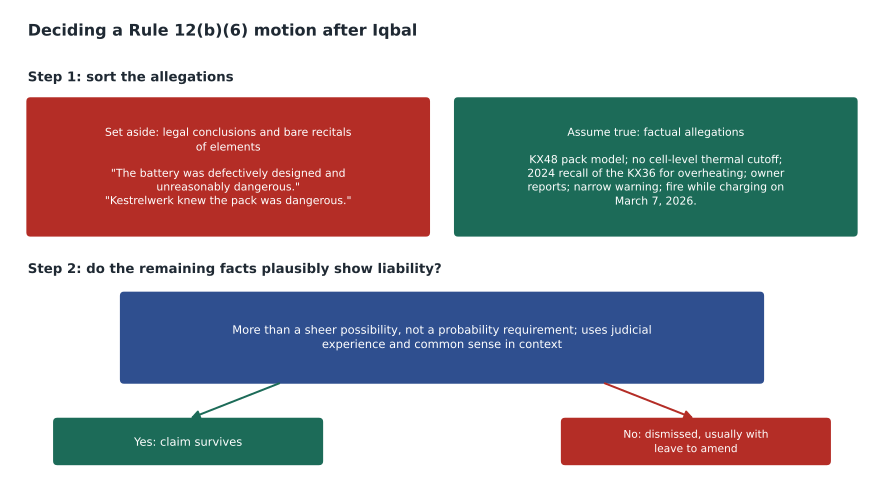
First, the court identifies allegations that are no more than legal conclusions, which are not entitled to the assumption of truth. Threadbare recitals of the elements of a claim, supported by mere conclusory statements, do not suffice. Second, the court assumes the truth of the remaining well-pleaded factual allegations and asks whether they plausibly give rise to an entitlement to relief. Plausibility requires more than a sheer possibility that a defendant has acted unlawfully, but it is not a probability requirement. Deciding plausibility is a context-specific task that requires the court to draw on its judicial experience and common sense. In Iqbal, the factual allegations were consistent with a legitimate policy of holding people with suspected terrorist links, so discriminatory purpose was not plausible.
Critics argue that plausibility pleading lets judges dismiss meritorious cases before plaintiffs can use discovery to find facts held only by defendants, such as internal company documents. Supporters respond that defendants should not face expensive discovery on the strength of conclusory accusations. Studies of dismissal rates after Iqbal have reached mixed conclusions. Whatever its merits, the standard governs every federal civil case, and Berk v. Choy (Lesson 7) confirms that a federal complaint is judged by these federal pleading rules, not by state requirements that a plaintiff submit evidence at the outset.
Responding to the complaint
A defendant has 21 days after being served to respond, under Rule 12(a), or 60 days after the request was sent if it waived service (90 if the request was sent abroad). For removed cases, Rule 81(c)(2) gives a defendant that has not yet answered the longest of 21 days after receiving the initial pleading, 21 days after service of the summons, or 7 days after the notice of removal is filed. The response can be an answer, a pre-answer motion under Rule 12, or both.
Rule 12(b) lists seven defenses that may be raised by motion: lack of subject-matter jurisdiction; lack of personal jurisdiction; improper venue; insufficient process; insufficient service of process; failure to state a claim upon which relief can be granted; and failure to join a party under Rule 19. Other Rule 12 motions include a motion for a more definite statement under Rule 12(e), when a pleading is so vague or ambiguous that the party cannot reasonably prepare a response; a motion to strike under Rule 12(f), for redundant, immaterial, impertinent or scandalous matter; and a motion for judgment on the pleadings under Rule 12(c), after the pleadings are closed.
Rule 12 has a structure designed to prevent piecemeal motions. Under Rule 12(g)(2), a party that makes a Rule 12 motion generally may not make another one raising a defense that was available but omitted. Under Rule 12(h)(1), the defenses of lack of personal jurisdiction, improper venue, insufficient process and insufficient service are waived if not included in the first Rule 12 motion or, if no motion is made, in the answer. Under Rule 12(h)(2), failure to state a claim, failure to join a required party and failure to state a legal defense may still be raised in later pleadings, by motion for judgment on the pleadings, or at trial. Under Rule 12(h)(3), lack of subject-matter jurisdiction may be raised at any time. If a party presents matters outside the pleadings on a Rule 12(b)(6) or 12(c) motion and the court considers them, Rule 12(d) requires the court to treat the motion as one for summary judgment and give all parties a reasonable opportunity to present pertinent material.
| Defense | Rule | Deadline |
|---|---|---|
| Lack of personal jurisdiction | 12(b)(2) | First Rule 12 motion or answer, under 12(h)(1) |
| Improper venue | 12(b)(3) | First Rule 12 motion or answer |
| Insufficient process or service | 12(b)(4), (5) | First Rule 12 motion or answer |
| Failure to state a claim | 12(b)(6) | Through trial, under 12(h)(2) |
| Failure to join a required party | 12(b)(7) | Through trial, under 12(h)(2) |
| Lack of subject-matter jurisdiction | 12(b)(1) | Any time, under 12(h)(3) |
The answer
An answer responds to each allegation in the complaint. Under Rule 8(b), the defendant must admit or deny each allegation, or state that it lacks knowledge or information sufficient to form a belief about its truth, which has the effect of a denial. A denial must fairly respond to the substance of the allegation; a party that intends to deny only part of an allegation must admit the rest. Under Rule 8(b)(6), an allegation, other than one about the amount of damages, is admitted if a responsive pleading is required and the allegation is not denied. Careless answers can therefore concede key facts.
Under Rule 8(c), a party must affirmatively state any avoidance or affirmative defense, such as the statute of limitations, assumption of risk, contributory negligence, release, res judicata and waiver. An affirmative defense is one that defeats the claim even if the plaintiff's allegations are true, and the defendant usually bears the burden of proving it. A defense not pleaded may be forfeited, though courts often allow late amendments. Courts are divided on whether Twombly's plausibility standard applies to affirmative defenses. Kestrelwerk's answer, if it must file one, will raise Delgado's own comparative fault in charging the pack with a charger the manual did not approve, and assumption of the risk, defenses that Ohio's product liability statute expressly addresses.
Rule 11
Every pleading, written motion and other paper must be signed by at least one lawyer of record, or by a party who has no lawyer. Under Rule 11(b), by presenting a paper to the court, the signer certifies that, to the best of the person's knowledge, information and belief, formed after an inquiry reasonable under the circumstances: the paper is not presented for any improper purpose, such as to harass, cause unnecessary delay or needlessly increase costs; the legal contentions are warranted by existing law or by a nonfrivolous argument for changing it; the factual contentions have evidentiary support or, if specifically so identified, will likely have it after a reasonable opportunity for investigation or discovery; and denials are warranted on the evidence or reasonably based on a lack of information.
Sanctions are discretionary and limited to what suffices to deter repetition of the conduct. A party seeking sanctions must serve the motion on the offending party and wait 21 days before filing it, under the safe-harbor provision of Rule 11(c)(2); if the paper is withdrawn or corrected in that time, no sanctions motion may be filed. Rule 11 does not apply to discovery papers, which Rule 26(g) governs. Courts have recently applied Rule 11 to lawyers who filed briefs containing fictitious case citations generated by artificial intelligence tools. In Mata v. Avianca, Inc. (S.D.N.Y. 2023), lawyers were sanctioned 5,000 dollars after submitting a brief citing nonexistent cases and then standing by them. Daniel Reyes says his old firm now requires a second lawyer to pull every cited case before filing. "Good," says Okafor-Bell. "The signature on a filing is a promise. Reading the cases is part of keeping it."
Amending pleadings
Under Rule 15(a)(1), a party may amend its pleading once as a matter of course within 21 days after serving it or, if the pleading requires a response, within 21 days after service of a responsive pleading or of a Rule 12(b), (e) or (f) motion, whichever is earlier. After that, a party may amend only with the opposing party's written consent or the court's leave, and Rule 15(a)(2) instructs that the court should freely give leave when justice so requires. In Foman v. Davis, 371 U.S. 178 (1962), the Court said leave should be granted absent reasons such as undue delay, bad faith, repeated failure to cure deficiencies, undue prejudice to the opposing party or futility.
An amendment can matter for the statute of limitations. Under Rule 15(c)(1)(B), an amendment relates back to the date of the original pleading when it asserts a claim or defense arising out of the conduct, transaction or occurrence set out, or attempted to be set out, in the original pleading. An amendment changing the party against whom a claim is asserted relates back only if, in addition, within the Rule 4(m) period the new party received such notice of the action that it will not be prejudiced in defending, and knew or should have known that the action would have been brought against it but for a mistake concerning the proper party's identity. In Krupski v. Costa Crociere S.p.A., 560 U.S. 538 (2010), a passenger injured on a cruise sued Costa Cruise Lines, the US sales agent, when the carrier named on her ticket was the Italian company Costa Crociere. The Court held that the amendment naming the right company related back, because the question is what the new defendant knew or should have known, not what the plaintiff knew.
The amended complaint
Within 21 days of Kestrelwerk's Rule 12(b) motion, Whitcomb files an amended complaint as a matter of course under Rule 15(a)(1)(B). She adds Kestrel North America LLC as a defendant, which leaves alienage jurisdiction intact because the LLC is a German citizen through its sole member. She organizes the claims under the categories of the Ohio Product Liability Act, which since 2005 has abrogated common-law product liability claims in Ohio: defective design under Ohio Revised Code § 2307.75, inadequate warning under § 2307.76 and nonconformance with representations under § 2307.77. And she replaces conclusions with facts:
- The Trail 750 uses a 48-volt lithium-ion pack, model KX48, made by Kestrelwerk with cells bought from a supplier.
- The KX48 has no thermal cutoff at the level of individual cells, only a pack-level fuse, a design that published battery-safety literature associates with a higher risk that a single failing cell will spread heat to its neighbors.
- In 2024, Kestrelwerk recalled its earlier KX36 pack in the United States after reports of overheating while charging.
- Riders in owner forums on Kestrelwerk's own website reported KX48 packs becoming hot to the touch while charging, beginning in 2025.
- Kestrelwerk's manual warned only to "use approved chargers" and did not warn that charging indoors near flammable materials could lead to fire.
- On March 7, 2026, Delgado's KX48 pack caught fire while charging in her garage, about four hours after she plugged it in.
Okafor-Bell asks the class to apply Iqbal. Strip out the conclusions, such as "unreasonably dangerous", and what remains is a specific product, a specific design feature, an earlier recall of a similar product for the same kind of failure, user reports, a narrow warning and a fire while charging. Those facts make it plausible, not merely possible, that the KX48 was defectively designed and inadequately labeled. The court will not decide whether Delgado can prove them; it will decide only whether, if true, they state a claim. The judge denies the renewed Rule 12(b)(6) motion. The judge also denies the Rule 12(b)(2) motion, finding that Delgado has made the prima facie showing of personal jurisdiction required at this stage, for the reasons explored in Lessons 2 and 3. Kestrelwerk and Kestrel North America answer in November.
Worked problem
Conclusion or fact?
Classify each allegation as a legal conclusion or a factual allegation for Iqbal step one: (a) "Kestrelwerk knew the KX48 was dangerous." (b) "In May 2025, Kestrelwerk's customer-service team received at least 12 reports of KX48 packs overheating while charging." (c) "The KX48 was defective within the meaning of Ohio Revised Code § 2307.75." (d) "The KX48's only thermal protection is a pack-level fuse."
Show solution
- (a) Knowledge may be alleged generally under Rule 9(b), but standing alone this is conclusory; it needs factual support, which (b) supplies.
- (b) A factual allegation, assumed true at the pleading stage.
- (c) A legal conclusion: it applies the statute's legal standard and is not assumed true.
- (d) A factual allegation about the product's design.
Answer: (b) and (d) are factual allegations entitled to the assumption of truth; (c) is a legal conclusion; (a) is a conclusion that becomes plausible when supported by facts like (b).
Common mistakes
MistakeA complaint survives a motion to dismiss if the plaintiff could prove some set of facts supporting the claim.
InsteadTwombly retired that standard. A complaint must allege facts that make the claim plausible on its face.
MistakePlausibility means the plaintiff must show she will probably win.
InsteadPlausibility is more than possibility but is not a probability requirement; the court assumes the factual allegations are true.
MistakeA defendant can raise lack of personal jurisdiction in a second Rule 12 motion.
InsteadRule 12(g)(2) and 12(h)(1) make the defense waived if omitted from the first Rule 12 motion.
MistakeRule 11 sanctions can be filed immediately.
InsteadThe safe harbor requires serving the motion and waiting 21 days so the paper can be withdrawn or corrected.
Summary and key terms
- Rule 8(a) requires a jurisdictional statement, a short and plain statement of the claim showing entitlement to relief, and a demand for relief; Rule 9(b) requires particularity for fraud and mistake.
- Twombly and Iqbal require facts that make a claim plausible: set aside legal conclusions, assume factual allegations are true and ask whether they plausibly show liability.
- Defendants respond by answer or Rule 12 motion; some defenses are waived if omitted from the first motion or answer, while subject-matter jurisdiction is never waived.
- Rule 8(b) requires specific admissions and denials; unanswered allegations are admitted; affirmative defenses must be pleaded under Rule 8(c).
- Rule 11 requires a reasonable inquiry into facts and law, with a 21-day safe harbor; fictitious AI-generated citations have drawn sanctions.
- Rule 15 allows amendment as of course within 21 days and freely with leave; amendments relate back if they arise from the same conduct, and party changes require notice and a mistake (Krupski).
- Complaint
- The pleading that starts a lawsuit by stating the plaintiff's claims and requested relief.
- Notice pleading
- The 1938 approach requiring only fair notice of the claim.
- Plausibility standard
- The Twombly and Iqbal requirement of enough facts to make a claim plausible on its face.
- Answer
- The defendant's pleading admitting or denying the complaint's allegations and stating defenses.
- Affirmative defense
- A defense that defeats the claim even if the plaintiff's allegations are true, which the defendant must plead.
- Motion to dismiss
- A Rule 12(b) motion asking the court to end a claim on a threshold ground.
- Safe harbor
- Rule 11's 21-day period to withdraw or correct a challenged paper before a sanctions motion is filed.
- Relation back
- The rule treating an amended pleading as filed on the original date for limitations purposes.
Practice problems
Work each problem on paper first, then reveal the answer to check.
Why did the complaint in Twombly fail?
Show answer
It alleged parallel conduct, which is consistent with independent action, plus a conclusory assertion of agreement; it did not plausibly suggest the agreement that the antitrust claim required.
Kestrelwerk's answer says nothing about Delgado's allegation that she bought the bike on June 2, 2025. What is the effect?
Show answer
Under Rule 8(b)(6), the allegation is admitted because it was not denied.
When could Whitcomb amend her complaint without the court's leave?
Show answer
Within 21 days after service of Kestrelwerk's Rule 12(b) motion, under Rule 15(a)(1)(B).
What did Krupski v. Costa Crociere focus on in deciding relation back?
Show answer
What the newly named defendant knew or should have known about the plaintiff's mistake, not the plaintiff's knowledge.
Lesson quiz · 5 questions
Score 60% or more to complete this lesson.
Create a free account to save your progress, take quizzes and earn a certificate.