
LAWU-101 · Lesson 6 of 12 · 23 min
Removal, venue and transfer
▶ Video coming soon A video version of this lesson is on the way.
Ana Whitcomb chose the Franklin County Court of Common Pleas deliberately. Delgado lives in the county, the fire happened there, and Whitcomb tries cases in that courthouse every year. She named two defendants: Kestrelwerk, which designed and built the bike, and Ridgeline, the Ohio shop that sold it. Her complaint alleges that Ridgeline was itself negligent. Its mechanic assembled the bike, installed the battery and sold Delgado a cheaper third-party charger that Kestrelwerk's manual did not approve, telling her it was "just as good." Whitcomb knows that keeping Ridgeline in the case also keeps it out of federal court, because Ridgeline, like Delgado, is an Ohio citizen.
Then, in July 2026, Ridgeline's insurer offers to settle. Delgado accepts, and on August 20 Whitcomb files a notice dismissing Ridgeline from the case. Kestrelwerk had been served through the German central authority on August 3. Gregory Hale moves fast: on September 10, Kestrelwerk files a notice of removal in the United States District Court for the Southern District of Ohio, Eastern Division, which sits in Columbus. Okafor-Bell uses those dates to teach removal, and then turns to the questions of which federal courthouse hears a case and when a case can be moved from one federal district to another.
Removal
Removal lets a defendant move a case from state court to federal court. Under 28 U.S.C. § 1441(a), any civil action brought in a state court of which the federal district courts have original jurisdiction may be removed by the defendant or defendants to the district court for the district and division embracing the place where the action is pending. The right belongs only to defendants. In Home Depot U.S.A., Inc. v. Jackson, 587 U.S. 435 (2019), the Court held that a third-party defendant brought into a case on a counterclaim is not a "defendant" who can remove under section 1441(a). The plaintiff chose the state forum and cannot later remove.
Removal is a one-way door to a specific place. A case removed from the Franklin County court goes to the federal district and division that includes Franklin County, here the Southern District of Ohio at Columbus. The defendant cannot pick another district. The federal court must have original jurisdiction, as if the plaintiff had filed there, judged by the plaintiff's complaint under the well-pleaded complaint rule from Lesson 5.
Procedure and timing
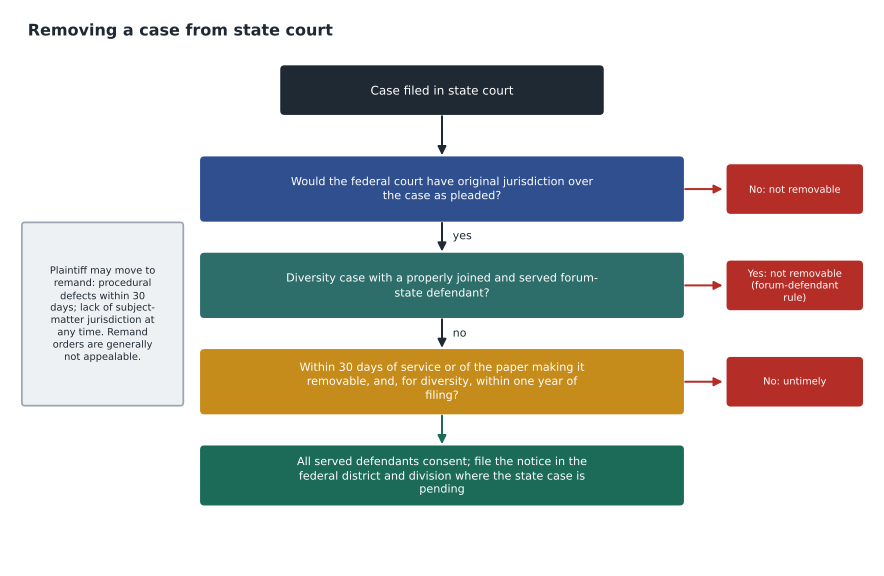
Under 28 U.S.C. § 1446, the defendant files a notice of removal in federal court containing a short and plain statement of the grounds for removal, then files a copy in the state court, which ends the state court's power over the case unless and until it is remanded. In Dart Cherokee Basin Operating Co. v. Owens, 574 U.S. 81 (2014), the Court held that the notice need only plausibly allege the facts supporting jurisdiction, including the amount in controversy; evidence is required only if the plaintiff or court questions the allegation. That matters in Ohio, whose Civil Rule 8(A) tells plaintiffs seeking more than 25,000 dollars to say so but not to state the amount, so a defendant must often show the amount from the nature of the injuries.
The notice must be filed within 30 days after the defendant receives the initial pleading through service. In Murphy Brothers, Inc. v. Michetti Pipe Stringing, Inc., 526 U.S. 344 (1999), the Court held that the clock starts with formal service, not with an informal copy faxed or emailed to the defendant. When there are several defendants, each has 30 days from its own service, and all defendants who have been properly joined and served must join in or consent to removal, a requirement called the rule of unanimity, codified in section 1446(b)(2)(A).
If the case stated by the initial pleading is not removable, section 1446(b)(3) gives the defendant 30 days from receiving a copy of an amended pleading, motion, order or other paper from which it can first be ascertained that the case has become removable. Courts apply a voluntary-involuntary rule: a case becomes removable only through the plaintiff's voluntary act, such as dismissing the nondiverse defendant, and not through a court order dismissing that defendant over the plaintiff's objection, which might be reversed on appeal. In diversity cases, section 1446(c)(1) adds an outer limit: no removal more than one year after the action was commenced, unless the plaintiff acted in bad faith to prevent removal.
The forum-defendant rule
Section 1441(b)(2) adds a limit for diversity cases: a case otherwise removable solely on the basis of diversity may not be removed if any of the parties in interest properly joined and served as defendants is a citizen of the state in which the action is brought. The idea is that a local defendant needs no protection from local bias. While Ridgeline was in the case, it blocked removal twice over: it destroyed complete diversity and it was a forum defendant. The words "and served" have produced a well-known controversy over snap removal, in which a forum defendant removes a case before any defendant has been served. Courts of appeals have divided on whether the plain text permits it.
Applying the rules to the Delgado dates
Jordan Kimura works through the dates. When Kestrelwerk was served on August 3, the case was not removable: Ridgeline was still a defendant, and both it and Delgado were Ohio citizens. Delgado's voluntary dismissal of Ridgeline on August 20 made the case removable for the first time, leaving an Ohio plaintiff against a German defendant, which is alienage jurisdiction, with damages plainly above 75,000 dollars. Kestrelwerk removed on September 10, within 30 days of the dismissal under section 1446(b)(3) and well within one year of the April 14 filing. No other defendant needed to consent, and no forum defendant remained. The removal was proper.
Improper joinder
Suppose Ridgeline had not settled. Kestrelwerk's alternative strategy would have been to argue that Whitcomb had joined Ridgeline only to defeat diversity, a doctrine courts call fraudulent or improper joinder. The removing defendant must show that the plaintiff has no reasonable possibility of recovering against the nondiverse defendant under state law, or that the jurisdictional facts were pleaded fraudulently. If it succeeds, the court disregards the nondiverse defendant's citizenship. The burden is heavy, and doubts are resolved in favor of remand.
Ohio's product liability statute shows how the argument would work. Under Ohio Revised Code § 2307.78, a supplier that did not make the product is generally liable only for its own negligence or for the product's failure to conform to the supplier's own representations, unless one of several exceptions makes it answer as if it were the manufacturer, such as when the manufacturer cannot be brought before an Ohio court. Kestrelwerk would argue that Ridgeline was a mere seller. Whitcomb would answer that her complaint alleges Ridgeline's own negligence in assembling the bike and supplying an unapproved charger, and its representation that the charger was just as good. That would almost certainly be enough to defeat an improper joinder argument.
The Supreme Court recently described the stakes when a court gets this question wrong. In Hain Celestial Group, Inc. v. Palmquist (2026), Texas parents sued a baby-food maker and Whole Foods, a Texas citizen, in Texas state court. The manufacturer removed, arguing that Whole Foods had been improperly joined; the district court agreed, dismissed Whole Foods and later entered judgment for the manufacturer after trial. The Fifth Circuit held that Whole Foods had been properly joined. A unanimous Supreme Court, in an opinion by Justice Sotomayor, held that because complete diversity had never existed, the federal court never had jurisdiction, so its judgment had to be vacated and the case returned to state court, years of litigation notwithstanding. A district court cannot create jurisdiction through its own mistakes.
Remand
A plaintiff who believes removal was improper moves to remand under 28 U.S.C. § 1447(c). A motion based on a defect other than lack of subject-matter jurisdiction, such as missing the 30-day deadline or the forum-defendant rule, must be made within 30 days after the notice of removal is filed, or the defect is waived. Lack of subject-matter jurisdiction can be raised at any time before final judgment. Under section 1447(d), an order remanding a case is generally not reviewable on appeal, though Congress has made exceptions, including for cases removed under the federal officer and civil rights removal statutes and, under the Class Action Fairness Act, for class actions. A court that remands may award fees when the removing party lacked an objectively reasonable basis for removal (Martin v. Franklin Capital Corp., 546 U.S. 132 (2005)).
Venue
Personal and subject-matter jurisdiction tell you which courts have power. Venue rules pick, from among the courts with power, the specific place that is appropriate. In federal court, the general venue statute is 28 U.S.C. § 1391. Under section 1391(b), a civil action may be brought in: (1) a judicial district in which any defendant resides, if all defendants are residents of the state in which the district is located; (2) a judicial district in which a substantial part of the events or omissions giving rise to the claim occurred, or a substantial part of the property involved is situated; or (3) if there is no district in which the action may otherwise be brought, any district in which any defendant is subject to the court's personal jurisdiction.
Section 1391(c) defines residence. A natural person resides in the district where she is domiciled. An entity with the capacity to sue and be sued, if it is a defendant, resides in any district in which it is subject to personal jurisdiction with respect to the action. A defendant not resident in the United States may be sued in any judicial district, and its presence is disregarded in deciding where venue lies as to other defendants. Venue in a removed case is governed by section 1441(a), which sends the case to the district embracing the state court; the general venue statute does not apply.
Had Whitcomb filed directly in federal court against Kestrelwerk, venue would have been proper in the Southern District of Ohio under section 1391(b)(2), because the fire and Delgado's injuries occurred in Columbus, and also because Kestrelwerk, as a foreign defendant, may be sued in any district under section 1391(c)(3). An objection to venue, like an objection to personal jurisdiction, is waived if not raised in the defendant's first Rule 12 motion or answer, under Rule 12(b)(3) and 12(h)(1).
| Question | Source | Can it be waived? |
|---|---|---|
| Subject-matter jurisdiction | Article III; 28 U.S.C. §§ 1331, 1332, 1367 | No; raise any time |
| Personal jurisdiction | Due process; long-arm statute; Rule 4(k) | Yes, if omitted from first Rule 12 motion or answer |
| Venue | 28 U.S.C. § 1391; § 1441(a) for removed cases | Yes, same rule |
| Service of process | Rule 4; Hague Convention | Yes, same rule |
Transfer between federal courts
A federal case filed in one district can be moved to another. Under 28 U.S.C. § 1404(a), for the convenience of parties and witnesses and in the interest of justice, a district court may transfer any civil action to any other district where it might have been brought, or to any district to which all parties have consented. Courts weigh private interest factors, such as the location of witnesses and evidence, the parties' convenience and the plaintiff's choice of forum, and public interest factors, such as court congestion, local interest in the controversy and familiarity with the governing law.
Transfer does not change the governing law. In Van Dusen v. Barrack, 376 U.S. 612 (1964), the Court held that when a defendant obtains a transfer under section 1404(a), the transferee court must apply the law, including the choice-of-law rules, that the transferor court would have applied. In Ferens v. John Deere Co., 494 U.S. 516 (1990), the Court applied the same rule when the plaintiff sought the transfer. The point is that a transfer for convenience should not change the outcome.
Forum-selection clauses change the analysis. In Atlantic Marine Construction Co. v. United States District Court, 571 U.S. 49 (2013), the Court held that a valid forum-selection clause choosing another federal district should be enforced through section 1404(a) and given controlling weight in all but the most exceptional cases. The plaintiff's choice of forum gets no weight, the parties' private interests are deemed to favor the chosen forum, and the original court's choice-of-law rules do not travel with the case.
If venue is improper, 28 U.S.C. § 1406(a) directs the court to dismiss or, if it is in the interest of justice, transfer the case to a district where it could have been brought. A court may transfer under that section even if it lacks personal jurisdiction over the defendant (Goldlawr, Inc. v. Heiman, 369 U.S. 463 (1962)). Separately, 28 U.S.C. § 1407 lets the Judicial Panel on Multidistrict Litigation transfer similar cases from many districts to one judge for coordinated pretrial proceedings, the process governed since December 2025 by Rule 16.1.
Forum non conveniens
When the more convenient forum is in another country, a federal court cannot transfer the case there. It can only dismiss under the doctrine of forum non conveniens. In Piper Aircraft Co. v. Reyno, 454 U.S. 235 (1981), a small plane made in Pennsylvania by Piper, with propellers made in Ohio by Hartzell, crashed in Scotland, killing the pilot and five passengers, all Scottish. The decedents' estates sued in the United States, where strict liability law was more favorable than in Scotland. The Supreme Court upheld dismissal in favor of Scotland. The court must first find that an adequate alternative forum exists; the possibility that the foreign law is less favorable to the plaintiff does not by itself make the forum inadequate. It then weighs private and public interest factors, giving less deference to a foreign plaintiff's choice of an American forum than to a domestic plaintiff's choice of her home forum.
Marcus Webb asks whether Kestrelwerk might seek dismissal in favor of Germany, where its engineers and documents are. Okafor-Bell thinks the motion would fail. Delgado is an American plaintiff suing in her home forum, which gets strong deference; the injury, the medical evidence and the witnesses to the fire are all in Ohio; Ohio law will likely govern; and Ohio has a strong interest in protecting its residents from defective products sold there. German documents can be obtained through discovery, a problem for Lesson 10.
Worked problem
Was removal timely?
Change one fact: a state judge, over Delgado's objection, dismisses Ridgeline on May 20 after finding that Ohio law does not allow a claim against it. Kestrelwerk removes on June 1. Delgado moves to remand. What should the federal court do?
Show solution
- Before May 20, there was no complete diversity, so the case was not removable.
- Ridgeline left the case through a court order entered over the plaintiff's objection, not through Delgado's voluntary act.
- Under the voluntary-involuntary rule, an involuntary dismissal of the nondiverse defendant does not make the case removable, because the order could be reversed on appeal, bringing Ridgeline back.
- Kestrelwerk might argue that Ridgeline was improperly joined from the start, but that requires showing no reasonable possibility of recovery against Ridgeline, a heavy burden, and Hain Celestial shows the risk of getting it wrong.
Answer: The court should probably remand. Under the voluntary-involuntary rule, the involuntary dismissal did not make the case removable, and Kestrelwerk is unlikely to prove improper joinder given Delgado's negligence allegations against Ridgeline.
Common mistakes
MistakeAny party can remove a case to federal court.
InsteadOnly defendants can remove under section 1441(a); not plaintiffs, and not third-party counterclaim defendants (Home Depot v. Jackson).
MistakeA defendant may remove to any federal district.
InsteadThe case goes to the district and division embracing the place where the state action is pending.
MistakeA diversity case can always be removed if complete diversity exists.
InsteadThe forum-defendant rule bars removal if a properly joined and served defendant is a citizen of the forum state, and the one-year limit applies.
MistakeA federal court can transfer a case to a court in another country.
InsteadIt can only dismiss under forum non conveniens; transfer statutes apply only between federal districts.
Summary and key terms
- Defendants may remove cases within federal original jurisdiction to the federal district and division where the state case is pending (28 U.S.C. § 1441(a)).
- Removal must occur within 30 days of formal service or of the paper first showing removability, with all served defendants consenting; diversity cases have a one-year limit.
- The forum-defendant rule bars removal of diversity cases when a properly joined and served defendant is a forum citizen; improper joinder lets courts disregard a defendant who has no reasonable possibility of liability.
- A wrongly retained removed case produces a void judgment that must be vacated and remanded (Hain Celestial, 2026).
- Section 1391 sets federal venue by defendants' residence, the location of events or property, or a fallback; foreign defendants can be sued in any district.
- Section 1404(a) transfers for convenience keep the original law (Van Dusen, Ferens) except under forum-selection clauses (Atlantic Marine); forum non conveniens dismissal is the tool for foreign forums (Piper).
- Removal
- A defendant's transfer of a case from state court to the federal court for the same place.
- Remand
- Sending a removed case back to state court.
- Rule of unanimity
- The requirement that all properly joined and served defendants consent to removal.
- Forum-defendant rule
- The bar on removing a diversity case when a properly joined and served defendant is a citizen of the forum state.
- Improper (fraudulent) joinder
- Joinder of a nondiverse defendant against whom the plaintiff has no reasonable possibility of recovery, which courts disregard for removal.
- Venue
- The rules choosing the appropriate geographic court among those with jurisdiction.
- Transfer
- Moving a case from one federal district to another under 28 U.S.C. §§ 1404 or 1406.
- Forum non conveniens
- A doctrine allowing dismissal when an adequate foreign forum is much more appropriate.
Practice problems
Work each problem on paper first, then reveal the answer to check.
Why was the Delgado case not removable when Kestrelwerk was served on August 3?
Show answer
Ridgeline, an Ohio citizen like Delgado, was still a defendant, so there was no complete diversity, and Ridgeline was also a forum defendant.
What did Murphy Brothers v. Michetti Pipe Stringing decide?
Show answer
The 30-day removal period begins with formal service, not with informal receipt of the complaint.
What happens to the governing law when a case is transferred under section 1404(a) without a forum-selection clause?
Show answer
The transferee court applies the law, including choice-of-law rules, that the transferor court would have applied (Van Dusen, Ferens).
Why is it unlikely that Kestrelwerk could obtain a forum non conveniens dismissal in favor of Germany?
Show answer
Delgado is a domestic plaintiff in her home forum, entitled to strong deference, and the evidence, witnesses, governing law and local interest all point to Ohio.
Lesson quiz · 5 questions
Score 60% or more to complete this lesson.
Create a free account to save your progress, take quizzes and earn a certificate.