
LAWU-101 · Lesson 2 of 12 · 23 min
Personal jurisdiction
▶ Video coming soon A video version of this lesson is on the way.
Kestrelwerk GmbH has never had an office in Ohio. Its factory is in Stuttgart. It sells its bikes in the United States through Kestrel North America LLC, a Delaware company with an office in Denver whose only member is Kestrelwerk itself. Kestrel North America supplies about 140 independent bike shops in 38 states, nine of them in Ohio, including Ridgeline Cycle Supply. Kestrelwerk runs advertising on American cycling websites, publishes an English-language owner's manual with a US warranty, and in 2024 ran a US recall of an earlier battery model.
Okafor-Bell asks Jordan Kimura, an Army veteran who leads the section's study group, a blunt question: "Can an Ohio court order a German company to pay Rosa Delgado?" Kimura says he assumes so, because the company sold the bike in Ohio and the bike burned in Ohio. "You are probably right," she says, "but you cannot assume it. A court's judgment is worthless against a defendant over whom the court had no personal jurisdiction. If Kestrelwerk is right that Ohio lacks power over it, any judgment Delgado wins there could be attacked as void. Today we learn why the answer depends on the defendant's own connections with the place where it is sued."
What personal jurisdiction is
Personal jurisdiction is a court's power to bind a particular defendant to its judgment. It is separate from subject-matter jurisdiction, which is a court's power to hear a type of case. A court needs both. The source of the limit is the Due Process Clause. For state courts, it is the Fourteenth Amendment, which forbids states to deprive any person of life, liberty or property without due process of law. A judgment for money takes property, so a state court may enter one only if exercising power over the defendant is consistent with due process.
Federal courts usually borrow the reach of the state where they sit. Rule 4(k)(1)(A) provides that serving a summons establishes personal jurisdiction over a defendant who is subject to the jurisdiction of a court of general jurisdiction in the state where the district court is located. So a federal court in Columbus can usually reach a defendant only if an Ohio state court could. Lesson 3 covers the exceptions, including Rule 4(k)(2) for foreign defendants and federal statutes authorizing nationwide service.
In practice, a court asks two questions. First, does a statute authorize jurisdiction? Each state has a long-arm statute defining when its courts may exercise power over defendants outside the state. Some statutes reach as far as the Constitution allows; others list specific acts, such as transacting business or committing a tort in the state. Second, if the statute is satisfied, does exercising jurisdiction comply with due process? For this course, assume a long-arm statute that reaches as far as due process allows, so the analysis collapses into the constitutional question. In practice, always check the statute first, because a narrower statute can end the case before the Constitution is reached.
Territorial power: Pennoyer v. Neff
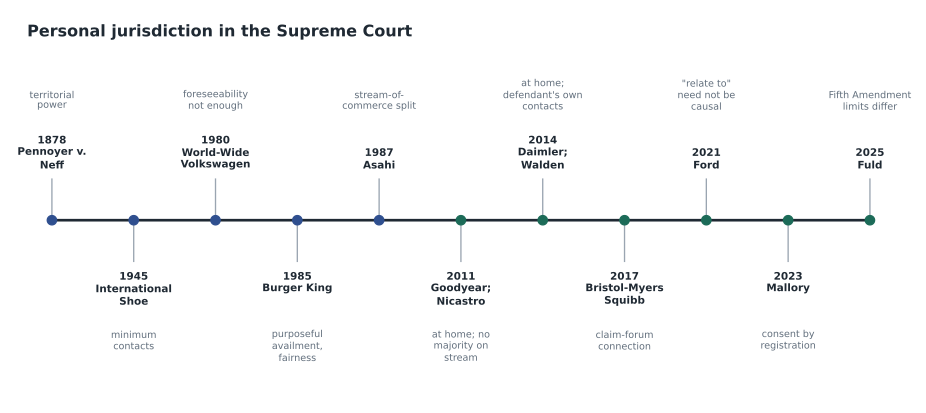
The modern law grew out of a nineteenth-century land dispute. In Pennoyer v. Neff, 95 U.S. 714 (1878), a lawyer named J.H. Mitchell sued his former client Marcus Neff in an Oregon state court for unpaid fees. Neff lived in California and was never served in Oregon; Mitchell gave notice only by publishing it in an Oregon newspaper. Neff did not appear, Mitchell won a default judgment, and land that Neff owned in Oregon was later sold at a sheriff's sale to satisfy it. The buyer was Sylvester Pennoyer. Neff then sued Pennoyer in federal court to recover the land, arguing that the Oregon judgment was void.
The Supreme Court agreed with Neff. Justice Field reasoned that each state has exclusive power over persons and property within its territory and no power over persons and property outside it. A state court could exercise power over a person, called in personam jurisdiction, if the defendant was served while physically present in the state, consented or was domiciled there. It could exercise power over property, called in rem or quasi in rem jurisdiction, but only if it seized or attached the property at the start of the case. Mitchell had not attached Neff's land when he sued, so the judgment against Neff personally was void. The Court also said that the newly ratified Fourteenth Amendment would allow such void judgments to be attacked as violations of due process.
Pennoyer's territorial model fit a world of horses and local business. It fit poorly with automobiles and national corporations. States developed fictions to stretch it. In Hess v. Pawloski, 274 U.S. 352 (1927), the Court upheld a Massachusetts law that treated any nonresident who drove on its roads as having appointed a state official to receive service in lawsuits arising from accidents there. Corporations were said to be "present" wherever they did enough business, or to have "consented" to suit by registering to do business. These fictions set up a more honest test.
Minimum contacts: International Shoe
International Shoe Co. v. Washington, 326 U.S. 310 (1945), replaced presence with contacts. The State of Washington sued International Shoe, a Delaware corporation based in St. Louis, to collect contributions to its unemployment compensation fund. The company had no office in Washington and made no contracts there, but it employed a dozen or so salesmen who lived in the state, displayed samples and solicited orders that were shipped from outside the state. Washington served notice on one salesman and mailed a copy to the company's headquarters.
The Court upheld jurisdiction. Chief Justice Stone wrote that due process requires only that, if the defendant is not present within the forum, it have certain minimum contacts with the forum such that the maintenance of the suit does not offend "traditional notions of fair play and substantial justice." The question was not presence but the quality and nature of the defendant's activities in the state. The company's sales activity in Washington was systematic and continuous, it benefited from the protection of Washington's laws, and the obligation sued on arose out of those very activities. It was fair to require it to defend there.
International Shoe sketched a spectrum. Casual or isolated activity unrelated to the claim would not support jurisdiction. Continuous and systematic activity giving rise to the claim would. In between, single or occasional acts could support jurisdiction for claims arising from them. Later cases turned this spectrum into two categories that frame the modern law: specific jurisdiction, for claims connected to the defendant's forum activities, and general jurisdiction, for any claim, when the defendant is essentially at home in the forum. This lesson covers specific jurisdiction; Lesson 3 covers general jurisdiction.
Purposeful availment
The cases after International Shoe insist that the relevant contacts be ones the defendant itself chose to create. In Hanson v. Denckla, 357 U.S. 235 (1958), the Court said there must be some act by which the defendant purposefully avails itself of the privilege of conducting activities within the forum state, invoking the benefits and protections of its laws. The unilateral activity of others who claim a relationship with the defendant is not enough.
World-Wide Volkswagen Corp. v. Woodson, 444 U.S. 286 (1980), shows the principle in a product case. The Robinson family bought an Audi from Seaway Volkswagen in Massena, New York, and set out for a new home in Arizona. In Oklahoma, another car hit the Audi from behind and it caught fire, severely burning Kay Robinson and two of her children. The Robinsons sued in Oklahoma state court against the manufacturer, the importer, the regional distributor (World-Wide Volkswagen, which served New York, New Jersey and Connecticut) and the retailer, Seaway. Only the distributor and the retailer challenged personal jurisdiction, and the Supreme Court held that Oklahoma could not reach them.
It was foreseeable that a car sold in New York might be driven to Oklahoma, the Court admitted, since cars are mobile by nature. But foreseeability alone is not enough. What matters is that the defendant's conduct and connection with the forum state are such that it should reasonably anticipate being haled into court there. World-Wide and Seaway did no business in Oklahoma, shipped nothing there and advertised nothing there. The only connection was the Robinsons' own decision to drive through. In an important passage, though, the Court distinguished manufacturers and distributors that serve a market directly. If a company delivers its products into the stream of commerce with the expectation that they will be purchased by consumers in the forum state, and its efforts to serve that market are not isolated, it can be sued there when its products cause injury. Audi and Volkswagen of America, which served the national market, did not contest jurisdiction.
Burger King Corp. v. Rudzewicz, 471 U.S. 462 (1985), applied the same principle to contracts. Two Michigan franchisees signed a twenty-year franchise agreement with Burger King, a Florida corporation, which called for payments to Miami and chose Florida law. When they stopped paying, Burger King sued them in federal court in Florida. The Court upheld jurisdiction. A contract with an out-of-state party is not automatically enough, but these defendants had deliberately reached out beyond Michigan to enter a long-term relationship with a Florida company, supervised from Florida. They could not claim surprise at being sued there.
Walden v. Fiore, 571 U.S. 277 (2014), sharpened the point. A Georgia police officer working at the Atlanta airport seized cash from two professional gamblers on their way home to Nevada and allegedly drafted a false affidavit. The gamblers sued him in Nevada, where they felt the injury. The Court unanimously held that Nevada lacked jurisdiction. The analysis looks at the defendant's contacts with the forum state itself, not his contacts with people who live there. The plaintiff cannot be the only link between the defendant and the forum.
Stream of commerce: Asahi and Nicastro
Component makers and foreign manufacturers raise a recurring question: is it enough that a company placed its product into a stream of commerce that it knew would carry the product into the forum? The Court has never produced a majority answer. In Asahi Metal Industry Co. v. Superior Court, 480 U.S. 102 (1987), a Japanese company made tire valve assemblies and sold them to a Taiwanese tire maker, which put them in motorcycle tires sold in California. After a fatal accident, the injured rider sued the Taiwanese company, which sought indemnity from Asahi. Four justices, led by Justice O'Connor, said awareness that products would reach California was not enough; there must be additional conduct aimed at the forum, such as designing the product for that market, advertising there or setting up channels for advice. Four others, led by Justice Brennan, said placing a product into a regular and anticipated flow of commerce into the forum was enough. But eight justices agreed that jurisdiction would be unreasonable anyway: the only remaining claim was an indemnity dispute between two foreign companies, California's interest was slight, and the burden on Asahi was severe.
The split resurfaced in J. McIntyre Machinery, Ltd. v. Nicastro, 564 U.S. 873 (2011). Robert Nicastro injured his hand on a metal-shearing machine in New Jersey. It was made in England by J. McIntyre, which sold through an independent American distributor and attended trade shows in the United States, but not in New Jersey. At most four machines ended up in New Jersey. A plurality of four justices said McIntyre had not targeted New Jersey and could not be sued there. Justice Breyer, joined by Justice Alito, concurred in the result on narrower grounds: a single isolated sale, even with a national sales strategy, was not enough under any of the Court's precedents. Three justices dissented. Lower courts still divide on the standard, and many treat Justice Breyer's concurrence as controlling.
The modern test for specific jurisdiction
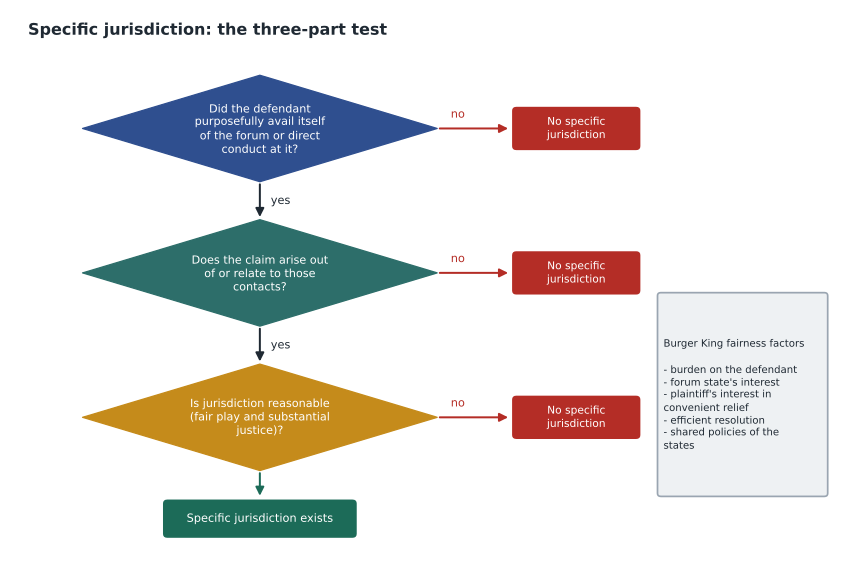
Lower courts usually express specific jurisdiction as a three-part test, drawn from these cases. The labels vary by circuit, but the substance is consistent.
- Purposeful availment or direction. Did the defendant deliberately reach out to the forum state, by doing business, shipping products, advertising or entering relationships there? For intentional torts, courts often ask whether the defendant expressly aimed its conduct at the forum, using the effects test from Calder v. Jones, 465 U.S. 783 (1984), where Florida-based writers and editors of the National Enquirer could be sued in California over an article about a California actress whose career and reputation were centered there.
- Relatedness. Does the plaintiff's claim arise out of or relate to the defendant's forum contacts? Lesson 3 covers how the Supreme Court interpreted this phrase in 2021.
- Reasonableness. Would exercising jurisdiction comport with fair play and substantial justice? Burger King lists the factors: the burden on the defendant, the forum state's interest in the dispute, the plaintiff's interest in convenient and effective relief, the interstate judicial system's interest in efficient resolution, and the shared interest of the states in furthering fundamental social policies. A defendant who has purposefully directed activities at the forum must present a compelling case that jurisdiction would be unreasonable. Asahi is the rare case where that argument succeeded.
Worked problem
Can Ohio reach Kestrelwerk?
Kestrelwerk designs and builds Trail 750 e-bikes in Germany, sells them to its Delaware subsidiary for distribution to US dealers including nine in Ohio, advertises on US cycling sites viewable in Ohio, and offers a US warranty through those dealers. Delgado bought her bike at Ridgeline's Columbus shop and was injured in Columbus. Apply the three-part test.
Show solution
- Purposeful availment: Kestrelwerk did not merely let its products drift into Ohio. It built a US distribution network that deliberately includes Ohio dealers, advertises to US riders and services warranties through local shops. That resembles the manufacturers in World-Wide Volkswagen that served the market directly, and it should satisfy even Justice O'Connor's stream-of-commerce-plus approach.
- Relatedness: Delgado's claim is that a bike Kestrelwerk sold into Ohio, through its Ohio dealer network, malfunctioned and injured her in Ohio. The claim arises out of Kestrelwerk's Ohio contacts in the most direct way.
- Reasonableness: Defending in Ohio burdens a German company, but it already does business across the US through a subsidiary and has US counsel. Ohio has a strong interest in injuries to its residents from products sold there, and Delgado's evidence and witnesses are in Ohio.
Answer: Specific jurisdiction over Kestrelwerk in Ohio is very likely. Kestrelwerk's best argument is that it acted only through an independent subsidiary, but the subsidiary's distribution served Kestrelwerk's own plan to sell in Ohio, and the claim arises directly from that market.
Common mistakes
MistakeIf it was foreseeable that the product would reach the state, the manufacturer can be sued there.
InsteadForeseeability alone is not enough. The defendant's own conduct must connect it to the forum so that it should reasonably anticipate being sued there.
MistakeA defendant is subject to jurisdiction wherever the plaintiff lives and feels the injury.
InsteadWalden v. Fiore holds that the defendant's own contacts with the forum state matter, not its contacts with the plaintiff.
MistakeAsahi produced a clear majority rule on stream of commerce.
InsteadAsahi split four to four on the stream-of-commerce standard; it was decided on reasonableness grounds. Nicastro also failed to produce a majority rule.
MistakePersonal jurisdiction and subject-matter jurisdiction are the same thing.
InsteadPersonal jurisdiction is power over the defendant; subject-matter jurisdiction is power over the type of case. A court needs both.
Summary and key terms
- Personal jurisdiction is a court's power to bind a defendant; its limits come from the Due Process Clause.
- Federal courts usually borrow the reach of the state where they sit, under Rule 4(k)(1)(A).
- Pennoyer v. Neff tied jurisdiction to presence and property in the state; International Shoe replaced that with minimum contacts and fair play and substantial justice.
- The defendant must purposefully avail itself of the forum (Hanson, World-Wide Volkswagen, Burger King), and its own forum contacts matter (Walden).
- The stream-of-commerce question remains unsettled after Asahi and Nicastro.
- Courts apply a three-part test for specific jurisdiction: purposeful availment, relatedness and reasonableness.
- Personal jurisdiction
- A court's power over a particular defendant, required for a binding judgment.
- Long-arm statute
- A state statute authorizing its courts to exercise jurisdiction over defendants outside the state.
- In personam jurisdiction
- Jurisdiction over a person, supporting a judgment that binds the defendant personally.
- In rem jurisdiction
- Jurisdiction over property, supporting a judgment about that property.
- Minimum contacts
- The defendant's connections with the forum that make suit there consistent with fair play and substantial justice.
- Purposeful availment
- Deliberate conduct by which a defendant takes advantage of the privilege of doing business in a state.
- Specific jurisdiction
- Jurisdiction over claims that arise out of or relate to the defendant's forum contacts.
- Stream of commerce
- The chain of distribution that carries products from a manufacturer to consumers in many places.
Practice problems
Work each problem on paper first, then reveal the answer to check.
Why was the Oregon judgment in Pennoyer v. Neff void?
Show answer
Neff was not served in Oregon, did not consent and was not domiciled there, and his land was not attached at the start of the case, so Oregon lacked power over him or his property.
In World-Wide Volkswagen, which defendants contested jurisdiction, and why did they win?
Show answer
The New York regional distributor and the retailer. They did no business in Oklahoma, and the only connection was the plaintiffs' decision to drive there.
State the three parts of the usual test for specific jurisdiction.
Show answer
Purposeful availment or direction toward the forum, a claim that arises out of or relates to those contacts, and reasonableness under the fairness factors.
Suppose Kestrelwerk had never sold to any dealer in Ohio and Delgado bought her bike in Colorado on vacation. What would change?
Show answer
Purposeful availment toward Ohio and relatedness would both be much weaker; Kestrelwerk would argue, as in World-Wide Volkswagen, that only Delgado's own choice brought the bike to Ohio.
Lesson quiz · 5 questions
Score 60% or more to complete this lesson.
Create a free account to save your progress, take quizzes and earn a certificate.