
LAWU-101 · Lesson 1 of 12 · 24 min
Courts, cases and the Federal Rules
▶ Video coming soon A video version of this lesson is on the way.
On the first Monday of the fall term, Professor Miriam Okafor-Bell walks into Room 104 at Larkhaven Law School with no notes, a coffee and a single printed news story. She reads it aloud. In March, an e-bike battery pack caught fire while charging in a garage in Columbus, Ohio. The owner, an emergency-room nurse named Rosa Delgado, burned both hands and forearms putting it out. Her car and garage were damaged. The bike was a Kestrel Trail 750, sold by an Ohio bicycle chain called Ridgeline Cycle Supply and built by a German company, Kestrelwerk GmbH, that sells bikes across the United States through a Delaware subsidiary.
"The story is invented," she says, "but every question it raises is real. Ms. Delgado wants to be compensated. Where can she sue? Which court will hear the case? Which state's law applies? How does she get papers to a company in Stuttgart? What must her complaint say? How does she find out what the company knew about its batteries? And if she wins, what stops the company from fighting the same fight again in the next case? That is civil procedure. It is the operating system of American litigation. Every other course you take this year assumes you know how a case moves through a court."
Section B will follow Delgado v. Ridgeline Cycle Supply, Inc. and Kestrelwerk GmbH through the whole course, from the decision about where to file to the final appeal. This first lesson builds the map: the two court systems, the stages of a lawsuit, where the Federal Rules of Civil Procedure come from, and how to read the cases and rules that the rest of the course depends on.
Two court systems
The United States has two parallel sets of courts. Each of the fifty states, plus the District of Columbia, runs its own courts under its own constitution and statutes. Alongside them sits the federal court system created under Article III of the United States Constitution, which vests the judicial power in one Supreme Court and in such lower courts as Congress chooses to establish. Congress has created 94 federal judicial districts, each with a district court that tries cases, and 13 courts of appeals: eleven numbered regional circuits, the District of Columbia Circuit and the Federal Circuit, which hears certain specialized appeals such as patent cases. Above them all sits the Supreme Court of the United States.
State court systems vary in their names but share a common shape. Most have trial courts of general jurisdiction, which can hear almost any kind of case, plus specialized or limited courts for small claims, family matters, probate and traffic. Most states have an intermediate appellate court and a court of last resort, usually called the supreme court. New York reverses the labels: its general trial court is called the Supreme Court, and its highest court is the Court of Appeals. Ohio, where Rosa Delgado lives, calls its general trial courts the Courts of Common Pleas, with one in each county.
The most important difference between the two systems is the scope of their power. State trial courts of general jurisdiction are presumed able to hear any case unless a statute takes it away. Federal courts are courts of limited jurisdiction. They may hear only the kinds of cases that Article III allows and that Congress has actually authorized by statute. The two most common categories are cases arising under federal law and cases between citizens of different states, and Lesson 5 examines both. A federal court must check its own subject-matter jurisdiction in every case, even if no party raises the issue.
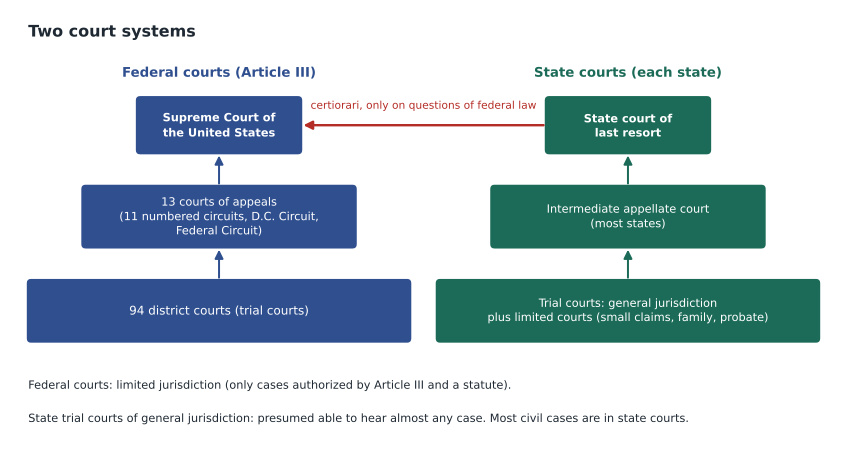
The two systems overlap. Many cases could be filed in either one, and a plaintiff's first strategic choice is often which to use. State courts must hear federal claims unless Congress has made federal jurisdiction exclusive, as it has for patent, federal antitrust and bankruptcy matters, among others. And federal courts hearing state-law claims apply state substantive law, a principle explored in Lesson 7. The overwhelming majority of civil cases in the country are filed and resolved in state courts.
The Supreme Court of the United States can review a state court's decision, but only on questions of federal law, and only after the state's highest court has ruled or declined to hear the case. When a state supreme court interprets its own state's law, its word is final. That is why the Ohio Supreme Court, not the Supreme Court of the United States, has the last word on what Ohio's product-liability statutes mean.
The life of a lawsuit
Okafor-Bell draws a long horizontal line across the whiteboard and marks it with stages. Every civil case in an American court moves through some version of the same sequence, though very few cases go all the way to the end of the line.
- Pleadings. The plaintiff files a complaint stating the claim and the relief requested. The defendant responds with an answer, a motion to dismiss, or both. Pleadings frame what the case is about.
- Service of process. The defendant must be formally notified with a summons and a copy of the complaint, in a way the law recognizes.
- Pretrial motions. Either side can ask the court to decide questions early, such as whether the court has power over the defendant or whether the complaint states a legal claim at all.
- Discovery. The parties exchange information: documents, electronically stored information, written answers to questions, depositions of witnesses and expert reports.
- Summary judgment. After discovery, a party can ask the court to decide the case, or part of it, without a trial because there is no genuine dispute about the material facts.
- Trial. If facts remain in dispute, a judge or jury hears the evidence and decides. Post-trial motions can challenge the verdict.
- Judgment and appeal. The court enters a final judgment, which the losing party can usually appeal. The judgment then binds the parties in later cases.
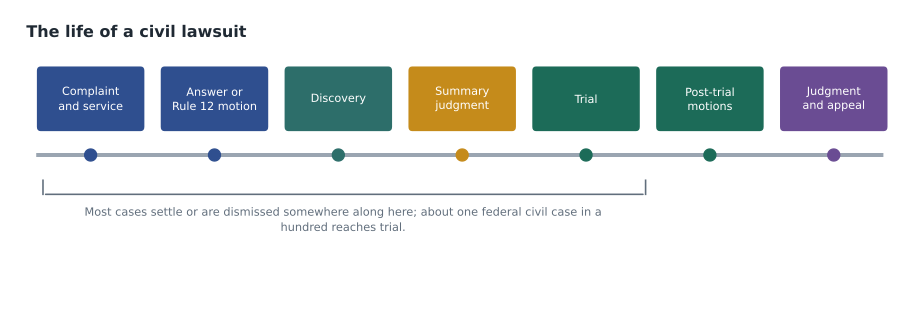
Daniel Reyes, who spent three years as a paralegal at a personal-injury firm in El Paso, raises his hand. "In three years I saw two trials," he says. "Everything else settled." Okafor-Bell nods. Only about one federal civil case in a hundred reaches trial. The rest settle, are dismissed, are decided on motions, or end in default. But the rules of trial still shape every case, because parties bargain in the shadow of what would happen if they did not settle. A defendant who expects to lose a motion for summary judgment will offer more to settle before the motion is decided.
Where the Federal Rules come from
Before 1938, federal courts in law cases generally followed the procedure of the state where they sat, while equity cases followed separate federal equity rules. The result was confusing and technical. Pleading in many states still followed the code pleading reforms of the nineteenth century, and a lawyer could lose a meritorious case by choosing the wrong form of action or stating facts in the wrong way. In the Rules Enabling Act of 1934, now codified at 28 U.S.C. § 2072, Congress authorized the Supreme Court to prescribe general rules of practice and procedure for the federal courts, with one important limit: the rules may not abridge, enlarge or modify any substantive right.
The Federal Rules of Civil Procedure took effect in 1938. They merged law and equity into a single form of action, the civil action. They replaced technical code pleading with simple notice pleading. They created broad discovery, which was a dramatic change from earlier practice, and they gave judges tools to decide cases before trial. Rule 1 states the goal that still guides interpretation: the rules should be construed, administered and employed to secure the just, speedy and inexpensive determination of every action and proceeding.
The Federal Rules were influential far beyond federal court. Many states adopted rules modeled closely on them, so a lawyer who knows the federal rules can usually find her way around a state's civil rules quickly. Other states, including California and New York, kept their own distinct procedural codes, though even these borrowed heavily from the federal model over time. Ohio's Rules of Civil Procedure, which govern the Delgado case while it stays in state court, follow the federal numbering closely.
How the rules change
The rules are amended through a deliberate process. A proposal starts with the Judicial Conference's Advisory Committee on Civil Rules, which drafts language and publishes it for public comment. It then goes to the Standing Committee on Rules of Practice and Procedure, then to the Judicial Conference of the United States, and then to the Supreme Court. If the Court approves an amendment and transmits it to Congress by May 1, it takes effect on December 1 of that year unless Congress acts to block or change it. The whole cycle usually takes at least three years.
Recent amendments show the process at work. On December 1, 2025, a new Rule 16.1 took effect, giving judges a framework for the early management of multidistrict litigation, the procedure that consolidates many similar federal cases before one judge for pretrial work. Companion amendments to Rules 16(b) and 26(f) took effect the same day, requiring parties and courts to address early how and when parties will describe documents they withhold as privileged. No civil rule amendments took effect on December 1, 2026. Further proposed changes to Rules 7.1, 26, 41, 45 and 81 are moving through the committees, with December 1, 2027 the earliest date they could take effect.
The Federal Rules are not the only source of procedure in federal court. Congress has enacted many procedural statutes in Title 28 of the United States Code, including the jurisdiction, venue, removal and transfer statutes that dominate the first half of this course. Each district court also has local rules, authorized by Rule 83, covering things like page limits and filing formats, and individual judges often issue standing orders about their own practices. A careful lawyer checks all four layers: the Constitution, statutes, the Federal Rules, and local rules and orders.
| Source | Examples | Who makes it |
|---|---|---|
| United States Constitution | Due process limits on personal jurisdiction; Article III; Seventh Amendment jury right | Ratified text, interpreted by courts |
| Federal statutes | 28 U.S.C. §§ 1331, 1332, 1367, 1391, 1404, 1441 | Congress |
| Federal Rules of Civil Procedure | Rule 8 pleading, Rule 26 discovery, Rule 56 summary judgment | Supreme Court under the Rules Enabling Act, subject to Congress |
| Local rules and standing orders | Page limits, filing formats, motion procedures | Each district court and individual judges |
| Case law | International Shoe, Erie, Twombly, Celotex | Courts interpreting all of the above |
Reading cases and rules
Much of civil procedure is case law: decisions in which courts interpret the Constitution, statutes and rules. Hannah Lindqvist, a former history teacher, asks how to read the citations that fill the casebook. Okafor-Bell writes one on the board: International Shoe Co. v. Washington, 326 U.S. 310 (1945). The case name comes first, usually the parties' names. Then comes the volume number of the reporter, the reporter's abbreviation, the first page of the opinion, and the year. U.S. stands for United States Reports, the official reporter of Supreme Court decisions. Decisions of the federal courts of appeals appear in the Federal Reporter (F., F.2d, F.3d and now F.4th), and published district court decisions appear in the Federal Supplement (F. Supp. and its later series). Very recent Supreme Court decisions are often cited by docket number until their page numbers in the United States Reports are assigned.
A judicial opinion has a predictable anatomy. It states the facts and the procedural history, identifies the question presented, gives the holding and explains the reasoning. Concurring opinions agree with the result for different reasons; dissenting opinions disagree with the result. Only the holding, the rule necessary to decide the case, binds later courts. Statements that go beyond what was needed to decide the case are called dicta, and later courts can treat them as persuasive but not binding.
American courts follow precedent, a principle called stare decisis. A lower court must follow the decisions of the courts above it in its own system. A federal district court in Ohio must follow the Sixth Circuit and the Supreme Court of the United States, but it is not bound by decisions of the Ninth Circuit, though it may find them persuasive. On questions of Ohio law, a federal court must follow the Ohio Supreme Court. When a federal court must decide an unsettled question of state law, it predicts how the state's highest court would rule.
Reading a rule requires the same discipline as reading a statute. Start with the text and read every word, including the subsections. Check the definitions and the cross-references. Then read the Advisory Committee Notes, which the committee writes when it proposes each amendment and which courts often treat as persuasive evidence of what the rule means. Finally, find the cases that have applied the rule. Marcus Webb, who worked as an engineer at a battery-storage startup, says it sounds like reading a technical specification. "It is exactly like that," Okafor-Bell says, "except that the specification is argued over by people paid to find ambiguity in it."
Choosing a forum: the first strategic decision
Rosa Delgado's lawyer, Ana Whitcomb, practices at a small plaintiffs' firm in Columbus. Before she drafts anything, she must decide where to file. That decision has several parts, and each one is a later lesson in this course.
- Which state's courts, or which federal district? The court must have personal jurisdiction over each defendant, meaning power to bind that defendant to its judgment (Lessons 2 and 3).
- State court or federal court? A federal court needs subject-matter jurisdiction. Here, that would almost certainly have to be diversity of citizenship, and Ridgeline, an Ohio company, shares Delgado's Ohio citizenship (Lesson 5). Even if she files in state court, the defendants may try to move the case to federal court (Lesson 6).
- Which courthouse? Venue statutes and rules pick the specific district or county (Lesson 6).
- Which law? A court's choice of law and, in federal court, the Erie doctrine decide whose substantive law applies (Lesson 7).
Priya Natarajan asks why it matters so much, if the law is the same everywhere. Okafor-Bell answers with a list: juries differ from place to place; judges differ; procedural rules differ, including how much discovery is allowed and how strict the pleading standard is; the speed of the docket differs; and travel costs and convenience matter to witnesses and clients. Lawyers on both sides care deeply about where a case is heard. The rules you will study were designed, in part, to keep that choice fair.
Worked problem
Mapping Delgado's options
Rosa Delgado, an Ohio citizen, wants to sue Ridgeline Cycle Supply (an Ohio corporation) and Kestrelwerk GmbH (a German company) for her injuries from the battery fire in Columbus. List the questions her lawyer must answer before filing, in the order this course will study them.
Show solution
- Personal jurisdiction: can an Ohio court (state or federal) bind Kestrelwerk, a German company that sells through a US subsidiary? Ridgeline, based in Ohio, plainly can be sued there.
- Service: how will each defendant be formally served, including a company in Germany?
- Subject-matter jurisdiction: is a federal court available? Delgado and Ridgeline are both Ohio citizens, so a suit against both would lack complete diversity.
- Removal and venue: if she files in an Ohio state court, can the defendants move the case to federal court, and in which county or district is venue proper?
- Governing law: which state's product-liability law applies, and, if the case is in federal court, which rules are substantive and which procedural?
Answer: Her lawyer must work through personal jurisdiction, service, subject-matter jurisdiction, removal and venue, and governing law before filing. The answers point toward an Ohio state court in Franklin County, where she lives and was injured, but the German defendant's contacts with Ohio and the possibility of removal will need careful analysis.
Common mistakes
MistakeFederal courts can hear any case that state courts can hear.
InsteadFederal courts are courts of limited jurisdiction. They hear only cases authorized by Article III and by a federal statute.
MistakeThe US Supreme Court can review any state court decision.
InsteadIt reviews state court decisions only on questions of federal law. State supreme courts have the final word on their own state's law.
MistakeThe Federal Rules can change substantive rights if the Supreme Court approves them.
InsteadThe Rules Enabling Act forbids rules that abridge, enlarge or modify any substantive right.
MistakeEverything a court says in an opinion is binding precedent.
InsteadOnly the holding binds later courts. Dicta can be persuasive but is not binding.
Summary and key terms
- The United States has fifty-one state court systems and a federal system of 94 district courts, 13 courts of appeals and the Supreme Court.
- State trial courts of general jurisdiction can hear almost any case; federal courts are courts of limited jurisdiction.
- A civil lawsuit moves through pleadings, service, motions, discovery, summary judgment, trial and appeal, though most cases settle or end earlier.
- The Federal Rules of Civil Procedure, adopted in 1938 under the Rules Enabling Act, merged law and equity, created notice pleading and broad discovery, and cannot alter substantive rights.
- Rules change through a multi-year committee process; Rule 16.1 on multidistrict litigation and privilege-description amendments took effect December 1, 2025.
- Federal procedure comes from the Constitution, statutes, the Federal Rules, local rules and case law.
- Court of general jurisdiction
- A trial court presumed able to hear any kind of case unless a statute removes it.
- Court of limited jurisdiction
- A court, such as a federal district court, that may hear only the categories of cases authorized by constitution and statute.
- Rules Enabling Act
- The 1934 statute, 28 U.S.C. § 2072, authorizing the Supreme Court to make procedural rules that do not change substantive rights.
- Stare decisis
- The principle that courts follow precedent, especially decisions of higher courts in the same system.
- Holding
- The rule of law necessary to decide a case, which binds later courts.
- Dicta
- Statements in an opinion that were not necessary to decide the case.
- Advisory Committee Notes
- Explanations written by the rules committee when a rule is adopted or amended, often used to interpret the rule.
- Multidistrict litigation
- A federal procedure that transfers similar cases from many districts to one judge for coordinated pretrial proceedings.
Practice problems
Work each problem on paper first, then reveal the answer to check.
Rosa Delgado's lawyer files in the Franklin County Court of Common Pleas. Which court system is that, and what kind of jurisdiction does it have?
Show answer
It is an Ohio state trial court of general jurisdiction, presumed able to hear her tort claims.
What limit does the Rules Enabling Act place on the Federal Rules of Civil Procedure?
Show answer
The rules may not abridge, enlarge or modify any substantive right.
A federal district court in Ohio faces a conflict between a Ninth Circuit decision and a Sixth Circuit decision. Which must it follow?
Show answer
The Sixth Circuit, because Ohio is in the Sixth Circuit. The Ninth Circuit decision is only persuasive.
Explain the citation 326 U.S. 310 (1945).
Show answer
Volume 326 of the United States Reports, the opinion beginning at page 310, decided in 1945.
Lesson quiz · 5 questions
Score 60% or more to complete this lesson.
Create a free account to save your progress, take quizzes and earn a certificate.