
LAWU-101 · Lesson 10 of 12 · 25 min
Discovery
▶ Video coming soon A video version of this lesson is on the way.
The most important evidence in Delgado's case is a lump of melted metal and plastic in an evidence locker in Columbus: what remains of the KX48 battery pack. The second most important evidence is in Stuttgart, on Kestrelwerk's servers: the engineering files for the KX48, its test results, the root-cause analysis behind the 2024 recall of the earlier KX36 pack and the database of customer complaints. Delgado cannot win without some of the second, and Kestrelwerk cannot defend itself without examining the first. Discovery is how each side gets what the other has.
Okafor-Bell calls discovery the defining feature of American civil litigation. "Most legal systems give a party very limited access to its opponent's documents," she says. "Ours gives broad access, and expects the parties to manage it largely on their own, with the judge stepping in when they cannot agree. It is the reason American litigation is powerful, and the reason it is expensive." This lesson covers the scope of discovery, its main tools, privilege and work product, experts, electronically stored information, and what happens when evidence is in another country.
Planning and initial disclosures
Discovery in federal court begins with planning. Under Rule 26(f), the parties must confer as soon as practicable, and in any event at least 21 days before the scheduling conference, to discuss the claims and defenses, settlement, initial disclosures and a proposed discovery plan. Since December 1, 2025, the plan must also address the timing and method for complying with the duty to describe documents withheld as privileged. The court then issues a scheduling order under Rule 16(b), setting deadlines for joining parties, amending pleadings, completing discovery and filing motions.
Under Rule 26(a)(1), each party must, without waiting for a request, provide initial disclosures, usually within 14 days after the Rule 26(f) conference: the name and contact information of each individual likely to have discoverable information that the party may use to support its claims or defenses; a copy or description of documents and electronically stored information the party may use; a computation of each category of damages claimed; and any insurance agreement that may cover a judgment. Delgado's disclosures list her treating doctors, the firefighters who responded, her neighbor who saw the smoke, her medical bills, her lost wages and a computation of her damages. Kestrelwerk's list its battery engineers and its product liability insurance.
The scope of discovery
Rule 26(b)(1) defines the scope. Parties may obtain discovery regarding any nonprivileged matter that is relevant to any party's claim or defense and proportional to the needs of the case, considering the importance of the issues at stake in the action, the amount in controversy, the parties' relative access to relevant information, the parties' resources, the importance of the discovery in resolving the issues, and whether the burden or expense of the proposed discovery outweighs its likely benefit. Information within this scope need not be admissible in evidence to be discoverable.
The proportionality factors were moved into the definition of scope by amendments that took effect December 1, 2015. Those amendments also deleted the old phrase allowing discovery of information "reasonably calculated to lead to the discovery of admissible evidence," which many lawyers had treated as a broad definition of scope, and removed the court's power to order discovery of any matter relevant to the subject matter of the action. Chief Justice Roberts's year-end report on the federal judiciary for 2015 emphasized that the changes were meant to make lawyers and judges think seriously about cost and focus discovery on what matters.
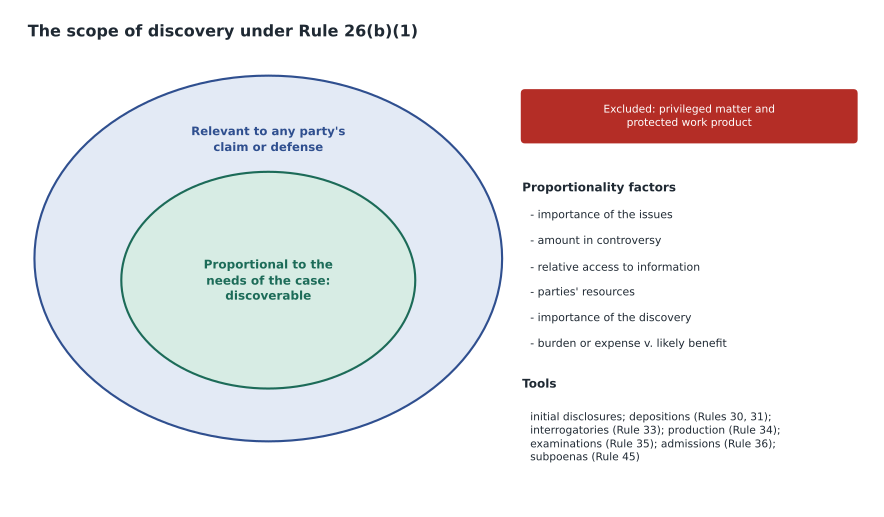
Proportionality is likely to decide the first big fight in Delgado's case. At the parties' Rule 26(f) conference in October, Whitcomb previewed the request she served in November: all documents concerning overheating, thermal events or fires involving any Kestrelwerk battery pack anywhere in the world since 2018. Kestrelwerk has said it will object that it has made dozens of pack models for scooters, cargo bikes and e-bikes sold in forty countries, and that collecting and translating every document would cost far more than the case is worth. Okafor-Bell predicts how a magistrate judge would rule: by narrowing the request. Discovery would likely cover the KX-series packs, including the KX36 and KX48, which share a cell layout and protection design; complaints from the United States and the European Union, where Kestrelwerk keeps searchable records; and the period from 2020 to the present. A judge would note that Delgado has no other access to this information, that the issues of product safety are important, and that a sharper request gives her most of the benefit at a fraction of the cost.
The tools of discovery
- Depositions (Rules 30 and 31). A party may question a witness under oath, before a court reporter and often on video. Each side may take up to ten depositions without leave, and each is limited to one day of seven hours. Under Rule 30(b)(6), a party may name an organization as the deponent and list topics; the organization must designate one or more people to testify on its behalf about information known or reasonably available to it. Depositions may be taken remotely by stipulation or court order under Rule 30(b)(4).
- Interrogatories (Rule 33). Written questions to another party, answered in writing under oath. Each party may serve up to 25, including discrete subparts. Interrogatories are useful for basic facts, such as the names of the engineers who designed the KX48 and the dates of its testing.
- Requests for production (Rule 34). A party may request documents, electronically stored information and tangible things in another party's possession, custody or control, and may request entry onto land for inspection. Since 2015, an objection must state whether any responsive materials are being withheld on the basis of the objection. Requests may also be used to inspect and test physical evidence, such as the remains of the battery.
- Physical and mental examinations (Rule 35). When a party's physical or mental condition is in controversy, the court may order an examination by a suitably licensed examiner for good cause. In Schlagenhauf v. Holder, 379 U.S. 104 (1964), the Court held that these requirements are not satisfied by mere conclusory allegations; the condition must genuinely be in controversy. Delgado's hand injuries are central to her damages claim, so Kestrelwerk can expect to obtain an order for an examination by a hand surgeon of its choosing if Delgado will not agree to one.
- Requests for admission (Rule 36). A party may ask another party to admit the truth of facts or the genuineness of documents. A matter is admitted unless the party responds within 30 days. Requests for admission narrow the issues for trial.
- Subpoenas to nonparties (Rule 45). Nonparties are not bound by Rules 30, 33 or 34, but may be compelled by subpoena to testify or produce documents. Whitcomb has subpoenaed Ridgeline, now a nonparty, for its records of the sale, its mechanic's assembly notes and its sales of the third-party charger.
Privilege and work product
Discovery does not reach privileged matter. The most important privilege in civil litigation is the attorney-client privilege, which protects confidential communications between a client and lawyer made for the purpose of obtaining or providing legal advice. In Upjohn Co. v. United States, 449 U.S. 383 (1981), the Court held that the privilege protects communications between a corporation's lawyers and its employees at any level, when the employees communicate at the direction of their superiors to help counsel give legal advice to the corporation. The privilege protects communications, not underlying facts: Kestrelwerk's engineers must testify about what they know about the KX48, even if they also told the company's lawyers.
The work-product doctrine protects materials prepared in anticipation of litigation. It began with Hickman v. Taylor, 329 U.S. 495 (1947). After a tugboat, the J. M. Taylor, sank in the Delaware River and five crew members drowned, the tug owners' lawyer, Samuel Fortenbaugh, interviewed the survivors and took written statements. A deceased crew member's representative demanded copies of the statements and Fortenbaugh's memoranda of oral interviews. The Court refused to order production, holding that a lawyer's preparation of a case is protected from discovery unless the other side shows necessity and that denial would cause hardship, and that a lawyer's mental impressions deserve even stronger protection. Otherwise, the Court said, much of what is now put down in writing would remain unwritten, and lawyers would be reluctant to prepare.
Rule 26(b)(3) codifies the doctrine. Documents and tangible things prepared in anticipation of litigation or for trial by or for a party or its representative are discoverable only if they are otherwise discoverable and the requesting party shows substantial need and cannot, without undue hardship, obtain their substantial equivalent by other means. Even then, the court must protect against disclosure of the mental impressions, conclusions, opinions or legal theories of a party's lawyer or other representative, which courts call opinion work product. Kestrelwerk's internal root-cause analysis of the 2024 KX36 recall, prepared by engineers to fix a safety problem, is likely not work product, because it would have been created regardless of litigation. A memo its US lawyers wrote evaluating litigation risk from the recall is.
A party withholding documents as privileged must describe them in enough detail to let others assess the claim, usually in a privilege log, under Rule 26(b)(5)(A). In cases with millions of electronic documents, inadvertent production of privileged material is almost inevitable. Federal Rule of Evidence 502 provides that inadvertent disclosure does not waive privilege if the holder took reasonable steps to prevent and correct it, and Rule 502(d) allows a court to order that disclosure in the litigation does not waive privilege at all. Careful lawyers ask for a Rule 502(d) order at the start of every large case.
Experts
Expert testimony is critical in product cases. Under Rule 26(a)(2), a party must disclose the identity of any expert it may use at trial, and a retained expert must provide a written report containing a complete statement of all opinions and the basis for them, the facts or data considered, exhibits, the expert's qualifications and publications, a list of other cases in which the expert has testified in the previous four years, and the expert's compensation. Experts who were not retained, such as treating physicians, must be disclosed with a summary of the subject matter and facts and opinions to be offered. Since 2010, Rule 26(b)(4) protects drafts of expert reports and most communications between a party's lawyer and its retained expert. An expert retained only to consult, and not expected to testify, generally cannot be deposed except in exceptional circumstances.
Delgado's expert is a fire investigator and electrochemical engineer who will testify that the fire started inside the KX48 pack from an internal short circuit in a single cell, which spread heat to neighboring cells because the design lacked cell-level thermal protection. Kestrelwerk's expert will testify that the third-party charger overcharged the pack. Marcus Webb, who worked in battery storage, says that is exactly how such disputes go. "Then you understand why the judge will care so much about whether each expert's method is reliable," Okafor-Bell replies. That question, under Federal Rule of Evidence 702, returns in Lesson 11.
Electronically stored information and preservation
Most discoverable information today is electronic: email, chat messages, databases, design files, phone data. Rules amended in 2006 made electronically stored information a distinct category, allowed requests to specify the form of production, and limited discovery of information that is not reasonably accessible because of undue burden or cost. A party's duty to preserve relevant evidence begins when litigation is reasonably anticipated, not when it is filed. In the influential Zubulake v. UBS Warburg decisions of 2003 and 2004 in the Southern District of New York, Judge Shira Scheindlin held that once a party reasonably anticipates litigation, it must suspend routine destruction and put in place a litigation hold, and that counsel must take affirmative steps to make sure relevant information is preserved.
Rule 37(e), rewritten in 2015, governs the loss of electronically stored information that should have been preserved. If the information is lost because a party failed to take reasonable steps to preserve it and cannot be restored or replaced through additional discovery, the court, on finding prejudice to another party, may order measures no greater than necessary to cure the prejudice. Only on finding that the party acted with the intent to deprive another party of the information's use may the court presume the information was unfavorable, instruct the jury that it may or must so presume, or dismiss the action or enter a default judgment. Physical evidence, such as the battery pack itself, is governed by courts' inherent power to sanction spoliation.
The battery pack illustrates the stakes. Whitcomb's first act after Delgado hired her in March was to send Kestrelwerk and Ridgeline preservation letters, and to have the fire department's evidence moved to a secure facility. Any destructive testing, such as cutting open the pack to examine its cells, would destroy evidence. So in October the parties agreed on a joint inspection protocol: both sides' experts attend, the work is photographed and filmed, and no one tests the pack alone. A party that tested the pack unilaterally could face sanctions for spoliation.
Protective orders and enforcement
Under Rule 26(c), a court may, for good cause, issue an order to protect a party or person from annoyance, embarrassment, oppression or undue burden or expense, including orders that trade secrets or confidential commercial information not be revealed or be revealed only in a specified way. Kestrelwerk's design files and test data are confidential, so in November the parties submitted a stipulated protective order limiting their use to this case and marking the most sensitive documents for attorneys' eyes only. In Seattle Times Co. v. Rhinehart, 467 U.S. 20 (1984), the Court held that such orders, limited to information obtained through discovery, do not violate the First Amendment.
When a party refuses to provide discovery, the requesting party may move to compel under Rule 37(a), after first conferring in good faith to try to resolve the dispute. The court ordinarily awards the expenses of the motion, including attorney's fees, against the losing side unless its position was substantially justified. A party that disobeys a discovery order faces escalating sanctions under Rule 37(b), from orders that facts be taken as established to the striking of pleadings, dismissal or default. Rule 26(g) requires lawyers to sign discovery requests, responses and objections, certifying after reasonable inquiry that they are consistent with the rules and not interposed for any improper purpose.
Evidence in another country
Kestrelwerk's documents and engineers are in Germany. The Hague Convention on the Taking of Evidence Abroad in Civil or Commercial Matters provides procedures, including letters of request sent through central authorities, for obtaining evidence in member countries. In Société Nationale Industrielle Aérospatiale v. United States District Court, 482 U.S. 522 (1987), a case arising from the crash of a plane made by French state-owned companies, the Court held that the Evidence Convention is not the exclusive means of obtaining discovery from a foreign party subject to a US court's jurisdiction. A federal court may order a foreign party to produce documents under the Federal Rules, after a comity analysis weighing the importance of the documents, their specificity, whether the information originated in the United States, the availability of alternative means, and the competing national interests.
German law adds complications. The European Union's General Data Protection Regulation restricts transfers of personal data out of the EU, and German courts have historically limited the use of the Convention for American-style pretrial document discovery. Kestrelwerk, as a party, cannot avoid discovery by pointing to German law, but courts often accommodate such concerns, for example by allowing redaction of employees' personal data and production under the protective order. Okafor-Bell expects the court to order Kestrelwerk to produce the KX-series documents under the Federal Rules, with names of non-engineering employees redacted, and to allow a Rule 30(b)(6) deposition of Kestrelwerk on battery design and testing, taken by videoconference with an interpreter.
Worked problem
Is it work product?
Delgado requests three Kestrelwerk documents: (a) the 2024 engineering report explaining why KX36 packs overheated and what design changes were made; (b) a 2025 memo from Kestrelwerk's US litigation counsel assessing the risk of lawsuits over KX48 overheating; (c) a March 2026 statement taken by Kestrelwerk's insurer from a Ridgeline mechanic after Delgado's fire, when the mechanic has since moved abroad and cannot be found. Which are protected?
Show solution
- (a) The engineering report was prepared to diagnose and fix a safety problem, a business purpose, not in anticipation of litigation. It is not work product and is discoverable, subject to the protective order.
- (b) The lawyer's risk memo was prepared in anticipation of litigation and contains a lawyer's mental impressions and legal theories. It is opinion work product, and it is likely also privileged.
- (c) The insurer's statement was prepared in anticipation of litigation by a party's representative, so it is fact work product. But the mechanic is unavailable, so Delgado may be able to show substantial need and inability to obtain the substantial equivalent without undue hardship.
Answer: Document (a) is discoverable; (b) is protected; (c) is work product that Delgado may be able to obtain because she cannot get its substantial equivalent another way, with any of the insurer's mental impressions redacted.
Common mistakes
MistakeAnything relevant is discoverable.
InsteadDiscovery must also be nonprivileged and proportional to the needs of the case under Rule 26(b)(1).
MistakeFacts become privileged if a client tells them to a lawyer.
InsteadThe privilege protects the communication, not the underlying facts, which remain discoverable.
MistakeAny document a company creates after an accident is work product.
InsteadWork product covers materials prepared in anticipation of litigation, not documents created for ordinary business purposes.
MistakeLosing electronic evidence always leads to an adverse-inference instruction.
InsteadUnder Rule 37(e), the harshest sanctions require a finding of intent to deprive; otherwise, measures are limited to curing prejudice.
Summary and key terms
- Rule 26(f) planning, Rule 16(b) scheduling and Rule 26(a)(1) initial disclosures start discovery; since 2025 plans must address privilege descriptions.
- Scope covers nonprivileged matter relevant to a claim or defense and proportional to the needs of the case, under factors added in 2015.
- The main tools are depositions, interrogatories, requests for production, physical and mental examinations, requests for admission and subpoenas to nonparties.
- The attorney-client privilege covers confidential legal communications, including with corporate employees (Upjohn); work product protects trial preparation (Hickman, Rule 26(b)(3)), with near-absolute protection for opinion work product.
- Experts must be disclosed with reports; drafts and most lawyer-expert communications are protected.
- The duty to preserve begins when litigation is reasonably anticipated; Rule 37(e) limits sanctions for lost ESI; foreign discovery may proceed under the Federal Rules after a comity analysis (Aérospatiale).
- Initial disclosures
- Information each party must provide without a request under Rule 26(a)(1).
- Proportionality
- The requirement that discovery be proportional to the needs of the case, weighed by the Rule 26(b)(1) factors.
- Deposition
- Testimony under oath taken outside court, usually by oral questioning.
- Rule 30(b)(6) deposition
- A deposition of an organization through designated witnesses on listed topics.
- Attorney-client privilege
- Protection for confidential communications between lawyer and client for legal advice.
- Work product
- Materials prepared in anticipation of litigation, protected under Hickman and Rule 26(b)(3).
- Litigation hold
- An instruction to suspend routine destruction and preserve relevant information.
- Spoliation
- The destruction or loss of evidence that should have been preserved.
Practice problems
Work each problem on paper first, then reveal the answer to check.
What two phrases did the 2015 amendments remove from Rule 26(b)(1)?
Show answer
The language allowing discovery reasonably calculated to lead to admissible evidence, and the court's power to order discovery of matter relevant to the subject matter of the action.
How many interrogatories may a party serve without leave?
Show answer
Twenty-five, including discrete subparts.
Why did the Court protect Fortenbaugh's materials in Hickman v. Taylor?
Show answer
They were prepared in anticipation of litigation, the requesting party showed no necessity or hardship, and lawyers' mental impressions need protection so that they will prepare cases in writing.
Why do the parties need a joint protocol before testing the burned battery pack?
Show answer
Destructive testing would destroy evidence, so unilateral testing could be spoliation; a joint protocol lets both sides' experts observe and document the work.
Lesson quiz · 5 questions
Score 60% or more to complete this lesson.
Create a free account to save your progress, take quizzes and earn a certificate.