
LAWU-101 · Lesson 4 of 12 · 21 min
Service of process and notice
▶ Video coming soon A video version of this lesson is on the way.
On April 14, 2026, Ana Whitcomb files Delgado's complaint in the Franklin County Court of Common Pleas. Filing starts the case, but it does not bring the defendants into it. Each defendant must be served: formally given the summons and complaint in a way the law recognizes. Serving Ridgeline is routine. Ohio's rules, like the federal rules, let her serve a corporation through its statutory agent, and Ridgeline's agent is listed in public records. Serving Kestrelwerk is another matter. It is in Stuttgart, and Germany has firm views about how foreign lawsuits may be served on its residents.
Okafor-Bell tells the class that service is where good cases go to die. "Students think jurisdiction is the hard part and service is paperwork," she says. "Then they miss a deadline, or serve a German company by mail, and spend six months fighting a motion they should never have faced." This lesson covers the constitutional requirement of notice, the federal rules on service and the special rules for serving defendants abroad. It uses the federal rules, because the case will soon be in federal court (Lesson 6), and Ohio's rules on these points are closely modeled on them.
The constitutional standard: notice and an opportunity to be heard
Due process requires more than a court with power over the defendant. It also requires notice of the suit and an opportunity to be heard. The leading case is Mullane v. Central Hanover Bank & Trust Co., 339 U.S. 306 (1950). A New York bank managed a common trust fund pooling many small trusts, and it asked a New York court to approve its accounts, which would cut off beneficiaries' claims against it for mismanagement. New York law required only that notice be published in a newspaper. The Supreme Court held that publication was not enough for beneficiaries whose names and addresses the bank knew.
Justice Jackson wrote that the fundamental requirement is notice "reasonably calculated, under all the circumstances, to apprise interested parties of the pendency of the action and afford them an opportunity to present their objections." The means chosen must be such as one desirous of actually informing the person might reasonably adopt. Publication might be acceptable for beneficiaries whose whereabouts could not be found with due diligence, because nothing better was practical, but for known beneficiaries, ordinary mail was a cheap and far more reliable alternative.
Later cases apply the same standard. In Jones v. Flowers, 547 U.S. 220 (2006), Arkansas sent a certified letter warning a homeowner that his house would be sold for unpaid taxes. The letter came back unclaimed, and the state sold the house anyway. The Court held that when the government learns that its notice has failed, it must take additional reasonable steps, if any are available, such as resending by regular mail or posting notice on the door. The constitutional question is always whether the method was reasonable in light of what the sender knew.
The opportunity to be heard also limits what a plaintiff can do before judgment. In Connecticut v. Doehr, 501 U.S. 1 (1991), the Court struck down a Connecticut statute that allowed a plaintiff to attach a defendant's house at the start of an assault case, without notice or a hearing and without posting a bond, on the plaintiff's sworn statement alone. Balancing the defendant's property interest, the risk of a mistaken attachment and the plaintiff's interest, the Court held that due process required more. Prejudgment remedies such as attachment, garnishment and replevin remain available, but they must come with safeguards.
Service under Rule 4
Rule 4 implements the notice requirement in federal court. The plaintiff must have a summons issued by the clerk, signed and sealed, naming the court and parties, and stating the time within which the defendant must appear and defend. Under Rule 4(c), the plaintiff is responsible for having the summons and complaint served, and any person who is at least 18 years old and not a party may serve them. Under Rule 4(l), the server files proof of service, usually an affidavit.
The methods depend on who is being served. Under Rule 4(e), an individual in the United States may be served by delivering the papers to the individual personally; by leaving them at the individual's dwelling or usual place of abode with someone of suitable age and discretion who resides there; or by delivering them to an agent authorized by appointment or by law to receive service. Rule 4(e)(1) also allows any method permitted by the law of the state where the district court sits or where service is made. Many state laws allow service by certified mail, which is how this option often matters.
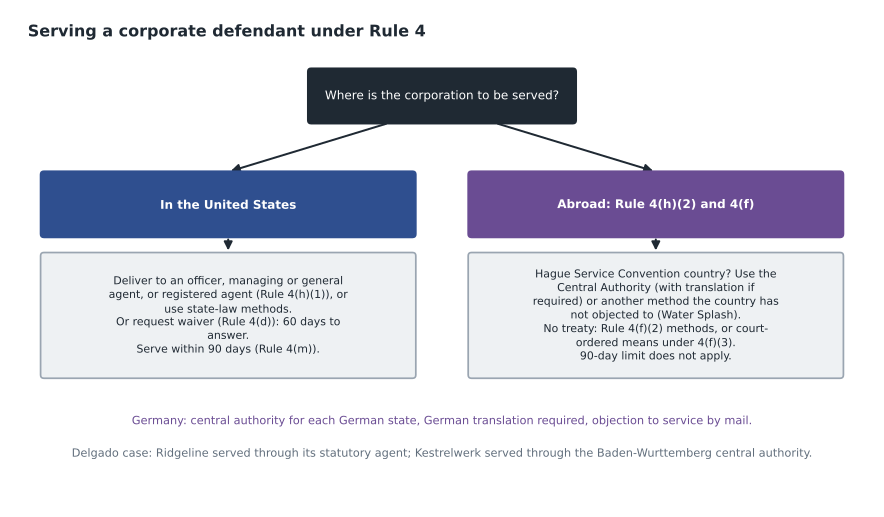
Under Rule 4(h)(1), a corporation, partnership or association in the United States may be served by delivering the papers to an officer, a managing or general agent, or any other agent authorized by appointment or by law to receive service, or by following state law. Every state requires corporations that do business there to keep a registered or statutory agent for exactly this purpose, so serving a domestic corporation is usually simple. Whitcomb serves Ridgeline through its statutory agent in Dayton on April 16.
Waiver of service
Rule 4(d) encourages defendants to avoid the cost of formal service. The plaintiff may mail or otherwise send the defendant a notice of the lawsuit, a copy of the complaint and a request to waive service. A defendant that signs and returns the waiver within the time allowed, at least 30 days after the request is sent or 60 days if it is sent outside the United States, avoids formal service and receives extra time to respond: 60 days from when the request was sent, or 90 days if sent abroad, rather than the usual 21 days after service. A defendant in the United States that refuses without good cause must pay the costs of formal service and of any motion to collect them. Waiving service does not waive any objection to personal jurisdiction or venue.
The 90-day deadline
Rule 4(m) requires service within 90 days after the complaint is filed. If service is not made in time, the court must dismiss the action without prejudice against that defendant or order that service be made within a specified time, and it must extend the time if the plaintiff shows good cause for the failure. The 90-day limit, reduced from 120 days in 2015, does not apply to service in a foreign country under Rule 4(f) or on a foreign state under Rule 4(j)(1), because service abroad often takes longer. A dismissal without prejudice can still be fatal if the statute of limitations has run in the meantime.
Defects in the summons or in service can be challenged by motion. Rule 12(b)(4) covers insufficient process, meaning a defect in the summons itself, and Rule 12(b)(5) covers insufficient service of process, meaning a defect in how it was delivered. Like personal jurisdiction, these defenses are waived if left out of a defendant's first Rule 12 motion or answer.
Serving a defendant abroad
Rule 4(h)(2) provides that a foreign corporation served outside the United States may be served in any manner prescribed by Rule 4(f) for individuals, except personal delivery. Rule 4(f) offers three paths. Under Rule 4(f)(1), service may be made by any internationally agreed means reasonably calculated to give notice, such as those authorized by the Hague Service Convention. Under Rule 4(f)(2), if there is no international agreement, or the agreement allows other means, service may be made by methods such as those prescribed by the foreign country's own law. Under Rule 4(f)(3), the court may order other means not prohibited by international agreement. Some courts have authorized service by email under Rule 4(f)(3), especially where a defendant is hard to find, as long as the method satisfies due process and no treaty forbids it.
The Hague Convention on the Service Abroad of Judicial and Extrajudicial Documents in Civil or Commercial Matters, which the United States and Germany both joined, is mandatory when it applies: it governs whenever a document must be transmitted abroad for service in a member country. Its main channel is a Central Authority that each member country designates. The plaintiff sends a request on the Convention's standard form to the Central Authority in the receiving country, which arranges service under its own law and returns a certificate. Germany has designated central authorities for each of its federal states, requires that documents served through them be translated into German, and has objected to the Convention's provisions allowing service by postal channels and through private agents.
The Supreme Court has decided two important cases on the Convention. In Volkswagenwerk Aktiengesellschaft v. Schlunk, 486 U.S. 694 (1988), the plaintiff served the German car maker by serving its wholly owned US subsidiary, Volkswagen of America, under an Illinois rule treating the subsidiary as the parent's involuntary agent for service. The Court held that the Convention did not apply, because under Illinois law service was complete in the United States and no document had to be transmitted abroad. Whether that shortcut is available depends on the law of the forum state; it worked in Schlunk because Illinois law treated the subsidiary as the parent's agent for this purpose.
In Water Splash, Inc. v. Menon, 581 U.S. 271 (2017), the Court held that the Convention does not prohibit service by mail. Article 10(a) preserves the freedom to send judicial documents by postal channels directly to persons abroad, provided the receiving country has not objected and service by mail is otherwise authorized by the law that governs the case. Because Germany has objected to Article 10, service by mail on Kestrelwerk in Germany would not be valid.
Whitcomb takes no chances. She asks Kestrelwerk's US lawyer, Gregory Hale, whether his client will waive service. Kestrelwerk refuses; as a defendant outside the United States, it faces no cost-shifting penalty for doing so. She then has the summons and complaint translated into German and sends them to the German central authority for Baden-Württemberg, the state where Stuttgart is located, on the Convention's standard request form. Service is completed through a German local court on August 3, 2026, and a certificate of service comes back in September. Marcus Webb works out that service took about three and a half months from the request. That is why Rule 4(m) exempts foreign service from the 90-day limit.
| Defendant | Location | Method | Rule |
|---|---|---|---|
| Ridgeline Cycle Supply, Inc. | Dayton, Ohio | Delivery to its statutory agent | Rule 4(h)(1) or state law |
| Kestrel North America LLC (if added) | Denver, Colorado | Delivery to its registered agent, or waiver | Rule 4(h)(1), Rule 4(d) |
| Kestrelwerk GmbH | Stuttgart, Germany | Request to German central authority with German translation | Rule 4(h)(2), Rule 4(f)(1), Hague Convention |
Limits and traps
Some limits on service come from the courts themselves. Many jurisdictions recognize an immunity from service for parties, witnesses and lawyers who enter a state only to attend court proceedings, so that people are not discouraged from appearing. Courts also refuse to uphold service obtained by fraud, such as luring a defendant into the state with a false story so he can be served there; in Wyman v. Newhouse, 93 F.2d 313 (2d Cir. 1937), a judgment based on service after the defendant was enticed into Florida by false representations was held void.
Service also matters for the statute of limitations. In federal question cases, filing the complaint generally stops the limitations clock. But in diversity cases, the Supreme Court has held that state law determines whether filing or service tolls a state statute of limitations, a rule explored in Lesson 7 under Walker v. Armco Steel Corp., 446 U.S. 740 (1980). A plaintiff in a state that requires service, not just filing, before the limitations period expires can lose her claim through slow service even after filing on time.
Once a defendant has appeared, later papers are served under Rule 5, which is much simpler. Pleadings, motions, discovery papers and other documents are usually served on the party's lawyer, and in practice almost always through the court's electronic filing system, which sends notice to every registered user in the case.
Worked problem
Was service valid?
Suppose Whitcomb had mailed the summons and complaint in English, by international registered mail, directly to Kestrelwerk's headquarters in Stuttgart, and Kestrelwerk's legal department received them. Kestrelwerk moves to dismiss under Rule 12(b)(5). What result?
Show solution
- The Hague Service Convention applies, because the documents had to be transmitted to Germany for service.
- Under Water Splash, the Convention permits service by mail only if the receiving country has not objected to Article 10 and the governing law otherwise authorizes it.
- Germany has objected to service by postal channels, so mail service is not a permitted Convention method.
- Actual receipt does not cure the defect when a mandatory treaty method was not followed, though a court will usually give the plaintiff a chance to serve properly rather than dismiss.
Answer: Service was insufficient. The court would likely quash the service and allow Whitcomb to re-serve through the German central authority. Because Rule 4(m) does not apply to foreign service, the case would probably survive, but months would be lost.
Common mistakes
MistakePublishing notice in a newspaper always satisfies due process.
InsteadUnder Mullane, publication is not enough for parties whose names and addresses are known or reasonably ascertainable.
MistakeIf a defendant actually receives the papers, the method of service does not matter.
InsteadService must follow an authorized method, and the Hague Convention is mandatory when it applies.
MistakeSigning a waiver of service waives objections to personal jurisdiction.
InsteadRule 4(d)(5) provides that waiving service does not waive jurisdiction or venue objections.
MistakeThe 90-day limit in Rule 4(m) applies to every defendant.
InsteadIt does not apply to service in a foreign country under Rule 4(f) or on a foreign state under Rule 4(j)(1).
Summary and key terms
- Due process requires notice reasonably calculated to inform parties of the action and give them a chance to respond (Mullane), plus further reasonable steps if the sender learns notice failed (Jones v. Flowers).
- Prejudgment remedies such as attachment require procedural safeguards (Connecticut v. Doehr).
- Rule 4 governs the summons and methods of service on individuals (Rule 4(e)) and organizations (Rule 4(h)).
- Rule 4(d) waiver saves costs and gives the defendant more time; it does not waive jurisdiction or venue objections.
- Rule 4(m) requires service within 90 days, except for service abroad.
- The Hague Service Convention is mandatory when documents must be sent abroad; Germany requires translation and objects to service by mail (Water Splash, Schlunk).
- Service of process
- Formal delivery of the summons and complaint to a defendant in a manner the law authorizes.
- Summons
- The court document directing the defendant to appear and defend within a stated time.
- Abode service
- Leaving the papers at a person's dwelling with a resident of suitable age and discretion.
- Waiver of service
- A defendant's agreement under Rule 4(d) to accept the complaint without formal service.
- Hague Service Convention
- The treaty governing service of judicial documents among member countries, mainly through central authorities.
- Central Authority
- The office a Hague Convention country designates to receive and execute foreign service requests.
- Prejudgment attachment
- Seizing or encumbering a defendant's property before judgment to secure a possible recovery.
- Insufficient service of process
- A defense under Rule 12(b)(5) that the papers were not delivered in an authorized way.
Practice problems
Work each problem on paper first, then reveal the answer to check.
What standard did Mullane set for constitutionally adequate notice?
Show answer
It must be reasonably calculated, under all the circumstances, to inform interested parties of the action and give them an opportunity to object.
Kestrel North America, served in Colorado, signs and returns a waiver of service. How long does it have to respond to the complaint?
Show answer
Sixty days from the date the request was sent, because the request was sent within the United States.
Why did the Hague Convention not apply in Schlunk?
Show answer
Under Illinois law, serving the US subsidiary as the German parent's involuntary agent completed service in the United States, so no document had to be transmitted abroad.
Why might a plaintiff in a diversity case care whether the state counts filing or service as stopping the limitations clock?
Show answer
Under Walker v. Armco Steel, state law decides that question in diversity cases, so a plaintiff who files on time but serves late may lose the claim if the state requires timely service.
Lesson quiz · 5 questions
Score 60% or more to complete this lesson.
Create a free account to save your progress, take quizzes and earn a certificate.