
LAWU-101 · Lesson 11 of 12 · 25 min
Summary judgment and trial
▶ Video coming soon A video version of this lesson is on the way.
As the fall semester ends, Delgado v. Kestrelwerk GmbH is in discovery, with a scheduling order that sets the close of fact discovery for September 2027 and dispositive motions for the following month. Okafor-Bell tells Section B that the last two lessons will follow the case forward the way the lawyers themselves must, by projecting it. "Every litigator plans the end of a case from the beginning," she says. "Ana Whitcomb drafted her complaint thinking about what she would need to survive summary judgment. Gregory Hale is taking depositions now with an eye on his summary judgment motion. And both of them are thinking about the jury."
This lesson covers the two ways a case that survives the pleadings is decided on the merits: summary judgment under Rule 56, and trial, with its jury right, its procedures and the motions that can take a case away from the jury or set aside its verdict.
The summary judgment standard
Rule 56(a) provides that the court shall grant summary judgment if the movant shows that there is no genuine dispute as to any material fact and the movant is entitled to judgment as a matter of law. A fact is material if it might affect the outcome under the governing substantive law. A dispute is genuine if the evidence is such that a reasonable jury could return a verdict for the nonmoving party. A party may move for summary judgment on a whole case or on particular claims or defenses, and unless a local rule or order provides otherwise, any time until 30 days after the close of all discovery.
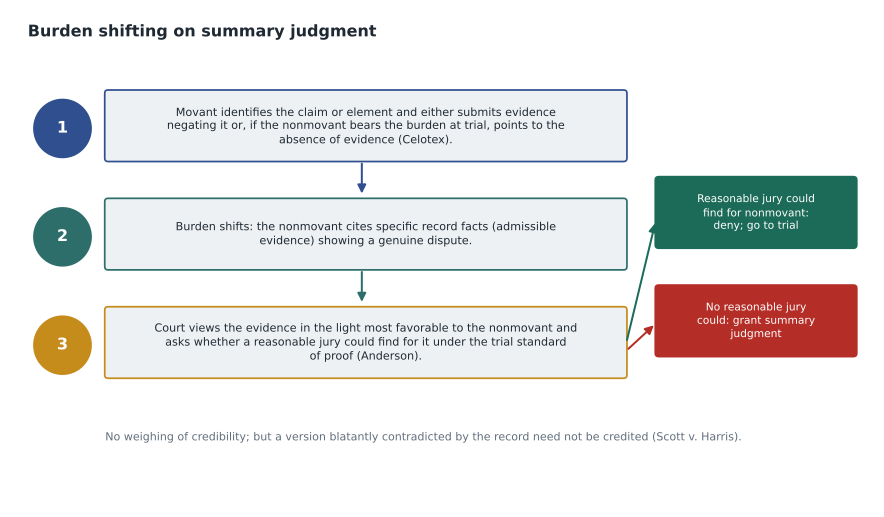
Summary judgment is not a trial on paper. The judge does not weigh the evidence, decide which witnesses are credible or choose between reasonable inferences. The court views the evidence in the light most favorable to the nonmoving party and draws all reasonable inferences in its favor. If the record could support a verdict either way, the case goes to trial. The Supreme Court summarily reversed a court of appeals for failing to follow that principle in Tolan v. Cotton, 572 U.S. 650 (2014), where the lower court had credited a police officer's version of disputed events over the plaintiff's in granting summary judgment.
A party supports or opposes a motion by citing particular parts of materials in the record, such as depositions, documents, electronically stored information, affidavits or declarations, stipulations, admissions and interrogatory answers, under Rule 56(c). Affidavits and declarations must be made on personal knowledge, set out facts that would be admissible in evidence and show that the declarant is competent to testify. If a nonmovant shows by affidavit or declaration that, for specified reasons, it cannot present facts essential to justify its opposition, the court may defer the motion or allow time for more discovery under Rule 56(d).
The 1986 trilogy
Three decisions in 1986 made summary judgment a central part of federal practice. In Celotex Corp. v. Catrett, 477 U.S. 317 (1986), the widow of a man who died from asbestos exposure sued many manufacturers. Celotex moved for summary judgment, arguing that she had no evidence that her husband had been exposed to its products. The court of appeals held that Celotex had to produce evidence negating exposure. The Supreme Court disagreed. A party that will not bear the burden of proof at trial can meet its initial burden by pointing out to the court that there is an absence of evidence to support the nonmoving party's case. The burden then shifts to the nonmoving party to designate specific facts showing a genuine issue for trial. Summary judgment, the Court said, is an integral part of the federal rules, designed to secure the just, speedy and inexpensive determination of every action.
In Anderson v. Liberty Lobby, Inc., 477 U.S. 242 (1986), a libel case brought by a public figure, the Court held that the summary judgment standard mirrors the standard for judgment as a matter of law at trial, and that the court must apply the substantive evidentiary burden that would govern at trial. Because a public figure must prove actual malice by clear and convincing evidence, the question was whether a reasonable jury could find actual malice with that convincing clarity. In Matsushita Electric Industrial Co. v. Zenith Radio Corp., 475 U.S. 574 (1986), American television makers alleged that Japanese manufacturers had conspired for twenty years to sell televisions below cost in the United States to drive them out of business. The Court held that, because the alleged conspiracy made little economic sense, the plaintiffs needed more persuasive evidence to show a genuine issue: conduct as consistent with permissible competition as with illegal conspiracy does not, standing alone, support an inference of conspiracy.
Later cases continue the approach. In Scott v. Harris, 550 U.S. 372 (2007), a motorist sued a deputy who ended a high-speed chase by bumping his car off the road. The motorist's account described careful driving, but the dash-camera video showed a dangerous chase. The Court held that when one party's version of events is blatantly contradicted by the record, so that no reasonable jury could believe it, a court should not adopt that version for purposes of ruling on summary judgment.
Experts and summary judgment
In product cases, summary judgment often turns on expert testimony, because a jury cannot find a design defect or causation in a technical product without it. Federal Rule of Evidence 702 governs admissibility. In Daubert v. Merrell Dow Pharmaceuticals, Inc., 509 U.S. 579 (1993), the Court made trial judges gatekeepers who must ensure that expert testimony is both relevant and reliable, considering factors such as whether the theory can be and has been tested, peer review and publication, the known or potential error rate and general acceptance. Kumho Tire Co. v. Carmichael, 526 U.S. 137 (1999), extended the gatekeeping duty to all expert testimony, including engineering opinions based on experience. A December 2023 amendment to Rule 702 clarified that the proponent must show the court that it is more likely than not that the testimony meets each of the rule's requirements, including that the opinion reflects a reliable application of reliable methods to the facts.
Okafor-Bell projects the motions in Delgado's case. Kestrelwerk will move to exclude Delgado's expert's opinion that an internal short circuit started the fire, arguing that the pack was too badly burned to support any conclusion. Delgado's expert will point to the joint inspection: computed tomography scans showing that one cell had ruptured from the inside while its neighbors failed later, the pattern of melting, and the charger's own logs showing normal voltage. If the court finds the method reliable, the dispute between the experts becomes a classic genuine dispute of material fact for the jury. Kestrelwerk might well win partial summary judgment on Delgado's claim under Ohio Revised Code § 2307.77 for nonconformance with a representation, if discovery shows that Kestrelwerk made no specific representation about the KX48's safety on which she relied. The design defect and warning claims would almost certainly go to trial.
The right to a jury
The Seventh Amendment provides that in suits at common law, where the value in controversy exceeds twenty dollars, the right of trial by jury shall be preserved. The amendment binds federal courts; the Supreme Court has never applied it to the states, which protect civil jury rights through their own constitutions. The word "preserved" has led to a historical test: the right attaches to claims that would have been tried at law, rather than in equity or admiralty, in the English courts in 1791, and to modern statutory claims analogous to them.
In Chauffeurs, Teamsters & Helpers Local No. 391 v. Terry, 494 U.S. 558 (1990), the Court described two steps: compare the action to eighteenth-century actions brought in the courts of England before the merger of law and equity, and examine whether the remedy sought is legal or equitable in nature. The second step is more important, and money damages are the traditional legal remedy. In SEC v. Jarkesy, 603 U.S. 109 (2024), the Court held that when the Securities and Exchange Commission seeks civil penalties for securities fraud, the defendant is entitled to a jury trial in court rather than an administrative proceeding, because the claim resembles common-law fraud and civil penalties are a legal remedy; the so-called public-rights exception did not apply.
When legal and equitable claims are joined, the jury decides the common factual issues first. In Beacon Theaters, Inc. v. Westover, 359 U.S. 500 (1959), and Dairy Queen, Inc. v. Wood, 369 U.S. 469 (1962), the Court held that a judge may not decide an equitable claim first in a way that would bind the jury on overlapping facts, because that would deprive the parties of the jury on the legal claims. Delgado seeks money damages for personal injury, a claim at law, so she has a jury right.
The right must be claimed. Under Rule 38, a party must serve a written demand for a jury no later than 14 days after the last pleading directed to the issue is served, or the right is waived, though Rule 39(b) gives the court discretion to order a jury trial on motion. Delgado's state court complaint included a jury demand, and Rule 81(c)(3) provides that a party who demanded a jury in accordance with state law before removal need not renew the demand.
Selecting the jury
A federal civil jury has between six and twelve members under Rule 48, and unless the parties stipulate otherwise the verdict must be unanimous. Jurors are questioned in voir dire under Rule 47, conducted by the judge or the lawyers, to uncover bias. A party may challenge a prospective juror for cause, an unlimited number of times, for reasons such as a relationship to a party or a fixed opinion about the case, and may also exercise peremptory challenges, which require no reason; in federal civil cases each side ordinarily has three, under 28 U.S.C. § 1870. Peremptory challenges may not be based on race or sex: Edmonson v. Leesville Concrete Co., 500 U.S. 614 (1991), extended the rule of Batson v. Kentucky to civil cases, and J.E.B. v. Alabama ex rel. T.B., 511 U.S. 127 (1994), extended it to sex.
The trial and motions for judgment as a matter of law
A jury trial follows a familiar sequence: opening statements, the plaintiff's case with direct and cross-examination, the defendant's case, any rebuttal, closing arguments, the judge's instructions and the jury's deliberations. Rule 51 requires parties to make requests for jury instructions and to object to instructions on the record before the jury retires, or the objection is generally forfeited except for plain error. Under Rule 49, a court may require a special verdict, with written findings on each factual issue, or a general verdict accompanied by answers to written questions. Ohio's comparative fault law makes a special verdict form likely in Delgado's case, so that the jury can assign shares of responsibility to Delgado and to each defendant.
Under Rule 50(a), once a party has been fully heard on an issue during a jury trial, the court may grant judgment as a matter of law against it if a reasonable jury would not have a legally sufficient evidentiary basis to find for the party on that issue. The standard is the same as for summary judgment, applied to the trial record. A motion may be made at any time before the case is submitted to the jury and must specify the judgment sought and the law and facts that entitle the movant to it. If the court denies the motion, the movant may file a renewed motion under Rule 50(b) no later than 28 days after the entry of judgment, and may join an alternative request for a new trial.
The renewed motion is essential to an appeal. In Unitherm Food Systems, Inc. v. Swift-Eckrich, Inc., 546 U.S. 394 (2006), the Court held that a party that made a Rule 50(a) motion before the verdict but failed to renew it under Rule 50(b) after the verdict could not challenge the sufficiency of the evidence on appeal. And a party cannot make a Rule 50(b) motion on a ground it did not raise in its Rule 50(a) motion. Daniel Reyes writes both rules in capital letters in his notes.
| Motion | Rule | When | Standard |
|---|---|---|---|
| Motion to dismiss | 12(b)(6) | Before the answer | Do the factual allegations plausibly state a claim? |
| Judgment on the pleadings | 12(c) | After pleadings close | Same as 12(b)(6), on all pleadings |
| Summary judgment | 56 | Usually after discovery | Any genuine dispute of material fact? |
| Judgment as a matter of law | 50(a) | At trial, before submission to the jury | Legally sufficient evidentiary basis for a reasonable jury? |
| Renewed judgment as a matter of law | 50(b) | Within 28 days after judgment | Same, on the full trial record |
| New trial | 59 | Within 28 days after judgment | Verdict against the clear weight of the evidence, prejudicial error or excessive damages |
After the verdict: new trials and relief from judgment
Under Rule 59, a court may grant a new trial on all or some issues for any reason for which a new trial has traditionally been granted in federal court, including a verdict against the clear weight of the evidence, prejudicial errors in admitting evidence or instructing the jury, misconduct, and excessive or inadequate damages. A motion must be filed within 28 days after entry of judgment. A judge deciding whether a verdict is against the weight of the evidence may weigh the evidence, which is not allowed on a Rule 50 motion, but should not simply substitute her own view for the jury's.
When damages are excessive, a judge may order remittitur: the plaintiff chooses between accepting a reduced award and a new trial. The reverse, additur, in which the defendant chooses between paying more and a new trial, is not allowed in federal court; Dimick v. Schiedt, 293 U.S. 474 (1935), held that it violates the Seventh Amendment. In a diversity case, the standard for excessiveness may come from state law under Gasperini (Lesson 7), and a state's statutory damages cap, such as Ohio's cap on noneconomic damages, is applied after the verdict as part of the substantive law.
Rule 60 allows relief from a final judgment in limited circumstances: clerical mistakes, under Rule 60(a), and, under Rule 60(b), mistake or excusable neglect, newly discovered evidence, fraud by an opposing party, a void judgment, a satisfied or discharged judgment, or any other reason that justifies relief. Motions on the first three grounds must be made within a year, and every Rule 60(b) motion within a reasonable time; in Coney Island Auto Parts, Inc. v. Burton (2026), the Court confirmed that the reasonable-time limit applies even to motions claiming that a judgment is void.
In a bench trial, the judge decides the facts and must find the facts specially and state conclusions of law separately under Rule 52(a). Findings of fact, whether based on oral or other evidence, must not be set aside unless clearly erroneous, and the reviewing court gives due regard to the trial court's opportunity to judge witnesses' credibility. A party may move for judgment on partial findings under Rule 52(c) once the opposing party has been fully heard on an issue.
Worked problem
A Celotex motion
Suppose that at the close of discovery Delgado's only evidence on causation is her own testimony that the battery caught fire while charging, and her expert has been excluded under Rule 702. Kestrelwerk moves for summary judgment, pointing out that Delgado has no admissible evidence that a defect in the KX48, rather than the third-party charger or something else, caused the fire. How should the court rule?
Show solution
- Delgado bears the burden at trial of proving that a defect proximately caused her injury, an element of her Ohio product liability claims.
- Under Celotex, Kestrelwerk can meet its initial burden by pointing to the absence of evidence of a defect causing the fire; it need not prove the charger did it.
- The burden shifts to Delgado to cite specific record facts that would allow a reasonable jury to find causation.
- Her testimony shows that a fire occurred, but without expert evidence a jury would have to speculate about whether a defect caused it, given the charger and other possible causes. Many states, including Ohio, allow a defect to be proved by circumstantial evidence in some cases, but the plaintiff must still offer evidence that makes other reasonable causes, such as the charger, unlikely; testimony that a fire occurred, standing alone, rarely does that.
Answer: Summary judgment for Kestrelwerk would be likely. The example shows why Rule 702 rulings often decide product cases: excluding the plaintiff's causation expert can leave no genuine dispute for trial.
Common mistakes
MistakeOn summary judgment, the judge decides which side's evidence is more believable.
InsteadThe judge views the evidence in the light most favorable to the nonmovant and asks only whether a reasonable jury could find for it.
MistakeA defendant moving for summary judgment must disprove the plaintiff's claim.
InsteadUnder Celotex, a movant without the burden of proof at trial may point to the absence of evidence supporting an element.
MistakeThe Seventh Amendment guarantees jury trials in state civil cases.
InsteadIt applies only in federal court; states protect civil jury rights under their own constitutions.
MistakeA party can challenge the sufficiency of the evidence on appeal after making only a Rule 50(a) motion.
InsteadUnitherm requires a renewed Rule 50(b) motion after the verdict.
Summary and key terms
- Summary judgment is granted when there is no genuine dispute of material fact and the movant is entitled to judgment as a matter of law, viewing evidence for the nonmovant (Rule 56, Tolan).
- Celotex lets a movant point to an absence of evidence; Anderson applies the trial standard of proof; Matsushita requires more evidence for implausible claims; Scott v. Harris disregards versions blatantly contradicted by the record.
- Expert admissibility under Rule 702, as amended in 2023, and Daubert often decides product cases at summary judgment.
- The Seventh Amendment preserves jury trial for suits at common law, judged mainly by the legal or equitable nature of the remedy (Terry, Jarkesy); the jury decides common issues before the judge decides equitable claims (Beacon, Dairy Queen).
- Jury demands are due within 14 days of the last pleading on the issue; juries have six to twelve members and must be unanimous unless the parties agree otherwise.
- Rule 50 judgment as a matter of law, renewed after verdict under Rule 50(b), and Rule 59 new trials, including remittitur, police verdicts; Rule 60 provides limited relief from judgments.
- Summary judgment
- Judgment without trial when there is no genuine dispute of material fact.
- Material fact
- A fact that might affect the outcome under the governing law.
- Genuine dispute
- A dispute on which a reasonable jury could find for the nonmoving party.
- Judgment as a matter of law
- A ruling under Rule 50 that no reasonable jury could find for a party on an issue.
- Special verdict
- A verdict consisting of the jury's written findings on each factual issue.
- Peremptory challenge
- A challenge removing a prospective juror without stating a reason, subject to bans on race and sex discrimination.
- Remittitur
- An order giving the plaintiff a choice between a reduced award and a new trial.
- Daubert gatekeeping
- The trial judge's duty to admit only relevant and reliable expert testimony.
Practice problems
Work each problem on paper first, then reveal the answer to check.
What must a nonmovant do after a proper Celotex motion?
Show answer
Designate specific facts in the record, through admissible evidence, showing a genuine issue for trial on the challenged element.
Why did Anderson v. Liberty Lobby matter for libel plaintiffs?
Show answer
The court had to ask whether a reasonable jury could find actual malice by clear and convincing evidence, the burden at trial, which made summary judgment easier to obtain.
Delgado demanded a jury in her Ohio state complaint before removal. Must she file a new demand in federal court?
Show answer
No. Rule 81(c)(3) provides that a party who demanded a jury in accordance with state law before removal need not renew the demand.
Kestrelwerk moves under Rule 50(a) at the close of evidence, the jury returns a verdict for Delgado, and Kestrelwerk files no further motion. Can it argue on appeal that the evidence was insufficient?
Show answer
No. Under Unitherm, it needed to renew the motion under Rule 50(b) within 28 days after judgment.
Lesson quiz · 5 questions
Score 60% or more to complete this lesson.
Create a free account to save your progress, take quizzes and earn a certificate.