
LAWU-101 · Lesson 5 of 12 · 23 min
Subject-matter jurisdiction
▶ Video coming soon A video version of this lesson is on the way.
Kestrelwerk's lawyers would much rather defend in federal court in Columbus than in the Franklin County Court of Common Pleas. They believe federal judges apply the pleading and expert-evidence rules more strictly, and that a federal jury, drawn from a wider area than a single county, may be less generous. Whether they can get there depends on subject-matter jurisdiction: a court's power to hear a particular kind of case. Okafor-Bell writes two words on the board, "limited jurisdiction", and underlines them twice.
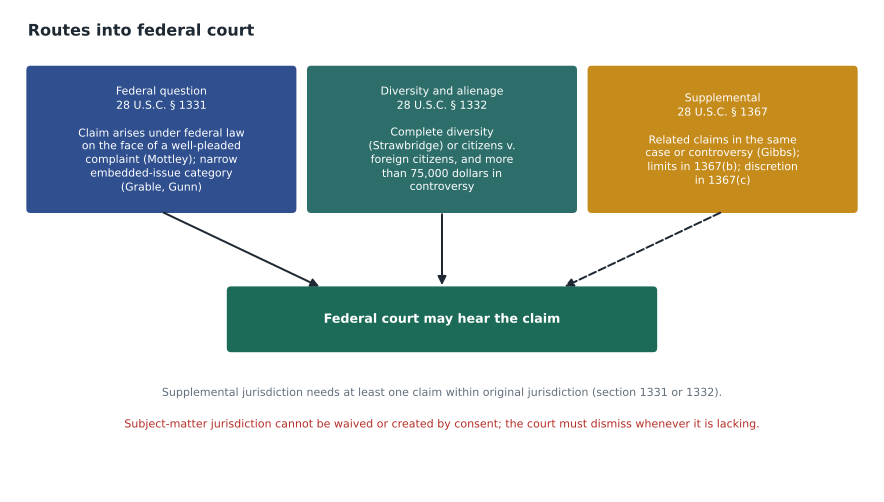
"A state trial court can hear Ms. Delgado's case because it can hear almost anything," she says. "A federal court can hear it only if the case fits into a box that the Constitution allows and Congress has actually opened. If it does not fit, the federal court must dismiss, no matter how far the case has gone and no matter what the parties want." This lesson covers the boxes: federal question jurisdiction, diversity jurisdiction and supplemental jurisdiction.
Limited jurisdiction
Article III, section 2 of the Constitution lists the kinds of cases the federal judicial power can reach, including cases arising under federal law, cases between citizens of different states, and cases between citizens of a state and foreign citizens. These are outer limits. The lower federal courts can hear only cases that Congress has authorized by statute, and Congress has never given them the full constitutional grant. The main statutory grants are in Title 28 of the United States Code: section 1331 for federal questions, section 1332 for diversity and section 1367 for supplemental jurisdiction.
Subject-matter jurisdiction cannot be created by consent, waiver or estoppel. The parties cannot agree to give a federal court power it lacks, and a defendant who fails to object does not waive the defect. Rule 12(h)(3) provides that if the court determines at any time that it lacks subject-matter jurisdiction, it must dismiss the action. A party may raise the issue for the first time on appeal, even the party that chose the federal court and lost. In Capron v. Van Noorden, 6 U.S. (2 Cranch) 126 (1804), a plaintiff who lost at trial successfully argued on appeal that the federal court had lacked jurisdiction over his own suit. Courts must raise the issue themselves when the parties do not. The party invoking federal jurisdiction bears the burden of establishing it.
Federal question jurisdiction
Section 1331 gives district courts original jurisdiction of all civil actions arising under the Constitution, laws or treaties of the United States. Most federal question cases are easy: the plaintiff sues under a federal statute that creates the cause of action, such as the federal civil rights statute, 42 U.S.C. § 1983, or the federal employment discrimination laws. Justice Holmes once summarized the core of the test: a suit arises under the law that creates the cause of action.
The most important limit is the well-pleaded complaint rule, from Louisville & Nashville Railroad Co. v. Mottley, 211 U.S. 149 (1908). Erasmus and Annie Mottley were injured in a train accident in 1871 and settled with the railroad in exchange for free lifetime passes. In 1906, Congress prohibited railroads from giving free passes, and the railroad stopped honoring them. The Mottleys sued in federal court for breach of contract, anticipating that the railroad would rely on the federal statute and arguing that the statute did not apply to them or was unconstitutional. The Supreme Court, raising the issue on its own, held that the federal court lacked jurisdiction. Whether a case arises under federal law must be determined from the plaintiff's own claim as stated in a well-pleaded complaint, not from an anticipated defense. The Mottleys' claim was for breach of contract, a state-law claim, so they had to sue in state court. (They did, won there, and then lost in the Supreme Court on the federal question when the case came up from the state system.)
A narrow category of state-law claims can arise under federal law because they turn on an embedded federal issue. In Grable & Sons Metal Products, Inc. v. Darue Engineering & Manufacturing, 545 U.S. 308 (2005), the IRS seized Grable's land for unpaid taxes and sold it to Darue. Grable sued in state court to quiet title, a state-law claim, arguing that the IRS had not given notice in the way federal tax law required. The Court held that the case belonged in federal court because it necessarily raised a disputed, substantial question of federal tax law that a federal court could resolve without upsetting the balance of federal and state judicial work. Gunn v. Minton, 568 U.S. 251 (2013), restated the test in four parts: a federal issue that is necessarily raised, actually disputed, substantial and capable of resolution in federal court without disrupting the federal-state balance. In Gunn, a state legal malpractice claim arising from a lawyer's handling of a patent case did not qualify, because the federal issue was not substantial to the federal system as a whole.
Delgado's claims are for product liability, negligence and breach of warranty, all under Ohio law. No federal statute creates them, and they do not necessarily turn on a substantial federal question. A federal product-safety regulation might come up as evidence, but that is not enough. Federal question jurisdiction is unavailable.
Diversity jurisdiction
Section 1332(a) gives district courts jurisdiction of civil actions where the matter in controversy exceeds the sum or value of 75,000 dollars, exclusive of interest and costs, and the action is between citizens of different states; between citizens of a state and citizens or subjects of a foreign country; or between citizens of different states in which foreign citizens are additional parties. The purpose traditionally given is to protect out-of-state litigants from possible local bias in state courts.
Complete diversity
Since Strawbridge v. Curtiss, 7 U.S. (3 Cranch) 267 (1806), the diversity statute has been read to require complete diversity: no plaintiff may be a citizen of the same state as any defendant. This is a reading of the statute, not of the Constitution. In State Farm Fire & Casualty Co. v. Tashire, 386 U.S. 523 (1967), the Court confirmed that Article III requires only minimal diversity, meaning at least one plaintiff and one defendant of different citizenship. Congress has used minimal diversity in some statutes, including the federal interpleader statute and the Class Action Fairness Act (Lesson 9).
Citizenship of individuals
An individual is a citizen of the state where she is domiciled. Domicile means physical presence in a place combined with an intention to remain there indefinitely. A person keeps her old domicile until she acquires a new one. In Mas v. Perry, 489 F.2d 1396 (5th Cir. 1974), Jean Paul Mas, a French citizen, and his wife Judy, who grew up in Mississippi, were graduate students in Louisiana who discovered that their landlord had installed two-way mirrors in their bedroom and bathroom. They sued him in federal court in Louisiana. The court held that Mrs. Mas remained a citizen of Mississippi: she had lived in Louisiana only as a student, without intending to stay indefinitely, and had not acquired a new domicile. Mr. Mas was a citizen of France. Both claims had diversity. Citizenship is determined as of the time the action is filed, and later moves do not destroy jurisdiction. A United States citizen domiciled abroad is a citizen of no state, and so cannot sue or be sued under the diversity statute.
Citizenship of corporations and other entities
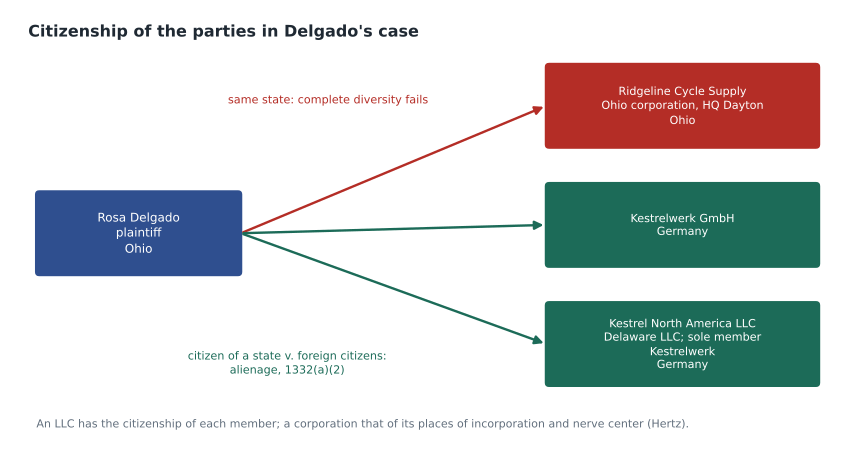
Section 1332(c)(1) provides that a corporation is a citizen of every state and foreign country in which it is incorporated and of the state or foreign country where it has its principal place of business. In Hertz Corp. v. Friend, 559 U.S. 77 (2010), the Court held that the principal place of business is the nerve center: the place where the corporation's high-level officers direct, control and coordinate its activities, usually its headquarters. Ridgeline, incorporated in Ohio with its headquarters in Dayton, is a citizen of Ohio only.
Unincorporated associations are treated differently. In Carden v. Arkoma Associates, 494 U.S. 185 (1990), the Court held that a limited partnership is a citizen of every state of which any of its partners is a citizen. Lower courts apply the same rule to limited liability companies: an LLC has the citizenship of each of its members, traced through any layers of members until an individual or corporation is reached. Where it is organized and where it has its office do not matter. Kestrel North America LLC is organized in Delaware with an office in Denver, but its only member is Kestrelwerk, so it shares Kestrelwerk's citizenship. Assume, as courts usually do with comparable foreign companies, that Kestrelwerk is a citizen only of Germany, where it is organized and has its headquarters. Kestrel North America is then a German citizen for diversity purposes, not a citizen of Delaware or Colorado.
Amount in controversy
The amount in controversy must exceed 75,000 dollars, not counting interest and costs. The plaintiff's good-faith claim controls unless it appears to a legal certainty that the claim is really for less, a standard from St. Paul Mercury Indemnity Co. v. Red Cab Co., 303 U.S. 283 (1938). A single plaintiff may add together all her claims against a single defendant, related or not, to reach the amount. But separate plaintiffs cannot combine their separate claims, and a plaintiff cannot add claims against different defendants who are not jointly liable. Delgado's medical bills, lost wages as a nurse unable to work for months, pain and suffering and property damage plainly exceed 75,000 dollars against each defendant.
Two judge-made exceptions keep certain matters out of federal court even with diversity: the domestic relations exception, which covers divorce, alimony and child custody decrees (Ankenbrandt v. Richards, 504 U.S. 689 (1992)), and the probate exception, which covers probating a will and administering an estate (Marshall v. Marshall, 547 U.S. 293 (2006)). Both are narrow. A tort suit between former spouses, for example, can still be heard.
Applying the rules to Delgado
Okafor-Bell asks Priya Natarajan to work through the possibilities. If Delgado sues Ridgeline and Kestrelwerk together, there is an Ohio citizen on both sides, so complete diversity fails, and section 1332(a)(3) cannot help because it too requires citizens of different states on each side of the dispute. If Delgado sues only Kestrelwerk and Kestrel North America, the case is between a citizen of Ohio and citizens of Germany: alienage jurisdiction under section 1332(a)(2), with the amount satisfied. A plaintiff who wants to stay in state court therefore has an obvious reason to include a local defendant like Ridgeline, and Lesson 6 explains what defendants can do about it.
| Parties sued | Citizenship | Federal jurisdiction? |
|---|---|---|
| Ridgeline only | Ohio v. Ohio | No |
| Kestrelwerk only | Ohio v. Germany | Yes, alienage, 1332(a)(2) |
| Kestrelwerk and Kestrel North America | Ohio v. Germany and Germany | Yes, alienage |
| Ridgeline, Kestrelwerk and Kestrel North America | Ohio v. Ohio, Germany, Germany | No: Ohio citizens on both sides |
Supplemental jurisdiction
A federal court with jurisdiction over one claim can often hear related claims that would not qualify on their own. Before 1990, courts called this pendent and ancillary jurisdiction. In United Mine Workers v. Gibbs, 383 U.S. 715 (1966), a mine superintendent sued a union under federal labor law and joined a state-law claim arising from the same events. The Court held that federal courts have power to hear state claims that derive from a common nucleus of operative fact with a federal claim, such that a plaintiff would ordinarily be expected to try them all in one proceeding, though courts have discretion not to exercise that power.
Congress codified these doctrines in 28 U.S.C. § 1367. Section 1367(a) grants supplemental jurisdiction over all other claims so related to claims in the action within the court's original jurisdiction that they form part of the same case or controversy under Article III. Courts read this to incorporate the Gibbs common-nucleus test.
Section 1367(b) limits supplemental jurisdiction in diversity cases, to keep plaintiffs from evading the complete diversity rule. When original jurisdiction rests solely on diversity, a court does not have supplemental jurisdiction over claims by plaintiffs against persons made parties under Rules 14, 19, 20 or 24, or over certain claims by persons joined as plaintiffs under Rules 19 or 24, when exercising jurisdiction would be inconsistent with section 1332. The provision codified Owen Equipment & Erection Co. v. Kroger, 437 U.S. 365 (1978), where a widow suing a diverse defendant tried to add a claim against a third-party defendant from her own state, which the Court held she could not do. In Exxon Mobil Corp. v. Allapattah Services, Inc., 545 U.S. 546 (2005), however, the Court held that section 1367 does allow supplemental jurisdiction over the claims of additional plaintiffs who do not individually meet the amount requirement, so long as at least one plaintiff does and complete diversity is maintained.
Section 1367(c) lets a court decline supplemental jurisdiction if a claim raises a novel or complex issue of state law, substantially predominates over the federal claims, or if the court has dismissed all claims within its original jurisdiction, or in other exceptional circumstances. Section 1367(d) pauses the state statute of limitations on a dismissed supplemental claim while it is pending and for 30 days after dismissal; in Artis v. District of Columbia, 583 U.S. 71 (2018), the Court held that this means the clock actually stops.
The pleading drives supplemental jurisdiction. In Royal Canin U.S.A., Inc. v. Wullschleger (2025), a pet owner sued pet-food companies in state court over prescription dog food, raising both federal and state claims. The defendants removed the case to federal court based on the federal claims. The plaintiff then amended her complaint to delete every reference to federal law and asked the court to send the case back. A unanimous Supreme Court held that once the amended complaint dropped all federal claims, the federal court lost supplemental jurisdiction over the remaining state claims and had to remand. The plaintiff, as the Court put it, is the master of the complaint.
Worked problem
A related state claim
Suppose Delgado also had a federal claim against Kestrel North America under a federal consumer statute, and an Ohio negligence claim against Ridgeline, an Ohio citizen, arising from the same fire. If she sues both in federal court, can the court hear the claim against Ridgeline?
Show solution
- The federal claim against Kestrel North America is within original jurisdiction under section 1331.
- The negligence claim against Ridgeline has no independent basis: it is a state claim between Ohio citizens.
- Section 1367(a): both claims arise from the same battery fire, a common nucleus of operative fact, so they are part of the same case or controversy. Section 1367(a) expressly reaches claims involving the joinder of additional parties.
- Section 1367(b) does not apply, because original jurisdiction does not rest solely on diversity.
- Section 1367(c): the court has discretion to decline if, for example, the federal claim is dismissed early.
Answer: Yes. The court has supplemental jurisdiction over the claim against Ridgeline, subject to its discretion under section 1367(c). The answer would be different in a pure diversity case, where adding Ridgeline would destroy complete diversity.
Common mistakes
MistakeIf the defendant raises a federal defense, the case arises under federal law.
InsteadUnder the well-pleaded complaint rule from Mottley, jurisdiction depends on the plaintiff's claim, not an anticipated defense.
MistakeA corporation is a citizen only of its state of incorporation.
InsteadIt is a citizen of every state or country of incorporation and of its principal place of business, the nerve center under Hertz.
MistakeAn LLC is a citizen of the state where it is organized.
InsteadAn LLC has the citizenship of each of its members.
MistakeThe parties can agree to federal jurisdiction.
InsteadSubject-matter jurisdiction cannot be conferred by consent or waived, and the court must dismiss whenever it finds jurisdiction lacking.
Summary and key terms
- Federal courts need a constitutional and statutory basis for every claim; subject-matter jurisdiction cannot be waived, and lack of it can be raised at any time.
- Section 1331 covers claims arising under federal law, judged by the well-pleaded complaint (Mottley), plus a narrow class of embedded federal issues (Grable, Gunn).
- Section 1332 requires complete diversity (Strawbridge) and more than 75,000 dollars in controversy.
- Individuals are citizens of their domicile; corporations of their places of incorporation and nerve center (Hertz); LLCs and partnerships of every member.
- Section 1367 grants supplemental jurisdiction over claims in the same case or controversy, limited in diversity cases by 1367(b) and subject to discretion under 1367(c).
- Dropping all federal claims after removal ends supplemental jurisdiction and requires remand (Royal Canin, 2025).
- Subject-matter jurisdiction
- A court's power to hear a particular type of case.
- Federal question jurisdiction
- Jurisdiction under 28 U.S.C. § 1331 over cases arising under federal law.
- Well-pleaded complaint rule
- The rule that federal question jurisdiction depends on the plaintiff's claim, not on defenses.
- Diversity jurisdiction
- Jurisdiction under 28 U.S.C. § 1332 over cases between citizens of different states, or involving foreign citizens, above the amount requirement.
- Complete diversity
- The requirement that no plaintiff share citizenship with any defendant.
- Domicile
- Physical presence in a place with the intention to remain there indefinitely.
- Nerve center
- A corporation's principal place of business: where its officers direct, control and coordinate its activities.
- Supplemental jurisdiction
- Jurisdiction under 28 U.S.C. § 1367 over claims related to a claim within the court's original jurisdiction.
Practice problems
Work each problem on paper first, then reveal the answer to check.
Why did the federal court lack jurisdiction in Mottley?
Show answer
The Mottleys' claim was a state-law breach of contract claim; the federal statute entered only as an anticipated defense, which cannot create federal question jurisdiction.
Kestrelwerk's US subsidiary is a Delaware LLC with an office in Colorado whose only member is Kestrelwerk. What is its citizenship for diversity purposes?
Show answer
German, because an LLC takes the citizenship of its members, and its only member is Kestrelwerk.
Delgado moves to Florida in October 2026, after filing. Does that change the diversity analysis?
Show answer
No. Citizenship is determined at the time the action is filed.
What did Exxon Mobil v. Allapattah hold about additional plaintiffs?
Show answer
Section 1367 allows supplemental jurisdiction over claims of additional plaintiffs who do not meet the amount requirement, as long as at least one plaintiff does and complete diversity is maintained.
Lesson quiz · 5 questions
Score 60% or more to complete this lesson.
Create a free account to save your progress, take quizzes and earn a certificate.