
LAWU-101 · Lesson 3 of 12 · 24 min
Modern personal jurisdiction: general jurisdiction, consent and the internet
▶ Video coming soon A video version of this lesson is on the way.
Gregory Hale, the partner defending Kestrelwerk, sends Ana Whitcomb a letter before she files. Kestrelwerk, he writes, will contest jurisdiction in any American court except where it agrees to appear. Whitcomb reads the letter to Okafor-Bell's class, as the professor has arranged, and asks the students the questions it forces her to answer. Could she avoid the fight by suing somewhere Kestrelwerk is "at home"? Would it matter if Delgado had bought her bike secondhand from someone in Indiana? Does the company's registration to do business in some states count as consent? And what about Kestrelwerk's website, which anyone in Ohio can visit?
Lesson 2 developed specific jurisdiction from its foundations. This lesson completes the picture with general jurisdiction, the Supreme Court's recent decisions on the connection between the claim and the forum, the traditional bases of presence and consent, the special rules for federal courts and the problem of online contacts.
General jurisdiction: where a defendant is at home
General jurisdiction allows a court to hear any claim against a defendant, even a claim with no connection to the forum. Because it is so broad, the Supreme Court has made it narrow. For an individual, the paradigm forum is the person's domicile, the place where she lives with the intention to remain. For a corporation, the Court has identified two paradigm forums: its place of incorporation and its principal place of business.
The early landmark was Perkins v. Benguet Consolidated Mining Co., 342 U.S. 437 (1952). During the Japanese occupation of the Philippines in World War II, the president of a Philippine mining company returned to his home in Ohio and ran the company from there: he kept its files, held directors' meetings, paid salaries and managed its affairs. A shareholder sued the company in Ohio on claims unrelated to Ohio. The Court held that Ohio could exercise jurisdiction because the company's wartime principal, if temporary, place of business was in Ohio. In Helicopteros Nacionales de Colombia, S.A. v. Hall, 466 U.S. 408 (1984), by contrast, a Colombian helicopter company's purchases of helicopters and training in Texas did not make it subject to general jurisdiction there for a crash in Peru.
Two modern cases tightened the test. In Goodyear Dunlop Tires Operations, S.A. v. Brown, 564 U.S. 915 (2011), two boys from North Carolina died in a bus accident near Paris, allegedly because of a defective tire made by Goodyear's subsidiaries in Turkey, France and Luxembourg. Some of those subsidiaries' tires reached North Carolina through the stream of commerce, but the Court unanimously held that this was not enough for general jurisdiction. The test is whether the defendant's affiliations with the state are so continuous and systematic as to render it essentially at home there.
Daimler AG v. Bauman, 571 U.S. 117 (2014), made the test even more demanding. Argentine residents sued Daimler, the German parent company, in California federal court over alleged human-rights abuses by its Argentine subsidiary during Argentina's military dictatorship. They argued that Daimler was at home in California because its US subsidiary, Mercedes-Benz USA, made large sales there. The Court rejected the argument. Even assuming the subsidiary's contacts could be attributed to Daimler, a corporation is not at home everywhere it does substantial business. Apart from its place of incorporation and principal place of business, general jurisdiction exists only in an exceptional case, like Perkins. In BNSF Railway Co. v. Tyrrell, 581 U.S. 402 (2017), the Court applied Daimler to hold that a railroad with more than 2,000 miles of track and about 2,000 employees in Montana was not at home there.
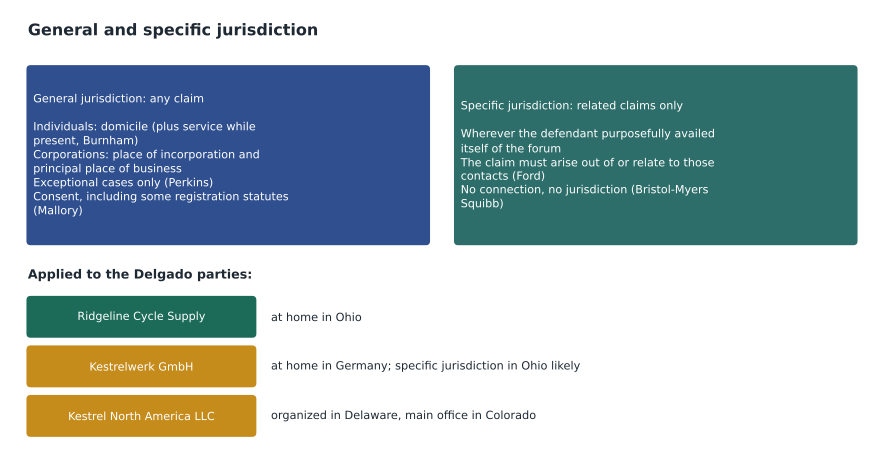
Okafor-Bell applies the rule to the Delgado parties. Ridgeline, an Ohio corporation with its main office in Dayton, is at home in Ohio and can be sued there on any claim. Kestrelwerk is at home in Germany. Kestrel North America is organized in Delaware with its main office in Colorado, and courts generally treat a limited liability company as at home where it is organized and has its principal place of business. None of the three is at home anywhere else. Whitcomb could avoid any jurisdiction fight with Kestrelwerk only by suing in Germany, which she has no wish to do. So she must rely on specific jurisdiction in Ohio.
The connection between the claim and the forum
Specific jurisdiction requires that the claim arise out of or relate to the defendant's forum contacts. Two recent decisions mark its limits.
In Bristol-Myers Squibb Co. v. Superior Court, 582 U.S. 255 (2017), more than 600 people sued the drug maker in California state court over the blood thinner Plavix. Most of them, nearly 600, were not California residents, did not buy or take Plavix in California and were not injured there. They argued that their claims were identical to the California residents' claims and that Bristol-Myers did substantial business in California. The Court held that California lacked specific jurisdiction over the nonresidents' claims. What was missing was a connection between the forum and the specific claims at issue. The company's California activities, including research there on other products, had nothing to do with these plaintiffs' injuries.
Ford Motor Co. v. Montana Eighth Judicial District Court, 592 U.S. 351 (2021), went the other way. Two consolidated cases involved Ford vehicles that malfunctioned in the plaintiffs' home states: a 1996 Explorer in Montana, where the driver, Markkaya Gullett, was killed, and a 1994 Crown Victoria in Minnesota, where a passenger, Adam Bandemer, suffered serious brain damage. Ford had designed, made and first sold those particular vehicles elsewhere; they reached Montana and Minnesota later through resales. Ford argued that the claims did not arise out of its forum contacts because nothing it did in those states caused the injuries.
The Court unanimously rejected Ford's argument. Justice Kagan wrote that the phrase "arise out of or relate to" has two parts. The first asks about causation, but the second contemplates that some relationships will support jurisdiction without a causal showing. Ford had systematically served a market in Montana and Minnesota for the very vehicles that the plaintiffs alleged malfunctioned and injured them there: it advertised them, sold them through dealers, and serviced and supplied parts for them. When a company does that, and its product malfunctions in the state and injures a resident, the state may hear the claim. The Court added that "relate to" does not mean anything goes; it incorporates real limits. Justices Alito and Gorsuch, joined in part by Justice Thomas, concurred in the judgment and questioned the broader framework.
The class tests the doctrine with a variation. Suppose Delgado bought her Trail 750 used from a rider in Indiana, who had bought it new from a dealer there. Under Ford, Ohio could still hear the claim: Kestrelwerk serves an Ohio market for the very model that burned in Ohio and injured an Ohio resident. Now suppose instead that a Michigan resident, injured by a Trail 750 bought and used in Michigan, wants to join Delgado's Ohio suit. Bristol-Myers says no. Kestrelwerk's Ohio activities have no connection to the Michigan rider's claim, so Ohio could hear it only if Kestrelwerk were at home in Ohio, which it is not.
| Bristol-Myers Squibb (2017) | Ford (2021) | |
|---|---|---|
| Plaintiffs | Nonresidents, not prescribed or injured in California | Residents injured in their home states |
| Defendant's forum activity | Large sales and research, but not tied to these plaintiffs' claims | Advertising, selling and servicing the same vehicle models in the forum |
| Causal link required? | No connection at all to the claims | No: relate to does not require causation |
| Result | No specific jurisdiction | Specific jurisdiction |
Presence and consent
Two older bases of jurisdiction survived International Shoe. The first is presence. In Burnham v. Superior Court, 495 U.S. 604 (1990), a New Jersey man was served with divorce papers while briefly visiting his children in California. All nine justices agreed that California had jurisdiction, though they split on why. Four, led by Justice Scalia, said service on a person physically present in the state satisfies due process because of its long historical pedigree. Four others, led by Justice Brennan, said that a person who voluntarily visits a state avails himself of its benefits, so jurisdiction is usually fair. This is sometimes called tag jurisdiction. It applies to individuals; courts generally do not apply it to corporations whose employees happen to be served in the state.
The second is consent. A defendant can consent to jurisdiction by agreeing to it in a contract, often through a forum-selection clause. In Carnival Cruise Lines, Inc. v. Shute, 499 U.S. 585 (1991), the Court enforced a clause printed on cruise tickets requiring suits to be brought in Florida. A defendant also consents by appearing in a case and failing to object to jurisdiction in time, as explained below.
Mallory v. Norfolk Southern Railway Co., 600 U.S. 122 (2023), revived a third kind of consent. Pennsylvania's statute requires out-of-state corporations that register to do business there to accept that they may be sued in Pennsylvania on any claim. Robert Mallory, who had worked for Norfolk Southern as a freight-car mechanic in Ohio and Virginia, sued the railroad in Pennsylvania, alleging that his work had exposed him to carcinogens that caused his cancer. Norfolk Southern, a Virginia corporation, was registered in Pennsylvania. In a five-to-four decision, the Court held that the Due Process Clause did not prevent Pennsylvania from exercising jurisdiction based on that registration, relying on a 1917 precedent, Pennsylvania Fire Insurance Co. v. Gold Issue Mining & Milling Co. Justice Alito, who provided the fifth vote, suggested that such statutes might violate the dormant Commerce Clause, a question the Court left open.
Mallory matters only where a state's registration statute actually treats registration as consent to general jurisdiction. Most states' statutes do not say so, and many state courts have held that registration alone is not consent. Hannah Lindqvist asks whether Kestrelwerk itself is registered anywhere. It is not; only its subsidiary, Kestrel North America, is registered in several states. Whitcomb could not use Mallory against Kestrelwerk in any event.
Federal courts and foreign defendants
A federal court's reach usually mirrors the state's under Rule 4(k)(1)(A). But Rule 4(k) provides other bases. Rule 4(k)(1)(B) allows service within 100 miles of the courthouse on parties added under Rules 14 or 19, even across state lines. Rule 4(k)(1)(C) allows jurisdiction whenever a federal statute authorizes it; some statutes, such as the federal interpleader statute, provide for nationwide service of process. Rule 4(k)(2) addresses foreign defendants: for a claim arising under federal law, serving a defendant who is not subject to the general jurisdiction of any state's courts establishes jurisdiction if it is consistent with the Constitution and laws of the United States. Courts applying it look at the defendant's contacts with the United States as a whole.
The constitutional limit on federal courts is the Fifth Amendment's Due Process Clause, not the Fourteenth's. In Fuld v. Palestine Liberation Organization, 606 U.S. 1 (2025), American victims of terrorist attacks sued the Palestine Liberation Organization and the Palestinian Authority under the Anti-Terrorism Act. A 2019 statute, the Promoting Security and Justice for Victims of Terrorism Act, provides that these defendants are deemed to consent to jurisdiction in such cases if they engage in certain conduct, including making payments to people imprisoned for or killed while committing attacks that harmed Americans. The Court upheld the statute, holding that the Fifth Amendment does not impose the same state-sovereignty-based limits as the Fourteenth Amendment, and that the statute's link between the conduct and jurisdiction was fair. The Court did not define the outer limits of federal jurisdiction under the Fifth Amendment, which lower courts will work out.
Online contacts
A website can be read anywhere. Does that mean its owner can be sued anywhere? Courts have consistently said no. An early and influential approach, from Zippo Manufacturing Co. v. Zippo Dot Com, Inc., 952 F. Supp. 1119 (W.D. Pa. 1997), placed websites on a sliding scale: passive sites that merely post information support little or no jurisdiction; sites through which a defendant actively does business with forum residents, such as by entering contracts and transmitting files, support jurisdiction; interactive sites in the middle require a closer look. Many courts now treat the Zippo scale as only a starting point and apply the ordinary tests: did the defendant purposefully direct its online activity at the forum, for example by selling and shipping products to forum residents or targeting them with advertising? In Ford, the Court expressly declined to address internet transactions, so the questions remain open.
Marcus Webb points out that Kestrelwerk's US website lets visitors find a dealer by entering a zip code, and that it lists Ridgeline's three Ohio shops. Okafor-Bell says that fact helps Whitcomb, not because the site can be seen in Ohio, but because it shows Kestrelwerk deliberately directing Ohio customers to Ohio dealers.
Raising and waiving the objection
Unlike subject-matter jurisdiction, personal jurisdiction protects an individual right and can be waived. Under Rule 12(h)(1), a defendant waives the defense of lack of personal jurisdiction if it fails to include it in its first Rule 12 motion or, if it makes no such motion, in its answer. A defendant who wants to contest jurisdiction should do so at the start, usually by a Rule 12(b)(2) motion to dismiss. The defendant can combine that objection with other defenses without waiving it. The old practice of a special appearance, limited to contesting jurisdiction, survives in some state systems but is unnecessary under the federal rules.
A defendant who believes a court lacks jurisdiction has a riskier option: ignore the suit, suffer a default judgment and attack the judgment as void when the plaintiff tries to enforce it, which is called a collateral attack. If the defendant is right, the judgment is void. If it is wrong, it has lost its chance to defend on the merits. A Rule 60(b)(4) motion to vacate a void judgment must also be brought within a reasonable time; the Supreme Court so held in Coney Island Auto Parts, Inc. v. Burton in January 2026, rejecting the view that a void judgment may be challenged at any time.
Worked problem
Three possible forums
Whitcomb considers suing Kestrelwerk in (a) Ohio, (b) Delaware, where Kestrel North America is organized, and (c) Pennsylvania, where Kestrel North America is registered to do business but Delgado has no connection. Assess each.
Show solution
- Ohio: specific jurisdiction is very likely, because Kestrelwerk serves an Ohio market for the Trail 750 and the bike burned in Ohio, injuring an Ohio resident (Lesson 2 and Ford).
- Delaware: Kestrel North America is at home there, but Kestrelwerk is not. Under Daimler, a subsidiary's place of incorporation does not make the parent at home. Delgado's claim has no connection to Delaware, so there is no specific jurisdiction either.
- Pennsylvania: Kestrel North America's registration might support general jurisdiction over Kestrel North America under Mallory, but it says nothing about Kestrelwerk, which is not registered. A suit there would also invite a dormant Commerce Clause challenge and would gain Delgado nothing.
Answer: Ohio is the only realistic forum for suing Kestrelwerk. Delaware and Pennsylvania offer jurisdiction, if at all, only over the subsidiary.
Common mistakes
MistakeA large company is subject to general jurisdiction wherever it does substantial business.
InsteadAfter Daimler, a corporation is at home only in its place of incorporation and principal place of business, except in a truly exceptional case.
MistakeRelatedness requires that the defendant's forum conduct caused the injury.
InsteadFord holds that the claim must arise out of or relate to the contacts; relate to does not always require causation.
MistakeMallory means that registering to do business anywhere is consent to general jurisdiction.
InsteadMallory applies only where a state's statute makes registration consent, and it left a dormant Commerce Clause challenge open.
MistakeA defendant can raise lack of personal jurisdiction at any time.
InsteadUnder Rule 12(h)(1), the defense is waived if left out of the first Rule 12 motion or the answer.
Summary and key terms
- General jurisdiction allows any claim but exists only where the defendant is at home: domicile for individuals; place of incorporation and principal place of business for corporations (Goodyear, Daimler, BNSF).
- Specific jurisdiction requires a connection between the forum and the specific claim (Bristol-Myers Squibb), but relate to does not always require causation (Ford).
- Presence when served (Burnham) and consent, including forum-selection clauses and some registration statutes (Mallory), also support jurisdiction.
- Federal courts may use Rule 4(k)(1)(B), (C) and 4(k)(2); the Fifth Amendment limits them, and Fuld (2025) held those limits differ from the Fourteenth Amendment's.
- Online contacts count when the defendant purposefully directs activity at the forum; mere accessibility is not enough.
- Lack of personal jurisdiction is waived if not raised in the first Rule 12 motion or answer.
- General jurisdiction
- Jurisdiction over any claim against a defendant, available where the defendant is at home.
- At home
- The standard for general jurisdiction: domicile for individuals; place of incorporation and principal place of business for corporations.
- Tag jurisdiction
- Jurisdiction based on serving an individual while physically present in the forum state.
- Forum-selection clause
- A contract term choosing the court where disputes must be brought.
- Registration statute
- A state law requiring out-of-state companies to register before doing business; a few treat registration as consent to general jurisdiction.
- Rule 4(k)(2)
- The rule allowing federal courts to exercise jurisdiction over foreign defendants on federal claims based on contacts with the United States as a whole.
- Collateral attack
- Challenging a judgment in a later proceeding, such as when the plaintiff tries to enforce it.
- Sliding scale
- The Zippo approach to websites, from passive to actively commercial.
Practice problems
Work each problem on paper first, then reveal the answer to check.
Why could Ohio exercise general jurisdiction over the mining company in Perkins?
Show answer
Its president ran the company from Ohio during the war, making Ohio its principal, if temporary, place of business.
What was missing in Bristol-Myers Squibb that was present in Ford?
Show answer
A connection between the forum and the specific claims. The nonresident plaintiffs' claims had nothing to do with California, while Ford served a market in the forum for the very vehicles that injured residents there.
A Kestrelwerk engineer flies to Columbus for a trade show and is personally served with a summons naming him as a defendant. Is there jurisdiction over him? Over Kestrelwerk?
Show answer
Over him, very likely, under Burnham. Not over Kestrelwerk by that act alone; serving an employee does not make the corporation present.
Kestrelwerk files a Rule 12(b)(6) motion arguing that Delgado fails to state a claim, and says nothing about jurisdiction. Later it moves to dismiss for lack of personal jurisdiction. What happens?
Show answer
The jurisdiction defense is waived under Rule 12(h)(1) because it was omitted from Kestrelwerk's first Rule 12 motion.
Lesson quiz · 5 questions
Score 60% or more to complete this lesson.
Create a free account to save your progress, take quizzes and earn a certificate.