
BAR-255 · Lesson 9 of 12 · 18 min
Virgin Islands torts: comparative negligence and the Tort Claims Act
▶ Video coming soon A video version of this lesson is on the way.
The first client Ayana met on her own was Wilfred Gumbs, a retired fisherman whose truck had been struck by a government vehicle at a roundabout outside Christiansted. His medical bills were already larger than he could pay. 'Can I sue the government?' he asked. Ayana knew the answer was yes, with conditions, and she knew one of the conditions had a short clock. She checked the date of the accident before she finished taking notes.
This lesson covers how Virgin Islands tort law works in practice: where the rules come from after Banks, the comparative negligence statute, limitations periods, and the Virgin Islands Tort Claims Act, which governs claims against the territorial government. These are the rules a new lawyer meets in the first month of a general practice.
Where tort law comes from
Most Virgin Islands tort law is common law. Before 2011, courts applied the Restatements under 1 V.I.C. section 4, and many older decisions do exactly that. After Banks, a court deciding an open tort question weighs prior local decisions, the majority rule elsewhere and the soundest rule for the territory. Lesson 8 explains the method.
Statutes override the common law where they apply, and two statutes matter most in ordinary tort practice. The comparative negligence statute, in Title 5 of the Virgin Islands Code, governs how a plaintiff's own fault affects recovery. The Virgin Islands Tort Claims Act, in Title 33, governs suits against the territorial government. A lawyer handling an injury case reads both before giving advice.
Comparative negligence
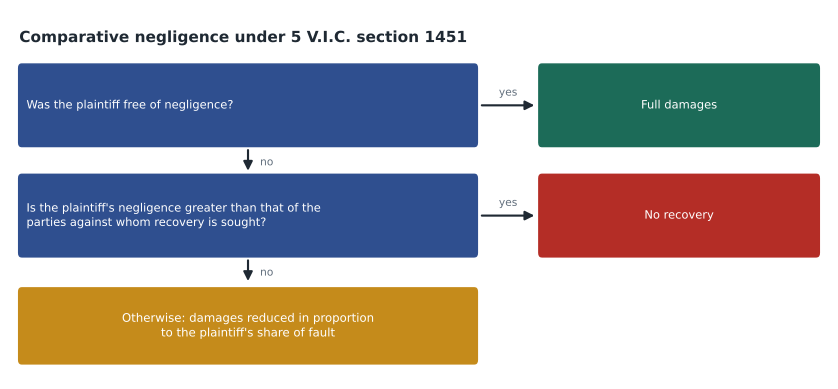
The Virgin Islands replaced the old rule of contributory negligence, under which any fault by the plaintiff barred recovery, with a comparative negligence statute, 5 V.I.C. section 1451. Under the statute, a plaintiff's own negligence does not bar recovery unless it is greater than the negligence of the party or parties against whom recovery is sought. Where the plaintiff recovers, damages are reduced in proportion to the plaintiff's share of the fault.
The rule is a form of modified comparative negligence, sometimes called the not-greater-than or 51 percent bar. A plaintiff found 50 percent at fault recovers half of the damages. A plaintiff found 51 percent at fault recovers nothing.
The statute also addresses how liability is divided among two or more defendants. Before advising a client on how a judgment will be shared, or whether one defendant can be made to pay another's share, a lawyer should read section 1451 itself and the decisions construing it, because the allocation rules are detailed and have been the subject of litigation.
Courts have applied comparative fault principles beyond simple negligence. In Murray v. Fairbanks Morse (1979), the Third Circuit, deciding Virgin Islands law, applied comparative principles in a strict products liability case, so that a plaintiff's own fault could reduce recovery against a manufacturer.
| Plaintiff's share of fault | Damages of 100,000 dollars | Result |
|---|---|---|
| 0 percent | 100,000 dollars | Full recovery |
| 20 percent | 80,000 dollars | Reduced by 20 percent |
| 50 percent | 50,000 dollars | Not greater than the defendant's fault; recovery reduced by half |
| 51 percent | Nothing | Plaintiff's fault is greater; recovery barred |
Limitations periods
Title 5 of the Virgin Islands Code also sets the limitations periods for civil actions. Personal injury actions generally must be brought within two years, and other kinds of claims have their own periods, which differ for contract, property and other actions. Because the periods are short and the rules on accrual and tolling have been litigated, a new lawyer should calendar the limitations date for every new matter on the day the file opens and confirm it against the statute rather than relying on memory.
Claims against the government are different. They carry their own notice requirement under the Tort Claims Act, which runs much sooner than the ordinary limitations period.
The Virgin Islands Tort Claims Act
The Government of the Virgin Islands, like a state, is immune from suit unless it consents. Congress gave the territorial government attributes of autonomy similar to those of a sovereign government, and courts have recognized its sovereign immunity. The Legislature waived that immunity in part through the Virgin Islands Tort Claims Act, in Title 33 of the Code.
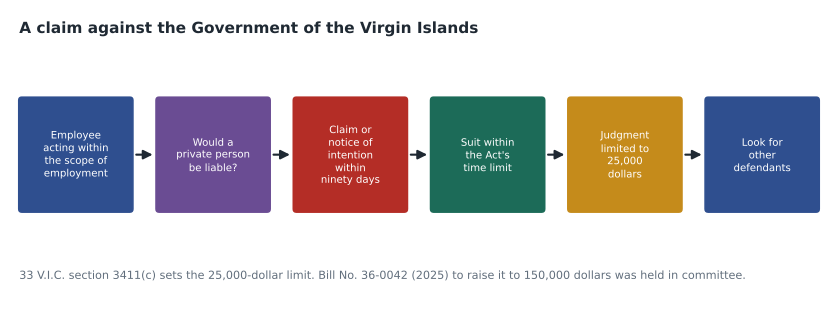
Under the Act, the Government may be liable for injury, loss of property, or personal injury or death caused by the negligent or wrongful act or omission of an employee acting within the scope of office or employment, under circumstances in which a private person would be liable to the claimant under the law of the place where the act or omission occurred. The waiver is limited: it covers negligent and wrongful conduct of the kind for which a private person would answer, and it has been read not to extend to an employee's gross negligence.
The damages limit
The most striking feature of the Act is its limit on damages. Under 33 V.I.C. section 3411(c), a judgment for damages against the Government of the Virgin Islands may not exceed 25,000 dollars. The figure has not changed in many years, and it is far lower than the limits in most states.
The limit has been the subject of reform proposals. In February 2025, a bill was introduced in the Legislature, Bill No. 36-0042, to raise the maximum judgment from 25,000 dollars to 150,000 dollars. The bill was held in committee in April 2025, and the 25,000-dollar limit remains the law. A lawyer should check for later amendments before advising a client, but should not assume one has passed.
The practical consequences are significant. A person seriously injured by a government vehicle may have damages far above 25,000 dollars and yet recover no more than that from the Government. Counsel will look for other defendants: a private contractor, a vehicle manufacturer, or the employee personally where the law allows. The Act also contains provisions on the Government's responsibility for judgments against its employees, and those provisions must be read carefully when an employee is named.
Timing and the notice requirement
The Act sets strict procedural requirements. A claimant must file a claim, or a notice of intention to file a claim, within a short period after the claim accrues; for personal injury and property damage claims, the Act's period is ninety days. The claim and notice must contain the information the Act requires, and they are filed with the offices the Act designates. A suit then must be brought within the time the Act allows.
Courts treat these requirements seriously. A claimant who misses the notice deadline may lose the claim against the Government entirely, even if the ordinary two-year limitations period has not run. The Act allows late notice in some circumstances, on application and a showing of a reasonable excuse, but a lawyer should never plan on that.
That is why Ayana checked the date of Wilfred Gumbs's accident before anything else. The accident had happened five weeks earlier. She had time, but not much.
Other defendants and other theories
Because the damages limit is low, a careful lawyer always asks who else may be responsible. In a vehicle case, the employee driver, a private contractor maintaining the road, or the maker of a defective part may be possible defendants. In a premises case, a private manager of a government building may be liable. Each defendant raises its own questions of duty, often decided under Banks if no Virgin Islands decision governs.
The Act does not govern claims against the United States. A claim arising from the conduct of a federal employee in the territory, such as a National Park Service ranger on St. John, falls under the Federal Tort Claims Act, with its own administrative claim requirement and its own two-year period. A Virgin Islands lawyer needs to identify which government employed the person at fault.
Damages
Recoverable damages in an ordinary tort case include medical expenses, lost earnings, loss of earning capacity, pain and suffering and, in a death case, the losses the territory's wrongful death statute allows. Punitive damages may be available against private defendants for outrageous conduct under the common law, but a lawyer should not expect them against the Government. Where an open question of damages law arises, the Banks analysis applies.
Worked problem
A claim against the Government
On October 9, 2026, a Department of Public Works truck driven by an employee on a work assignment runs a stop sign and strikes Wilfred Gumbs's pickup. Wilfred, who was driving slightly over the speed limit, is injured; his damages are estimated at 160,000 dollars. He consults Ayana on November 16, 2026. Advise him.
Show solution
- Waiver: the employee was acting within the scope of employment, and a private employer would be liable, so the Tort Claims Act applies.
- Deadline: a claim or notice of intention must be filed within ninety days of accrual, by early January 2027; it should be filed promptly.
- Comparative negligence: if Wilfred is found partly at fault for speeding, his damages are reduced by his share; he is barred only if his fault is greater than the Government's.
- Limit: any judgment against the Government cannot exceed 25,000 dollars under section 3411(c), unless the law has changed.
- Other defendants: consider whether the employee or anyone else can be sued, subject to the Act's rules on employees.
Answer: Wilfred has a viable claim, but the notice deadline is weeks away and the recovery from the Government is capped at 25,000 dollars. Ayana should file the notice immediately and investigate other sources of recovery.
Common mistakes
MistakeAny contributory negligence bars recovery in the Virgin Islands.
InsteadUnder 5 V.I.C. section 1451, recovery is barred only if the plaintiff's negligence is greater than that of the defendants; otherwise damages are reduced.
MistakeA claim against the Government has the ordinary two-year limitations period with no other deadline.
InsteadThe Tort Claims Act requires a claim or notice of intention within ninety days of accrual for personal injury.
MistakeThe Government's liability is unlimited.
InsteadUnder 33 V.I.C. section 3411(c), a judgment against the Government may not exceed 25,000 dollars.
MistakeThe 2025 bill raised the cap to 150,000 dollars.
InsteadBill No. 36-0042 was held in committee in April 2025; the 25,000-dollar limit remains.
MistakeA claim against a federal park ranger goes under the Virgin Islands Tort Claims Act.
InsteadClaims against federal employees fall under the Federal Tort Claims Act.
Intake questions for an injury case
Ayana now uses a short intake checklist for every new injury matter. When and where did the injury happen? Who was involved, and who employed them? Was any government vehicle, building or employee involved, and if so, which government: the territory or the United States? What did the client do, and could any of it be described as careless? What are the medical bills, lost earnings and other losses so far? Is there insurance, and has anyone already contacted an insurer? Which deadlines apply, and what is the earliest of them? The last question goes on her calendar before the client leaves the office.
The checklist reflects a simple truth about Virgin Islands tort practice. Most cases turn less on unusual legal doctrine than on facts, deadlines and sources of payment. A lawyer who identifies every potential defendant early, files the right notice on time and documents the client's losses carefully has done most of the work that decides the outcome.
Summary and key terms
- Virgin Islands tort law is mostly common law, decided under Banks where no local precedent governs, with statutes overriding where they apply.
- 5 V.I.C. section 1451 bars a plaintiff only if the plaintiff's negligence is greater than the defendants'; otherwise damages are reduced proportionally.
- Personal injury actions generally must be brought within two years; calendar every limitations date.
- The Virgin Islands Tort Claims Act waives immunity for negligent or wrongful acts of employees within the scope of employment where a private person would be liable.
- A claim or notice of intention must be filed within ninety days of accrual for personal injury and property claims.
- Judgments against the Government are limited to 25,000 dollars under 33 V.I.C. section 3411(c); a 2025 bill to raise the limit was held in committee.
- 0
- comparative negligence
- 1
- 5 V.I.C. section 1451
- 2
- modified comparative fault
- 3
- limitations period
- 4
- sovereign immunity
- 5
- Virgin Islands Tort Claims Act
- 6
- notice of intention
- 7
- scope of employment
- 8
- damages limit
- 9
- Federal Tort Claims Act
Practice problems
Work each problem on paper first, then reveal the answer to check.
A plaintiff is found 40 percent at fault and has damages of 50,000 dollars against a private defendant. What does she recover?
Show answer
30,000 dollars: her damages reduced by her 40 percent share, since her fault is not greater than the defendant's.
What is the maximum judgment against the Government of the Virgin Islands under the Tort Claims Act?
Show answer
25,000 dollars under 33 V.I.C. section 3411(c).
What must a person injured by a government employee file, and when?
Show answer
A claim or a notice of intention to file a claim within ninety days after the claim accrues.
Which statute governs a claim against a federal employee in the territory?
Show answer
The Federal Tort Claims Act, not the Virgin Islands Tort Claims Act.
Lesson quiz · 5 questions
Score 60% or more to complete this lesson.
Create a free account to save your progress, take quizzes and earn a certificate.