
BAR-255 · Lesson 2 of 12 · 19 min
Eligibility, education, application deadlines and fees
▶ Video coming soon A video version of this lesson is on the way.
Ayana filed her application on Monday, November 16, 2026, two weeks before the deadline for the February 2027 exam. She had planned to file earlier, but the application asked for things she did not have on hand: a certified copy of her law school transcript, the exact dates of every address she had lived at since college, and a list of every job she had held, including a summer at a car rental counter on the airport road. Hyacinth Petersen, the senior partner at her firm, watched her assemble it and told her the story of a friend who had missed a deadline by a day and waited six months for the next exam. 'In this territory,' Petersen said, 'late means next time.'
This lesson covers who may apply, the education requirement, the filing deadlines and how the territory treats late applications, the fees, and the mechanics of filing through the Judiciary's electronic system.
The eligibility criteria
Rule 204(d) lists the criteria for regular admission. An applicant must be at least 21 years old. The applicant must be a citizen of the United States or, if not a citizen, a resident who is a lawful permanent resident. The applicant must be of good moral character. The applicant must not be disbarred, suspended or otherwise sanctioned in any state, district, territorial, federal or foreign jurisdiction, unless reinstated or exonerated, and must not be the subject of pending disciplinary action anywhere. An applicant admitted elsewhere must be a current member in good standing of that jurisdiction. And the applicant must be a graduate of a law school accredited by the American Bar Association.
Two of those criteria deserve emphasis because they are stricter than in many states. The minimum age of 21 is higher than the minimum of 18 found in several jurisdictions, although it rarely matters for law graduates. The citizenship and residence criterion requires United States citizenship or lawful permanent residence; it is narrower than the rules of states that admit any applicant lawfully present or that set no immigration requirement at all. Applicants in other immigration categories should read the rule carefully and ask the Office of Bar Admissions before filing.
The disciplinary criterion has a filing consequence as well. Under Rule 204(c)(6), a person who is disbarred, suspended or sanctioned without reinstatement or exoneration, or who faces pending disciplinary action, may not even file an application. A lawyer with a pending grievance elsewhere must wait for it to be resolved.
| Criterion | Rule 204(d) requirement |
|---|---|
| Age | At least 21 |
| Citizenship | United States citizen, or non-citizen lawful permanent resident |
| Character | Good moral character |
| Discipline | Not disbarred, suspended or sanctioned anywhere (unless reinstated or exonerated); no pending discipline |
| Other admissions | If admitted elsewhere, a member in good standing |
| Education | Graduate of an ABA-accredited law school |
The education requirement
The education rule is simple to state. Rule 204(d)(5) requires graduation from a law school accredited by the American Bar Association. The Court's admission pages repeat the point in plain terms: graduates of law schools that are not ABA-accredited are not eligible.
Several consequences follow. A graduate of a state-accredited school that lacks ABA approval cannot sit. A graduate of a foreign law school cannot sit, even if the graduate holds an LL.M. from an ABA-approved school; NCBE's summary of the territory's rules states that foreign law graduates are not eligible. And there is no law office study route of the kind that Vermont, Virginia, Washington and a few other states keep. Every applicant for regular admission has a J.D. or LL.B. from an ABA-approved school.
The rule also affects the score transfer and motion routes. A lawyer who passed the NextGen exam in a state that admits graduates of non-ABA schools cannot transfer that score into the Virgin Islands unless the lawyer also holds an ABA-approved degree. Rule 204(g) builds that requirement into the transfer rule expressly.
Students cannot take the exam early. The Virgin Islands has no rule letting a student sit before graduation, and law students do not register in advance with the Office of Bar Admissions. The application is filed once the applicant is eligible.
The filing deadlines
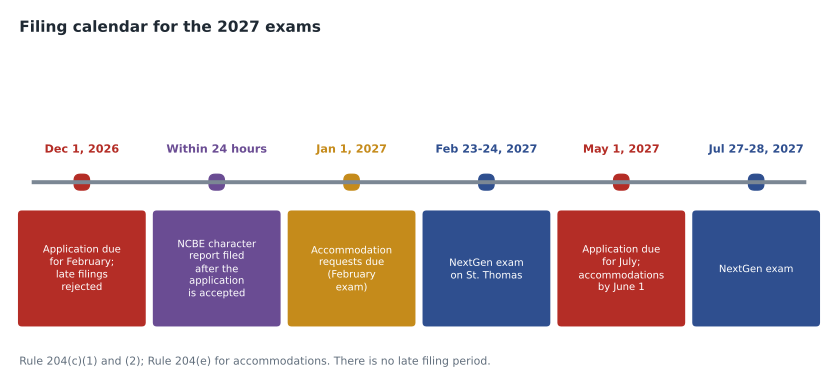
Rule 204(c)(1) sets two deadlines. An applicant for the February exam must file by December 1 of the preceding year. An applicant for the July exam must file by May 1. Applications are filed electronically.
The more important rule is the one that follows. Under Rule 204(c)(2), an application that is not filed by the deadline is rejected. There is no late filing period and no late fee that buys extra time. NCBE's chart for the territory confirms the point by listing no late deadline for either exam.
Marchetti told Ayana that December 1 should be treated as the last possible day, not the target. 'Electronic systems go down. Notaries go on vacation. Files fail to upload at four in the afternoon. Aim for mid-November.' Ayana's November 16 filing gave her two weeks of margin.
Accommodations
An applicant who needs testing accommodations for a disability must request them by the deadline in Rule 204(e): January 1 for the February exam and June 1 for the July exam. The chair of the Committee may accept a late request for good cause, but an applicant should not rely on that. Documentation from a qualified professional is normally required, and gathering it takes time, so an applicant who expects to request accommodations should begin before filing the application itself.
The fees
Rule 204(c) sets the application fee for admission by examination at 1,100 dollars: 100 dollars paid to the Clerk of the Supreme Court as a filing fee and 1,000 dollars paid to the Committee of Bar Examiners. The fees are generally nonrefundable, though the rule allows a refund for good cause.
Several other costs come on top. The applicant pays NCBE directly for the character and fitness investigation and for the MPRE. Because the NextGen exam is given on the applicant's own laptop through secure testing software, NCBE also charges a technology fee, listed by the Court at 149 dollars and paid through the applicant's NCBE account. Applicants from St. Croix or St. John also budget for travel to St. Thomas, where the exam is given, and often for a hotel for two nights.
Admission on motion has its own, higher fee: 2,500 dollars, split between 500 dollars to the Clerk and 2,000 dollars to the Committee, plus the NCBE character fee. Lesson 11 covers that route.
| Item | Amount | Paid to |
|---|---|---|
| Application for admission by examination | 1,100 dollars (100 filing plus 1,000 Committee) | Clerk and Committee |
| NextGen technology fee | 149 dollars | NCBE |
| Character and fitness report | NCBE fee | NCBE |
| MPRE | NCBE fee | NCBE |
| Application for admission on motion | 2,500 dollars (500 filing plus 2,000 Committee) | Clerk and Committee |
| Virgin Islands Law Component | No fee | Not applicable |
Filing through the Judiciary's electronic system
Applications are not mailed. The applicant creates an e-filing profile with the Virgin Islands Judiciary's electronic filing system and files the prescribed Application for Admission to the Virgin Islands Bar, with its attachments, as a new matter. The Court's FAQ notes that all answers must be typewritten. Later filings, including the NCBE character materials and, eventually, the letter of intent to sit for the Law Component, are filed in the same pending matter.
The application asks for the applicant's education, every residence and job for a period of years, every court case in which the applicant was a party, financial obligations, any criminal history and any prior bar applications or discipline. It requires authorizations so that the Committee and NCBE can obtain records. Certified transcripts and certificates of good standing from any other jurisdiction of admission are attached or sent separately as the instructions require.
Ayana built her application from a spreadsheet she started in October. One column for every address since 2016, one for every job, one for every school. When she reached the question about court cases, she listed a small claims matter in which her car rental employer had sued a customer and she had been a witness, not a party. Petersen told her to disclose it anyway with an explanation. 'They would rather read one extra paragraph than wonder why you left something out.'
Worked problem
Checking eligibility
Basil Hendricks is a lawyer admitted in Florida who graduated from a Florida law school that is not ABA-approved. He passed the Florida bar exam, has practiced for eight years and is in good standing. He wants to move to St. Thomas and asks whether he can sit for the Virgin Islands exam in February 2027 or be admitted on motion.
Show solution
- Education: Rule 204(d)(5) requires graduation from an ABA-accredited law school for regular admission.
- Exam route: his degree is not from an ABA-approved school, so he is not eligible to sit.
- Motion route: Rule 204(j) also requires an ABA-approved J.D. or LL.B., so his years of practice do not cure the problem.
- Other options: special admission or pro hac vice may be available for limited purposes, but not for general practice.
Answer: Basil cannot obtain regular admission in the Virgin Islands under the current rules, however long he has practiced. He should confirm with the Office of Bar Admissions whether any limited form of practice fits his plans.
Common mistakes
MistakeA late application can be accepted with a late fee.
InsteadUnder Rule 204(c)(2), applications filed after the deadline are rejected; there is no late period.
MistakeAn LL.M. from an ABA-approved school qualifies a foreign-trained lawyer.
InsteadRegular admission requires graduation from an ABA-accredited law school; foreign law graduates are not eligible.
MistakeStudents may sit before graduation.
InsteadThe territory has no early exam option; applicants file once they are eligible.
MistakeThe February deadline is in January.
InsteadThe February deadline is December 1 of the preceding year; the July deadline is May 1.
MistakeThe 1,100-dollar fee covers everything.
InsteadThe MPRE, the NCBE character report and the 149-dollar technology fee are paid separately to NCBE.
Gathering documents early
The application is easier to finish if the documents are requested before the forms are filled in. Law schools take time to send certified transcripts and certifications of graduation. Courts in other jurisdictions take time to issue certificates of good standing. Employers from years ago may need to be tracked down. A credit report is worth pulling early so that any surprises can be addressed and explained.
Ayana's list had eleven items: her law school transcript and certification of graduation, her college transcript, her MPRE score report, a copy of her driver's license and passport, her birth certificate, a credit report, records of the small claims matter in which she had been a witness, a list of every address since 2016 with dates, a list of every employer with supervisors' names and contact information, three character references who were not relatives, and a copy of her NCBE account confirmation. She requested the outside documents in early October, which left her time to chase the two that did not arrive.
Keeping the application current
The duty of candor does not end when the application is filed. Applicants must keep their answers accurate and complete until admission, so a change of address, a new job, a new court matter or any other development that affects an answer should be reported promptly in the pending matter. An applicant who moves from St. Croix to St. Thomas between filing and the exam, or who receives a traffic citation in January, should update the file rather than wait to be asked.
Reapplying after an unsuccessful exam
An applicant who does not pass must file a new application for a later exam by its deadline and pay the fee again. Because the rules set no maximum number of attempts, the main constraints are practical: the filing calendar, the cost, and the time limits that apply to the MPRE and to any transferred score. An applicant who has already passed the Law Component should check whether the result remains usable for the later admission, because Rule 204(h) treats results more than three years old as stale.
Summary and key terms
- Applicants must be at least 21, a United States citizen or lawful permanent resident, of good moral character, free of unresolved discipline and in good standing elsewhere.
- Only graduates of ABA-accredited law schools are eligible; there is no foreign-graduate or law office route.
- Applications are due December 1 for February and May 1 for July; late applications are rejected.
- Accommodation requests are due January 1 for February and June 1 for July.
- The exam application fee is 1,100 dollars; NCBE fees and the 149-dollar technology fee are extra; motion applicants pay 2,500 dollars.
- Applications are filed through the Judiciary's electronic filing system, with typewritten answers.
- 0
- eligibility criteria
- 1
- lawful permanent resident
- 2
- ABA-accredited law school
- 3
- filing deadline
- 4
- late application
- 5
- accommodations
- 6
- filing fee
- 7
- technology fee
- 8
- electronic filing system
- 9
- good standing
Practice problems
Work each problem on paper first, then reveal the answer to check.
What is the filing deadline for the February exam?
Show answer
December 1 of the preceding year, under Rule 204(c)(1).
What happens to an application filed on December 2 for the February exam?
Show answer
It is rejected under Rule 204(c)(2); the applicant must file for a later exam.
How is the 1,100-dollar exam application fee divided?
Show answer
100 dollars to the Clerk as a filing fee and 1,000 dollars to the Committee of Bar Examiners.
Can a foreign-trained lawyer with a U.S. LL.M. sit for the Virgin Islands exam?
Show answer
No. Regular admission requires graduation from an ABA-accredited law school, and foreign law graduates are not eligible.
Lesson quiz · 5 questions
Score 60% or more to complete this lesson.
Create a free account to save your progress, take quizzes and earn a certificate.