
BAR-255 · Lesson 8 of 12 · 19 min
Virgin Islands common law and the Banks analysis
▶ Video coming soon A video version of this lesson is on the way.
Eldon Ottley's first brief in the Superior Court, in 2019, cited a section of the Restatement (Second) of Torts as if it were a statute. Opposing counsel's reply began with a single sentence: 'Plaintiff has not conducted a Banks analysis.' The judge agreed, and Eldon spent a weekend rewriting the brief. He tells the story to every new clerk, and he told it to Ayana in her first month. 'In most places, you look up the rule. Here, sometimes, you have to argue for it.'
This lesson explains how the Virgin Islands finds its common law: the old statutory rule that made the Restatements the law, the Supreme Court's 2011 decision in Banks v. International Rental and Leasing Corp. that replaced it, the three-factor Banks analysis, and how courts treat older decisions. It is one of the most distinctive features of Virgin Islands law and a regular subject under Virgin Islands practice on the Law Component.
The Restatement rule
For most of the territory's history, a statute told Virgin Islands courts where to find the common law. Section 4 of Title 1 of the Virgin Islands Code provided that the rules of the common law, as expressed in the Restatements of the Law approved by the American Law Institute, and, where not so expressed, as generally understood and applied in the United States, were the rules of decision in the courts of the Virgin Islands, unless local law provided otherwise.
The effect was unusual. In every state, the Restatements are secondary sources: respected summaries of the law that courts may follow or reject. In the Virgin Islands, they had the force of statute. A litigant could win a tort or contract dispute by showing what the relevant Restatement section said, and courts, including the federal courts that decided most local appeals before 2007, routinely applied Restatement sections as binding law.
The arrangement had a practical logic. The territory was small, its courts had limited resources, and a ready-made body of rules saved judges from building the common law case by case. But it also had costs. The Restatements were written for the country as a whole, not for a small island territory, and later Restatements increasingly argued for what the law should be rather than describing what most courts did.
Banks v. International Rental and Leasing Corp.
In Banks v. International Rental and Leasing Corp., 55 V.I. 967, decided on December 15, 2011, the Supreme Court of the Virgin Islands changed the system. The case was a personal injury appeal, but its importance lies in what the Court said about where Virgin Islands common law comes from.
The Court held that section 4 had been implicitly repealed by the legislation that established the Supreme Court as the territory's highest court. As the highest court of the territory, the Supreme Court has the authority, like the highest court of a state, to shape the common law of its jurisdiction. That authority cannot coexist with a statute requiring courts to follow whatever the American Law Institute publishes. After Banks, the Restatements are persuasive authority, not binding law.
The three Banks factors
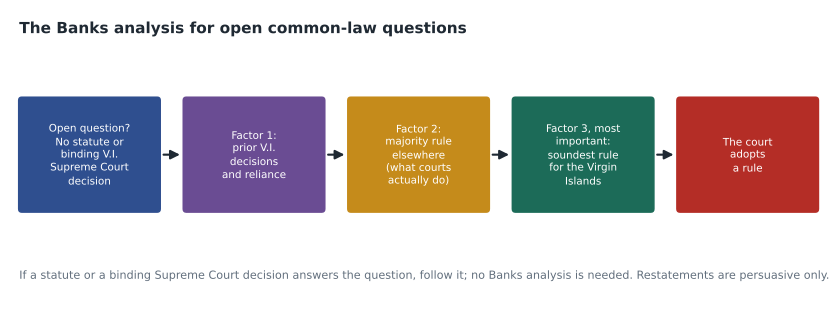
Banks also told courts what to do instead. When a court faces a common-law question that Virgin Islands precedent does not already answer, it must conduct what has come to be called a Banks analysis, weighing three factors.
First, the court considers whether Virgin Islands courts have previously adopted a rule on the question, and whether litigants may have relied on it. Reliance matters because changing a rule that people have organized their affairs around can be unfair.
Second, the court considers the position taken by a majority of courts in other jurisdictions. The majority rule is evidence of what has worked elsewhere and what most American lawyers expect.
Third, and most important, the court determines which approach represents the soundest rule for the Virgin Islands. That factor lets the court consider the territory's particular circumstances: its size, its economy, its geography, its institutions and its people. A rule that suits a large mainland state may not suit three islands.
Government of the Virgin Islands v. Connor
In Government of the Virgin Islands v. Connor, 60 V.I. 597 (2014), the Supreme Court explained the analysis in more detail. Commentators regard Connor as the clearest statement of what each factor requires. Under the first factor, a court looks for reasoned local decisions on which litigants might have relied. Under the second, it examines how other jurisdictions actually resolve the question. Under the third, it weighs all the persuasive authority to decide which rule best suits the territory's needs.
Connor also addressed the Restatements directly. Because modern Restatements often advocate for what the law should be, a court cannot simply treat a Restatement section as proof of the majority rule. The second factor requires a look at what courts do, not what the American Law Institute recommends.
Connor and later decisions also addressed older precedent. The Supreme Court indicated that it would reconsider decisions that rested solely on section 4, and that the Superior Court may depart from such a decision when it thoroughly explains its reasoning. In Antilles School, Inc. v. Lembach (2016), the Court again cautioned that pre-Banks decisions based only on section 4 should not be blindly followed.
Decisions of the federal courts
Before 2007, the Third Circuit and the Appellate Division of the District Court were, in practice, the highest courts on questions of Virgin Islands law. Their decisions fill the older case reporters. What weight do they have now?
The Supreme Court has answered that question in a way that respects the history without being bound by it. In Garcia v. Garcia (2013), it described Third Circuit decisions interpreting local law during the period when that court served as the territory's highest court as entitled to great respect, but not binding on the Supreme Court. The Third Circuit itself recognized, in DeFoe v. Phillip (2012), that the Supreme Court of the Virgin Islands may reject the Third Circuit's earlier local-law decisions.
The practical rule for a new lawyer is to treat pre-2007 federal decisions on local law as persuasive, often highly persuasive, but to check whether the Supreme Court of the Virgin Islands has since addressed the question. And a decision that simply applied a Restatement section under section 4 is especially vulnerable.
| Source of law | Weight in Virgin Islands courts today |
|---|---|
| Virgin Islands statutes | Binding |
| Decisions of the Supreme Court of the Virgin Islands | Binding on the Superior Court |
| Pre-2007 Third Circuit decisions on local law | Entitled to great respect; not binding on the Supreme Court |
| Pre-Banks decisions resting only on section 4 | May be reconsidered; not to be blindly followed |
| Restatements of the Law | Persuasive only; not proof of the majority rule by themselves |
| Majority rule in other jurisdictions | A Banks factor, weighed with reliance and the soundest rule |
Briefing a Banks analysis
Because Banks requires courts to weigh specific factors, it also requires lawyers to brief them. Courts in the territory have reminded litigants that a party who asks a court to adopt a common-law rule must present a Banks analysis, and some decisions have suggested that failing to do so may have consequences. A brief that simply cites a Restatement section, or a case from a single state, invites the response Eldon received.
A good Banks section in a brief usually follows the three factors in order. It collects the Virgin Islands decisions, including Superior Court opinions, that have addressed the question and explains whether anyone has relied on them. It surveys other jurisdictions, counting carefully and citing representative cases rather than relying on a treatise's description. And it argues why the proposed rule is the best one for the territory, using local facts: the size of the islands, the structure of their economy, their insurance markets, the experience of their courts and the needs of their residents.
Not every question requires a full analysis. If the Supreme Court has already adopted a rule after a Banks analysis, the Superior Court follows it, and a lawyer cites that decision. If a statute governs, the statute controls. Banks applies to open common-law questions.
How Banks interacts with the NextGen exam
The NextGen exam tests generally accepted rules. A Virgin Islands lawyer begins with those rules too, because they are evidence under the second Banks factor. But the lawyer cannot stop there. The Virgin Islands may have adopted a different rule, either in a statute, such as the comparative negligence statute covered in lesson 9, or in a Supreme Court decision after a Banks analysis.
For exam purposes, the lesson is simple: on the NextGen exam, apply the general rule stated or tested. On the Law Component and in practice, ask whether Virgin Islands law is different, and know how to argue the point under Banks if it is open.
Worked problem
Building a Banks argument
Saltpond Villas, a small resort on St. Croix, is sued by a guest who slipped on a wet pool deck. The guest argues that a hotel owes its guests the highest degree of care, citing a Restatement comment and a pre-2007 Appellate Division decision that applied it under section 4. Saltpond's lawyer argues the ordinary duty of reasonable care applies. No Supreme Court of the Virgin Islands decision addresses the question. How should each side brief it?
Show solution
- Precedent: neither side can rely on a binding Supreme Court decision; the Appellate Division decision is persuasive and, because it rested only on section 4, is open to reconsideration.
- Factor one: the guest argues that resorts have relied on the old rule in buying insurance; Saltpond argues no reasoned local decision analyzed the question independently.
- Factor two: both sides survey how courts in other jurisdictions treat the duty of innkeepers to guests, citing actual decisions rather than the Restatement alone.
- Factor three: each side argues the soundest rule for a territory whose economy depends on tourism, considering safety, insurance costs and fairness to visitors.
Answer: The court will adopt a rule after weighing all three factors, giving the most weight to which rule best suits the Virgin Islands. Either side that skips the analysis and simply cites the Restatement risks losing the argument.
Common mistakes
MistakeThe Restatements are binding law in the Virgin Islands.
InsteadBanks (2011) held that 1 V.I.C. section 4 was implicitly repealed; the Restatements are persuasive only.
MistakeThe majority rule always wins under Banks.
InsteadThe most important factor is the soundest rule for the Virgin Islands.
MistakePre-2007 Third Circuit decisions on local law bind the Supreme Court of the Virgin Islands.
InsteadThey are entitled to great respect but are not binding, as Garcia v. Garcia (2013) explained.
MistakeA Restatement section proves the majority rule.
InsteadConnor (2014) explained that modern Restatements often advocate; courts must look at what other jurisdictions actually do.
MistakeEvery common-law question requires a new Banks analysis.
InsteadWhere a statute or a Supreme Court decision already governs, courts follow it.
Researching a Banks question
A Banks question calls for research in three directions at once. For the first factor, the researcher searches Virgin Islands decisions, including Superior Court opinions, which often contain careful Banks analyses on questions the Supreme Court has not reached. For the second, the researcher surveys decisions from other jurisdictions, ideally counting how many states follow each approach and noting any recent trend. For the third, the researcher gathers the policy arguments, including facts about the territory that make one rule more sensible than another, and looks for any statute that signals a legislative preference. A short chart of jurisdictions and their rules, attached to a memo, makes the analysis easy for a supervising lawyer or a judge to follow.
Summary and key terms
- 1 V.I.C. section 4 once made the Restatements the rules of decision in Virgin Islands courts.
- Banks v. International Rental and Leasing Corp., 55 V.I. 967 (2011), held that section 4 was implicitly repealed; the Restatements are now persuasive only.
- The Banks analysis weighs prior local decisions and reliance, the majority rule elsewhere, and, most importantly, the soundest rule for the Virgin Islands.
- Connor (2014) explained the factors and cautioned against treating Restatements as the majority rule.
- Pre-2007 federal decisions on local law are entitled to great respect but are not binding; pre-Banks decisions resting only on section 4 may be reconsidered.
- Lawyers asking a court to adopt a common-law rule must brief the Banks factors.
- 0
- 1 V.I.C. section 4
- 1
- Restatements of the Law
- 2
- Banks analysis
- 3
- Banks v. International Rental and Leasing Corp.
- 4
- Government of the Virgin Islands v. Connor
- 5
- majority rule
- 6
- soundest rule
- 7
- reliance
- 8
- persuasive authority
- 9
- implicit repeal
Practice problems
Work each problem on paper first, then reveal the answer to check.
What did 1 V.I.C. section 4 provide?
Show answer
That the common law as expressed in the Restatements, and otherwise as generally understood and applied in the United States, supplied the rules of decision absent contrary local law.
What did Banks hold about section 4?
Show answer
That it was implicitly repealed by the legislation establishing the Supreme Court as the territory's highest court, so the Restatements are no longer binding.
What are the three Banks factors, and which is most important?
Show answer
Prior Virgin Islands decisions and reliance, the majority rule elsewhere, and the soundest rule for the Virgin Islands; the third is the most important.
How should a lawyer treat a 1995 Third Circuit decision on Virgin Islands tort law?
Show answer
As persuasive authority entitled to great respect, while checking whether the Supreme Court of the Virgin Islands has since addressed the question and whether the decision rested only on section 4.
Lesson quiz · 5 questions
Score 60% or more to complete this lesson.
Create a free account to save your progress, take quizzes and earn a certificate.