
BAR-255 · Lesson 5 of 12 · 19 min
Exam changes: the move from the legacy UBE to NextGen in July 2026
▶ Video coming soon A video version of this lesson is on the way.
Eldon Ottley, the junior partner at Ayana's firm, took the Virgin Islands bar exam in July 2019. He remembers the Multistate Bar Examination as two hundred multiple-choice questions over a long day, followed by six essays and two performance tests the next. When Ayana showed him a NextGen practice set, he read it twice. 'This is closer to what I actually do in the office,' he said. 'Read a file, find the law, write the letter.' Then he added, 'I am glad I don't have to take it.'
This lesson explains how and when the Virgin Islands moved to NextGen, how the old and new exams compare, what the change means for score transfer in and out of the territory, and how a candidate should study during the transition years.
The decision and the timeline
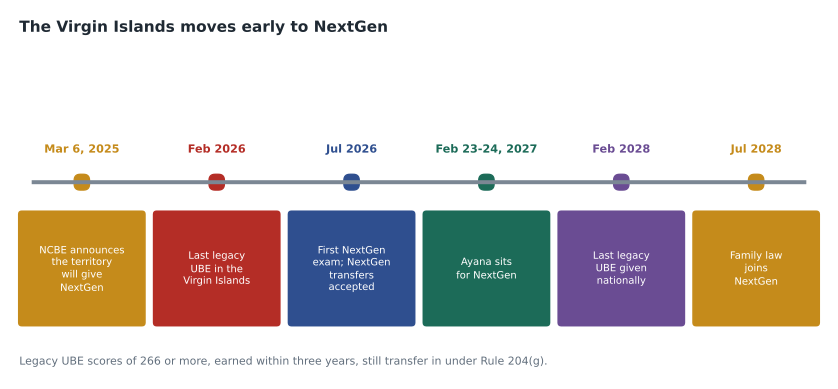
For years the Virgin Islands gave the Uniform Bar Examination, the national exam made up of the Multistate Bar Examination, the Multistate Essay Examination and the Multistate Performance Test. On March 6, 2025, NCBE announced that the Supreme Court of the Virgin Islands intended to replace the UBE with the NextGen bar exam beginning in July 2026.
The territory followed through. NCBE's jurisdiction summary lists February 2026 as the final Virgin Islands administration of the legacy UBE and July 2026 as the first administration of the NextGen exam. The Court amended Rule 204 to define the Virgin Islands Bar Examination as the components of the NextGen exam and to set the 616 passing score.
That made the Virgin Islands one of the first jurisdictions in the country to give NextGen, in the inaugural national administration in July 2026. Many states will not switch until July 2027 or July 2028, and several have not yet set a date. The territory's small number of applicants made an early move practical.
How the legacy exam and NextGen compare
The legacy UBE and NextGen test many of the same subjects, but they test them differently.
The legacy exam was divided by instrument. The MBE was a day of 200 multiple-choice questions on seven subjects. The MEE was six 30-minute essays, graded by each jurisdiction. The MPT was two 90-minute performance tests. The three were weighted 50, 30 and 20 percent and combined into a score on a 400-point scale.
NextGen mixes question types within each session. It adds integrated question sets that test doctrine and skills together, includes research-based performance tasks, and reduces the amount of memorized law. NCBE grades the written answers centrally. The score is reported on a new 500 to 750 scale, which cannot be converted directly into a legacy UBE score.
The legacy MEE also changed near the end. NCBE removed conflict of laws, family law, trusts and estates and secured transactions from the MEE starting in July 2026, to align it with NextGen. That change affected candidates in states still giving the legacy exam; it did not affect Virgin Islands candidates, who by then sat for NextGen.
| Feature | Legacy UBE | NextGen |
|---|---|---|
| Last or first Virgin Islands administration | Last: February 2026 | First: July 2026 |
| Structure | MBE, MEE and MPT on separate parts of the exam | Three sessions mixing multiple choice, integrated sets and performance tasks |
| Length | Two full days | A day and a half |
| Grading of written work | By each jurisdiction | Centrally by NCBE |
| Score scale | 400-point scale | 500 to 750 |
| Virgin Islands score | 266 minimum for legacy transfer | 616 to pass |
Transfer of legacy scores
The change does not wipe out legacy scores. Under Rule 204(g), the Virgin Islands accepts a legacy UBE score earned in another United States jurisdiction if the score is at least 266 and was earned no more than three years before the application. A lawyer who passed the legacy UBE in, say, New York in July 2025 with a 280 may transfer that score to the territory until mid-2028, provided the other requirements are met.
The same rule accepts NextGen scores earned elsewhere. A NextGen score transfers if it meets the Virgin Islands passing score of 616, was earned no more than three years earlier, and the applicant holds an ABA-approved degree. NCBE's chart notes that the territory began accepting transferred NextGen scores with the July 2026 administration.
The territory does not accept a transferred MBE score by itself. Rule 204(g) states that MBE scores from another jurisdiction, or from a prior Virgin Islands administration, are not accepted. Under the old system some states let candidates carry a strong MBE score forward to a later exam; the Virgin Islands never did, and with NextGen the point is moot for local candidates.
Transfer out of the territory
A Virgin Islands NextGen score can be used elsewhere, but only in jurisdictions that accept NextGen scores and only if the score meets their minimum. A candidate who passes in the Virgin Islands with a 618 has passed here but would not meet a 620 requirement in a state that has set that score. Candidates who expect to practice on the mainland as well should check NCBE's table of NextGen jurisdictions and their score requirements.
There is a further wrinkle during the transition. Many states still give the legacy exam and have not yet decided whether, or from when, they will accept NextGen scores. A candidate hoping to transfer a Virgin Islands score to such a state may have to wait or sit again.
What the change means for studying
Marchetti gives NextGen candidates three pieces of advice.
First, study from NextGen materials. NCBE publishes a content scope that lists the tested topics for each period, an official examinees' guide, sample questions and study aids, and the Court's admission page links to them. Legacy MBE question banks are still useful for drilling doctrine, but a candidate who prepares only with legacy materials will be surprised by integrated sets and research tasks.
Second, practice the skills. A performance task rewards a candidate who reads a file carefully, identifies what the client needs, finds the governing rule in the library and writes clearly. Those habits come from practice, not memorization.
Third, use the right content scope. NCBE's content scope can change from one period to the next. For a February 2027 sitting, the Court points candidates to the content scope and examinees' guide covering July 2026 through February 2027. Candidates sitting later should check for updates; family law, for example, joins the tested concepts in July 2028.
Ayana built her schedule around those points: ten weeks of doctrine review with NextGen-aligned materials, three full practice sessions under time limits, and a performance task every week. She kept a list of rules she had misremembered and reviewed it every Sunday.
Worked problem
Choosing between transfer and sitting in the territory
Sylvester Harrigan grew up on St. Thomas and graduated in May 2026 from an ABA-approved school in New York. He is working in New York and can sit for New York's legacy UBE in February 2027, which New York will give until it moves to NextGen in July 2028. He plans to return home in 2028. Should he sit in New York and transfer, or sit in the Virgin Islands?
Show solution
- Transfer rule: a legacy UBE score of at least 266, earned within three years, transfers to the Virgin Islands under Rule 204(g).
- Timing: a February 2027 score could transfer until early 2030.
- Other requirements: he would still need the Law Component, the MPRE score of 75 within the window, character review and the interview.
- Alternative: sitting for NextGen in the Virgin Islands avoids the transfer step but requires travel and a different exam format.
Answer: Either route can work. If Sylvester will practice in New York first, sitting there and transferring a score of 266 or higher within three years is sensible; he should plan the Law Component and character process well before the three years run.
Common mistakes
MistakeThe Virgin Islands will switch to NextGen in 2028 with most states.
InsteadIt gave its first NextGen exam in July 2026, after its last legacy UBE in February 2026.
MistakeLegacy UBE scores can no longer be used in the Virgin Islands.
InsteadLegacy scores of 266 or higher, earned within three years, still transfer under Rule 204(g).
MistakeA strong MBE score can be carried to a later Virgin Islands exam.
InsteadTransferred MBE scores are not accepted, from other jurisdictions or prior Virgin Islands exams.
MistakeA NextGen score of 616 passes everywhere.
InsteadEach jurisdiction sets its own score; some require 620.
MistakeLegacy MBE question banks are enough preparation.
InsteadNextGen adds integrated sets and research tasks; candidates should study with NextGen materials and the current content scope.
Why jurisdictions moved to NextGen
NCBE developed the NextGen exam after a multi-year study of what new lawyers actually do in their first years of practice. That research found that newly licensed lawyers spend much of their time on tasks such as researching and analyzing law, writing, interviewing clients and managing their matters, and comparatively little time recalling detailed rules from memory. The new exam reflects that finding. It tests fewer subjects in less depth, provides more of the law within the questions, and asks candidates to use legal skills on realistic tasks.
For a small jurisdiction, the change also had practical advantages. Central grading by NCBE relieves the Committee of grading essays itself, and a single national score scale makes it easier for lawyers to move between jurisdictions that have adopted the exam. The territory's early adoption meant that its candidates were among the first anywhere to sit for the new format.
Advice for repeat takers
A candidate who sat for the legacy UBE in the Virgin Islands before the change and did not pass now faces a different exam. The doctrine overlaps, but the question types do not. Marchetti advises repeat takers to start with a NextGen diagnostic rather than resuming where they left off, to spend extra time on performance tasks and integrated sets, and to drop topics that NextGen does not test, such as subjects removed from the content scope.
A repeat taker who passed the legacy UBE elsewhere with a score of 266 or more, but has not yet been admitted in the Virgin Islands, should watch the three-year clock. Once it runs, the score can no longer be transferred, and the candidate would have to sit for NextGen.
Watching for changes
The transition is not finished nationally. NCBE continues to publish updated content scopes, examinees' guides and lists of jurisdictions with their first administration dates, passing scores and score-transfer policies. Some states have not yet announced their NextGen passing scores. A Virgin Islands candidate who hopes to transfer a score to another jurisdiction, or a lawyer elsewhere hoping to transfer into the territory, should check NCBE's current tables and the receiving jurisdiction's rules shortly before applying, rather than relying on information from a year earlier.
How Ayana's group used the change
In Marchetti's online study group, Ayana was one of only a few members sitting for NextGen in February 2027; most of the others were sitting for legacy exams in states that had not yet switched. That turned out to be useful. Ayana took the performance-task practice the others did for the MPT and adapted it to the NextGen format, and the others drilled NextGen-style integrated questions with her because they found them a good test of whether they truly understood a rule. Marcus Bell, who had passed Missouri's first NextGen exam in July 2026, joined two of her sessions to describe the pacing of the real thing.
The lesson for any candidate during a transition is to find out exactly which exam you will take, gather materials designed for it, and ignore advice that was written for the other one.
A note on score comparisons
Candidates sometimes try to convert a legacy UBE score into a NextGen score, or compare the territory's old and new passing scores, to judge whether the new exam is harder. The exams measure different things in different ways, and no simple formula turns one score into the other. For a Virgin Islands candidate, the only number that matters is 616 on the NextGen scale. For a lawyer transferring an older score into the territory, the only number that matters is 266 on the legacy scale, earned within three years. Comparing them across exams adds anxiety without adding information.
Summary and key terms
- NCBE announced on March 6, 2025 that the Virgin Islands would give NextGen from July 2026.
- The territory's last legacy UBE was February 2026; its first NextGen exam was July 2026.
- NextGen mixes question types, grades written work centrally and reports scores from 500 to 750.
- Legacy UBE scores of 266 and NextGen scores of 616, earned within three years, transfer in; MBE scores do not.
- Candidates should study with NextGen materials and the content scope for their administration.
- 0
- legacy UBE
- 1
- NextGen
- 2
- MBE
- 3
- MEE
- 4
- MPT
- 5
- content scope
- 6
- score transfer
- 7
- transition period
- 8
- centrally graded
- 9
- examinees' guide
Practice problems
Work each problem on paper first, then reveal the answer to check.
When did the Virgin Islands give its first NextGen exam?
Show answer
July 2026, after its last legacy UBE in February 2026.
What legacy UBE score does the Virgin Islands accept for transfer, and how old may it be?
Show answer
At least 266, earned no more than three years before the application.
Does the territory accept a transferred MBE score?
Show answer
No. MBE scores from other jurisdictions or prior Virgin Islands exams are not accepted.
Which content scope should a February 2027 candidate use?
Show answer
NCBE's content scope and examinees' guide for the July 2026 through February 2027 period, as linked by the Court.
Lesson quiz · 5 questions
Score 60% or more to complete this lesson.
Create a free account to save your progress, take quizzes and earn a certificate.