
BAR-255 · Lesson 6 of 12 · 19 min
The Virgin Islands Law Component
▶ Video coming soon A video version of this lesson is on the way.
Ayana received her Notice of Registration Eligibility from the Office of Bar Admissions a few days after her application was complete. It meant she could now register for the Virgin Islands Law Component. She printed the Court's outline of Virgin Islands law, all of it, and put it in a binder with colored tabs: government, legal profession, practice, administrative law, business associations, domestic relations, wills. 'It is open book,' she told Marchetti. 'How hard can it be?' Marchetti said, 'Ninety minutes, fifty questions, no going back. You will find out.'
This lesson explains what the Law Component is, who must take it, when and how it is given, the subjects it covers, the passing score and how to prepare, and how to keep Virgin Islands law separate from the general law tested on the NextGen exam.
What the Law Component is
The Virgin Islands Law Component, often abbreviated VILC, is the territory's own test of local law. Rule 204(e) lists it as one of the four components of regular admission, alongside the bar exam, the MPRE and the character examination. The Court's VILC page explains that the requirement has applied to all applicants for regular admission since January 1, 2018.
The Committee of Bar Examiners develops the test, and Rule 204 allows it to seek the help of the Virgin Islands Bar Association in doing so. NCBE does not write or grade it.
The Law Component is separate from the NextGen exam. It is given on different dates, through different software, and graded separately. Passing one does not count toward the other.
Who must take it
Every applicant for regular admission must pass the Law Component. That includes applicants admitted by examination, by NextGen or legacy score transfer, and on motion. Rule 204(j) lists completion of the Law Component among the requirements for motion admission, and the Court's regular admission overview lists it as a requirement for all regular admission. Pro hac vice and special admission applicants are governed by other rules.
When and how it is given
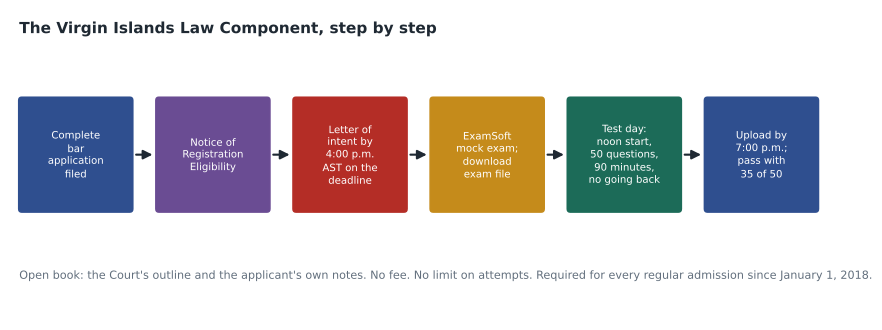
An applicant may take the Law Component only after filing a complete application and before admission. Rule 204(i) states that sequence. In practice, the Office of Bar Admissions sends the applicant a Notice of Registration Eligibility, and only then can the applicant register.
The test has been offered four times a year, in March, June, September and December, and the Court posts the dates for each year. To register, the applicant files a letter of intent electronically through the Judiciary's filing system during the registration period, naming the specific test date. Filings are due by 4:00 p.m. Atlantic Standard Time on the deadline, and the Court's page says deadlines are not extended.
The test is online and open book. The Committee uses ExamSoft software, and applicants must complete a mock exam beforehand and download a fresh exam file before each test date. On test day the exam password is released at 11:45 a.m. and the exam begins at noon, Atlantic Standard Time. Applicants have 90 minutes to answer 50 multiple-choice questions. Backward navigation is not allowed, so an applicant cannot skip ahead and return to a question. After finishing, the applicant must upload the exam file to ExamSoft by 7:00 p.m. that day; an applicant who misses the upload deadline receives a score of zero and must retake the test.
The passing score and retakes
The passing score is 70 percent, or 35 of the 50 items. There is no limit on attempts; an applicant who does not pass registers again for a later date. There is no fee for the Law Component.
Rule 204(h) sets a broader time limit that affects planning. A bar exam result more than three years old is not acceptable for admission, and an applicant who is not admitted within three years of passing the bar exam must retake the entire exam. An applicant who keeps failing the Law Component, or who delays taking it, could run out that clock.
The subjects
The Court lists seven subject areas for the Law Component. Each is covered in the Court's outline, which the Court publishes on its website and describes as a study aid, not a treatise or an exhaustive statement of the law.
Virgin Islands government and constitutional law covers the territory's status, the Revised Organic Act of 1954, the branches of the territorial government, the extension of federal constitutional rights and the relationship with the federal government. Lesson 7 covers this material.
The legal profession covers the admission rules, the integrated bar, the Rules of Professional Conduct and the disciplinary system. Lessons 1 through 3 and 11 cover this material.
Virgin Islands practice covers the court system, the court rules, jurisdiction, the territory's approach to common law under the Banks analysis and practical matters of litigating in the territory. Lessons 7 and 8 cover much of it.
Administrative law covers how territorial agencies make rules and decisions and how those decisions are reviewed.
Business associations covers Virgin Islands corporations, limited liability companies and partnerships under Title 13 of the Virgin Islands Code.
Domestic relations covers marriage, divorce, support and custody under Title 16. Lesson 10 covers the main rules.
Wills covers the execution, validity and probate of wills and the administration of estates under Title 15. Lesson 10 covers the main rules.
| Law Component subject | Where this course covers it |
|---|---|
| Virgin Islands government and constitutional law | Lesson 7 |
| Legal profession | Lessons 1 to 3 and 11 |
| Virgin Islands practice | Lessons 7 and 8 |
| Administrative law | This lesson and the Court's outline |
| Business associations | This lesson and the Court's outline |
| Domestic relations | Lesson 10 |
| Wills | Lesson 10 |
Preparing for an open-book test
An open-book test is not an easy test. Fifty questions in 90 minutes allows less than two minutes per question, and an applicant who must search the outline for every answer will run out of time. The no-backward-navigation rule makes it worse: a question skipped is a question lost.
Marchetti's approach for Ayana had four parts. First, read the whole outline once, quickly, to see its structure. Second, read it again carefully and build a one-page index of where each topic sits, by page or tab. Third, write short notes on the points most likely to be tested: the structure of the courts, the Banks factors, the admission requirements, the grounds and residence rule for divorce, the formal requirements for a will. Fourth, practice answering questions with a timer, using her own questions written from the outline.
The outline and the applicant's own notes may be used during the test, so the notes are part of the preparation. Ayana's notes ran to twelve pages. She tabbed them to match the outline and kept a single summary page on top.
Ayana also planned her test-day setup with the same care she gave the NextGen exam: a quiet room at the firm reserved for the afternoon, a wired internet connection, a charged laptop and a calendar reminder at 6:00 p.m. to upload her file. 'If you miss the upload, you get a zero,' Marchetti said. 'Nobody wants to retake an exam because of a button.'
Keeping Virgin Islands law separate from NextGen
The NextGen exam tests general law. The Law Component tests Virgin Islands law. A candidate who studies both at the same time must keep them apart.
Consider negligence. On the NextGen exam, a question on a plaintiff's own negligence is answered using the generally accepted rules described in the question or in NCBE's content scope. On the Law Component, a question may ask about the Virgin Islands comparative negligence statute and its particular rule. The same is true for divorce: the NextGen exam does not test family law until July 2028, and when it does it will test general principles, while the Law Component tests the Virgin Islands grounds and residence requirement.
The Banks analysis adds a twist. In the Virgin Islands, many common-law questions are decided by the territory's courts weighing local precedent, majority rules elsewhere and the best rule for the territory. A Virgin Islands lawyer therefore often begins with the majority rule, which is what the NextGen exam tests, and then asks whether a Virgin Islands court has adopted something different. Lesson 8 explains the method.
Worked problem
Planning the Law Component around the bar exam
Leroy Matthias files his application on November 20, 2026 for the February 2027 NextGen exam. He receives a Notice of Registration Eligibility in early December. He wants to take the Law Component only after he passes the bar exam, in case he fails. Is that sensible?
Show solution
- Timing rule: the Law Component may be taken after a complete application is filed and must be passed before admission.
- Results: bar results arrive within ten weeks, around early May 2027.
- Risk of waiting: if he waits, admission is delayed until he passes the Law Component on a later date, and missing an upload or a deadline delays it further.
- Clock: Rule 204(h) requires admission within three years of passing the bar exam.
Answer: Waiting is permitted but delays admission. Many applicants take the Law Component before the bar exam, or soon after, so that admission can follow promptly once bar results arrive.
Common mistakes
MistakeOnly exam applicants take the Law Component.
InsteadAll regular admission applicants must pass it, including score transfer and motion applicants.
MistakeThe Law Component is part of the NextGen exam.
InsteadIt is a separate online test written by the Committee and given on its own dates.
MistakeAn open-book test needs little preparation.
InsteadFifty questions in 90 minutes with no backward navigation requires a well-indexed outline and practice.
MistakeAn applicant can return to skipped questions.
InsteadBackward navigation is not allowed.
MistakeThe upload can be done the next morning.
InsteadThe file must be uploaded by 7:00 p.m. on test day, or the score is zero.
Administrative law and business associations
Two of the seven subjects are not covered elsewhere in this course, so a candidate should give them particular attention in the Court's outline.
Administrative law on the Law Component focuses on how territorial agencies act and how their actions are challenged. Candidates should understand how agencies adopt rules, what procedures they must follow when deciding individual cases, how a person aggrieved by an agency decision seeks review, which court hears that review, and how much deference the reviewing court gives the agency's findings. Licensing, permitting and benefits decisions are common examples in a small territory where many daily activities require government approval.
Business associations on the Law Component focuses on Virgin Islands entity law in Title 13 of the Virgin Islands Code: how corporations, limited liability companies and partnerships are formed and registered, the duties of directors, officers, managers and partners, how owners are protected from personal liability and when that protection is lost, and how entities are dissolved. The territory has long been used for incorporating businesses that operate elsewhere, so questions may also touch on registration requirements and the role of the Office of the Lieutenant Governor, which keeps the territory's business records.
Making the outline usable
Ayana's index of the outline fit on one page. Down the left side she listed every topic she expected to see; next to each, the tab and page where it appeared, and a two- or three-word reminder of the key point. During her timed practice sets, she found that she reached for the index on almost every question for the first week and on fewer than half by the third. That is the goal: an open-book test rewards the candidate who rarely needs the book.
A sample question in the style of the Law Component
The following question is original and illustrates the format. A lawyer passed the NextGen exam in Missouri in July 2026 with a score above 616 and was admitted there. She applies to the Virgin Islands by NextGen score transfer. Which statement is correct? (A) She must sit for the NextGen exam on St. Thomas. (B) She must pass the Virgin Islands Law Component before admission. (C) She is exempt from the MPRE because she is already admitted in Missouri. (D) She may begin practicing as soon as her application is accepted. The answer is (B): every applicant for regular admission must pass the Law Component, and transferred scores do not excuse the MPRE or the other requirements.
Summary and key terms
- The Virgin Islands Law Component is the Committee's own online, open-book, multiple-choice test of local law, required since January 1, 2018.
- Every applicant for regular admission must pass it, after filing a complete application and before admission.
- It has 50 questions in 90 minutes, no backward navigation, and a passing score of 70 percent (35 of 50); there is no fee and no attempt limit.
- Applicants register by letter of intent through the filing system and must upload the exam file by 7:00 p.m. on test day.
- Subjects: government and constitutional law, legal profession, practice, administrative law, business associations, domestic relations and wills.
- 0
- Virgin Islands Law Component
- 1
- Notice of Registration Eligibility
- 2
- letter of intent
- 3
- open-book exam
- 4
- ExamSoft
- 5
- backward navigation
- 6
- outline
- 7
- passing percentage
- 8
- Rule 204(h)
- 9
- local law
Practice problems
Work each problem on paper first, then reveal the answer to check.
How many questions does the Law Component have, and how long do applicants have?
Show answer
Fifty multiple-choice questions in 90 minutes.
What is the passing score?
Show answer
Seventy percent, or 35 of 50 correct.
What happens if an applicant fails to upload the exam file by 7:00 p.m.?
Show answer
The applicant receives a score of zero and must retake the test.
Which seven subjects does the Law Component cover?
Show answer
Virgin Islands government and constitutional law, legal profession, Virgin Islands practice, administrative law, business associations, domestic relations and wills.
Lesson quiz · 5 questions
Score 60% or more to complete this lesson.
Create a free account to save your progress, take quizzes and earn a certificate.