
BAR-255 · Lesson 12 of 12 · 17 min
Capstone: U.S. Virgin Islands practice questions and an exam-day plan
▶ Video coming soon A video version of this lesson is on the way.
On Sunday, November 22, 2026, Ayana and Marchetti held their last long session before Ayana's final weeks of study. Marchetti had prepared ten short questions on the admission rules and a memo problem on Virgin Islands law, all original, and an exam-day checklist. 'Treat it like the real thing,' she said. 'Timer on. Then we talk.' Ayana answered the ten questions in twelve minutes and spent forty minutes on the memo. This lesson reproduces the session.
The capstone has three parts: short questions on admission, an original practice problem answered in memo form, and an exam-day plan for the February 2027 NextGen exam and the Law Component.
Part one: ten short questions
Answer each question in a sentence or two, then compare your answer with the explanation that follows.
Question 1. An applicant files her application for the February 2027 exam at 9:00 a.m. on December 2, 2026. What happens? Answer: it is rejected. Rule 204(c)(1) requires filing by December 1, and Rule 204(c)(2) provides that late applications are rejected. She may apply for the July 2027 exam by May 1, 2027.
Question 2. An applicant's Virgin Islands application is accepted on a Tuesday morning. When must the NCBE character materials be filed? Answer: within 24 hours, so by Wednesday morning, in the same pending matter.
Question 3. An applicant scored 76 on the MPRE in November 2023 and passes the NextGen exam in July 2027. Does the MPRE score count? Answer: no. The MPRE must be taken no earlier than three years before the administration in which the applicant passes. Three years before July 2027 is July 2024, and November 2023 is earlier.
Question 4. What score must an applicant reach on the Virgin Islands NextGen exam? Answer: 616, under Rule 204(f).
Question 5. An applicant's laptop battery fails in the second session. Can she get extra time? Answer: no. Rule 204(c) provides no extra time for technical failures.
Question 6. A lawyer passed the legacy UBE in Colorado in February 2025 with a 272. Can he transfer the score in 2027? Answer: yes, if he applies within three years of earning it. A legacy score of at least 266 transfers under Rule 204(g). He must still pass the Law Component, meet the MPRE requirement and complete the character examination and interview.
Question 7. How many questions are on the Law Component, how long is it, and what is the passing score? Answer: 50 questions in 90 minutes, with a passing score of 70 percent, or 35 correct.
Question 8. A lawyer has practiced in Georgia for six of the last seven years after passing the Georgia bar exam. What else must be true for admission on motion? Answer: she must hold an ABA-approved degree, Georgia must admit Virgin Islands lawyers on motion without examination, she must be in good standing everywhere with no pending discipline, she must show good character, and she must pass the Law Component.
Question 9. A new lawyer receives notice of eligibility on March 1. By when must she take the oath? Answer: within 90 days of the notice, under Rule 204(i), so by the end of May.
Question 10. Can a failing applicant ask the Committee to regrade a performance task? Answer: no. Applicants cannot see their answers or obtain regrading or other review, under Rule 204(f).
Ayana missed one: she answered question 3 as yes, forgetting that the window counts back from the exam she passes, not the one she first takes. Marchetti made her write the rule on an index card.
Part two: a practice problem
The following problem is original and the facts are invented. Read it, then write a short memo applying Virgin Islands law.
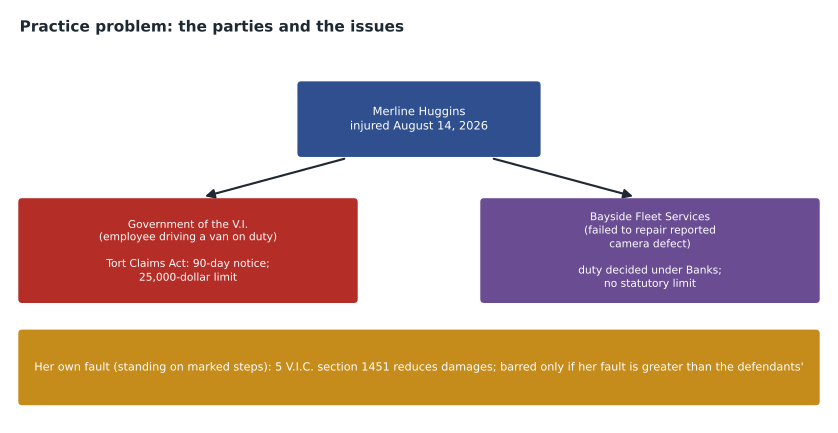
Merline Huggins owns a small guesthouse in Frederiksted. On August 14, 2026, a territorial government employee, driving a Department of Health van to a scheduled site visit, backed into the guesthouse's front steps while Merline was standing on them. She fell and broke her wrist. She had been standing on the steps rather than the sidewalk, which a sign asked guests to use while the steps were being painted, though she owns the guesthouse and put up the sign herself. Her medical bills and lost income total 48,000 dollars. The van's backup camera, installed by a private contractor, Bayside Fleet Services, had been malfunctioning for weeks, and the Department had reported the problem to Bayside twice without a repair. Merline consulted a lawyer on November 18, 2026. She asks whether she can recover her losses, from whom, and what she must do now.
A model answer
MEMORANDUM. To: Hyacinth Petersen. From: Ayana Liburd. Re: Merline Huggins, injury claim. Date: November 23, 2026.
Question presented. Can Ms. Huggins recover her losses from the Government of the Virgin Islands and Bayside Fleet Services, and what must she do now?
Short answer. Probably yes, against both, but recovery from the Government is limited to 25,000 dollars and depends on a notice of intention filed promptly. Her own conduct may reduce her recovery but is unlikely to bar it. Bayside's liability is a common-law question that may require a Banks analysis.
Claim against the Government: rule. The Virgin Islands Tort Claims Act waives the Government's immunity for injury caused by the negligent or wrongful act or omission of an employee acting within the scope of employment, where a private person would be liable. A claim or notice of intention must be filed within ninety days after the claim accrues, and a judgment against the Government may not exceed 25,000 dollars under 33 V.I.C. section 3411(c).
Application. The driver was on a scheduled site visit, so he was acting within the scope of employment. A private driver who backed into a person without looking would be liable for negligence, and the Department's decision to keep using a van with a known defective camera is further evidence of negligence. The claim accrued on August 14, 2026. Ninety days ran on November 12, 2026, six days before she consulted us. The notice deadline appears to have passed. We should immediately review whether the Act permits late notice on application and a showing of reasonable excuse, gather facts supporting an excuse, and file the application without delay. If late notice is not allowed, the claim against the Government is lost, but the claim against Bayside is not affected.
Comparative negligence: rule. Under 5 V.I.C. section 1451, a plaintiff's negligence bars recovery only if it is greater than the negligence of the parties against whom recovery is sought; otherwise damages are reduced in proportion to her fault.
Application. Ms. Huggins stood on steps she had marked for guests to avoid. A factfinder could assign her some fault, but backing a van into a person standing on visible steps is the more serious lapse. Her fault is unlikely to be greater than the combined fault of the driver, the Department and Bayside, so her recovery would be reduced, not barred.
Claim against Bayside: rule. Whether a contractor that maintains a vehicle owes a duty to a pedestrian injured when the vehicle's defective safety equipment contributes to an accident is a common-law question. If no Supreme Court of the Virgin Islands decision answers it, the court will conduct a Banks analysis, weighing prior Virgin Islands decisions and reliance, the majority rule elsewhere and the soundest rule for the territory.
Application. We should research Virgin Islands decisions on contractors' duties to third parties, survey how other jurisdictions treat a maintenance contractor's duty to foreseeable third parties when it fails to repair a reported safety defect, and argue that imposing a duty is the soundest rule for a territory where government vehicles are maintained by private firms. Bayside is not protected by the Tort Claims Act's limit, so it is the more important source of recovery for her 48,000 dollars in losses. The two-year limitations period for personal injury runs to August 2028, but we should file well before then.
Recommendation. Act on the notice issue this week. Investigate Bayside's maintenance records and the Department's repair requests. Prepare a Banks analysis on Bayside's duty. Advise Ms. Huggins that her own conduct may reduce her recovery.
Marchetti's comments on Ayana's memo were short. 'Good: you caught the notice date and did the arithmetic. Good: you separated the two defendants. Better: tell the partner in the first line that the deadline may have passed. That is what she needs to know first.'
Part three: the exam-day plan
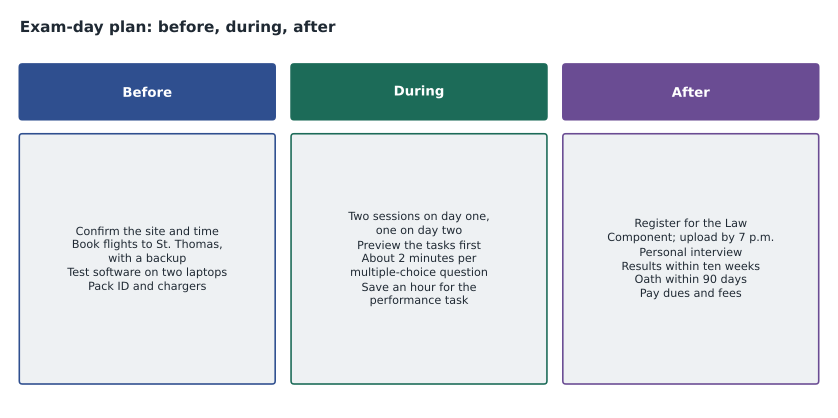
Ayana's plan for the February 2027 exam had three parts: before, during and after.
Before. Confirm the exam location and reporting time from the Committee's notice. Book flights to St. Thomas for Monday, February 22, with a backup option, and a hotel near the test site. Install and test the NCBE software on her laptop and her backup laptop; bring two chargers. Review the permitted-items list. Pack identification, the admission ticket and snacks. Sleep.
During. Day one has two three-hour sessions, day two one. In each session, glance at the performance task and integrated sets first, then pace the multiple-choice questions at about two minutes each, saving roughly an hour for the performance task. Mark doubtful multiple-choice questions and return to them if time allows. Eat lunch, walk outside, and do not discuss the morning's questions with anyone.
After. Fly home Wednesday afternoon. If the Law Component is still ahead, register by letter of intent for the next date as soon as eligible, complete the ExamSoft mock exam, and set a reminder to upload the file by 7:00 p.m. on test day. Watch for the personal interview notice. Expect results within ten weeks. Prepare for the oath and bar dues.
| When | Task |
|---|---|
| By December 1, 2026 | File application (done November 16); NCBE character materials within 24 hours of acceptance |
| By January 1, 2027 | Accommodation requests, if any |
| January 2027 | Software tested on both laptops; travel booked |
| February 22, 2027 | Travel to St. Thomas |
| February 23 and 24, 2027 | NextGen exam: two sessions on day one, one on day two |
| Next available date | Law Component, if not already passed; upload by 7:00 p.m. |
| Within ten weeks | Results; then certification, oath within 90 days, dues and fees |
Final advice
Marchetti ended the session with a list she gives every candidate, adjusted for the territory. Know your rule. File early. Have the NCBE report ready before you file. Check your MPRE window. Study NextGen with NextGen materials. Index the Law Component outline. Practice the upload. Book two ways to get to St. Thomas. And when the results come, read the email twice before you celebrate, then celebrate.
Common mistakes
MistakeThe MPRE window counts back from the first exam an applicant takes.
InsteadIt counts back from the administration in which the applicant passes.
MistakeA memo should save the bad news for the end.
InsteadPut urgent issues, such as a missed notice deadline, at the top.
MistakeA claim against a government contractor is subject to the 25,000-dollar limit.
InsteadThe Tort Claims Act limit applies to judgments against the Government, not private contractors.
MistakeExam-day planning can wait until the week before.
InsteadFlights, hotels, software and backup equipment should be arranged weeks in advance.
MistakePassing the NextGen exam completes admission.
InsteadApplicants must also pass the Law Component, complete the interview and take the oath.
Debrief
After the session, Ayana wrote down three things she would do differently. First, she would read the date of every event in a fact pattern and do the deadline arithmetic before anything else, because the notice issue in the memo problem was the most important point and the easiest to miss. Second, she would separate defendants at the start of the analysis, because each one raised different law. Third, on the short questions, she would slow down on any question involving a time window and write the dates out.
Marchetti added one more. 'You knew the law. What will cost you points is reading too fast. On the NextGen exam and on the Law Component, the facts are written carefully. Every date and every number is there for a reason.'
Summary and key terms
- The short questions review deadlines, the 24-hour character filing, the MPRE window, the 616 score, technical failures, score transfer, the Law Component, motion, the oath and the no-review rule.
- The practice problem combines the Tort Claims Act notice and limit, comparative negligence under section 1451 and a Banks analysis of a contractor's duty.
- A good memo leads with urgent issues and separates defendants.
- The exam-day plan covers travel to St. Thomas, software and backup equipment, pacing across three sessions and the steps after the exam.
- 0
- capstone
- 1
- practice problem
- 2
- memo
- 3
- question presented
- 4
- short answer
- 5
- notice deadline
- 6
- comparative fault
- 7
- Banks analysis
- 8
- exam-day plan
- 9
- pacing
Practice problems
Work each problem on paper first, then reveal the answer to check.
In the practice problem, when did the Tort Claims Act notice period run?
Show answer
Ninety days after August 14, 2026, on November 12, 2026.
Why is Bayside Fleet Services important to Ms. Huggins's recovery?
Show answer
Because the 25,000-dollar limit applies only to the Government; a private contractor's liability is not capped by the Act.
What is the first thing a memo on this problem should tell the supervising partner?
Show answer
That the Tort Claims Act notice deadline appears to have passed and requires immediate action.
What should a candidate pack for the NextGen exam?
Show answer
Identification, the admission materials, a laptop with tested software, a backup if possible, chargers and permitted snacks.
Lesson quiz · 5 questions
Score 60% or more to complete this lesson.
Create a free account to save your progress, take quizzes and earn a certificate.