
BAR-255 · Lesson 10 of 12 · 19 min
Virgin Islands family law, wills and estates
▶ Video coming soon A video version of this lesson is on the way.
Petersen and Ottley handles a steady stream of family and probate work: divorces, child support modifications, wills for retirees and estates that have sat unopened for years because no one knew where to start. In her first month, Ayana drafted a petition for divorce, a simple will for a couple in Estate Grove Place, and a petition to settle a small estate without full administration. She told Marchetti it was the most useful month of her education. 'Nobody tested me on any of it,' she said. 'And I used all of it.'
Domestic relations and wills are both subjects on the Virgin Islands Law Component, and they make up a large share of a general practice in the territory. This lesson covers the main rules: marriage and divorce, the residence requirement and its history, property, alimony, custody and support, protective orders, and wills, probate and small estates.
Sources of family law
Virgin Islands family law is mainly statutory. Title 16 of the Virgin Islands Code governs domestic relations: marriage, divorce, annulment, alimony, custody, support and protection from domestic violence. The Family Division of the Superior Court hears family cases, and the Superior Court's rules include provisions specific to family matters. Where the statutes leave a question open, the Banks analysis applies, as it does to other common-law questions.
Federal law adds pieces. Interstate child support is governed by a uniform act adopted throughout the United States and its territories, and the federal child support program shapes the territory's enforcement system.
Grounds for divorce
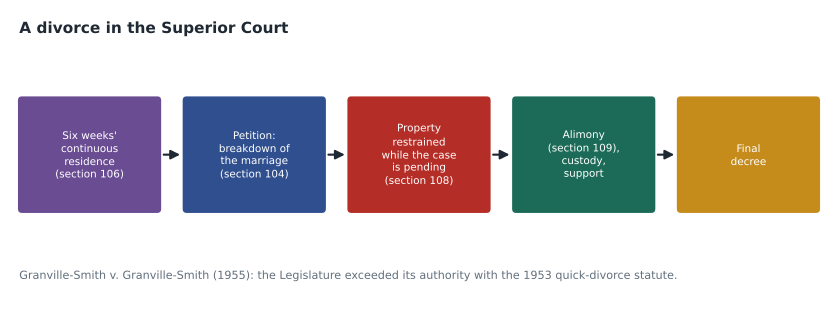
The Virgin Islands is a no-fault divorce jurisdiction. Under 16 V.I.C. section 104, the ground for divorce is a breakdown of the marriage relationship to such an extent that the legitimate objects of matrimony have been destroyed and there remains no reasonable likelihood that the marriage can be preserved. The court does not ask who was to blame for the breakdown, though conduct may matter to other issues such as custody.
Residence and the Granville-Smith history
Under 16 V.I.C. section 106(a), the spouse who files must have been a resident of the Virgin Islands continuously for at least six weeks before filing and must be a resident when the case begins. It does not matter where the couple married.
The six-week rule has a history. In the mid-twentieth century the islands, like Nevada, attracted people seeking quick divorces. In 1953 the Legislature enacted a statute that, in effect, allowed courts to grant divorces to people who had been physically present for six weeks without requiring that they actually make the islands their home. In Granville-Smith v. Granville-Smith, 349 U.S. 1 (1955), the Supreme Court of the United States held that the Legislature had exceeded its authority under the Organic Act in enacting that statute. The decision is a reminder that the territorial Legislature acts under powers granted by Congress, and that genuine residence is the foundation of divorce jurisdiction.
Property
While a divorce is pending, 16 V.I.C. section 108 restrains both spouses from disposing of property. A spouse who sells or hides assets during the case risks sanctions and the unwinding of the transaction.
Virgin Islands law has historically given divorce courts a narrower power over property than the equitable distribution statutes of most states. The statutes address particular kinds of property, notably the marital homestead, rather than giving the court a general power to divide everything the spouses acquired during the marriage, and property held jointly may be divided under ordinary rules of co-ownership. Many couples resolve property by agreement, and the court may approve a settlement. Because the scope of the court's power over property is a frequent source of dispute, a lawyer should read Title 16 and the homestead provisions carefully before advising a client about what a court can award.
Alimony
Under 16 V.I.C. section 109, the court may order alimony in a lump sum, in installments or in other forms. In deciding whether to award alimony and how much, the court considers the circumstances of each spouse, their needs, each spouse's independence and earning capacity, ability to pay, physical condition and the standard of living the couple shared. Evidence of income, expenses, debts and assets is central, and a lawyer preparing an alimony case gathers financial records early.
Custody and support
Custody decisions turn on the best interests of the child. The court considers the child's relationship with each parent, each parent's ability to provide care, the child's needs, any history of domestic violence, and, where the child is old enough, the child's preferences. Joint and sole custody arrangements are both available.
Child support is calculated under guidelines, which set a presumptive amount based on the parents' incomes and the child's needs, subject to adjustment. The territory's child support agency, within the Department of Justice, helps establish paternity and support orders and enforces them, and orders from other jurisdictions are enforced under the uniform interstate act.
Protection from domestic violence
Title 16 also provides civil protective orders for victims of domestic violence. A victim may seek a temporary order on an emergency basis and a longer order after a hearing. Orders can direct the abuser to stay away, leave a shared home, refrain from contact and, in some cases, surrender firearms. Violating an order is a crime. Lawyers handling divorces and custody cases must watch for signs of abuse and know how to obtain protection quickly.
| Issue | Virgin Islands rule | Source |
|---|---|---|
| Ground for divorce | Breakdown of the marriage with no reasonable likelihood it can be preserved | 16 V.I.C. section 104 |
| Residence | Six continuous weeks before filing; resident at filing | 16 V.I.C. section 106(a) |
| Property during the case | Neither spouse may dispose of property | 16 V.I.C. section 108 |
| Alimony | Lump sum or installments; needs, earning capacity, ability to pay, lifestyle | 16 V.I.C. section 109 |
| Custody | Best interests of the child | Title 16 |
| Domestic violence | Temporary and longer protective orders | Title 16 |
Wills
Title 15 of the Virgin Islands Code governs decedents' estates and fiduciary relations. It now contains the Virgin Islands Uniform Probate and Fiduciary Relations Code, which is based on the Uniform Probate Code used in many states. A new lawyer drafting wills or handling estates should read the code's provisions, including its effective-date and transition provisions, because estates of people who died before the code took effect may be governed by earlier law.
A valid will generally must be in writing, signed by the testator, and signed by witnesses who saw the testator sign or acknowledge the will. A will may also be made self-proved by a sworn statement of the testator and witnesses, which simplifies probate. Whether a will written entirely in the testator's handwriting but not witnessed can be valid, and whether a court may excuse a defect in execution, depend on the code's specific provisions, so a lawyer should check them rather than assuming the rule of another jurisdiction.
The Law Component tests wills, so a candidate should know the execution requirements, revocation, the effect of marriage and divorce on a will, and the basic rules for interpreting gifts, as the Court's outline presents them.
Probate and small estates
The Probate Division of the Superior Court handles the probate of wills and the administration of estates. Its procedures are set out in the Superior Court's probate rules, which cover petitions to probate a will, the appointment of a personal representative, notice to heirs and creditors, inventories, accounts and the closing of the estate. The court also has rules for recording a will that was probated in another jurisdiction, which matters in a territory where many people own property on the islands but die elsewhere.
For small estates, the Superior Court offers a simpler procedure for settling an estate without full administration, and it publishes a self-help guide explaining it. A lawyer helping a family with a modest estate should consider that route first.
When a person dies without a will, the intestacy provisions of Title 15 decide who inherits. A surviving spouse and children usually take first, with more distant relatives taking only if closer ones do not survive.
Real property in the territory adds practical issues. Many families hold land that passed informally through several generations without probate, sometimes called heir property, and clearing title can require opening several old estates. A lawyer handling such a matter needs patience, a good title search and careful attention to which law governed each death.
Worked problem
Divorce residence and a will
Anton Weekes moved from Atlanta to St. Thomas on October 1, 2026 to work for a hotel. He wants to file for divorce from his wife, who still lives in Atlanta, on November 6, 2026. He also has a will he signed in Georgia in 2019 that leaves everything to her. Advise him.
Show solution
- Residence: section 106(a) requires six continuous weeks of residence before filing; from October 1 to November 6 is a little over five weeks, so he should wait until at least November 12.
- Ground: he must allege a breakdown of the marriage under section 104; fault is not required.
- Property: once the case is filed, section 108 restrains both spouses from disposing of property.
- Will: he should review whether the Virgin Islands code revokes provisions for a former spouse on divorce, and in any event make a new will now.
Answer: Anton should wait until he has six full weeks of residence before filing, and should make a new will rather than relying on the effect of divorce on his Georgia will.
Common mistakes
MistakeVirgin Islands divorces require proof of fault.
Instead16 V.I.C. section 104 provides a no-fault ground: breakdown of the marriage.
MistakeA person can file for divorce the day after arriving.
InsteadSection 106(a) requires six continuous weeks of residence before filing.
MistakeGranville-Smith upheld the territory's quick-divorce statute.
InsteadThe Supreme Court held in 1955 that the Legislature exceeded its authority in enacting the 1953 statute.
MistakeVirgin Islands courts divide all marital property equitably like most states.
InsteadThe court's power over property is narrower and depends on Title 16 and the homestead provisions; read them carefully.
MistakeEvery estate must go through full administration.
InsteadSmall estates may be settled without full administration under the Superior Court's procedure.
Drafting a simple will
For a client with a modest estate, a simple will usually names a personal representative and an alternate, leaves specific items to named people, leaves the rest of the estate to a spouse or children, names a guardian for minor children, and includes the formal clauses the code requires for execution and self-proving. Ayana's first will, for a retired couple in Estate Grove Place, took her an afternoon to draft and another hour to review with Hyacinth Petersen, who added a clause dealing with what happens if a beneficiary dies before the testator.
Execution is where wills most often fail. Petersen and Ottley follows the same routine for every signing: the client reads the will aloud or confirms each page, signs in front of two disinterested witnesses and a notary, the witnesses sign, and everyone signs the self-proving affidavit. The original goes in the firm's vault, and the client gets a copy marked as a copy. A routine like that avoids most of the disputes that later reach the Probate Division.
Family law and the Law Component
The Law Component's domestic relations questions tend to test the statutory rules covered in this lesson: the ground for divorce, the residence requirement, what the court may order during and after the case, and the standards for custody and support. Candidates should be able to cite the sections of Title 16 by number and should read the outline's treatment of matters this lesson covers only briefly, such as annulment, legal separation and the enforcement of support orders.
Summary and key terms
- Title 16 governs Virgin Islands family law; the Family Division of the Superior Court hears family cases.
- The ground for divorce is breakdown of the marriage (section 104); the filing spouse needs six continuous weeks of residence (section 106(a)).
- Granville-Smith v. Granville-Smith (1955) held the 1953 quick-divorce statute beyond the Legislature's authority.
- Section 108 restrains disposal of property during the case; section 109 governs alimony; custody turns on the child's best interests.
- Title 15 contains the Virgin Islands Uniform Probate and Fiduciary Relations Code; the Probate Division handles estates, with a simpler route for small estates.
- 0
- no-fault divorce
- 1
- breakdown of the marriage
- 2
- residence requirement
- 3
- Granville-Smith v. Granville-Smith
- 4
- alimony
- 5
- best interests of the child
- 6
- protective order
- 7
- Uniform Probate and Fiduciary Relations Code
- 8
- self-proved will
- 9
- settlement without administration
Practice problems
Work each problem on paper first, then reveal the answer to check.
What is the ground for divorce in the Virgin Islands?
Show answer
A breakdown of the marriage to the point that its legitimate objects are destroyed and there is no reasonable likelihood it can be preserved, under 16 V.I.C. section 104.
How long must a spouse reside in the territory before filing for divorce?
Show answer
Six continuous weeks immediately before filing, and the spouse must be a resident when filing (section 106(a)).
What did Granville-Smith v. Granville-Smith decide?
Show answer
That the territorial Legislature exceeded its authority under the Organic Act in enacting a 1953 statute allowing quick divorces without genuine residence.
Which court division handles estates, and is there a simpler route for small estates?
Show answer
The Probate Division of the Superior Court; small estates may be settled without full administration.
Lesson quiz · 5 questions
Score 60% or more to complete this lesson.
Create a free account to save your progress, take quizzes and earn a certificate.