
BAR-255 · Lesson 4 of 12 · 19 min
The Virgin Islands bar exam: NextGen format, scoring and the 616 passing score
▶ Video coming soon A video version of this lesson is on the way.
Ayana will sit for the bar exam on Tuesday and Wednesday, February 23 and 24, 2027, on St. Thomas. She lives on St. Croix, so the exam starts with a trip: a short flight or seaplane hop across the forty miles of open water between the islands, a hotel near the test site, and a return home after the second day. Marchetti wanted to talk about the trip before she talked about the exam. 'Book the flight now. Book a backup. Weather happens.'
This lesson explains what the Virgin Islands bar exam is, how the NextGen exam is structured, how it is scored, what 616 means, and the rules that govern laptops, technical problems, results and review.
What the Virgin Islands bar exam is
Rule 204(e) defines the Virgin Islands Bar Examination as the components of the NextGen Uniform Bar Examination, prepared by NCBE. Since July 2026, the territory has given only the NextGen exam. It is given twice a year, in February and July, on the national dates NCBE sets. The rule provides that the exam is held on St. Thomas and may also be held on St. Croix when enough applicants register there; applicants should not assume a St. Croix site and should check the notice for their administration.
The bar exam is only one component. An applicant for admission by examination must also pass the Virgin Islands Law Component, earn the required MPRE score and complete the character examination and personal interview. Passing the NextGen exam alone does not make anyone a lawyer.
The structure of the NextGen exam
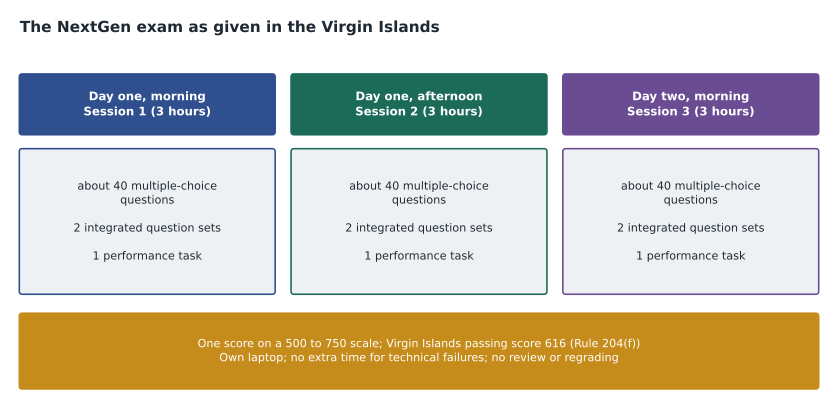
The NextGen exam is given over a day and a half, in three sessions of three hours each. Day one has two sessions, one in the morning and one in the afternoon. Day two has a single morning session.
Each session contains the same three kinds of questions. There are about 40 multiple-choice questions, some with one correct answer and some asking the candidate to select two. There are two integrated question sets, each built around a short fact pattern with a mix of multiple-choice, short-answer and drafting questions. And there is one performance task, in which the candidate works from a file of facts and a library of legal authorities to produce a practical document. Some performance tasks are longer research tasks that count more heavily.
Candidates may answer questions within a session in any order, and they manage their own time across the three question types. NCBE's suggested pacing is roughly two minutes per multiple-choice question, about half an hour for each integrated set, and about an hour for the performance task.
What the exam tests
The NextGen exam tests foundational legal skills and foundational concepts and principles together, rather than testing subjects in isolation. The skills are legal research, legal writing, issue spotting and analysis, investigation and evaluation, client counseling and advising, negotiation and dispute resolution, and client relationship and management.
The concepts and principles come from eight subjects: civil procedure, contract law including Article 2 of the Uniform Commercial Code, evidence, torts, business associations, constitutional law, criminal law and procedure, and real property. Family law joins the list from July 2028. Within those subjects, NCBE's content scope lists the specific topics tested, and some topics are tested only in performance tasks, where the law is provided.
Professional responsibility appears on the NextGen exam as part of the skills, especially client relationship and management, but the MPRE remains a separate requirement in the Virgin Islands.
None of the exam tests Virgin Islands law. A question on negligence, for example, applies generally accepted rules, not the Virgin Islands comparative negligence statute. The Law Component is where local law is tested. Lesson 6 explains how to keep the two apart.
| Element | NextGen exam |
|---|---|
| Length | Three sessions of three hours each over a day and a half |
| Question types | Multiple choice, integrated question sets, performance tasks |
| Subjects (concepts) | Civil procedure, contracts, evidence, torts, business associations, constitutional law, criminal law and procedure, real property; family law from July 2028 |
| Skills | Research, writing, analysis, investigation, counseling, negotiation, client relationship |
| Score scale | 500 to 750 |
| Virgin Islands passing score | 616 |
Scoring and the 616 passing score
NCBE reports a single NextGen score on a scale from 500 to 750. The score combines all three question types. NCBE's blueprint weights them at roughly 49 percent for multiple choice, 21 percent for integrated question sets and 30 percent for performance tasks. Responses that require writing are graded centrally by NCBE using common standards, which is one of the differences from the legacy exam, where jurisdictions graded essays themselves.
Each jurisdiction chooses its own passing score. Rule 204(f) sets the Virgin Islands passing score at 616, and the rule allows the Committee to change it with the Court's approval. In NCBE's tables of NextGen jurisdictions, some states have chosen 610, others 620, and several have not yet announced a score. The Virgin Islands is one of the jurisdictions that has already given the exam and has a fixed score.
The scale is not a percentage. A score of 616 does not mean 616 points out of 750 or any particular percentage of questions answered correctly. NCBE equates scores across administrations, so a 616 in February 2027 reflects the same level of performance as a 616 in July 2026. A candidate cannot predict a score by counting correct answers.
Marchetti reminds her students that 616 is a threshold, not a target. 'You are aiming to be comfortably above it. If your practice scores are near the line, you are not ready yet.'
Laptops and technical problems
The NextGen exam is delivered digitally through a secure testing browser. Rule 204(c) requires applicants to take the exam on their own laptops, and the Court's admission page tells applicants to download and test the software in advance. NCBE offers a free online preview of the exam software, and Ayana used it twice before her first practice exam.
The rule also contains a warning that applicants should take seriously: no extra time is given for technical failures. A laptop that crashes, a battery that dies or a forgotten charger is the applicant's problem. Ayana planned to bring a charger, a spare charger and her firm's backup laptop, already loaded with the software, in case her own failed.
Results and review
The Court's FAQ states that results are sent within ten weeks of the exam. For a February 23 and 24 exam, that means results by early May.
The territory does not allow review of results. Under Rule 204(f), applicants cannot see their answers and cannot ask for regrading or other review. A result is final. A failing applicant's remedy is to apply for the next exam, by the next filing deadline.
The rules do not set a maximum number of attempts. An applicant who does not pass may reapply as often as needed, subject to the ordinary deadlines, fees and character requirements.
Worked problem
Planning around the rules
Ophelia Maddox lives on St. John and works in a law office on St. Thomas. She asks whether she can request extra time if her laptop freezes during the first session, and whether she can see her performance task if she fails.
Show solution
- Technical failures: Rule 204(c) provides that no extra time is given for technical failures.
- Review: Rule 204(f) provides that applicants cannot see their answers and cannot obtain regrading or review.
- Planning: she should test the software in advance, bring backup power and, if possible, a backup laptop.
- If she fails: she reapplies by the next deadline; there is no attempt limit.
Answer: Ophelia cannot get extra time for a technical problem or see her answers. She should prepare her equipment carefully and treat each attempt as final.
Common mistakes
MistakeThe Virgin Islands still gives the legacy UBE with the MBE.
InsteadSince July 2026 the Virgin Islands bar exam consists of the NextGen exam.
MistakeA 616 means about 82 percent of the available points.
InsteadThe NextGen scale runs from 500 to 750 and is equated; it is not a percentage.
MistakeAn applicant can request extra time if the laptop crashes.
InsteadRule 204(c) gives no extra time for technical failures.
MistakeA failing applicant can ask the Committee to regrade an answer.
InsteadRule 204(f) bars viewing answers, regrading and other review.
MistakeThe NextGen exam tests Virgin Islands law.
InsteadIt tests general law and skills; local law is tested on the Virgin Islands Law Component.
Inside a performance task
A performance task gives the candidate a File and a Library. The File contains the facts: a memo from a supervising lawyer explaining the assignment, interview notes, letters, emails, contracts or court papers. The Library contains the law: statutes, regulations and cases, some real and many invented for the task. The candidate's job is to produce what the supervising lawyer asked for, such as an objective memo, a persuasive brief, a client letter, a discovery plan or a draft contract clause, using only the law in the Library.
Three habits separate strong performance task answers from weak ones. First, read the task memo twice and do exactly what it asks, in the format it asks for. Second, read the Library before the File, so that the facts can be read with the governing rules in mind. Third, organize the answer around the legal issues, applying each rule to the specific facts rather than summarizing the cases. Research-based performance tasks add a further step: the candidate must decide which authorities in the Library actually answer the question and explain why the others do not.
Inside an integrated question set
An integrated question set begins with a short fact pattern, often a client situation, followed by several related questions. Some are ordinary multiple-choice questions on doctrine. Others ask the candidate to choose the best next step, draft a short provision, identify missing facts, or explain advice to a client in a few sentences. Because the questions build on the same facts, a careful first reading pays off across the whole set.
Short written answers are graded for substance, not style. A candidate who answers the question asked in two clear sentences scores better than one who writes a paragraph of general law. Ayana practiced by writing answers to sample questions within strict word limits and comparing them with NCBE's sample responses.
Building a study schedule
Marchetti recommends about ten weeks of full-time study for a first-time NextGen candidate, or longer for someone working full time. A typical plan spends the first six weeks reviewing the eight subjects with practice questions after each topic, then four weeks on mixed practice: timed sessions, integrated sets and at least one performance task every week. Two or three full-length simulated sessions under exam conditions, using the NCBE software, help a candidate learn pacing before the real exam.
Ayana worked full time at the firm through December and cut back to half days in January and February, with Hyacinth Petersen's blessing. She studied doctrine before work, did practice questions at lunch, and saved performance tasks for Saturday mornings.
What to bring and what to leave
NCBE and the Committee publish rules about what candidates may bring into the testing room. Candidates should expect to bring their laptop and power cord, identification and their admission materials, and to leave phones, smart watches, notes and bags outside the testing area or in designated storage. Ear plugs, medication and snacks are subject to the published rules. A candidate who brings a prohibited item into the room risks having the exam invalidated, so it is worth reading the permitted-items list twice and packing the night before.
The secure browser locks the laptop while the exam is in progress, so candidates cannot open other programs or files. Before the exam, the laptop must meet NCBE's technical requirements, have enough free storage and a working battery, and have the latest version of the software installed. Candidates who use a work laptop should check in advance that their employer's security software does not interfere with the exam browser.
Summary and key terms
- The Virgin Islands bar exam consists of the NextGen exam, given in February and July on St. Thomas, and possibly on St. Croix.
- The exam has three three-hour sessions over a day and a half, each with multiple choice, integrated question sets and a performance task.
- Scores are reported on a 500 to 750 scale; the Virgin Islands passing score under Rule 204(f) is 616.
- Applicants use their own laptops, and no extra time is given for technical failures.
- Results come within ten weeks; there is no review or regrading, and no attempt limit.
- 0
- NextGen exam
- 1
- integrated question set
- 2
- performance task
- 3
- foundational skills
- 4
- foundational concepts
- 5
- score scale
- 6
- passing score
- 7
- equating
- 8
- secure testing browser
- 9
- regrading
Practice problems
Work each problem on paper first, then reveal the answer to check.
What is the Virgin Islands NextGen passing score, and who may change it?
Show answer
616, under Rule 204(f); the Committee may change it with the Supreme Court's approval.
How long is the NextGen exam?
Show answer
Three sessions of three hours each over a day and a half: two sessions on day one and one on day two.
Can an applicant who fails see the answers they wrote?
Show answer
No. Applicants cannot view their answers or seek regrading or other review.
How soon are results sent?
Show answer
Within ten weeks of the exam, according to the Court's FAQ.
Lesson quiz · 5 questions
Score 60% or more to complete this lesson.
Create a free account to save your progress, take quizzes and earn a certificate.