
BAR-255 · Lesson 11 of 12 · 18 min
Score transfer, admission on motion, the Virgin Islands Bar and the Rules of Professional Conduct
▶ Video coming soon A video version of this lesson is on the way.
Not everyone in Ayana's office came to the bar the way she is coming. Eldon Ottley passed the Virgin Islands exam in 2019. Hyacinth Petersen was admitted decades ago after years of practice in New York. And the firm's newest associate, Keziah Huntley, who started in October, is not a lawyer yet at all in the territory: she passed the NextGen exam in another jurisdiction in July 2026 and is transferring her score. Each route has its own rules, and each ends in the same place, with an oath, a certificate and a bill for bar dues.
This lesson covers the score transfer and motion routes, limited forms of admission, the steps from certification to the oath, the integrated Virgin Islands Bar, continuing legal education and the Rules of Professional Conduct that govern every Virgin Islands lawyer.
Admission by score transfer
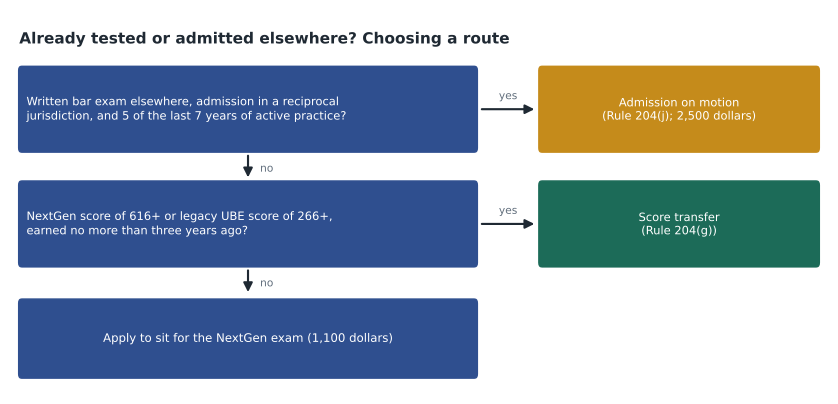
Rule 204(g) allows two kinds of score transfer. An applicant may transfer a NextGen score earned in another jurisdiction that gives the NextGen exam, if the score meets the Virgin Islands passing score of 616, was earned no more than three years before the application, and the applicant meets every other requirement, including graduation from an ABA-approved law school. An applicant may instead transfer a legacy Uniform Bar Examination score earned in another United States jurisdiction, if it is at least 266 and no more than three years old.
A transfer applicant does not retake the national exam, but the rest of the process is the same: the application and fee, the NCBE character report filed within 24 hours of acceptance, the MPRE score of 75 within its window, the Law Component and the personal interview. Transfer applicants should start early, because the three-year age limit keeps running while they complete the other steps.
Rule 204(g) does not accept a transferred MBE score from another jurisdiction or a prior Virgin Islands administration, and the territory does not accept scores from bar exams that are not the NextGen exam or the UBE.
Admission on motion
Rule 204(j) provides admission on motion for experienced lawyers. An applicant must hold a J.D. or LL.B. from an ABA-approved law school, must have passed a written bar examination for admission in another United States jurisdiction, and must be admitted in a jurisdiction that would admit members of the Virgin Islands Bar on motion without examination. The last condition is a reciprocity requirement: the Virgin Islands admits on motion only lawyers from jurisdictions that return the favor.
The applicant must be in good standing everywhere admitted, with no current or pending discipline, and must have been primarily engaged in the active practice of law for five of the seven years immediately before filing. The rule counts client representation in private practice, service as a government lawyer, teaching at an ABA-approved law school, judicial service, judicial clerkships and work as in-house counsel as active practice. It does not count work done before admission or unauthorized practice.
Motion applicants must also show good character and fitness and complete and pass the Law Component. The fee is 2,500 dollars, divided between 500 dollars to the Clerk and 2,000 dollars to the Committee, plus the NCBE character fee. The Committee may retain jurisdiction over a motion applicant for up to a year after admission, and an approved applicant must take the oath within one year of notice of approval or the application is dismissed.
| Route | Key requirements | Fee |
|---|---|---|
| Examination | Pass the NextGen exam in the territory with 616 | 1,100 dollars |
| NextGen score transfer | Score of 616 or more, no more than three years old | See the Court's fee schedule |
| Legacy UBE score transfer | Score of 266 or more, no more than three years old | See the Court's fee schedule |
| Admission on motion | Written exam elsewhere, reciprocity, five of seven years of practice | 2,500 dollars |
| All routes | ABA degree, MPRE 75, Law Component, character examination and interview | NCBE fees extra |
Limited admissions
Two forms of limited practice are available outside regular admission. Rule 201 governs pro hac vice admission, which lets a lawyer admitted elsewhere appear in a particular case in the Virgin Islands, usually with local counsel. Rule 202 governs special admission for certain government and public-service attorneys, who may practice in their official capacity without regular admission. Neither permits a general practice, and both carry their own conditions and, under the Bar's bylaws, their own membership class and dues.
From certification to the oath
When an applicant has met every requirement, Rule 204(i) directs the Committee to certify the applicant to the Supreme Court by written motion. The Court reviews the motion, and if it approves, the Clerk issues a Certificate of Admission and enters the applicant on the Roll of Attorneys.
The new lawyer must take the oath of admission. The oath, set out in Rule 204(i), commits the lawyer to support the laws of the United States and the Virgin Islands, to follow the Virgin Islands Rules of Professional Conduct and to treat opposing parties and counsel with fairness and civility. The oath must be taken within 90 days of notice of eligibility, and the signed oath is filed with the Office of Bar Admissions. Swearing-in ceremonies are optional; they require at least two justices, and an applicant may instead take the oath before a justice, a judge of a court of record or the Clerk.
Admission is not the end of the paperwork. Under Rule 204(i), a new lawyer may not practice until all dues and licensing fees are paid.
The integrated Virgin Islands Bar
Rule 205 establishes the Virgin Islands Bar Association as an integrated bar. Every attorney admitted to practice must be a member, and only members in good standing may practice. Membership is required even for work outside the courtroom, such as taking depositions or appearing before administrative agencies in Virgin Islands matters.
The Bar's bylaws, approved by the Court, set membership classes and dues. As published with the court rules, the classes are regular, special, inactive, pro hac vice and honorary members. Regular members, the ordinary admitted lawyers, pay annual dues set in the bylaws, with a reduced amount for members admitted for no more than a year; special, inactive and pro hac vice members pay a fraction of the regular amount. Dues for each year are due by December 1 of the preceding year, late fees increase on January 1 and February 1, and the Bar's treasurer may seek suspension of a member who remains delinquent after notice and a hearing.
For Ayana, the practical point is a date: once admitted, she will owe dues every year by December 1, and missing that date can put her license at risk.
Continuing legal education
Supreme Court Rule 208 requires Virgin Islands lawyers to complete continuing legal education. The Court's posted version of the rule shows amendments effective March 31, 2019. The rule sets an annual minimum number of credit hours, including hours on ethics and professionalism, a reporting deadline and consequences for failing to comply. New lawyers should read the current rule, note their first reporting deadline and keep their certificates.
The Rules of Professional Conduct
Every Virgin Islands lawyer is bound by the Virgin Islands Rules of Professional Conduct, adopted by the Supreme Court. The rules follow the structure and numbering of the ABA Model Rules of Professional Conduct, which is what the MPRE tests. A new lawyer who knows the Model Rules well has a strong foundation, but should read the territorial rules to find the places where they differ, and should consult the Court's decisions applying them.
Supreme Court Rule 203 governs professional responsibility and discipline. It sets out the procedure for investigating complaints against lawyers, the bodies that hear them and the sanctions available, from private reprimand to disbarment, with final decisions by the Supreme Court. The Court publishes its disciplinary opinions, and reading a few is the fastest way to learn what gets lawyers in trouble in the territory.
The most common problems are the same as anywhere: neglect of client matters, failure to communicate, mishandling of client funds and conflicts of interest. In a small bar, the consequences of a reputation for carelessness can be as serious as a formal sanction.
Federal court admission
Admission to the Virgin Islands Bar does not by itself admit a lawyer to the District Court of the Virgin Islands or the Third Circuit. Each federal court has its own admission procedure, usually requiring admission to the territorial bar, an application and a fee. A new lawyer planning to handle federal, admiralty or diversity cases should apply soon after admission.
Worked problem
Choosing a route
Keziah, the firm's new associate, graduated from an ABA-approved law school in May 2026 and passed the NextGen exam in Missouri in July 2026 with a 640. She took the MPRE in March 2025 and scored 92. She wants to be admitted in the Virgin Islands as soon as possible. Which route should she use, and what must she still do?
Show solution
- Transfer: a NextGen score of 640 exceeds 616 and is less than three years old, so she qualifies for NextGen score transfer under Rule 204(g).
- Education: her ABA-approved degree satisfies Rule 204(d)(5).
- MPRE: 92 exceeds 75, and a certified score from another jurisdiction no more than three years old is accepted.
- Remaining steps: file the application, file the NCBE character materials within 24 hours of acceptance, pass the Law Component, complete the personal interview and take the oath.
Answer: Keziah should apply by NextGen score transfer, arrange certification of her MPRE score and schedule the Law Component as soon as she receives her Notice of Registration Eligibility.
Common mistakes
MistakeAny lawyer with five years of practice can be admitted on motion.
InsteadRule 204(j) also requires a written exam elsewhere, admission in a reciprocal jurisdiction, an ABA-approved degree and the Law Component.
MistakeScore transfer applicants skip the Law Component.
InsteadEvery regular admission route requires the Law Component.
MistakeA new lawyer may practice as soon as the Certificate of Admission issues.
InsteadThe lawyer must also take the oath and pay all dues and licensing fees.
MistakeBar membership is voluntary for lawyers who only do transactional work.
InsteadRule 205 requires membership in good standing to practice, including depositions and agency appearances.
MistakeVirgin Islands admission includes admission to the District Court.
InsteadFederal courts have separate admission procedures.
Membership status changes
Supreme Court Rule 206 governs a lawyer's membership status, including moving between active and inactive status. A lawyer who leaves the territory or stops practicing may choose inactive status, which carries lower dues but does not permit practice. A lawyer returning to practice files the required request and pays the regular dues before resuming. Because only active members in good standing may practice, a lawyer whose status lapses through unpaid dues or missed continuing education must restore it before handling any Virgin Islands matter.
The first year of practice
Marchetti's advice for a new lawyer's first year in the territory was practical. Calendar every deadline twice. Pay bar dues before December 1. Track continuing education credits as they are earned. Keep client funds in a proper trust account and reconcile it every month. Ask a senior lawyer before doing anything that feels uncertain, and write down the advice. And read the Supreme Court's disciplinary opinions now and then, because in a small bar every one of them involves someone the new lawyer may someday meet.
Summary and key terms
- NextGen scores of 616 and legacy UBE scores of 266, no more than three years old, transfer under Rule 204(g); MBE scores do not.
- Admission on motion requires an ABA degree, a written exam elsewhere, reciprocity, good standing and five of seven years of active practice, plus the Law Component; the fee is 2,500 dollars.
- Pro hac vice (Rule 201) and special admission for government lawyers (Rule 202) allow limited practice only.
- After certification, the lawyer takes the oath within 90 days, is entered on the Roll of Attorneys and must pay dues and fees before practicing.
- The Virgin Islands Bar is integrated under Rule 205; dues are due by December 1 for the following year.
- Rule 208 requires continuing legal education; the Virgin Islands Rules of Professional Conduct follow the Model Rules, and Rule 203 governs discipline.
- 0
- score transfer
- 1
- admission on motion
- 2
- reciprocity
- 3
- active practice
- 4
- pro hac vice
- 5
- special admission
- 6
- Certificate of Admission
- 7
- oath of admission
- 8
- integrated bar
- 9
- continuing legal education
Practice problems
Work each problem on paper first, then reveal the answer to check.
What NextGen score transfers into the Virgin Islands?
Show answer
A score of at least 616, earned no more than three years before the application, for an applicant with an ABA-approved degree.
What practice requirement applies to admission on motion?
Show answer
Primary engagement in the active practice of law for five of the seven years immediately before filing.
Within what time must a new lawyer take the oath?
Show answer
Within 90 days of notice of eligibility, under Rule 204(i).
By what date are annual bar dues due?
Show answer
By December 1 of the year before the year the dues cover, under the Bar's bylaws.
Lesson quiz · 5 questions
Score 60% or more to complete this lesson.
Create a free account to save your progress, take quizzes and earn a certificate.