
BAR-255 · Lesson 1 of 12 · 17 min
Becoming a lawyer in the U.S. Virgin Islands
▶ Video coming soon A video version of this lesson is on the way.
Ayana Liburd grew up in Frederiksted, on the west end of St. Croix, in a house where the radio was always tuned to the morning call-in shows. Her grandmother argued with the callers. Her mother, a public school teacher, corrected their grammar. Ayana listened to the senators who came on to defend their bills and decided, somewhere around the age of twelve, that she wanted to be the person who actually read the bills. She left the island for college, then for law school at an ABA-approved school in Florida, and in May 2026 she came home with a J.D. and a job as a law clerk at Petersen and Ottley, a small general practice firm in Christiansted.
In September 2026 she joined Hollis Marchetti's online study group. Marchetti had coached candidates from a dozen states, but Ayana was her first from the Virgin Islands. 'Tell me how it works there,' Marchetti said on their first call. Ayana laughed. 'That is what I was hoping you would tell me.' Over the following weeks they worked it out together, rule by rule, and this course follows what they found.
This first lesson is a map. It explains who regulates admission in the Virgin Islands, what the main routes into practice are, how the territory's admission system compares with a state's, and how the rest of the course is organized.
The territory and its bar
The United States Virgin Islands is an unincorporated territory of the United States made up of three main islands, St. Croix, St. Thomas and St. John, and many smaller cays. Denmark sold the islands to the United States in 1917. Today the territory has an elected governor, a unicameral legislature and its own court system, but no territorial constitution of its own; its basic governing law is a federal statute, the Revised Organic Act of 1954. Lesson 7 explains that structure in detail.
For a bar applicant, the important point is that the territory regulates its own legal profession, much as a state does. The power to admit lawyers belongs to the Supreme Court of the Virgin Islands, the territory's highest local court. The Court exercises that power through rules it adopts, chiefly the Rules Governing Admission to the Virgin Islands Bar, which appear in the Supreme Court Rules beginning with Rule 201. The rule that governs ordinary admission by examination, score transfer and motion is Supreme Court Rule 204, and applicants will see it cited as V.I.S.Ct.R. 204 or VISCR 204.
The bar is small. A few hundred active lawyers serve a population of roughly a hundred thousand people across the islands, and many of them know each other. A new lawyer's reputation travels quickly between Christiansted and Charlotte Amalie, and judges notice who files clean papers on time. That size shapes the admission process too: the Committee meets applicants in person, and the territory adds its own test of local law to the national exam.
Who does what
Several bodies share the work of admission.
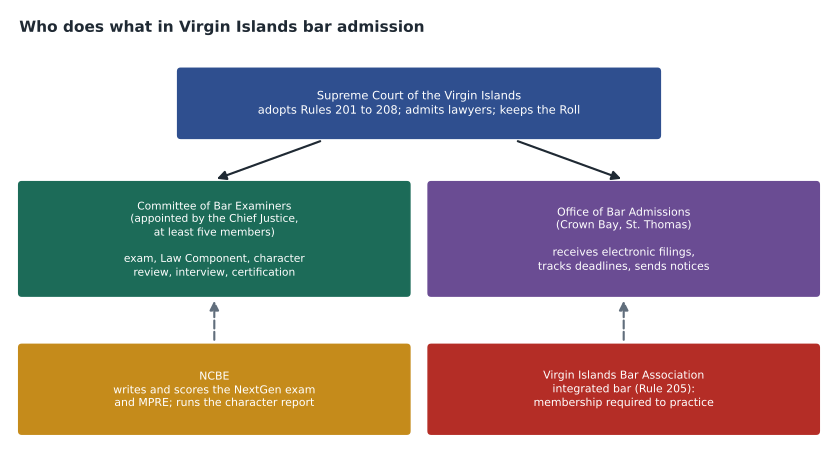
The Supreme Court of the Virgin Islands makes the final decision. It adopts the admission rules, appoints the people who administer them, reviews the Committee's motions to admit applicants, and enters new lawyers on the Roll of Attorneys.
The Committee of Bar Examiners administers the process. Under Rule 204(b), the Chief Justice appoints the Committee, which has at least five members who are members of the Virgin Islands Bar in good standing. The Committee examines applicants, investigates character and fitness, holds the personal interview, develops the Virgin Islands Law Component, and, when an applicant has satisfied every requirement, certifies the applicant to the Court by written motion.
The Office of Bar Admissions is the staff office that handles applications, deadlines and correspondence. It sits within the Judicial Branch's administrative offices at Crown Bay on St. Thomas, and applicants deal with it through the Virgin Islands Judiciary's electronic filing system.
The National Conference of Bar Examiners, or NCBE, prepares the national exams that the territory uses: the NextGen bar exam and the Multistate Professional Responsibility Examination, or MPRE. NCBE also runs the character and fitness investigation for the Virgin Islands, so applicants complete an NCBE Character and Fitness Report as part of the application. NCBE does not decide who is admitted. It writes and scores exams and gathers background information; the Committee and the Court decide.
The Virgin Islands Bar Association is the territory's integrated bar. Every lawyer admitted to practice must be a member, and only members in good standing may practice. The Bar does not decide admission, but a new lawyer joins it on admission and pays dues to it every year. Lesson 11 covers the Bar.
| Body | Main role |
|---|---|
| Supreme Court of the Virgin Islands | Adopts the rules, admits lawyers, keeps the Roll of Attorneys |
| Committee of Bar Examiners | Runs the exam and the Law Component, investigates character, interviews and certifies applicants |
| Office of Bar Admissions | Receives filings, tracks deadlines, communicates with applicants |
| NCBE | Writes and scores the NextGen exam and MPRE; runs the character report |
| Virgin Islands Bar Association | Integrated bar; membership and dues required to practice |
The routes into practice
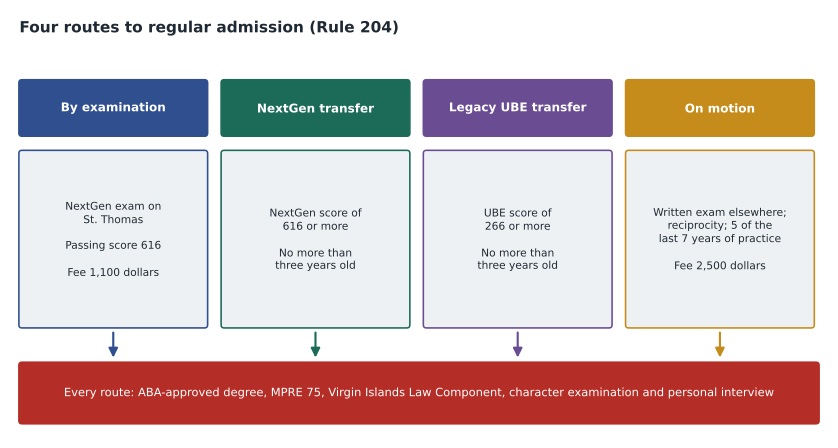
Rule 204 provides several routes to regular admission. The Court's admission pages list them as admission by examination, admission by NextGen score transfer, admission by legacy UBE score transfer, and admission on motion.
Admission by examination is the route for a new graduate like Ayana. The applicant takes the NextGen bar exam in the Virgin Islands, passes the Virgin Islands Law Component, has a qualifying MPRE score, and completes the character examination and personal interview.
Admission by score transfer is for an applicant who already passed the NextGen exam, or the older Uniform Bar Examination, in another jurisdiction. The applicant does not retake the national exam but must still meet the education, MPRE, character and Law Component requirements. Lesson 11 covers the score limits and the three-year age rule.
Admission on motion is for experienced lawyers admitted in a jurisdiction that offers reciprocity to Virgin Islands lawyers. It requires five of the last seven years of active practice, along with good standing, character and the Law Component.
Beyond regular admission, the rules provide limited forms of practice. Pro hac vice admission lets a lawyer from elsewhere appear in a particular case. Special admission lets certain government and public-service attorneys practice in their official roles. These are not substitutes for regular admission, and a lawyer who wants a general practice in the territory needs one of the regular routes.
What every route shares
Whatever the route, every applicant for regular admission must satisfy the same core requirements. The Court's regular admission overview lists them plainly: an MPRE scaled score of 75 or higher, passage of the Virgin Islands Law Component, and the character examination and personal interview. The education requirement, a degree from a law school approved by the American Bar Association, also applies to every route.
That common core matters for planning. A lawyer who transfers a strong score from another jurisdiction may assume the process is a formality, but the Law Component, the character report and the interview take time. A motion applicant may assume that years of practice excuse the local test, but they do not.
How the Virgin Islands differs from a typical state
Marchetti made a list for Ayana of the ways the Virgin Islands system differs from the states she knew best.
First, the territory was one of the earliest adopters of the NextGen bar exam. It gave its last legacy Uniform Bar Examination in February 2026 and its first NextGen exam in July 2026, so a February 2027 candidate sits for NextGen, not the old exam.
Second, the passing score is 616 on the NextGen scale. Several states that adopted NextGen chose 610 or 620; the Virgin Islands chose a score in between. Lesson 4 explains the scale.
Third, the territory requires its own test of local law. The Virgin Islands Law Component is an online, open-book, multiple-choice exam on Virgin Islands law, taken separately from the bar exam. Lesson 6 covers it.
Fourth, the education rule is strict. Only graduates of ABA-approved law schools may apply. There is no path for graduates of non-ABA schools and no path for foreign-trained lawyers.
Fifth, the MPRE score of 75 is lower than the score many states require, but it comes with a time limit tied to the bar exam. Lesson 3 explains it.
Sixth, there is no regrading. Applicants cannot see their answers and cannot ask for review of a result.
Seventh, the law a new lawyer practices is unusual. The territory's courts are developing their own common law, under a method called the Banks analysis, after decades in which the Restatements of the Law served as the default rules by statute. Lessons 7 through 10 cover the territory's courts and its distinctive law.
How to use this course
Lessons 2 through 6 follow the admission process: eligibility and deadlines, character and fitness and the MPRE, the NextGen exam, the transition from the legacy exam, and the Law Component. Lessons 7 through 10 cover Virgin Islands law that a new lawyer needs, much of which also appears on the Law Component: the territorial government and courts, the Banks analysis, torts and claims against the government, and family law, wills and estates. Lesson 11 covers score transfer, admission on motion, the integrated bar and the Rules of Professional Conduct. Lesson 12 brings everything together in practice questions, an original memo problem and an exam-day plan.
Marchetti's advice to Ayana was the same advice she gives every candidate. 'Read your own rule. Not a summary of it, the rule. In a small jurisdiction there is no one standing behind you to catch a missed deadline.'
Common mistakes
MistakeThe Committee of Bar Examiners admits lawyers.
InsteadThe Supreme Court of the Virgin Islands admits lawyers; the Committee certifies qualified applicants to the Court by written motion.
MistakeNCBE decides who passes in the Virgin Islands.
InsteadNCBE writes and scores the national exams and runs the character report; the Committee and the Court make the decisions.
MistakeA transferred score or years of practice excuses the local requirements.
InsteadEvery regular admission route requires the MPRE score of 75, the Virgin Islands Law Component, and the character examination and interview.
MistakeA February 2027 candidate in the Virgin Islands takes the legacy UBE.
InsteadThe territory gave its last legacy UBE in February 2026 and has given the NextGen exam since July 2026.
MistakeJoining the Virgin Islands Bar Association is optional.
InsteadThe Bar is integrated; membership in good standing is required to practice.
A timeline for a new graduate
Most first-time applicants follow the same broad sequence, and it helps to see it whole before working through each step. A graduate who wants to sit in February finishes law school in May, takes or confirms a qualifying MPRE score, starts the NCBE character report in the early fall, and files the Virgin Islands application well before December 1. Within a day of acceptance, the NCBE materials go into the pending matter. Over the winter the applicant studies for the NextGen exam, registers for the Law Component once the Office of Bar Admissions confirms eligibility, and sits for the national exam in late February. The personal interview, the Law Component and the bar results then come together, and a successful applicant is certified, sworn in and enrolled.
A graduate aiming at July follows the same steps on a later calendar, with the application due by May 1. Either way, the steps that most often cause delay are the ones that do not involve studying: transcripts that take weeks to arrive, a certificate of good standing from another jurisdiction, a missing signature on an NCBE release, or a forgotten upload. Ayana kept a single checklist taped above her desk at the firm and crossed off each item as it was filed.
Where to find the rules
The rules themselves are short enough to read in an afternoon. The Rules Governing Admission to the Virgin Islands Bar are published with the Supreme Court's rules on the Judiciary's website, and the Office of Bar Admissions maintains pages on regular admission, admission by examination, admission on motion, the Law Component and frequently asked questions. NCBE's jurisdiction summary for the Virgin Islands offers a convenient overview, but it is a secondary source; where it and the Court's rules differ, the rules control, and an applicant with a question should ask the Office of Bar Admissions in writing and keep the answer.
Summary and key terms
- The Supreme Court of the Virgin Islands regulates admission through its rules, chiefly Supreme Court Rule 204.
- The Committee of Bar Examiners, appointed by the Chief Justice, administers the exam, the Law Component and the character review, and certifies applicants.
- NCBE prepares the NextGen exam and the MPRE and runs the character report; it does not admit anyone.
- Routes to regular admission: examination, NextGen score transfer, legacy UBE score transfer and admission on motion.
- Every route requires an ABA-approved degree, an MPRE score of 75, the Virgin Islands Law Component, and the character examination and interview.
- The territory gave its first NextGen exam in July 2026 and uses a 616 passing score.
- 0
- Supreme Court of the Virgin Islands
- 1
- Committee of Bar Examiners
- 2
- Office of Bar Admissions
- 3
- Rule 204
- 4
- NCBE
- 5
- Virgin Islands Law Component
- 6
- admission on motion
- 7
- score transfer
- 8
- integrated bar
- 9
- Roll of Attorneys
Practice problems
Work each problem on paper first, then reveal the answer to check.
Which court rule governs regular admission in the Virgin Islands?
Show answer
Supreme Court Rule 204 of the Rules Governing Admission to the Virgin Islands Bar.
Who appoints the Committee of Bar Examiners, and how large must it be?
Show answer
The Chief Justice appoints it; it has at least five members who are members of the Virgin Islands Bar in good standing.
Name the four routes to regular admission.
Show answer
Examination, NextGen score transfer, legacy UBE score transfer, and admission on motion.
Which requirements apply to every route?
Show answer
An ABA-approved law degree, an MPRE scaled score of 75, passing the Virgin Islands Law Component, and the character examination and personal interview.
Lesson quiz · 5 questions
Score 60% or more to complete this lesson.
Create a free account to save your progress, take quizzes and earn a certificate.