
BAR-255 · Lesson 3 of 12 · 19 min
Character and fitness, the personal interview and the MPRE
▶ Video coming soon A video version of this lesson is on the way.
The morning after Ayana's Virgin Islands application was accepted, an email from the Office of Bar Admissions reminded her that she had 24 hours to file her NCBE Character and Fitness Report in the same matter. She had started the NCBE report in October, so she only needed to finalize it, print the signature pages, sign them and upload the full package. She did it at her kitchen table before work. 'Twenty-four hours is not a typo,' Marchetti said when Ayana told her. 'Most states give you weeks. Yours gives you a day. Have it ready before you file.'
This lesson covers the character and fitness requirement, the NCBE report and the Committee's investigation, the personal interview, how to handle difficult disclosures, and the MPRE score and time limit.
Why character and fitness matters
Rule 204(d) requires every applicant to be of good moral character, and Rule 204(e) lists a character examination and personal interview as one of the four components of the admission process, alongside the bar exam, the Law Component and the MPRE. The purpose is protective. A license to practice law gives a person access to clients' money, secrets and legal rights, and the Court wants assurance that new lawyers will be honest, diligent and able to meet their obligations.
The inquiry looks backward to predict the future. The Committee asks whether the applicant's past conduct shows a likelihood that the applicant will fail to meet the standards of the profession. Isolated mistakes from years ago, candidly disclosed and followed by a responsible life, rarely prevent admission. Patterns of dishonesty, recent serious misconduct and, above all, a lack of candor in the application itself are what cause problems.
The NCBE Character and Fitness Report
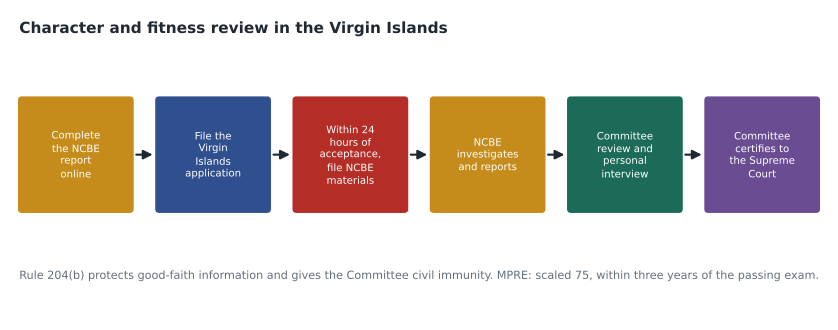
The Virgin Islands uses NCBE to gather background information. An applicant completes the NCBE Character and Fitness Report Application online through an NCBE account. When the application is finalized, NCBE's system generates a checklist, a PDF copy of the application and instructions for signatures and mailing.
The Virgin Islands adds a filing step of its own. Under the Court's admission instructions, the applicant must electronically file the entire NCBE application, together with the required authorization and release forms, in the applicant's pending Virgin Islands matter within 24 hours after the Virgin Islands application is accepted. Ayana's experience shows why it pays to finish the NCBE report before filing the territorial application.
NCBE then investigates. It contacts schools, employers, references, courts, licensing agencies and credit reporting agencies, and it sends the results to the Committee. The applicant pays NCBE's fee separately from the territorial application fee.
Protection for those who provide information
Rule 204(b) adopts the American Bar Association's model rule of February 1998 on immunity in bar admission. The Committee and its agents have civil immunity for acts within their official duties, and information provided in good faith about an applicant is privileged. The point of the rule is to encourage former employers, teachers and others to speak candidly about applicants without fear of a lawsuit.
The personal interview
Every applicant for regular admission sits for a personal interview. The interview is part of the character examination, and it is one of the features that reflect the territory's size: the Committee can meet each applicant in person.
An interview is not a cross-examination, but it is not a formality either. Committee members review the application and the NCBE report beforehand and may ask about anything in them: gaps in employment, financial problems, school discipline, traffic matters, prior applications and why the applicant wants to practice in the territory. They may also ask about the applicant's understanding of the Rules of Professional Conduct and the obligations of a Virgin Islands lawyer.
Marchetti's advice for interviews was simple. 'Know your application cold. If there is something in it you are not proud of, say what happened, say what you learned, and say what you have done since. Do not argue, do not minimize, do not blame anyone else.' She also told Ayana to dress as she would for court and to arrive early. The interview may be scheduled in person, so an applicant who lives on another island should check the location and plan travel in advance.
Difficult disclosures
Several kinds of history come up often in character review anywhere, and the Virgin Islands is no exception.
Financial problems, such as unpaid debts, accounts in collection or a bankruptcy, are common. The Committee is less interested in the debt itself than in how the applicant handled it. An applicant who ignored creditors raises concern; one who negotiated a payment plan and kept to it shows responsibility.
Criminal matters, including arrests that did not lead to conviction, must usually be disclosed if the application asks about them. Traffic matters may be covered too. The applicant should obtain the court records, disclose accurately and explain.
Academic discipline, such as a finding of plagiarism in college, is treated seriously because it involves honesty. Full disclosure, with the school's records, matters most here.
Mental health is a sensitive area. Bar examiners across the country have narrowed or removed questions about diagnosis and treatment in recent years, focusing instead on conduct. Applicants should answer the questions actually asked in the current application and seek advice if unsure.
Above all, candor. The most serious character problem an applicant can create is an omission or misstatement in the application itself. An applicant who discloses an embarrassing incident and explains it is far better placed than one who leaves it out and is found out.
| Issue | What helps | What hurts |
|---|---|---|
| Debts and collections | Payment plans, documentation, steady progress | Ignoring creditors, new defaults |
| Arrests or convictions | Court records, full disclosure, rehabilitation | Omission, minimizing, inconsistent accounts |
| Academic discipline | School records, candid explanation | Leaving it off the application |
| Prior bar applications | Disclosure of every prior application and result | Failing to mention a prior denial or withdrawal |
The MPRE requirement
The Multistate Professional Responsibility Examination is NCBE's national test of the rules of professional conduct, built mainly on the ABA Model Rules of Professional Conduct and related law. It has 60 multiple-choice questions, 50 scored and 10 unscored, answered in two hours, and it is reported on a scaled score from 50 to 150. It is given several times a year at test centers and, for some candidates, remotely.
Rule 204(f) sets the Virgin Islands minimum at a scaled score of 75. That is lower than the 80 or 85 many states require. But Rule 204(e) adds a timing condition: the MPRE must have been taken no earlier than three years before the bar exam administration in which the applicant passes. An applicant who took the MPRE in law school and then waited several years to sit for the bar exam may need to retake it.
An applicant who took the MPRE for another jurisdiction may use that score. Under Rule 204(g), a score from another United States jurisdiction is accepted if it meets the 75 minimum, the score is certified, and it is no more than three years old. Applicants arrange certification through NCBE's score services.
Ayana took the MPRE in August 2025, between her second and third years of law school, and scored 88. Her score is well above 75, and it falls within three years of the February 2027 exam. If she did not pass in February and waited until 2029 to try again, the timing rule would matter.
Worked problem
Applying the MPRE window
Cyril Lettsome took the MPRE in March 2023 and scored 79. He graduated in May 2024, worked in Atlanta and now plans to sit for the Virgin Islands NextGen exam in July 2027. Does his MPRE score count?
Show solution
- Score: 79 meets the 75 minimum.
- Window: the MPRE must be taken no earlier than three years before the administration in which he passes.
- Dates: three years before July 2027 is July 2024; March 2023 is earlier than that.
- Result: the score is too old for a July 2027 pass; he must retake the MPRE.
Answer: Cyril should register for an MPRE administration in 2026 or early 2027 so that a new score of 75 or higher falls within the window.
Common mistakes
MistakeThe NCBE character report can be filed weeks after the Virgin Islands application.
InsteadThe full NCBE application and releases must be filed in the pending matter within 24 hours of acceptance of the Virgin Islands application.
MistakeAn MPRE score of 75 is good forever.
InsteadIt must be taken no earlier than three years before the exam administration in which the applicant passes.
MistakeLeaving out a minor incident is safer than explaining it.
InsteadLack of candor in the application is itself a serious character problem.
MistakeThe interview is optional for applicants with clean records.
InsteadRule 204(e) makes the character examination and personal interview part of every regular admission.
MistakeThe Virgin Islands requires an MPRE score of 85.
InsteadThe minimum is a scaled score of 75.
Rehabilitation
When an applicant's past includes conduct that would raise doubts, the question becomes whether the applicant has been rehabilitated. Bar examiners across the country look at similar evidence: how long ago the conduct occurred, how old the applicant was, how serious it was, whether it was isolated or part of a pattern, whether the applicant made restitution, and how the applicant has lived since. Positive evidence matters as much as the absence of new problems. Steady employment, community service, honest dealings with creditors and letters from people who know the applicant well all help.
Rehabilitation is shown, not asserted. An applicant who writes that a past problem 'is behind me' adds little; an applicant who attaches a court's dismissal order, proof of completed payments and a supervisor's letter describing five years of reliable work adds a great deal. Marchetti told Ayana that the best explanations are short, factual and complete: what happened, when, what the result was, what the applicant learned, and what has happened since.
Duty to cooperate
Applicants must cooperate with the Committee's investigation. That means answering follow-up questions promptly and fully, signing releases, producing requested records and appearing for the interview. Delay and evasiveness are themselves relevant to character. An applicant who cannot obtain a document should say so and explain what efforts were made, rather than letting a request sit unanswered.
MPRE preparation
The MPRE tests the ABA Model Rules of Professional Conduct, the ABA Model Code of Judicial Conduct and generally accepted principles from leading court decisions on the law governing lawyers. Its main subject areas include the regulation of the profession, the client-lawyer relationship, client confidentiality, conflicts of interest, competence and diligence, litigation and other forms of advocacy, transactions and communications with persons other than clients, the different roles of a lawyer, safekeeping of funds and property, communications about legal services, lawyers' duties to the public and the legal system, and judicial conduct.
Most candidates prepare for two to four weeks, reviewing the rules and working through practice questions. Because the Virgin Islands Rules of Professional Conduct follow the structure of the Model Rules, MPRE study doubles as an introduction to the rules a Virgin Islands lawyer will follow in practice. NCBE administers the MPRE several times a year, and registration deadlines come weeks before each test date, so an applicant who needs a new score should register well ahead of the bar application deadline.
After certification
Character review does not end with a favorable interview. The Committee certifies an applicant to the Court only when every requirement is met, and an applicant who develops a new issue before admission, such as a new criminal charge or a disciplinary complaint in another jurisdiction, must report it. Once admitted, a lawyer is subject to the Virgin Islands Rules of Professional Conduct and the disciplinary rules, and the honesty expected in the application becomes the honesty expected in practice. Many of the questions on the application, about debts, court matters and candor, foreshadow the obligations that the Rules of Professional Conduct impose on every lawyer.
Ayana's interview notice had not yet arrived when she and Marchetti finished this lesson. She drafted a one-page summary of her application, listing every place she had lived and worked and the small claims matter, so that she could answer any question without hesitation. 'If they ask about the car rental counter,' Marchetti said, 'tell them what you learned about angry customers. It is the best preparation for practice you will ever get.'
Summary and key terms
- Good moral character is an eligibility criterion, and the character examination and personal interview are part of every regular admission.
- Applicants complete an NCBE Character and Fitness Report and must file it, with releases, within 24 hours of acceptance of the Virgin Islands application.
- Rule 204(b) gives the Committee civil immunity and protects good-faith information about applicants.
- Candor is the most important factor in character review.
- The MPRE minimum is a scaled score of 75, taken no earlier than three years before the administration in which the applicant passes.
- Transferred MPRE scores must be certified and no more than three years old.
- 0
- character and fitness
- 1
- good moral character
- 2
- NCBE Character and Fitness Report
- 3
- personal interview
- 4
- candor
- 5
- immunity
- 6
- MPRE
- 7
- scaled score
- 8
- three-year window
- 9
- score certification
Practice problems
Work each problem on paper first, then reveal the answer to check.
How long does an applicant have to file the NCBE character materials after the Virgin Islands application is accepted?
Show answer
Twenty-four hours.
What MPRE score does the Virgin Islands require, and what time limit applies?
Show answer
A scaled score of 75, taken no earlier than three years before the bar exam administration in which the applicant passes.
What does the ABA model immunity rule adopted in Rule 204(b) accomplish?
Show answer
It gives the Committee and its agents civil immunity for official acts and makes good-faith information about applicants privileged.
What is the single most damaging thing an applicant can do in character review?
Show answer
Omit or misstate information in the application; lack of candor is itself a serious problem.
Lesson quiz · 5 questions
Score 60% or more to complete this lesson.
Create a free account to save your progress, take quizzes and earn a certificate.