
BAR-255 · Lesson 7 of 12 · 19 min
Territorial government and the courts: the Revised Organic Act, the Supreme Court and the District Court
▶ Video coming soon A video version of this lesson is on the way.
On Ayana's first week at the firm, Hyacinth Petersen handed her a file with two captions on it. The same contract dispute had been filed in the Superior Court in Christiansted and, a month later, in the District Court of the Virgin Islands, two blocks away. 'Which one wins?' Petersen asked. Ayana started to answer, stopped, and asked for a day to read. She came back with a chart of the territory's courts, and Petersen pinned it to the wall of the library. 'Now you are ready to practice here,' she said. 'Almost.'
This lesson explains the territory's legal foundation, its government, and its two court systems: the local courts, headed by the Supreme Court of the Virgin Islands, and the federal District Court. These subjects are tested on the Law Component under Virgin Islands government and constitutional law and Virgin Islands practice, and they are the first things a new lawyer needs.
From Danish colony to United States territory
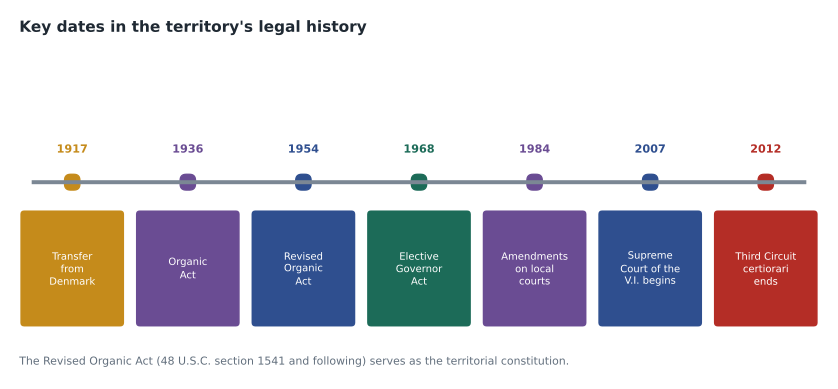
Denmark held the islands for most of two centuries. The United States bought them under a 1916 treaty for 25 million dollars, and the formal transfer took place on March 31, 1917, a date still celebrated as Transfer Day. Congress extended United States citizenship to many residents in 1927 and later broadened it.
Congress governs the territory under the Territory Clause of the Constitution, Article IV, section 3, which gives it power to make all needful rules and regulations respecting the territory of the United States. The Virgin Islands is an unincorporated territory. Under the line of Supreme Court decisions known as the Insular Cases, the Constitution does not apply in full to unincorporated territories of its own force; Congress decides how much of it applies, subject to fundamental rights.
Congress first organized a civil government for the islands in the Organic Act of 1936. It replaced that statute with the Revised Organic Act of 1954, which remains the territory's basic charter. It is codified in Title 48 of the United States Code, beginning at section 1541.
The Revised Organic Act as a constitution
The Virgin Islands has no constitution of its own. Residents have held several constitutional conventions over the decades, but none has produced a constitution that took effect. The Revised Organic Act therefore does the work a constitution does elsewhere: it creates the branches of government, divides power among them and protects individual rights.
Section 3 of the Act is the territory's bill of rights. It lists protections modeled on the federal Bill of Rights, and Congress amended it to extend many provisions of the United States Constitution to the territory, including much of the Bill of Rights and the Fourteenth Amendment's guarantees of due process and equal protection. A Virgin Islands lawyer raising a constitutional claim against the territorial government therefore cites both the Revised Organic Act and the federal provisions it makes applicable.
Because the Act is a federal statute, Congress can amend it, and it has done so many times. Major amendments include the Elective Governor Act of 1968, which allowed voters to elect their governor for the first time in 1970, and amendments in 1984 that allowed the local legislature to restructure the local courts. A lawyer reading an older case should check whether the version of the Act it relied on is still in force.
The territorial government
The executive branch is headed by an elected Governor and Lieutenant Governor, who serve four-year terms. The Governor appoints the heads of executive departments, including the Attorney General, who leads the Department of Justice and represents the Government of the Virgin Islands in litigation.
The Legislature of the Virgin Islands is unicameral. Its senators are elected from the St. Croix district and the St. Thomas and St. John district, with one at-large seat that must be held by a resident of St. John. Legislation becomes part of the Virgin Islands Code, which is organized by titles; lawyers cite it as, for example, 5 V.I.C. section 1451.
The territory elects a Delegate to the United States House of Representatives, who may serve on committees but does not vote on final passage of legislation. Residents do not vote in presidential general elections.
Two court systems
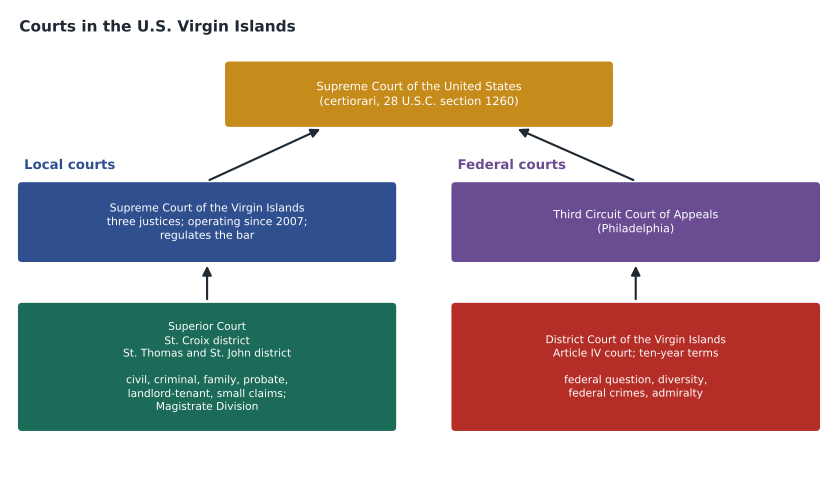
The territory has two court systems that sit side by side. The local system consists of the Superior Court and the Supreme Court of the Virgin Islands. The federal system consists of the District Court of the Virgin Islands, with appeals to the United States Court of Appeals for the Third Circuit. Understanding which court has jurisdiction, and how the two relate, is the first step in any Virgin Islands case.
The Superior Court
The Superior Court of the Virgin Islands is the territory's trial court of general jurisdiction. It sits in two districts, one on St. Croix and one on St. Thomas and St. John. It hears civil cases of every size, criminal cases under territorial law, family cases, probate matters, landlord and tenant cases and small claims. A Magistrate Division handles certain smaller matters.
The court was known as the Territorial Court until 2004, when the Legislature renamed it the Superior Court. Older cases and statutes refer to the Territorial Court, and a new lawyer should read those references as references to today's Superior Court.
The Supreme Court of the Virgin Islands
The Supreme Court of the Virgin Islands is the territory's highest local court. The Legislature created it in 2004, using the authority the 1984 amendments gave it, and the Court began operating in January 2007. It sits with three justices, one of whom is the Chief Justice.
The Court hears appeals from final judgments and certain other orders of the Superior Court. It also regulates the legal profession: it adopts rules of practice and procedure for the local courts, admits and disciplines lawyers, and governs the integrated bar.
Before the Supreme Court existed, appeals from the local trial court went to the Appellate Division of the District Court, a panel of judges sitting as an appellate court for local cases, with further review in the Third Circuit. That history explains why many decisions on Virgin Islands local law come from federal courts. Lesson 8 explains how the Supreme Court treats those decisions today.
Review in the United States Supreme Court
When Congress authorized the local supreme court, it provided for a transition. For the Court's early years, its decisions could be reviewed by the Third Circuit on a writ of certiorari. Congress ended that arrangement in a statute signed on December 28, 2012, Public Law 112-226. Since then, final decisions of the Supreme Court of the Virgin Islands are reviewable only by the Supreme Court of the United States on certiorari, under 28 U.S.C. section 1260, in the same way as decisions of a state's highest court.
That change made the Supreme Court of the Virgin Islands the final word on the meaning of territorial law, subject only to the United States Supreme Court on federal questions.
The District Court of the Virgin Islands
The District Court of the Virgin Islands is the federal trial court for the territory, created under the Revised Organic Act. It is not an Article III court. Its judges are appointed by the President with the Senate's consent for terms of ten years, rather than for life. It sits in two divisions, on St. Croix and on St. Thomas and St. John.
The District Court has the jurisdiction of a United States district court. It hears cases under federal law, cases between citizens of different states, federal criminal prosecutions and admiralty cases, which are common in an island territory. For diversity purposes, federal law treats the Virgin Islands as a state, so a citizen of the Virgin Islands can sue a citizen of Florida in the District Court if the amount in controversy is met. Appeals go to the Third Circuit in Philadelphia.
For decades the District Court also exercised jurisdiction over local matters, because the local trial court's jurisdiction was limited. The 1984 amendments allowed the Legislature to vest that jurisdiction in the local courts, and over time it did. Today local cases begin in the Superior Court.
| Court | Type | Main role |
|---|---|---|
| Superior Court | Local trial court | Civil, criminal, family, probate, landlord-tenant and small claims cases |
| Supreme Court of the Virgin Islands | Local high court | Appeals from the Superior Court; regulates the bar |
| District Court of the Virgin Islands | Federal trial court (Article IV) | Federal question, diversity, federal criminal and admiralty cases |
| Third Circuit | Federal appellate court | Appeals from the District Court |
| Supreme Court of the United States | Federal high court | Certiorari review of both systems |
Practicing in the local courts
Civil practice in the Superior Court is governed by the Virgin Islands Rules of Civil Procedure, adopted by the Supreme Court. The rules follow the general structure of the Federal Rules of Civil Procedure, but they are not identical. The most important difference for a new litigator is pleading. Rule 8 of the Virgin Islands rules describes the territory as a notice-pleading jurisdiction, and the territory has not adopted the federal plausibility standard. A complaint that might be dismissed in the District Court may survive in the Superior Court. A lawyer who files in both courts should draft to the stricter federal standard.
Appeals are governed by the Virgin Islands Rules of Appellate Procedure, and the Superior Court has its own rules on matters such as family and probate cases. Filing is electronic. The Law Component tests practical points of this kind under Virgin Islands practice, so a candidate should read the rules alongside the Court's outline.
Worked problem
Two courts, one dispute
Coralline Charters, a St. Thomas boat charter company organized in the Virgin Islands, sues Dorcas Sprauve, a Florida resident who chartered a boat and damaged it, for 120,000 dollars in the Superior Court on St. Thomas. Dorcas then files a separate action in the District Court seeking a declaration that she owes nothing. Where can each case proceed?
Show solution
- Superior Court: it has general jurisdiction over the territorial contract and tort claims.
- District Court: diversity exists, because a Virgin Islands company is treated as a citizen of a state, and the amount exceeds 75,000 dollars; admiralty jurisdiction may also apply to a vessel charter.
- Overlap: both courts can have jurisdiction; doctrines on parallel proceedings, abstention and claim preclusion will determine which case moves forward.
- Pleading: the District Court applies the federal plausibility standard; the Superior Court applies the territory's notice pleading rule.
Answer: Both courts may hear the dispute. Counsel must consider removal, abstention and which judgment will come first, and must plead to the federal standard in the District Court.
Common mistakes
MistakeThe Virgin Islands has its own constitution.
InsteadThe Revised Organic Act of 1954, a federal statute, serves as its constitution.
MistakeThe District Court of the Virgin Islands is an Article III court with life-tenured judges.
InsteadIt is an Article IV court whose judges serve ten-year terms.
MistakeThe Third Circuit still reviews decisions of the Supreme Court of the Virgin Islands.
InsteadSince Public Law 112-226 (2012), review is by the Supreme Court of the United States under 28 U.S.C. section 1260.
MistakeThe Territorial Court is the trial court.
InsteadIt was renamed the Superior Court in 2004.
MistakeThe Virgin Islands follows the federal plausibility pleading standard.
InsteadRule 8 of the Virgin Islands Rules of Civil Procedure describes a notice-pleading jurisdiction.
Federal law in the territory
Many federal statutes apply in the Virgin Islands just as they do in the states, but some apply differently or not at all, depending on what Congress provided. A lawyer facing a federal question should check whether the statute defines the Virgin Islands as a state, a territory or something else, and whether a special rule applies. Federal tax law is a well-known example: the territory has its own income tax system that mirrors the federal Internal Revenue Code, administered locally by the Virgin Islands Bureau of Internal Revenue, a structure that produces its own body of law and litigation.
Summary and key terms
- The United States acquired the islands from Denmark in 1917; Congress governs them under the Territory Clause as an unincorporated territory.
- The Revised Organic Act of 1954 serves as the territorial constitution; section 3 is its bill of rights.
- The territory has an elected Governor, a unicameral Legislature and a nonvoting Delegate to Congress.
- The Superior Court is the local trial court; the Supreme Court of the Virgin Islands, created in 2004 and operating since January 2007, hears appeals and regulates the bar.
- Since 2012, the United States Supreme Court reviews the local Supreme Court by certiorari under 28 U.S.C. section 1260.
- The District Court of the Virgin Islands is an Article IV federal court, with appeals to the Third Circuit.
- 0
- Territory Clause
- 1
- unincorporated territory
- 2
- Insular Cases
- 3
- Revised Organic Act
- 4
- Legislature of the Virgin Islands
- 5
- Superior Court
- 6
- Supreme Court of the Virgin Islands
- 7
- District Court of the Virgin Islands
- 8
- Article IV court
- 9
- notice pleading
Practice problems
Work each problem on paper first, then reveal the answer to check.
What serves as the territory's constitution?
Show answer
The Revised Organic Act of 1954, a federal statute codified in Title 48 of the United States Code.
When did the Supreme Court of the Virgin Islands begin operating, and how many justices does it have?
Show answer
January 2007, with three justices.
Which court reviews the Supreme Court of the Virgin Islands today?
Show answer
The Supreme Court of the United States, on certiorari under 28 U.S.C. section 1260, since a 2012 federal statute ended Third Circuit review.
Why is the District Court of the Virgin Islands called an Article IV court?
Show answer
It was created by Congress under its territorial power, and its judges serve ten-year terms rather than holding office for life.
Lesson quiz · 5 questions
Score 60% or more to complete this lesson.
Create a free account to save your progress, take quizzes and earn a certificate.