
BAR-254 · Lesson 9 of 12 · 20 min
Extracontractual civil liability under the 2020 Civil Code
▶ Video coming soon A video version of this lesson is on the way.
Marcus had spent part of October 2026 helping his Kansas City firm with a car accident case, so when Camila presented Puerto Rico tort law in mid-November he expected the familiar categories: negligence, intentional torts, strict liability, duty and breach. Camila's slides started somewhere else. 'In Puerto Rico we do not have torts in the plural,' she said. 'We have one general clause. The person who causes damage to another through fault or negligence must repair it. Everything else is commentary.' Marcus thought about it and laughed. 'That is the shortest tort course I have ever seen.' Nilda Ocasio, who had joined the call, corrected him: 'Short to state. Long to apply.'
This lesson covers Extracontractual Civil Liability, responsabilidad civil extracontractual, one of the six asterisked subjects. It explains the general clause of Article 1536 of the 2020 Civil Code and its three elements, the reduction of damages for the injured person's own fault, liability for others and for things, the valuation of damages, limitation periods and the August 2026 change to the liability of hospitals. Because many pending cases arise from facts before November 28, 2020, the lesson also notes the 1930 Code's counterpart provisions.
The general clause
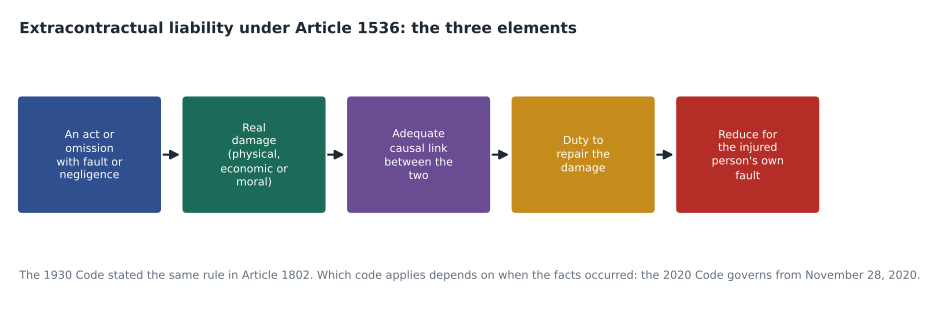
Article 1536 of the 2020 Civil Code states the general rule: a person who, through fault or negligence, causes damage to another must repair it. The 1930 Code stated the same principle in its Article 1802, and the Supreme Court's long line of decisions interpreting Article 1802 continues to guide the reading of Article 1536. Unlike the common law, which developed separate torts with separate elements, the civil law uses one flexible clause that covers carelessness, intentional harm and everything in between.
Courts break the clause into three elements. First, an act or omission involving fault or negligence, culpa o negligencia. Fault includes intentional conduct; negligence is the failure to exercise the care a prudent and reasonable person would exercise in the circumstances, which includes anticipating the risks that such a person would foresee. An omission creates liability when there was a legal duty to act and acting would have prevented the harm. Second, real damage, daño, which may be physical, economic or moral. Third, a causal link, nexo causal, between the conduct and the damage. Puerto Rico follows the theory of adequate causation: the cause in law is the one that, in the ordinary course of things and according to general experience, would be expected to produce the damage, not every condition without which it would not have happened. The Supreme Court reviewed causation in SLG Colón-Rivas v. ELA, 2016 TSPR 232.
Foreseeability and the duty of care
Negligence in Puerto Rico turns on foreseeability. The question is whether a prudent person in the defendant's position would have anticipated the risk of harm and taken precautions against it. A business must take reasonable steps to keep its premises safe for customers, but it is not an insurer: a plaintiff who slips on a floor must usually show that the business knew or should have known of the dangerous condition. A driver must drive with the care traffic conditions require. A physician must meet the standard of care recognized by the medical profession in light of modern means of communication and teaching. In each case, the court asks what a reasonable person would have foreseen and done.
The injured person's own fault
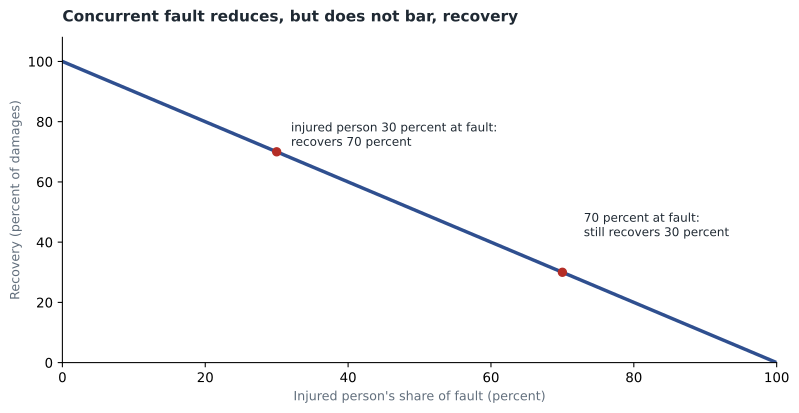
When the injured person's own negligence contributed to the damage, Puerto Rico does not bar recovery. It reduces the compensation in proportion to the injured person's share of fault. This is pure comparative negligence: a plaintiff who was 70 percent at fault still recovers 30 percent of her damages. The rule developed under the 1930 Code, whose Article 1802 provided that the injured person's concurrent imprudence does not exempt the defendant from liability but reduces the compensation, and courts apply the same proportional approach under the 2020 Code. A 2022 decision of the Court of Appeals, applying the 1930 Code, sent a case back to the trial court because it had placed 100 percent of the fault on the injured person instead of allocating percentages between her and the municipality.
Several co-causers
When two or more people cause the same damage, each whose conduct was an adequate cause is liable. How the liability is shared, and how the limitation period runs against each co-causer, has generated important case law. In Fraguada Bonilla v. Hospital Auxilio Mutuo, 2012 TSPR 126, decided under the 1930 Code, the Supreme Court held that a claim interrupting the limitation period against one co-causer does not interrupt it against the others, so a plaintiff must act against each potential defendant within the period. The Court returned to co-causers in Maldonado Rivera v. Suárez, 2016 TSPR 57, and in Pérez Hernández v. Lares Medical Center, 2021 TSPR 123. A candidate should read the 2020 Code's rules on joint and solidary liability alongside those cases.
Liability for others
Article 1540 of the 2020 Code makes certain persons liable for damage caused by the fault or negligence of those who depend on them. The traditional examples are parents for their minor children in their custody, guardians for their wards, and employers for their employees acting in the course of their duties. The Code also addresses independent contractors, for whom an owner is ordinarily not liable unless an exception applies. Vicarious liability can be avoided when the responsible person shows that she exercised the diligence of a prudent person to prevent the damage, a defense that is easier to describe than to prove.
Liability without fault
Article 1541 imposes liability without fault in specific situations, among them damage caused by animals, which falls on the possessor or user of the animal, and damage caused by things thrown or falling from a dwelling. Articles 1542 to 1544 codify products liability, under which a manufacturer or seller of a defective product that causes damage is liable without proof of negligence. Puerto Rico's courts had recognized strict products liability long before the 2020 Code; González Cabán v. JR Seafood, 2017 TSPR 187, and Rodríguez Méndez v. Laser Eye, 2016 TSPR 121, are among the more recent decisions.
The 2026 change for hospitals
Until August 2026, Article 1541 included, as one of its situations of liability without fault, the liability of hospitals and other health care institutions for certain damage. Act No. 191 of 2026, approved on August 19, 2026 and effective immediately, changed that. It added a new subsection (d) to Article 1540, making health care institutions vicariously liable for damage caused by their employees in the exercise of their functions and by persons operating exclusive service franchises within the institution, and it repealed the former subsection (g) of Article 1541. The stated purpose was to ease the burden on health care providers and protect the supply of medical services. The effect is that a hospital's liability for those categories now runs through the vicarious liability rules of Article 1540, with the defenses they allow, rather than through liability without fault. Because the act took effect immediately, a candidate should pay attention to the date of the facts in any medical liability question.
| Situation | Article of the 2020 Code | Basis of liability |
|---|---|---|
| Anyone causing damage through fault or negligence | 1536 | Fault or negligence |
| Parents, guardians, employers for dependents | 1540 | Vicarious; defense of due diligence |
| Health care institutions for employees and exclusive franchisees (from August 19, 2026) | 1540(d), added by Act No. 191 of 2026 | Vicarious |
| Animals; things thrown or falling from a dwelling | 1541 | Without fault |
| Defective products | 1542 to 1544 | Without fault (products liability) |
Damages
Damages in Puerto Rico are compensatory. The injured person recovers economic damages, such as medical expenses and lost earnings, and moral damages, daños morales, for physical and emotional suffering. Close relatives may recover for their own suffering caused by injury to or the death of a loved one. Punitive damages are not available under the general clause; they exist only where a special statute authorizes them. Article 1538 of the 2020 Code addresses the determination of damages.
Valuing moral damages is difficult, and the Supreme Court has given guidance on method. In Santiago Montañez v. Fresenius Medical Care, 2016 TSPR 76, the Court explained that a trial court estimating moral damages may look to awards in similar cases, adjusted to present value, while explaining how the case before it is similar or different. Appellate courts give deference to a trial court's valuation and intervene only when an award is clearly excessive or ridiculously low.
Time limits
Extracontractual claims carry a short limitation period. Under the 1930 Code, Article 1868 set a period of one year, running from the time the injured person knew of the damage and of who caused it; courts still apply that rule to facts before November 28, 2020. The 2020 Code keeps a one-year period for extracontractual claims. The period can be interrupted by filing suit, by an extrajudicial claim by the creditor or by the debtor's acknowledgment of the debt. The Supreme Court's decisions on when the injured person knew enough for the period to start, such as Rivera Ruiz v. Municipio de Ponce, 2016 TSPR 197, and on how interruption works, such as Fraguada Bonilla, are frequent exam material. A missed limitation period is also one of the most common sources of malpractice claims against Puerto Rico lawyers.
Claims against government
Claims against the Commonwealth and its municipalities are governed by special statutes that require timely notice and limit the damages recoverable, in addition to the general clause. Quílez Velar v. Ox Bodies, Inc., 2017 TSPR 165, and González Meléndez v. Municipio de San Juan, 2023 TSPR 95, are recent examples of the Court applying those rules. A candidate should check the notice requirements and limits in the governing statute whenever a government entity is a defendant.
Worked problem
A fall at a bakery
On February 10, 2026, Nereida Rosado slipped on spilled water near the coffee counter of a bakery in Caguas. An employee had seen the spill fifteen minutes earlier and said he would clean it later. Nereida was looking at her phone and walking quickly. She broke her wrist, missed six weeks of work and had surgery. She consulted Ocasio & Mattei on November 12, 2026.
Show solution
- The 2020 Code governs because the facts occurred after November 28, 2020; the general clause is Article 1536.
- Fault: the bakery's employee knew of the spill and did not clean it or warn customers; a prudent business would have acted, so the element is likely met.
- Damage and causation: the fracture, surgery, lost wages and suffering are real damages, and a known spill is an adequate cause of a fall.
- Nereida's inattention may be concurrent negligence, which would reduce her compensation in proportion to her share of fault, not bar it.
- The bakery is liable for its employee under Article 1540, and the one-year period requires the firm to file suit or make an interrupting extrajudicial claim before February 10, 2027.
Answer: Nereida has a strong claim, reduced by any share of fault assigned to her inattention, and the firm must act before the one-year period runs.
Common mistakes
MistakePuerto Rico follows contributory negligence or a 50 percent bar.
InsteadThe injured person's fault reduces compensation proportionally; it does not bar recovery.
MistakePuerto Rico courts award punitive damages under the general clause.
InsteadDamages are compensatory; punitive damages require a special statute.
MistakeSuing one co-causer interrupts the period against all.
InsteadFraguada Bonilla held that interruption against one does not reach the others.
MistakeHospitals remain liable without fault under Article 1541(g).
InsteadAct No. 191 of 2026 moved that liability to vicarious liability under Article 1540(d) from August 19, 2026.
MistakeThe limitation period starts on the day of the accident in every case.
InsteadIt runs from when the injured person knew of the damage and who caused it.
Medical liability in practice
Medical cases illustrate how the pieces fit together. The physician's liability rests on Article 1536 and the professional standard of care; the hospital's liability for its employees now rests on Article 1540(d); expert testimony is usually needed to establish both the standard and the causal link; and the one-year period, which runs from when the patient knew of the damage and who caused it, is often the first battleground.
Summary and key terms
- Article 1536 of the 2020 Code, like former Article 1802, makes a person who causes damage through fault or negligence liable to repair it.
- The elements are fault or negligence, real damage and an adequate causal link.
- The injured person's own fault reduces compensation proportionally; there is no bar to recovery.
- Article 1540 governs vicarious liability, including health care institutions since Act No. 191 of 2026; Article 1541 and Articles 1542 to 1544 impose liability without fault in specific cases.
- Extracontractual claims have a one-year limitation period, interrupted by suit, extrajudicial claim or acknowledgment.
- 0
- responsabilidad civil extracontractual
- 1
- culpa o negligencia
- 2
- daño moral
- 3
- nexo causal
- 4
- adequate causation
- 5
- concurrent negligence
- 6
- vicarious liability
- 7
- interruption of prescription
Practice problems
Work each problem on paper first, then reveal the answer to check.
What does Article 1536 of the 2020 Code provide?
Show answer
A person who causes damage to another through fault or negligence must repair it.
What happens when the injured person was partly at fault?
Show answer
Compensation is reduced in proportion to her share of fault.
What did Act No. 191 of 2026 change?
Show answer
It made health care institutions vicariously liable under a new Article 1540(d) and repealed former Article 1541(g), effective August 19, 2026.
Which case held that interrupting the period against one co-causer does not interrupt it against others?
Show answer
Fraguada Bonilla v. Hospital Auxilio Mutuo, 2012 TSPR 126.
Are punitive damages available under the general clause?
Show answer
No; only where a special statute authorizes them.
Lesson quiz · 5 questions
Score 60% or more to complete this lesson.
Create a free account to save your progress, take quizzes and earn a certificate.