
BAR-254 · Lesson 5 of 12 · 19 min
Exam changes: the 2022 passing score, the 2026 specification tables and NextGen
▶ Video coming soon A video version of this lesson is on the way.
Most of the study group spent part of the fall of 2026 talking about NextGen, the new bar exam NCBE launched in July 2026. Marcus had taken the first one in Missouri. Dana, Ngozi and Sofia were taking the old exam in February 2027 and worried about changes in the years after. Camila listened with interest but little concern. 'NextGen will not touch me,' she told the group. 'But Puerto Rico has had its own changes. The passing score dropped in 2022, the Civil Code changed in 2020, the ethics rules changed in January, and the Board rewrote the specification tables in May.'
This lesson explains each of those changes and what it means for a candidate sitting the reválida in 2027. The common thread is that a Puerto Rico candidate must watch the Supreme Court and the Board, not NCBE.
The passing score: from 596 to 569
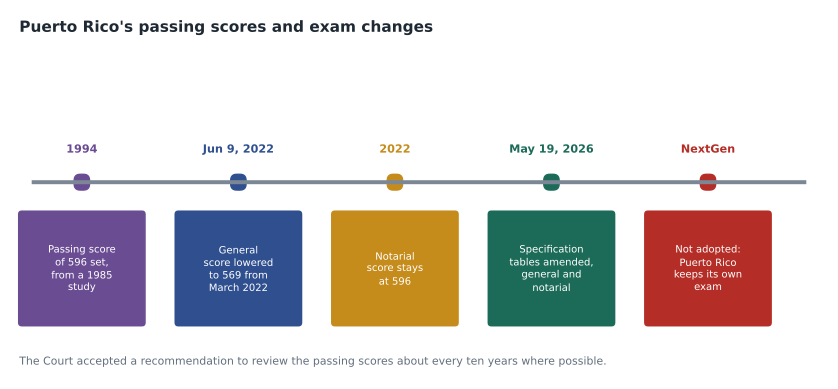
For almost three decades the general reválida had a passing score of 596 adjusted points. That number came from a study conducted in 1985 and was adopted in 1994. Over time, critics in the profession and the law schools questioned whether it still matched the minimum competence a new lawyer needs, and pass rates on the general exam were low.
The Supreme Court asked for a fresh look. A special commission was appointed to evaluate the passing score, and a psychometric study was conducted to measure where the line between minimal competence and its absence should fall. After receiving the commission's final report, the Court issued a resolution on June 9, 2022 lowering the passing score for the general reválida from 596 to 569 adjusted points. The Court applied the new score beginning with the exams given in March 2022, which meant that candidates from that sitting who had scored between 569 and 595 were moved from failing to passing. According to press reports at the time, the change added 72 successful candidates for a total of 154, a pass rate of about 42 percent for that sitting.
The notarial reválida kept its passing score of 596. The Court also accepted the recommendation that passing scores be reviewed periodically, about every ten years where possible, so that the standard does not drift out of date again.
What the change means for a 2027 candidate
For Camila, the 2022 change has two practical consequences. First, her target is 569 adjusted points, not 596, on the general reválida. Second, practice materials and advice from before 2022 may talk about 596 as the goal for the general exam. Old score reports and old study guides are still useful for content, but the number at the bottom has changed. The notarial target remains 596.
Marchetti added a third point from her own experience grading essays. A lower passing score does not make the exam easier to pass by luck. It means the Court decided that the old standard demanded more than minimal competence. The candidate still has to show that competence in both parts of the exam, and the two parts are weighted equally.
The 2026 specification tables
On May 19, 2026, the Board adopted a resolution amending the specification tables for the six asterisked subjects on the general exam and for the notarial exam. The September 2026 edict pointed candidates to that resolution. A specification table lists the topics within a subject and their relative weight, so an amendment can shift emphasis among topics, add topics or remove them.
The amendments came in a year of change. The new Rules of Professional Conduct took effect on January 1, 2026, and the 2020 Civil Code had been in force for more than five years, long enough for the Supreme Court to begin interpreting it. A candidate studying in late 2026 should take the tables in the May 2026 resolution as the current blueprint and compare her outline against them topic by topic. Camila did exactly that, highlighting every topic in her outline that appeared in the tables and adding the few that her outline had missed.
The 2020 Civil Code on the exam
The Civil Code of Puerto Rico of 2020, Act No. 55 of June 1, 2020, took effect on November 28, 2020, 180 days after its approval, and repealed the Civil Code of 1930. It reorganized and modernized the private law of Puerto Rico: persons, family, property, obligations, contracts, extracontractual liability and succession. Lessons 8 to 10 cover its main features.
The new Code affects the exam in two ways. First, the Board now writes questions on the 2020 Code, with its new article numbers. A candidate who learned the law from older materials keyed to the 1930 Code must learn the new numbering, because citing the right article is part of stating the applicable law. Second, the old Code has not disappeared. Courts continue to apply the 1930 Code to facts that occurred before November 28, 2020. Decisions of the Court of Appeals in 2022 and 2024 applied the 1930 Code's general tort clause, former Article 1802, and its one-year limitation period, former Article 1868, to events that took place before the new Code took effect. An essay question can therefore turn on which code governs, and a good answer says so explicitly.
| Change | Date | What it means for the exam |
|---|---|---|
| Passing score lowered from 596 to 569 | Resolution of June 9, 2022, effective from the March 2022 exam | Target 569 on the general exam; 596 still for notarial |
| 2020 Civil Code in force | November 28, 2020 | Learn new article numbers; know when the 1930 Code still applies |
| New Rules of Professional Conduct | Effective January 1, 2026 | Ethics questions follow the new Rules; old canons for pre-2026 conduct |
| Specification tables amended | Resolution of May 19, 2026 | Use the new tables as the blueprint for the six asterisked subjects and the notarial exam |
| NextGen | Not adopted | No effect on the reválida |
The new Rules of Professional Conduct
The third change is the new Rules of Professional Conduct, adopted by Resolution ER-2025-02 on June 17, 2025 and effective January 1, 2026. They replaced the 1970 Code of Professional Ethics, which the Court described as based mainly on the ABA Canons of 1908. The new Rules follow the topical order of the ABA Model Rules, with local adaptations. For the exam, that means questions on professional responsibility from 2026 onward are likely to be framed around the new Rules, while disciplinary cases about earlier conduct still apply the 1970 canons. Lesson 11 covers the Rules in more detail.
Why NextGen does not apply
NCBE's NextGen bar exam was first given in July 2026 and is replacing the UBE in many states between 2026 and 2028. NCBE's chart lists NextGen as not adopted in Puerto Rico, and nothing in the Board's regulation or edicts suggests a move to it. Puerto Rico's exam tests Puerto Rico law in Spanish, and much of that law, the civil law of obligations, property, family and succession and the notarial law, has no counterpart on any NCBE exam.
The same is true of NCBE's other changes. When NCBE removed conflict of laws, family law, trusts and estates and secured transactions from the Multistate Essay Examination in July 2026, nothing changed for Puerto Rico candidates, who never took the MEE. Family law and succession remain on the reválida's list of subjects because they are central to Puerto Rico practice, and to the notarial practice in particular.
Staying current
Because Puerto Rico's changes come from the Court and the Board, a candidate should check four places regularly: the Board's page on the Judicial Branch website for edicts, manuals, resolutions and released guides; the Supreme Court's resolutions; the Court's opinions, especially those interpreting the 2020 Civil Code; and announcements of the Continuing Legal Education Program, which signal what the Court expects lawyers to know. Camila set a calendar reminder to check the Board's page every Monday until the March 2027 exam.
Worked problem
Which code applies?
A practice essay from Camila's review course describes a car accident in Bayamón on August 3, 2020, and a lawsuit filed in 2021. A second essay describes an accident in Caguas on March 5, 2024. Both ask the candidate to state the applicable law on liability and on the time to sue.
Show solution
- The 2020 Civil Code took effect on November 28, 2020; facts before that date are governed by the 1930 Code.
- For the 2020 accident, the general clause is former Article 1802 of the 1930 Code and the one-year limitation period is former Article 1868, as the courts have continued to apply them.
- For the 2024 accident, the general clause is Article 1536 of the 2020 Code and the limitation rules of the 2020 Code apply.
- A strong answer identifies the governing code first, explains why, and then applies its rules.
Answer: The date of the facts decides which code applies. Naming the right code and article is part of earning the points for applicable law.
Common mistakes
MistakeThe passing score for the general reválida is 596.
InsteadIt has been 569 since the Court's 2022 resolution; 596 is the notarial passing score.
MistakePuerto Rico will move to NextGen with the states.
InsteadNCBE lists NextGen as not adopted in Puerto Rico.
MistakeThe 1930 Civil Code is no longer relevant.
InsteadCourts still apply it to facts that occurred before November 28, 2020.
MistakeThe specification tables never change.
InsteadThe Board amended them for the six asterisked subjects and the notarial exam on May 19, 2026.
MistakeNCBE's removal of family law from the MEE affects Puerto Rico.
InsteadPuerto Rico never used the MEE; family law remains a reválida subject.
How a passing score is set
A passing score on a licensing exam is not a percentage of questions answered correctly. It is a point on the score scale that the licensing authority decides separates candidates who have shown minimum competence from those who have not. Setting it is called standard setting, and it usually involves panels of experienced lawyers who review exam questions and answers and judge how a minimally competent new lawyer would perform. Psychometricians, specialists in measurement, then translate those judgments into a point on the scale and test whether the result is reliable. Puerto Rico's 2022 change followed that kind of process: a special commission, a psychometric study and a final report to the Court.
Because each sitting's scores are calibrated to a common scale, the passing score means the same thing from one sitting to the next. A candidate who scores 569 on a harder exam has shown the same level of competence as a candidate who scores 569 on an easier one. That is why the Board calibrates both parts of the exam before combining them, and why the Court can set a single passing score that applies at every sitting.
What has not changed
For all the changes since 2020, the basic architecture of the reválida is stable. The exam is still written by the Board and approved under the Court's authority. It is still given in Spanish twice a year, with answers allowed in Spanish or English. It still has a multiple-choice day and a discussion day for the general exam and a separate notarial exam. The six-attempt limit still applies, counted from September 1983. And the exam still tests Puerto Rico law, with its civil law core, rather than the general principles tested on NCBE's exams. A candidate who understands that architecture can absorb individual changes as they come.
Reading the Court's resolutions
Changes to the exam and to the profession usually arrive as resolutions of the Supreme Court, published on the Judicial Branch website with an identifier such as ER-2025-02. A resolution typically states what the Court is doing, why, when it takes effect and how the transition will work; some include concurring or dissenting statements by individual justices. Reading the operative part and the transition provisions first is the efficient approach. Camila kept a short file of the resolutions that mattered to her: the 2022 passing score resolution, the 2025 resolution adopting the Rules of Professional Conduct and the Board's May 2026 resolution amending the specification tables.
A note on pass rates
Pass rates on the general reválida have often been lower than on many state exams. Comparisons are difficult, because the exams, the candidate pools and the passing standards differ. For an individual candidate, pass rates matter less than preparation: the score depends on how well she knows the law tested and how well she writes under time pressure.
Summary and key terms
- The Supreme Court lowered the general passing score from 596 to 569 on June 9, 2022, effective from the March 2022 exam; the notarial score stays at 596.
- The Board amended the specification tables for the six asterisked subjects and the notarial exam on May 19, 2026.
- The 2020 Civil Code took effect on November 28, 2020; the 1930 Code still governs earlier facts.
- The new Rules of Professional Conduct took effect on January 1, 2026.
- NextGen and NCBE's MEE changes do not apply in Puerto Rico.
- 0
- passing score
- 1
- psychometric study
- 2
- specification table
- 3
- Act No. 55 of 2020
- 4
- transitional rule
- 5
- NextGen
Practice problems
Work each problem on paper first, then reveal the answer to check.
When did the Court lower the general passing score to 569?
Show answer
By resolution of June 9, 2022, applied from the March 2022 exam.
What is the notarial passing score?
Show answer
596 adjusted points.
When did the 2020 Civil Code take effect?
Show answer
November 28, 2020, 180 days after its approval on June 1, 2020.
Which code governs an accident in July 2020?
Show answer
The 1930 Civil Code, because the facts occurred before November 28, 2020.
Has Puerto Rico adopted NextGen?
Show answer
No. NCBE lists it as not adopted.
Lesson quiz · 5 questions
Score 60% or more to complete this lesson.
Create a free account to save your progress, take quizzes and earn a certificate.