
BAR-254 · Lesson 11 of 12 · 20 min
No reciprocity, federal court and practice after admission: CLE and the 2026 Rules of Professional Conduct
▶ Video coming soon A video version of this lesson is on the way.
Ngozi asked the question everyone in the group eventually asks about every jurisdiction. 'Once you are admitted, can you take your license anywhere?' For the UBE candidates the answer involved score transfer and admission on motion. For Camila, it ran the other way. 'Nothing comes in and almost nothing goes out,' she said. 'Puerto Rico does not accept anyone else's scores, and my reválida score will not transfer to any state. If I ever want to practice in Florida, I will take the Florida exam.' Then she turned to what interested her more: what happens after the oath.
This lesson covers four topics: why Puerto Rico has no score transfer or admission on motion and what that means in both directions; admission to the federal district court; the obligations every new Puerto Rico lawyer takes on, including the registry, continuing legal education and the voluntary bar association; and the Rules of Professional Conduct in force since January 1, 2026.
No transfer in, no transfer out
NCBE's chart for Puerto Rico shows that it does not accept legacy UBE scores, NextGen scores or transferred MBE scores, and that its rules provide no admission on motion. Every applicant, whatever her experience elsewhere, must pass the general reválida. Lawyers who have practiced for decades in a state are in the same position as new graduates, which reflects the Court's view that Puerto Rico's civil law and its Spanish-language practice require local testing.
The reverse is also true. Because Puerto Rico's exam is not the UBE and includes no MBE, a Puerto Rico candidate has no portable score to take to a state. A Puerto Rico lawyer who wants to practice in a state must meet that state's rules, which usually means sitting its exam or, after enough years of practice, applying for admission on motion if the state allows lawyers from Puerto Rico to qualify. A lawyer from another jurisdiction who needs to appear in a single case in Puerto Rico may ask for permission to appear for that case under the Supreme Court's rules on appearance by attorneys from outside Puerto Rico, which impose conditions such as association with local counsel.
Admission to the federal district court
Admission to the Puerto Rico bar does not admit a lawyer to practice in the United States District Court for the District of Puerto Rico. That court sets its own requirements under its local rules, and its proceedings are in English. Many Puerto Rico lawyers seek federal admission early in their careers, because federal questions, federal agencies and federal statutes are a large part of practice on the island. Héctor Mattei advised Camila to plan for federal admission in her first year of practice and to read the local rules carefully, since federal admission has its own application and requirements.
The oath and the registry
After the oath, a new lawyer's name is entered in the Supreme Court's Registro Único de Abogados, the RUA, and she receives a RUA number. The registry is how the Court and the public identify lawyers, and lawyers must keep their information current, including addresses, telephone numbers and electronic addresses for notifications. Courts and the Judicial Branch use the registry to send notices, so stale information can cause a lawyer to miss a court order.
The Colegio de Abogados y Abogadas
Membership in the Colegio de Abogados y Abogadas de Puerto Rico has been voluntary since the Supreme Court held in 2014 that compulsory membership could not be required as a condition of practicing law. The Colegio continues to offer continuing education, publications and professional programs, and many lawyers join, but joining is a choice. Questions about compulsory membership in other professional colleges have continued in the courts; in 2026, Puerto Rico courts struck down compulsory membership requirements for other professions, and challenges remain pending.
Continuing legal education
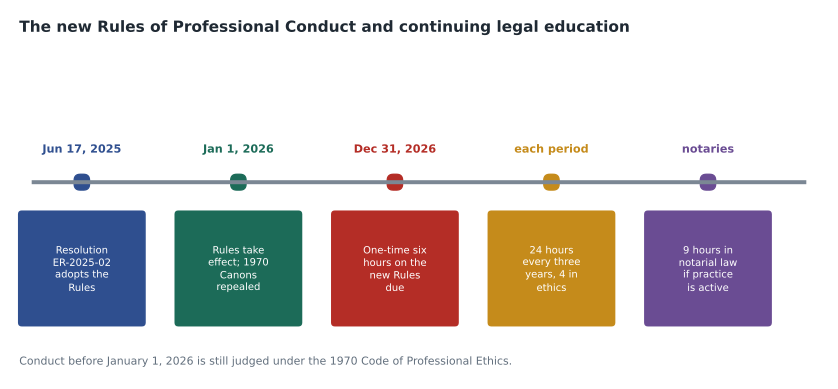
The Continuing Legal Education Program of the Supreme Court, known by its Spanish initials PEJC, administers the requirements for active lawyers. The ordinary requirement is 24 credit hours in each three-year compliance period, of which four hours must be in professional ethics. A lawyer with an active notarial practice at the end of the period must also complete nine hours in notarial law. Newly admitted lawyers receive an exemption under the program's regulation, and other exemptions are available in limited circumstances, so a new lawyer should confirm with the program when her first compliance period begins and what it requires.
Credits may be earned in several ways under the program's regulation: by attending approved or pre-approved courses, by obtaining credit for courses that were not pre-approved, by serving as a resource in qualifying courses or by teaching qualifying courses at recognized law schools. Lawyers must report their compliance as the program directs and keep copies of their certificates. Failure to comply can be referred to the Supreme Court and can lead to disciplinary proceedings.
The Rules of Professional Conduct of 2026
On June 17, 2025, the Supreme Court adopted the Rules of Professional Conduct of Puerto Rico by Resolution ER-2025-02, with an effective date of January 1, 2026. The new Rules replaced the Code of Professional Ethics of 1970, whose canons the Court described as based mainly on the ABA Canons of 1908. With the new Rules, Puerto Rico joined the states and the District of Columbia in using a body of rules modeled on the ABA Model Rules, adapted to local needs.
The Rules are binding norms, not aspirational canons. Each rule is followed by a comment that explains it and gives guidance, but the comments do not create new obligations. The Rules follow the topical order of the Model Rules, with a few local features the resolution identifies: a definitions rule at the start, Rule 1.0; a rule on technological competence, Rule 1.19; a chapter on the advisory function; and the integration of the notary's duties into the same body of rules, so that the same Rules govern a lawyer's work as advocate, adviser and notary.
The transition rules matter for the exam and for practice. Disciplinary proceedings for conduct before January 1, 2026 remain governed by the 1970 canons, so the Court's older opinions continue to apply to older conduct. Rule 7.2(b)(2), on lawyer referral services, does not take effect until the Court approves criteria for it. And the Court imposed a one-time requirement: lawyers who were active, temporarily suspended or readmitted before January 1, 2027 must complete six credit hours on the new Rules by December 31, 2026, in courses held on or after June 17, 2025 and approved by the program. Those hours count toward the ordinary 24-hour requirement and toward the four ethics hours. After a 75-day grace period, noncompliance may be referred to the Court.
| Rule or provision | What it does |
|---|---|
| Rule 1.0 | Definitions used throughout the Rules |
| First chapter | Client-lawyer relationship: competence, scope, diligence, communication, fees, confidentiality, conflicts |
| Rule 1.19 | Technological competence, a local addition |
| Advisory chapter | The lawyer as adviser, organized as its own chapter |
| Notarial duties | Integrated into the same body of rules |
| Rule 7.2(b)(2) | Lawyer referral services; deferred until the Court approves criteria |
| Transition | 1970 canons govern conduct before January 1, 2026 |
Ethics questions on the reválida
Ethics and Professional Responsibility is an asterisked subject, so Camila expected questions on the new Rules in March 2027. She organized her study around the situations that generate the most questions in any jurisdiction: conflicts of interest between current clients and with former clients; confidentiality and its exceptions; fees, especially contingent fees and the handling of client funds; candor to the tribunal; communications with represented persons; advertising and solicitation; and the duties that arise when a lawyer also acts as a notary. For each, she compared the new Puerto Rico rule with the Model Rule she had studied in law school and noted any differences, then read the Court's opinions applying the old canons to similar facts.
A new lawyer's first year
By the end of the session, Camila had a first-year plan for after admission. Update the RUA on the day of the oath. Decide whether to join the Colegio. Confirm the start of the first CLE compliance period. Plan for federal admission. And, if she passed the notarial reválida, set up her protocol, comply with the notarial reporting requirements and add notarial law hours to her CLE plan. Marchetti, who has watched hundreds of candidates become lawyers, called it the most complete first-year plan the group had produced.
Worked problem
Can these lawyers practice in Puerto Rico?
Nilda Ocasio receives three calls. (1) A Florida lawyer with fifteen years of practice wants to open an office in San Juan. (2) A Texas lawyer wants to appear for a client in a single contract case in the Court of First Instance. (3) A Puerto Rico lawyer admitted in 2023, who has never completed any continuing education, asks whether she is in trouble.
Show solution
- The Florida lawyer must pass the general reválida; Puerto Rico provides no admission on motion and accepts no transferred scores.
- The Texas lawyer may ask for permission to appear in that case under the Supreme Court's rules for attorneys from outside Puerto Rico, subject to their conditions, including association with local counsel.
- The 2023 admittee should check when her exemption for new admittees ended and when her first compliance period closes; if she is behind, she should complete the hours promptly, because noncompliance can be referred to the Court.
- If she was active in 2026, she also needed the six hours on the new Rules by December 31, 2026.
Answer: Only the second lawyer has a route without the reválida, and only for a single case. The third must check her CLE status immediately.
Common mistakes
MistakeA reválida score transfers to UBE states.
InsteadPuerto Rico's exam is not the UBE; there is no portable score.
MistakePuerto Rico admits experienced lawyers on motion.
InsteadIts rules provide no admission on motion.
MistakeAdmission in Puerto Rico includes the federal district court.
InsteadFederal admission is separate under the court's local rules.
MistakeThe new Rules apply to all disciplinary cases from 2026 on.
InsteadThe 1970 canons still govern conduct before January 1, 2026.
MistakeCLE is 12 hours a year as in many states.
InsteadIt is 24 hours per three-year period, with 4 in ethics, plus 9 notarial hours for active notaries.
How the Court enforces the Rules
Discipline in Puerto Rico is the Supreme Court's responsibility. A complaint against a lawyer or notary, whether from a client, an opposing party, a judge or the Court's own inspection offices, is investigated under the Court's procedures, and the lawyer must answer. In serious matters the Court may refer the case for a formal proceeding before a commissioner who receives evidence and reports to the Court. The Court then decides and publishes an opinion or resolution, which may impose a censure or reprimand, a suspension for a period or indefinitely, or disbarment. In urgent cases, such as a lawyer who has abandoned clients or failed to answer the Court, the Court may suspend immediately.
Two practical rules follow for a new lawyer. First, answer every communication from the Court or its offices promptly and completely; failure to respond is itself a ground for suspension, and many lawyers have been suspended for that reason alone. Second, keep the registry information current, because the Court sends its notices to the addresses in the RUA, and a lawyer who misses a notice because her address was out of date cannot blame the Court.
Staying current after admission
The Rules of Professional Conduct are new, and their meaning will develop through the Court's opinions over the coming years. The comments help, but the Court's decisions will settle questions the text leaves open, such as how the technological competence rule applies to new tools or how the integrated notarial duties interact with the duties of an advocate. A new lawyer should read the Court's disciplinary opinions as they appear and use her CLE hours to stay current. The one-time six-hour requirement in 2026 signaled how seriously the Court takes the transition.
Summary and key terms
- Puerto Rico accepts no transferred scores and provides no admission on motion; its own score is not portable to the states.
- The federal district court requires separate admission under its local rules.
- New lawyers register in the RUA; membership in the Colegio de Abogados y Abogadas is voluntary.
- CLE requires 24 hours every three years, 4 in ethics, plus 9 hours of notarial law for active notaries.
- The Rules of Professional Conduct took effect on January 1, 2026, with a one-time six-hour course due by December 31, 2026 for lawyers active in 2026.
- 0
- RUA
- 1
- PEJC
- 2
- compliance period
- 3
- Resolution ER-2025-02
- 4
- technological competence
- 5
- pro hac vice
Practice problems
Work each problem on paper first, then reveal the answer to check.
Does Puerto Rico accept transferred UBE scores?
Show answer
No, and it provides no admission on motion.
How many CLE hours must a Puerto Rico lawyer complete, and over what period?
Show answer
24 hours per three-year compliance period, including 4 in ethics.
How many notarial law hours must an active notary complete?
Show answer
Nine, if the notarial practice is active at the end of the period.
When did the Rules of Professional Conduct take effect?
Show answer
January 1, 2026.
Which rules govern discipline for conduct in 2025?
Show answer
The 1970 Code of Professional Ethics.
Lesson quiz · 5 questions
Score 60% or more to complete this lesson.
Create a free account to save your progress, take quizzes and earn a certificate.